Category: Military issues

  • Deaths of three soldiers exposes “secret” operation

    TT sends us a link from the Washington Post about the deaths of three special operations soldiers who died mysteriously in a car crash last April with three local women in Mali, Africa after the US had publicly announced that our aid to that country had ended. Apparently, the CID is taking time out from investigating bloggers to determine the facts of the car crash;

    At the very least, the April 20 accident exposed a team of Special Operations forces that had been working for months in Mali, a Saharan country racked by civil war and a rising Islamist insurgency. More broadly, the crash has provided a rare glimpse of elite U.S. commando units in North Africa, where they have been secretly engaged in counterterrorism actions against al-Qaeda affiliates.

    At the same time, the crash in Mali has revealed some details of the commandos’ clandestine activities that apparently had little to do with counterterrorism. The women killed in the wreck were identified as Moroccan prostitutes who had been riding with the soldiers, according to a senior Army official and a U.S. counterterrorism consultant briefed on the incident, both of whom spoke on the condition of anonymity because of the sensitivity of the matter.

    Of course, in the wake of the Secret Service scandals which have come to light, speculation about this accident involving the occupations of the three civilian women will cast doubts on the actual mission. But I find it difficult to believe that three soldiers obviously fighting a secret war undercover in a nation we had publicly abandoned would engage in mischief of that sort.

    I also doubt that Mitch McConnell would eulogize CPT Daniel Utley who was killed in that accident on the floor of the Senate if there was a whiff of scandal involved.

    The 3 were Capt. ­Daniel H. Utley, 33, and Sgt. 1st Class Marciano E. Myrthil, 39, were members of the 91st Civil Affairs Battalion, 95th Civil Affairs Brigade, which is based at Fort Bragg, N.C. and Master Sgt. Trevor J. Bast, 39, a communications technician with the Intelligence and Security Command at Fort Belvoir, VA.
  • Women in Sapper School

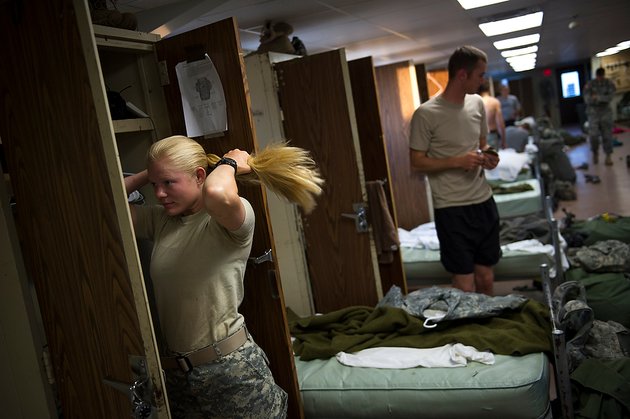
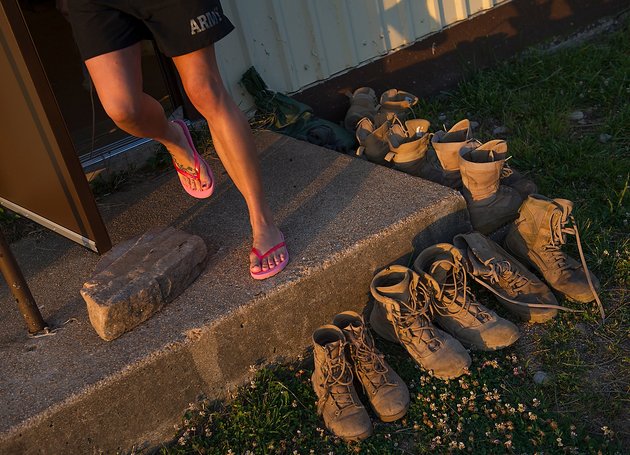
    The Washington Times‘ Kristina Wong writes about two women and their time in Sapper School at Fort Leonard Wood, MO;

    Capt. Armstrong and Capt. Stephanie Godman were determined to become No. 48 and No. 49.

    Of 36 engineers taking the course in June, three had dropped out, including one woman.

    At 5-foot-4 and 140 pounds, Capt. Armstrong, 26, is a West Point graduate who had considered becoming an orthopedic surgeon before falling in love with the idea of being an Army engineer. She wanted to attend sapper school to prove to herself that she could do exactly what the guys do, and prove that she is a capable leader.

    The article says that men who have been to both ranger and Sapper Schools say that Sapper School is tougher. Yeah, academically, maybe, but I get the impression of the way that is used in the article, it’s supposed to convince the Army to send women to Ranger School. I say send them to Ranger School and don’t change the standard and the watch the hippies get all up in arms about the drop out rate and make “GI Jane” comparisons.

    The article talks about “2 grueling weeks” in the field. Yeah, that’s almost like Ranger School.

  • McChrystal calls for a draft

    General Stan McChrystal, according to Josh Rogin at Foreign Policy, called for a return of the draft;

    “I think we ought to have a draft. I think if a nation goes to war, it shouldn’t be solely be represented by a professional force, because it gets to be unrepresentative of the population,” McChrystal said at a late-night event June 29 at the 2012 Aspen Ideas Festival. “I think if a nation goes to war, every town, every city needs to be at risk. You make that decision and everybody has skin in the game.”

    McChrystal admits that it would lead to a loss of professionalism in the ranks, but I guess because he’s a liberal deep inside (he voted for Obama, he says) the loss of a successful military is secondary to everyone’s feelings about war. Americans were largely against the surge in Iraq, and their opinions didn’t matter, because it happened anyway. Americans wanted the wars to end and they voted for Obama…the casualties since the “peace President” took office are 2/3s of the total US casualties in the nearly 11-year war. So what good would everyone having “skin in the game” do for our policies?

    I wonder what the casualty count would be if the force was partly draftees. In Vietnam, draftees were 25% of the total force but they accounted for 30.4% of the combat deaths.

    So, yeah, if the way everyone feels about our prospective wars is more important than the actual outcome, let’s start a draft.

  • C’Mon, Army Times – At Least Get the Headline Right!

    As Reagan might have said: “There they (the media) go again.”

    Army Times recently had a headline that, to be blunt, appears to be BS. And it appears to be BS due to either slipshod reporting or a deliberate decision to misrepresent reality.

    The headline claims that extra costs associated with Pakistan’s closing the normal supply routes for Afghanistan last November are over $2 billion. However, that figure is not supported by the information in that article itself.

    The figure was apparently obtained by adding additional Army costs for higher than projected fuel prices AND the closure of the Pakistani supply lines to Afghanistan ($1.7B), plus additional USAF costs for airlift ($0.369B) and C17 engine maintenance ($0.137B).  The article doesn’t identify any additional Navy costs, or any others for the Army and USAF, that are associated with  Pakistan closing the Afghan supply lines.

    These three items total $2.206B – which is pretty close to the figure given in the headline.  I’d guess that’s where the number came from, and that someone didn’t add correctly and got $2.1B instead.

    However, not all of these increased costs are due to the Pakistani supply line closure.  The Army buys one helluva lot of fuel; it uses a lot of that fuel in places outside of Afghanistan.  And as I recall, fuel costs spiked worldwide recently – to nearly $4/gallon in the US – which I’m sure was far more than originally projected.  The closure of the supply lines in Pakistan had nothing to do with that part of the Army’s increased costs included above.  And the USAF clearly states that only part of their costs for additional airlift and C17 maintenance are due to the supply line closure.  Calling all of those cost increases the result of closing those Pakistani supply lines is therefore bogus.

    Bottom line:  very shoddy work, Army Times.  I have little doubt that Pannetta’s estimate of an extra cost of $100M/month last month was low.  But based on what’s presented in the article, your estimate doesn’t appear to be any more accurate.

  • Remembering Iran . . . .

    On the day we celebrate our freedom, perhaps it’s apropos to remember just how fleeting freedom can be.

    A recent news headline indicates “concern democracy will be fleeting in Egypt” after the recent takeover by the Muslim Brotherhood.  IMO, there is damn good reason to be concerned.

    Many TAH readers might be too young to remember the details – but the Iranian Revolution did not begin with the pro-American Shah leaving Iran in early 1979 and Khomeini’s subsequent return.  Rather, the Iranian Revolution derived from what had been an “under the radar” anti-Western Islamist opposition movement for years – a movement which objected to the Shah’s modernization efforts as being “against Islam”.  In Khomeini, it had a charismatic (if exiled) leader, and also had democratic allies within Iranian society. In late 1978, those directing the Iranian Revolution made a play for power by disrupting Iran’s society through public demonstrations. The attempt was successful, and the Shah was forced to depart. Khomeini then returned.

    However, the Iranian Revolution did not immediately install Khomeini as a theocratic dictator on his return to Iran.  The Iranian military at first opposed giving Khomeini and his allies political control of Iran.  After a brief struggle the Iranian military relented, and an interim government was formed.  Elections were soon held and a regime led by democracy advocate Mehdi Bazargani was installed.  Hardline Khomeini supporters subsequently isolated Bazargani, neutralized him politically, and then systematically eliminated all non-radical elements from the “Revolution”.  Within a few months, they’d succeeded – and had also pushed through a new constitution making Iran effectively a theocracy.

    We’re still feeling the effects 33 years later.

    Fast forward 33 years.  In Egypt, we’ve seen a long-term, anti-Western Islamist opposition movement – the Muslim Brotherhood – oppose a pro-American government for years. The Muslim Brotherhood finally took to the streets and forced a longstanding US ally from power.  The Egyptian military at first opposed giving control to the Islamists.  However, after a brief period of unsettled violence, an interim government was formed. Elections were held; and the Muslim Brotherhood has now been elected elected to lead the Egyptian government.  It is now in the process of installing it’s own leadership as the Egyptian government. And that leadership is also calling for the return of the charismatic mastermind of the 1993 WTC bombing, Omar Abdel Rahman – who is currently in a US prison for that crime.

    I swear I’ve seen this film before.  And in terms of the United States’ interests and national security, it kinda sucked the first time around.

  • Hanson: CIB Revoked, Admin Separation In Process

    Some readers may remember Jonn’s article on CPT (then 1LT) Timothy R. Hanson, who received the CIB in Iraq under circumstances that were later questioned.

    A recap, for those unfamiliar with the story.  On 16 January 2008 Hanson led a small group of soldiers (8 total) into an ambush near Balad, Iraq.  Per later investigation, during that engagement Hanson shot one of his own men, PFC David H. Sharrett.  Hanson left the battlefield via helicopter approximately 40 minutes later with two wounded soldiers.  Hanson was uninjured.

    Though wounded, Sharrett was not recovered until 20+ minutes after Hanson had departed the battlefield.  Sharrett died roughly an hour later.  (Times cited here are from my review of the initial AR 15-6 investigation report and vary slightly from those cited in the article linked above).

    I don’t know why Hanson left the battlefield uninjured before he’d positively accounted for all his men; you’ll have to ask him that question.   I’d certainly like to.

    Hanson’s CIB orders are found here.  They note only a single date vice a period of service.  That indicates that the engagement where Hanson shot Sharrett was either Hanson’s first or only actual ground combat engagement during his deployment to Iraq.  Based on what’s been made public, my guess would be “only” – but I could be wrong.

    It is not my place to pass judgment on Hanson; I wasn’t there, and I haven’t seen all the evidence regarding what happened that day.   I don’t know why or how he shot Sharrett.  In the proverbial “fog of war”, bad things sometimes happen.  Hanson’s shooting one of his own men during the heat of battle appears to be one such case.

    But I simply don’t understand Hanson’s leaving the battlefield, uninjured, before positively accounting for all of his subordinates.  Maybe there was a sound tactical reason for his departure at that point;  maybe not.  I don’t know.  But based on what I’ve seen so far, I certainly can’t see a compelling reason for him to leave at that particular point in time.

    In any case, what I think is irrelevant.  The Army has re-investigated Hanson’s conduct and found it wanting.  While Hanson’s actions that day were apparently not determined criminal, the Army has decided that he did not serve successfully as an Infantry officer in combat.  Hanson’s CIB has been revoked, and he is being processed for administrative elimination from the US Army Reserve.

    DA often gets things wrong.  But IMO, they appear to have finally gotten this one more or less right.

    Sometimes the system works.


    Additional Background:

    One of the AR 15-6 investigations into this incident may be found here.  It appears to be the initial investigation.  I found the site to be somewhat unreliable, so you may need to try multiple times before you can download the files and view them.   Be forewarned that the files are scanned as images and are very large – 30 to 45 MB each.  If anyone can locate the later two AR 15-6 investigations online, please advise and I’ll post links to them here as well.

  • Fort Bragg victim ID’d

    Ex-PH2 sends us the news that the Army has identified the battalion commander who was murdered at his safety briefing to his troops on Thursday before they began their long weekend, was Lt. Col. Roy Tisdale, a Texas Aggie grad and a veteran of both Iraq and Afghanistan, according to MSNBC.

    Another victim, according to the Fayetteville Observer, was Spc. Michael E. Latham who was treated for his injuries and released;

    Latham, a signal support system specialist…is a Vacaville, Calif., native who joined the Army in October 2009.

    The shooter, who also shot himself, is still in critical condition and confined to the hospital. The Army hasn’t released his name yet.

    ADDED: I forgot to add this line from the MSNBC link;

    The alleged shooter was facing court martial for allegedly stealing a tool box worth nearly $2,000 from the motor pool, and could have been dishonorably discharged if found guilty, an Army official previously said.

  • Battalion Commander Killed at Fort Bragg

    Multiple reports on this today, but complete details are not yet available.

    Apparently a Battalion Commander at Fort Bragg, NC,  was shot and killed yesterday by another soldier during a safety briefing.  (Other reports indicated that the unit involved was the 525th Battlefield Surveillance Battalion Brigade and that all injured and killed were from that unit.) The gunman reportedly broke ranks, pulled a handgun, and fired, killing the Battalion Commander.  The gunman then shot himself, but survived and is in custody in “serious” condition.  A third soldier was injured. The incident is currently under investigation by CID.  Names of the injured and killed do not appear to have been publicly released.

    Condolences to the surviving family.