In today’s Washington Post appears Andrew J. Bacevich a history professor, a retired Army colonel and a Gold Star father who vocally opposed the Iraq War and George W. Bush. He has decided that the US doesn’t need a large Army. That an Army smaller than the one we had before Pearl harbor would be just fine. In fact, we don’t need many tanks, either. Of course, I’m guessing that the good professor wrote this before recent events in the Crimea which sort of exposed to the world that which realists have suspected all along – that the new Russia has the colonial ambitions of the old Soviet Russia.
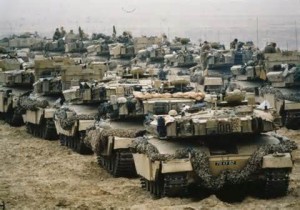
This isn’t 1940. Moreover, as an instrument of coercion, that smaller army would be more lethal than the much larger one that helped defeat Nazi Germany and imperial Japan. Given a choice between a few hundred of today’s Abrams tanks and a few thousand vintage Shermans, Gen. George Patton would not hesitate to choose the former.
Nice try, Colonel Bacevich, but we’re talking about an Army that won’t be facing 1944’s Tiger tanks, but Russian T-90s or some variant. Let’s try to avoid hyperbole, shall we?
Yet to judge by outcomes, the Army is not a force for decisive action. It cannot be counted on to achieve definitive results in a timely manner. In Afghanistan and Iraq, actions that momentarily appeared to be decisive served as preludes to protracted and inconclusive wars. As for preventing, shaping and winning, this surely qualifies as bluster — the equivalent of a newspaper promising advertisers that it will quadruple its print circulation.
Weak sauce. There was almost a decisive action with US armor in the first Gulf War, the first war with Iraq, until the history professors and politicians stuck their nose in and didn’t let us finish off Saddam Hussein. Then in the second war in Iraq, there was a decisive victory using US armor when Saddam’s statues fell. But, what the history professor should have learned from that war is that the enemy will attack you where he finds your weaknesses and so an army must be prepared in all aspects of warfare.
Defense per se figured as an afterthought, eclipsed by the conviction that projecting power held the key to transforming the world from what it is into what Washington would like it to be: orderly, predictable, respectful of American values and deferential to U.S. prerogatives.
The “Global War on Terror” put that proposition to the test, with disappointing results. Putting boots on the ground produced casualties and complications, but little by way of peace and harmony.
So, the good colonel professor figures that we’re unprepared at fighting armored warfare, our enemies will oblige us and fight us only in manner in which we’re prepared. Instead of looking at the long term history of warfare, he’d prefer to look at the last war exclusively – because that war, standing alone in history, supports his vision for a depleted military force. So we can have more Gold Star fathers.
A real student of history would look at the First Battle of Bull Run, Kasserine Pass and Task Force Smith, but Colonel Bacevich has a political point to enforce. Weak sauce, Colonel.
Thanks to Chock Block for the link.