Category: Hugo Chavez

  • Foreign policy by BDS

    r3038338851.jpg

    Earlier this month, we had Jimmy Carter in the Middle East conducting our foreign policy without anyone asking him to do so. He did his best to undermine the country’s standing in the world and accomplished nothing. Last year, Nancy Pelosi and a score of Democrat congress members did the same with Syria. Right before the Israelis bombed a nuclear facility Syria was building with another irrational member of the world community, North Korea. Carter and Pelosi both carried false messages (USAToday link);

    She said she brought a message to Assad from Israeli Prime Minister Ehud Olmert that Israel was ready for peace talks with Syria. Assad gave assurances that “he’s ready to engage in negotiations for peace with Israel,” Pelosi said. She later left Syria, heading for Saudi Arabia, the next leg of a Mideast tour.

    Carter falsely reported (Associated Press link);

    Former President Jimmy Carter said today that Hamas — the Islamic militant group that has called for the destruction of Israel — is prepared to accept the right of the Jewish state to “live as a neighbor next door in peace.”

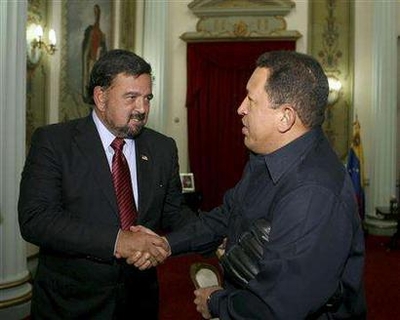
    Today we are treated to Bill Richardson, governor of New Mexico conducting his own foreign policy with Hugo Chavez; USAToday link);

    New Mexico Governor Bill Richardson told The Associated Press in a telephone interview that he plans to put forward a proposal for the release of the three U.S. defense contractors in the coming weeks and that Chavez is willing to work with him as a “primary mediator.”

    The Democratic governor met with Chavez on Saturday night to discuss the issue. The president did not release any statements following the meeting.

    […]

    Richardson, a former U.S. presidential candidate and energy secretary, said he was visiting Venezuela not as an official envoy but at the request of the hostages’ families.

    So what is it with Democrats? Are they so steeped in their hatred for this country that they want to undermine our foreign policy at every turn? Are they convinced that they’ll win elections by pandering to our enemies? If a Republican had done the same to a Democrat administration, they’d holler to high heaven.

    The Constitution charges the President as our sole head of state, and rested the faith of the people in his agents to conduct our foreign policy. But, Democrats have on countless occasions shown what they care about the Constitution. John Kerry tried to conduct his own foreign policy with North Vietnam, as a Navy officer, and a decade later with the communist regime in Nicaragua as a Senator with Tom Harkin.

    Jim McDermott and David Bonior tried to undermine US foreign policy in Iraq months before our attack on Hussein, and was possibly financed by Hussein. Their trip may have influenced Hussein to remain in power despite offers from the US to step down and caused the whole military operation.

    If Democrats really were concerned about our foreign policy, they’d get out of the way and wait for their own turn at bat instead of conducting their own foreign policy based on Bush Derangement Syndrome.

    UPDATE: More on Richardson’s visit to Chavez from Gateway Pundit, Jammie Wearing Fool and Fausta’s Blog.
  • Kirchner’s slight-of-hand

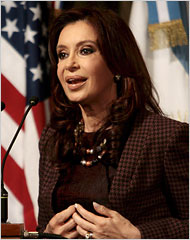
    14argentina190.jpg

    New Argentinian president Christina Kirchner tries her hand at distracting Argentinians and the world from her domestic problems by raising the specter of another war in the Fauklands (AFP link);

    Argentina’s claim to the Falkland Islands, which remain in British hands after the 1982 war between the two countries, is “inalienable,” President Cristina Kirchner said Wednesday.

    “The sovereign claim to the Malvinas Islands is inalienable,” she said in a speech marking the 26th anniversary of Argentina’s ill-fated invasion of the islands, located 480 kilometers (300 miles) off shore.

    The April 2, 1982 invasion prompted then British prime minister Margaret Thatcher to deploy naval forces to retake the Falklands, known as the Malvinas in Spanish.

    The short, bloody conflict led to Argentina’s surrender on June 14, 1982 after the death of 649 Argentines and 255 Britons.

    Kirchner’s problems actually began before her election when it was discovered that she was using hundreds of thousands of dollars from Venezuela’s socialist president Hugo Chavez in her campaign. A courier from Chavez was stopped at the airport in Buenas Aires with a suitcase stuffed with $800, 000 in what is now known throughout the region as “maleta-gate“.

    Yesterday, her latest challenge conditionally ended when farmers ended their three-week strike (Miami Herald);

    Thousands of farmers on Wednesday lifted a three-week strike that produced food shortages at markets throughout this 40 million-person country and represented the biggest challenge so far to President Cristina Fernández de Kirchner.

    The farmers didn’t achieve their main goal, killing an increase in export taxes on soybeans and sunflowers, but they said they would wait, for at most 30 days, for negotiations with the government to move forward. Speaking at a rally in the central Argentine city of Gualeguaychú, a spokesman for the country’s four main farm associations said farmers would go back to blocking roads and withholding their production if negotiations failed.

    Such measures have stopped tons of meat, fruit and other food from reaching markets, especially in Buenos Aires. Farmers began lifting roadblocks throughout the country Wednesday morning.

    Farmers have criticized what they said are crippling price freezes, export bans and tax hikes that the government implemented. The moves have targeted the country’s powerful farm sector, which produces about 60 percent of Argentina’s exports.

    Mary Anatasia O’Grady of the Wall Street Journal wrote that the farmers rose up against Kirchner’s “facism”;

    Argentina has been growing fast — better than 8% a year — since 2003. But this has largely been the result of the combination of a natural bounce after a collapse and a global boom in commodities. Meanwhile, simmering just beneath the surface of the recovery remains the fundamental contradiction that provoked the 2001 economic crisis. To wit, while a strong peso made Argentines prosperous in the 1990s, it was incompatible with the rigid, closed economy. The situation is the same today: Either the economy is opened, labor markets are made flexible and the business climate improves or the government clings to a weak peso policy as a way to compensate for an uncompetitive economic model and inflation comes back. Take your pick.

    By choosing the latter, the Kirchners have won the support of that segment of the Argentine economy loyal to the principles of 20th-century fascist Juan Peron. These include labor militants, government bureaucrats, the Peronist political machine and the likes of Mr. D’elía, whose thugs act as Mrs. Kirchner’s informal enforcers. But by generating inflation and provoking shortages Kirchneromics is also fueling widespread discontent.

    So taking a page from Hugo Chavez’ book, who has alternately told Venezuelans that he was targeted by the United States and Colombia for assasination, Kirchner decided to fan the flames of patriotism by flexing her military muscles, just as the military junta did twenty-six years ago. But, I’d remind Ms. Kirchner that the war against Britain ended up costing the junta their jobs eventually.

    Another Chavez acolyte, Daniel Ortega, is trying the same tactic in poverty-stricken Nicaragua by making noise about some islands in the Caribbean with Colombia (Reuters link);

    The two nations, separated by Panama and Costa Rica, lay claim to the isolated Caribbean Islands San Andres and Providencia off Nicaragua’s Atlantic Coast, as well as several keys and some 50,000 sq km of fishing waters.

    Colombia told the court in June border disputes were inevitable after the fall of the Spanish Empire in the Americas and the one in question was “definitively settled” in 1928, when Nicaragua and Colombia signed a treaty granting Colombia sovereignty over the islands.

    But Nicaragua’s Sandinista government in the 1980s annulled the accord and argued it was signed while Nicaragua was under U.S. military occupation.

    Many Nicaraguans consider the treaty a U.S. payoff to Colombia for arranging the independence of Panama from Colombia in order to build the Panama Canal.

    If the US unilaterally abrogated a treaty, you’d hear the screaming from one corner of the globe to the other, but communists and socialist are stroked by the world’s Left and the media as a whole.

  • Iranians mining uranium in Venezuela?

    veniran27.jpg

    This morning, I read in Weasel Zippers about the Chinese ratting out the Islamic Republic to the International Atomic Energy Agency (link to AP article)

    Diplomats say that China has given the U.N. nuclear watchdog intelligence linked to Tehran’s alleged attempts to make nuclear arms.

    The development is surprising because Beijing, along with Russia, has opposed U.S.-led attempts to impose harsh penalties on Tehran over its nuclear defiance of the U.N. Security Council.

    I thought it was pretty strange given the fact that it’s pretty likely the Chinese gave Iran the technology (at least indirectly) for the nuclear program in the first place. But then I read over on The Jungle Hut that there’s some evidence that Iran is mining uranium in Venezuela. Jungle Mom links to this World Check article;

    * An interesting postscript; Nasar’s whereabouts were known to the United States, but no attempts were ever made to capture or neutralise the man who was most likely the most dangerous terrorist to ever set foot in the Western Hemisphere. Claims have been made that he was subsequently captured by local authorities in Pakistan, and subsequently turned over to American agents, but no public confirmation has ever been issued. Exactly where is the man understood to be one of Al-Qaida’s leading theoreticians?

    * Did Al-Qaida take possession of some of the Venezuelan Uranium? most of it is presently being refined in Iranian laboratories, but was some diverted by Nasar?

    * For those who still doubt that Venezuela is now, with the able assistance of Iranian engineers on-site, processing Uranium for eventual use in weapons of mass destruction, please note that a number of Venezuelan publications have detailed the locations of the mines, and a senior Venezuelan governmental officials has, coincidentally, advised that any unauthorised aircraft overflights in the region where the mines are situated, are strictly prohibited, and that such aircraft will be subject to deadly force, and shot down.

    Gateway Pundit wrote about it last September and linked to another article a year older at VCrisis which raised the specter of Venezuela’s plans to help Iran with their program;

    Camilo Ospina, on the day he was sworn in as Colombia’s new ambassador to the Organization of American States, stated in a speech…stated further that “if you were to go straight in the direction of Arauca, arrive at the border and penetrate about 400 kilometers beyond, you will find two factories, one is a bicycle factory and the other a motorcycle factory. These two factories are a façade for a uranium excavation.”

    And he concluded: “Venezuela has no means of enriching uranium, but Iran does. If that came about, we would have a real problem.”

    This article in Spanish from Noticias24 mentions the important fact that Raul Reyes’ laptop mentioned 50 kilos of uranium, but Colombian police only found 30 kilos the other day. UK’s Spectator asks similar questions;

    …Hugo Chavez, president of Venezuela, is known to be in cahoots with Iran and has given free passage to people associated with al Qaeda, Hamas or Hezbollah. Which makes him a pretty dangerous kind of guy. But a few days ago Reuters reported something which raises the stakes and should ring the loudest possible alarm bells: that the authorities in Columbia have seized at least 30 kg of uranium from the FARC terrorists — who have received financial support from Chavez.

    Since the FARC revolutionaries don’t themselves appear to want to make a nuclear bomb to incinerate Bogota, it is most likely that the uranium stash was destined to be sold to a bidder who did want to make such a bomb. So to where was it destined — and where might other uranium from the same source have ended up?

    It may just be that Iran’s program is advancing faster than China expected due to this new source of uranium.

  • El Gran Circo de Chavez

    r2237890389.jpg

    Photo from Reuters

    (It’s not my fault he looks like Mickey Mouse in this picture – blame Reuters)

    So much Chavez buffoonery today, I just couldn’t let it pass without comment. The Miami Herald writes about Chavez’ supposed fascination with the death of Simon Bolivar;

    Bolívar, a leader of the revolution that freed Colombia and its neighbors from Spanish rule, died in Santa Marta 16 days later. ”It was easy to recognize,” reported the attending physician after an autopsy, that he died from tuberculosis.

    But Venezuelan President Hugo Chávez — whose devotion to Bolívar knows no bounds — is questioning that verdict and suggesting he was poisoned by oligarchs in neighboring Colombia — his main current foe after the United States.

    Chávez has created a high-level commission, led by his vice president, to open Bolívar’s coffin and ”clear up the important doubts woven around the death of the Liberator,” according to the Official Gazette.

    Chávez has even questioned whether Bolívar’s remains actually lay at the National Pantheon in downtown Caracas, about 10 blocks from where he was born in 1783.

    ”I swear I will not rest in the search for the real truth,” Chávez said in December, promising “an investigation with all the resources Venezuela can offer.”

    Historians dispute Chavez’ fixation;

    Referring to Chávez’s suggestion of assassination by poison, [Germán Carrera-Damas, Venezuela’s most prominent historian on Bolívar’s era] said, “There’s just as much evidence to say that Bolívar died from a fall in the bathroom. This is just a decoy by Chávez. When things get difficult at home for him, he invents something to distract people.”

    […]

    David Bushnell, a retired University of Florida expert on Bolívar, tied Chávez’s comments about Bolívar’s death to the president’s verbal attacks on Colombian President Alvaro Uribe, whom he has called a ”puppet” of the Colombian oligarchy and a ”lapdog” of the United States. The two countries engaged in a weeklong diplomatic crisis that ended earlier this month.

    ”Chávez says that the enemies facing him are the same ones who faced Bolívar,” Bushnell said by telephone from Gainesville. “If they killed Bolívar, according to Chávez’s thinking, then it would follow that they’re trying to kill him.

    ”It’s nonsense,” Bushnell added. “In Latin America in the 19th century, they used gunfire, not poison. What Chávez is claiming sounds like a Renaissance Italy tactic. I can’t think of any leading figure from 19th century Latin America who was killed by poison. A lot were shot, though.”

    Bloomberg reports that Chavez has plans to begin seizing “idle” farm land. Apparently, milk producers and farmers are causing the wide spread food shortages by failing to plant and produce, according to Chavez;

    “We have to intervene in all idle land,” Chavez said today during a ceremony to commemorate the government’s nationalization of a milk plant, in comments broadcast by state television. “We have to make them produce.”

    Chavez is using rising revenue from oil exports to try to resolve politically sensitive shortages of basic foods like milk, beans and beef before state and municipal elections scheduled this year.

    But, The Devil’s Excrement writes that the Chavez family in the state of Barinas, Venezuela has already started buying up parcels of land, making them one of the largest landowner families in the area;

    [Wilmer] Azuaje all of a sudden got ambitious and sensing the weakness of the Chavez name in Barinas, decided he could be Governor. Thus, despite the express prohibition by Chavez for people to announce candidacies, Azuaje announced he was running in November. However, he also decided to go for the jugular and denounced the Chavez family for corruption, saying they have accumulated large pieces of land, most of which they keep in somebody else’s name.

    He brought the evidence to the Comptroller’s Commission of the National Assembly and the stuff is apparently quite thorough, so much that they had to admit it as evidence and open an investigation.

    Even Leftist Venezuelanalysis (generally written and maintained by US Leftists in support of Chavez and his revolution) reports on this tidbit;

    “This cannot be socialism,” Azuaje asserted, and asked that the Comptroller`s Commission travel to Barinas and speak with those involved in the contracts to verify how Izarra and Báez were able to pay for the farms. He also denounced that the roadways in and around the farms owned by Chávez family members are better kept than statewide roads.

    Chavez is still haunted by Raul Reyes’ computer hard drive, so he pretends that it couldn’t have survived the attack according to Daniel at Venezuela News and Views;

    Chavez, scared shitless of the Reyes computer, is trying to promote the thesis that if Reyes was killed he certainly could not be survived by his computer. People like me, scientists by trade, know very well that if the bulk of Reyes body survived then there is a very good chance that the hard drive of his lap top could also make it.

    Of course, the best way for Chavez to redeem his image is shut down opposition media (BBC link);

    Meanwhile, the Venezuelan government is holding a series of events in Caracas to counter “media terrorism”.
    […]
    “Chavez’s government denies media outlets that are not subordinate to his hegemony access to public information”, David Natera, publisher of Venezuela’s Correo del Caroni newspaper, was quoted as saying by the Associated Press news agency.

    So, let’s recap; the oligarchs in Colombia are trying to kill Chavez because they killed Bolivar; while Chavez’ family is buying up land, and he’s trying to nationalize land (I remind readers that all politics in agrarian Latin America revolve around land reform), and to keep everyone quiet about his failures and FARC buffoonery, he tries to shut down the opposition media.

    I’m sorry but I don’t see the resemblance between Bolivar and Chavez.

  • Chavez not a McCainiac

    A few weeks ago, we read that the terrorists of FARC were hoping for an Obama victory, yesterday I wrote that a Democrat Congressman turned up in FARC computers as a collaborator with the terrorist organization. Today’s news brings word that Chavez, Venezuela’s terrorist-supporting, anti-American demagogue, announced he’s not supporting a McCain candidacy (Reuters link).

    Venezuelan President Hugo Chavez, a socialist and fierce U.S. critic, warned on Tuesday that relations with Washington could worsen if Republican candidate John McCain wins this year’s presidential election.

    Chavez said he hopes the United States and Venezuela can work better together when his ideological foe, U.S. President George W. Bush, leaves the White House next year, but he said McCain seemed “warlike.”

    “Sometimes one says, ‘worse than Bush is impossible,’ but we don’t know,” Chavez told foreign correspondents. “McCain also seems to be a man of war.”

    Chavez — who has called Bush “the devil”, “a donkey” and ‘Mr Danger” — accuses the United States of having imperial designs in Latin America and says the White House has plotted his overthrow.

    I guess Chavez wasn’t paying attention in 2004 when Osama bin Laden came out for a Kerry presidency. American voters don’t like being told by foreigners how we should vote.

    The Jawa Report writes that Chavez is meddling in Peru now, since his revolution isn’t catching on in Venezuela.

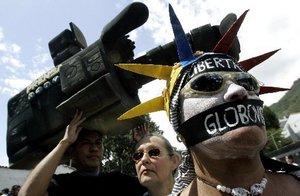
  • Chavez targets Globovision

    630-venezuela_protest_xhy101embeddedprod_affiliate56.JPG

    Howard Yane/AP Photo

    The Miami Herald reports this morning that Venezuelan president Hugo Chavez has threatened to allow television network Globovision’s license expire in November – the same tactic he used against RCTV last year when that network was forced to the internet from broadcast television.

    President Hugo Chávez’s dismantling of the critical press looks to be continuing as the leftist leader whips up public support to shut down Globovisión — less than a year after he refused to renew the license of the country’s most popular TV station.

    Chávez has called Globovisión, a 24-hour news channel, ”an enemy of the Venezuelan people,” and one of the owners has been verbally attacked. Fervent government supporters have called on the national tax office to investigate the station. Hundreds rallied outside of its offices last month.

    Chavez’ memory must be as short as his legs – closing RCTV was what angered students and inspired opposition to his rewritten Constitution in a referendum last November. Closing Globovision may the thing that drives him from office.

  • Venezuelans take their ($19b) ball and leave

    According to the Miami Herald this morning, Venezuelans are taking their money out of Venezuela and stashing it outside of the country;

    Capital flight out of Venezuela established a record during 2007, the Central Bank of Venezuela has reported, despite strict currency controls adopted in 2004 by President Hugo Chávez’s government to limit the outflow of money.

    Much of the money landed in the United States and especially Florida, through various means such as bank accounts, financial investments and asset purchases, said José Guerra, the Central Bank’s former chief economist, and Antonio Jorge, an economics professor at Florida International University.

    ”Miami is a natural destination for the escape of Venezuelan capital,” said Jorge.

    He estimated that at least 60 percent of the $19 billion ended up in the United States, given that nearly 70 percent of Venezuela’s international commercial exchange is with the United States.

    When I was in Panama last November, the common complaint of most Panamanians I talked with was that Venezuelans were driving up the price of real estate and luxury goods while they deposited their savings in Panamanian banks (Panama is Latin America’s Switzerland). In 2006, Venezuela’s GDP was $176b, if it remained at that figure, that means that more than 10% of it’s GDP is leaving the country – it’s an equivalent of over a trillion dollars leaving the US in a year.

    So that leaves me wondering what Chavez intends to do about it – because he can’t afford to have Venezuela hemorrhaging cash.

    Good news for Hugo, though is the fact that a judge in Great Britain overturned the decision that enabled Exxon/Mobil to freeze $12b of Venezuela’s assets (Bloomberg link);

    Exxon Mobil Corp.’s freeze on $12 billion of assets belonging to Venezuela’s state oil company was overturned by a U.K. court in a setback for the U.S. energy company in its dispute with President Hugo Chavez.

    A London court today said that an injunction freezing assets belonging to Petroleos de Venezuela SA, known as PDVSA, should be thrown out. Judge Paul Walker disclosed the ruling without giving his reasoning.

    Exxon, the world’s largest oil company, sought freeze orders in several countries to keep Venezuela from shifting assets out of the reach of an international arbitration commission that’s handling claims against Chavez’s government for last year’s takeover of an oil field. PDVSA had argued that U.K. courts didn’t have jurisdiction to intervene in the dispute.

    “The judge hasn’t allowed his court or his country to be an instrument” of Exxon, Samuel Moncada, Venezuela’s ambassador to the U.K., said in an interview. “This decision should have an effect on any reasonable court in the world.”

    So he’s still short a few billion bucks.

  • Paz Sin Fronteras

    Yesterday tens of thousands of music fans gathered on the border between Colombia and Venezuela to listen to the biggest names in Latin music perform from a bridge that spans the two nations in response to the recent Chavez-inspired crisis. Paz Sin Fronteras means “Peace Without Borders”.

    I suppose Chavez would have a difficult time forming these happy folks into an army.

    I found a video of some of the stars that includes Juanes the artist who formed the concert and Alejandro Sanz, arguably the biggest popular music artist in latin America. It’ll give you an idea of the size of the audience. Me? I like the music.

    [youtube I1nXzI1t3XI nolink]

    Katy of Caracas Chronicles reports that Venezuelan media was too fixated on Alo Presidente to notice. Miami Herald reports that President Uribe was asked not to come;

     Colombian President Alvaro Uribe had planned to attend but canceled on Sunday, saying Juanes’ manager asked him not to come because the show “was not to be a political event.”