Category: Hugo Chavez

  • Chavez’ sabre rattling

    r2382987742.jpg

    Photo from Reuters

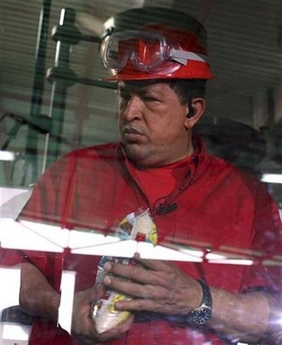
    Venezuela’s President Hugo Chavez speaks during his weekly broadcast ‘Alo Presidente’ in Caracas March 2, 2008. Chavez ordered tank battalions to the Colombian border on Sunday after Colombian troops struck inside another of its neighbors, Ecuador, in an attack on rebels.

    The death of Raul Reyes, FARC’s second-in-command was welcomed throughout the civilized world as good news of a small victory over the 40-year old band of narco-terrorists who abandoned their Marxist roots long ago for the profits of drug-running and kidnapping. Some of the details came out this morning when the Colombian government admitted that it fired missiles across the border with Equador to hit the terrorists’ base. The Colombians had done so with the explicit permission of the Equadoran government, run by Chavez acolyte Rafael Correa.

    Babalu Blog writes that Chavez has ordered ten battalions of the Venezuelan Army to the Colombian frontier and the Miami Herald claims that Chavez says Correa is mobilizing his forces in Equador as well;

    Chavez called the Colombian government “a terrorist state” as he sided with the leftist rebels it has battled for decades, saying its military “invaded Ecuador, flagrantly violated Ecuador’s sovereignty.”

    Neither Colombia’s foreign minister nor the country’s military leadership would comment on Chavez’s latest move when pressed by reporters for comment Sunday as they left a funeral service in Bogota for a Colombian soldier killed in Saturday’s raid.

    Speaking in Texas, U.S. National Security Council spokesman Gordon Johndroe said officials were monitoring the situation.

    “This is an odd reaction by Venezuela to Colombia’s efforts against the FARC, a terrorist organization that continues to hold Colombians, Americans and others hostage,” Johndroe said.

    Chavez said he had just spoken to Ecuadorean President Rafael Correa and that Ecuador was also sending troops to its border with Colombia. Chavez said his Ecuadorean ally told him that Uribe had lied and that the rebels were killed while asleep “in their pajamas.”

    “This is something very serious. This could be the start of a war in South America,” Chavez said. He warned Colombian President Alvaro Uribe: “If it occurs to you to do this in Venezuela, President Uribe, I’ll send some Sukhois” – Russian warplanes recently bought by Venezuela.

    Kate at A Colombo-Americana’s Perspective writes that Nicaragua’s Daniel Ortega has joined in the noise making;

    Nicaraguan President Daniel Ortega condemned Colombia’s killing of a top rebel commander and said it could hurt the chances of a peace accord.

    Ortega, a former Marxist revolutionary and U.S. Cold War foe who was voted back to power in late 2006, called on Colombian President Alvaro Uribe to seek a peace process with the Revolutionary Armed Forces of Colombia, or FARC.

    The Real Cuba quotes Chavez saying he wants to “liberate” Colombia from Uribe and that Uribe has turned Colombia into the Israel of Latin America;

    Upset at the death of FARC terrorist Raul Reyes at the hands of the Colombian army, Hugo Chávez accused the Colombian president of being a “criminal” and promised to “liberate” the neighboring country.

    “The Colombian government has become the Israel of Latin America,” an agitated Chavez said, mentioning another country that he has criticized for its military strikes. “We aren’t going to permit Colombia to become the Israel of these lands.”

    Chavez accused Colombian president Alvaro Uribe of being a puppet of Washington and acting on behalf of the U.S. government, saying “Dracula’s fangs are covered in blood.” “Some day Colombia will be freed from the hand of the (U.S.) empire,” Chavez said. “We have to liberate Colombia,” he added.

    The “Israel” of Latin America because they attack terrorists before the terrorists have a chance to attack them. I suppose a civilized nation might question why FARC terrorists were snoozing unmolested in Equador. But instead Chavez is upset that Colombia has snatched his publicity over the released hostages last week and feels a need to grab headlines again.

    Well, this explains why Chavez is buying tons of weapons from Russia as I wrote the other day. Kate wrote yesterday that Chavez announced the formation of “Bolivarian Police” that he can form from his loyal chavistas – also as I predicted the other day. Daniel at Venezuela News and Views writes that squatter shacks are multiplying, that food is harder to come by and that garbage is piling up – while Chavez puts Venezuelans in danger of a needless war.

    Ed Morrisey at Hot Air questions if this doesn’t mean that Chavez is admitting to an alliance with FARC terrorists. I think it’s much simpler than that – just Chavez getting more free press.
  • House jacks up fuel prices

    Hoping to scoop out some of those profits that oil companies have been reaping lately, the House passed what they named the “Renewable Energy and Energy Conservation Tax Act of 2008”. The stated purpose was not to give consumers and US taxpayers some relief from high fuel prices. Let Steny Hoyer explain (Reuters/Yahoo link);

    “We simply must begin to break our addiction to fossil fuels, particularly our addiction to foreign sources of oil,” said Rep. Steny Hoyer of Maryland, the House Democratic majority leader.

    “We”? Got a mouse in your pocket, Steny? Better yet; got an alternative fuel in your pocket, Steny?

    House Democrats said oil companies that have earned record profits off $100-a-barrel oil did not need the tax breaks, and the money could be better used to promote alternative energy supplies for the future.

    First of all, how is drawing more taxes off from oil profits going to “promote alternative energies for the future”? That always gets me – the solution is always give money to the government, not give money to people who’ll actually do something worthwhile.

    All that happens when government jacks up taxes on oil companies, oil companies pass the burden on to consumers. Oil profits won’t suffer, just the poor working folks who have to fill their fuel tanks up everyday to schlep off to work will suffer. But try and explain that to Congress.

    But guess who doesn’t get hit with the higher taxes – Hugo Chavez. From CQ Politics (h/t Michele Malkin) ;

    The tax package (HR 5351), which passed 236-182, repeals subsidies for five major oil and gas companies to offset $13.7 billion of the $18.1 billion in renewable-energy tax breaks contained in the bill.

    Meanwhile, Citgo Petroleum Corp. would continue to receive a 6 percent deduction for domestic manufacturing that the largest firms would lose.

    Citgo, which refines oil and markets and transports gasoline in the United States, is owned by a subsidiary of the government-owned Petróleos de Venezuela, S.A., or PDVSA. Because Citgo does not drill for oil and gas domestically or abroad, it does not fall under the bill’s definition of companies that will lose a major tax break.

    The five big companies targeted by the bill — Chevron, BP, ExxonMobil, Shell and ConocoPhillips — all produce and refine oil and sell gasoline in the United States, and therefore under the bill would lose the domestic manufacturing deduction they received as part of a corporate tax law in 2004 (PL 108-357).

    Now how do we get independence from foreign oil producers by giving them a tax break and more heavily taxing our domestic producers? Huh? Can one of you rocket scientists on the Left explain that to me?

    Back to the Reuters story;

    Under the bill, energy companies would no longer be able to exclude a certain portion of their oil and gas production income from U.S. taxes and would also have to pay U.S. taxes on some foreign income that also was taxed in the country where it was earned.

    Makes tons of sense doesn’t it? Don’t allow domestic exploration for fuels, and tax domestic producers – sometimes double taxation.

    Right now, the Bush Administration has threatened to veto this garbage, but just wait until Democrats have both ends of Pennsylvania Avenue again. We’ll all be riding bicycles in no time – well, we’ll have no jobs to get to, so we might as well ride bikes around.

  • Chavez’ arms race

    capt8ccb2e02375f42809da9667d5dc272d5venezuela_colombia_hostages_xfll114.jpg

    Photo from Associated Press

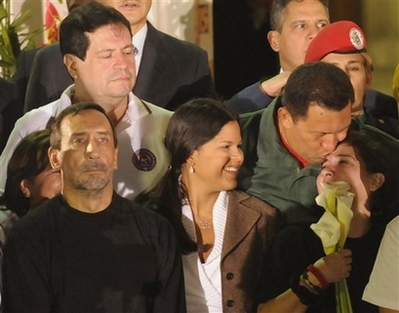
    Hugo Chavez took credit, once again, for negotiating the release of four more Colombian hostages from the Colombian Armed Revolutionary Front (FARC) yesterday – four out of at least 800 (since FARC and the Colobian people can’t seem to settle on a number between 50 and thousands – not to mention the Venezuelans that Chavez won’t admit have been kidnapped).

    Daniel at Venezuela News and Views recounts the entire event from in front of his television in Caracas and observes;

    the hostage release was the most important item in Chavez agenda now that success is so scarce for him.

    Colombian president Uribe wasn’t quite so unforgiving of FARC (Reuters link);

    “The FARC should understand the Colombian people expect them to release all the hostages in their power,” Uribe said in a television address in which he thanked Chavez.

    Uribe, whose father was killed in a botched FARC kidnapping, is popular at home for a U.S.-backed military offensive that has forced the rebels from swathes of Colombia.

    Meanwhile, the Miami Herald tells the story of Chavez arms purchases from Vlad Putin;

    Venezuelan President Hugo Chávez is purchasing ”three or four times” more weapons than he needs, a top U.S. intelligence chief said Wednesday, but there is no evidence so far he is providing arms to Colombian guerrillas.

    […]

    At a Senate Armed Services Committee hearing, Florida Republican Sen. Mel Martinez, asked if Chávez’s recent weapons purchases, especially the assault rifles, exceeded Venezuela’s defense needs.

    ”Yes, sir,” McConnell responded, “probably three or four times more than what he would need.”

    When asked if Chávez could use the surplus to ”destabilize neighboring governments, particularly Colombia” and assist Colombia’s left-wing FARC guerrillas, McConnell said: “Could very well be.”

    […]

    From Russia, Chávez has purchased the assault rifles, a munitions factory, 53 helicopters — including a dozen Mi-17 military helicopters — and 14 SU-30MK fighters.

    McConnell added that on the purchase of the assault rifles, ”one of the thoughts is [Chávez] forming an internal militia to enforce his authoritarian rule.” But when pressed if Chávez meant to arm his supporters to stifle domestic opposition, Maples said that he hasn’t seen any evidence of it.

    But, that’s what Noriega did in Panama when he began to lose control of the Panamanian people – he formed the Dignity Battalions, armed them with old weapons from the Guardia Nacional and gave them free rein to wander the streets and literally beat the opposition bloody.

    Francisco Rodriguez, formerly Chavez’ chief economist, warns of “An Empty Revolution” in Foreign Affairs magazine;

    Chávez’s political success does not stem from the achievements of his social programs or from his effectiveness at redistributing wealth. Rather, through a combination of luck and manipulation of the political system, Chávez has faced elections at times of strong economic growth, currently driven by an oil boom bigger than any since the 1970s.

    Like voters everywhere, Venezuelans tend to vote their pocketbooks, and until recently, this has meant voting for Chávez. But now, his mismanagement of the economy and failure to live up to his pro-poor rhetoric have finally started to catch up with him. With inflation accelerating, basic foodstuffs increasingly scarce, and pervasive chronic failures in the provision of basic public services, Venezuelans are starting to glimpse the consequences of Chávez’s economic policies — and they do not like what they see.

    So while Chavez scores huge political points with foreign interests (like FARC, China and Iran) he slowly losing his grip on Venezuela’s internal electoral process – and buying weapons. It doesn’t take a rocket scientist to do the math on this one.

  • Chavez focuses on what’s important

    r4199006110.jpg

    Photo from Reuters

    Michele Malkin writes this morning that Venezuelan President Hugo Chavez is focused on the important issues that affect Venezuelans – like using Spanish words.

    President Hugo Chavez’s government is taking its battle against U.S. “imperialism” into Venezuelans’ vocabulary, urging state phone company workers to eschew English-language business and tech terms that have crept into the local vernacular.

    Meanwhile, Venezuelans on the border with Colombia have less important concerns – like kidnapped family members (Miami Herald link);

    President Hugo Chávez has reveled in praise worldwide for helping secure the release last month of two Colombian hostages held by the FARC guerrillas in the neighboring country.

    But his efforts to free other Colombians from captivity are provoking anger here along Venezuela’s western border with Colombia, where kidnappings of Venezuelan ranchers and businessmen have risen dramatically.

    ”The president says that the guerrillas don’t hold Venezuelans,” said Alejandro García, a municipal official. “The facts say otherwise. We have proof from witnesses, telephone records and [ransom] letters.”

    Cattle growers and their political allies say Colombian rebels hold 16 Venezuelan kidnap victims and complain that Chávez is doing little to win their freedom, despite his sway with the FARC.

    The Devil’s Excrement reports that food shortages in Venezuela are influencing the government to begin issuing ration cards;

    And so it begins. After shortages arising from price controls and the Government’s inefficient intervention into the food distribution chain, the new PDVSA owned PDVAL markets will have what effectively represents the introduction of rationing cards in Venezuela.

    Las Armas de Coronel reports that the Venezuelan oil industry, the main engine of the Venezuelan economy is collapsing. This morning, Venezuela announced an end to food exports (Adelaide Now link);

    VENEZUELA will halt exports of foods such as milk and meat unless domestic demand is met first, the government said today, as leftist president Hugo Chavez struggles with shortages of staple products.

    Venezuelan shoppers have for months faced shortages of basics such as milk and chicken, a problem the government blames on growing demand and hoarding but business leaders say stems from price controls that do not keep pace with high inflation.

    Oh, and bombings of business interests in the capitol probably aren’t very important, either (AP/MSNBC link);

    A small bomb exploded outside the headquarters of Venezuela’s leading business chamber on Sunday, killing one person, police said.

    The blast occurred near the entrance of the Fedecamaras business chamber headquarters in Caracas’s middle-class district of La Florida at approximately 1 a.m. local time (2 a.m. EST), killing an unidentified man and shattering windows, Federal Police Chief Marcos Chavez said.

    “There’s a person who was close by, and presumably could have been hit by the shock wave,” Chavez said in a brief telephone interview. “We still have not identified the person.”

    It probably doesn’t matter that Chavez has threatened businesses represented at the bombed business chamber;

    Government officials have denied that Chavez’s administration was behind previous attacks.

    Last week, Gonzalez strongly criticized Chavez for accusing local businesses of stockpiling products to sell later at inflated prices as Venezuelans struggle with sporadic food shortages.

    Chavez warned recently that any business caught hoarding goods such as chicken, eggs and milk “should be seized and taken under government control” — threats that alarmed Fedecamaras.

    The socialist leader called Empresas Polar — Venezuela’s largest food producer — a “clear example” of the kind of business that is ripe for takeover.

    But, for pete’s sake, please say “raton” instead of “mouse” – after all what’s most important here?

  • Chavez, Nestle, Exxon; milk and oil politics

    2008_02_10t233956_368x450_us_venezuela_food.jpg

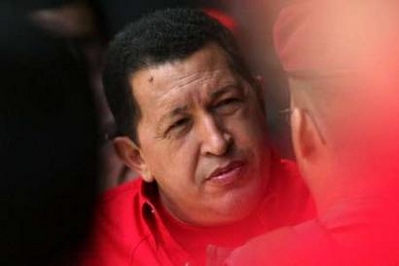
    Venezuelan President Hugo Chavez visits a rice plant during his weekly Alo Presidente broadcast in Barinas, 525km (326 miles) from Caracas, February 10, 2008.

    Photo from Reuters

    Last week, Exxon Mobil convinced a British court to freeze about $12 billion of assets belonging to Venezuela’s state-owned oil company Petroleos de Venezuela SA in Exxon’s case against Venezuela for seizing the company’s property. So of, course, because an international company, backed by a British court froze Venezuela’s money in foreign banks, Chavez blames the United States and threatens to cut off oil to the US (Breitbart link);

    Chavez has repeatedly threatened to cut off oil shipments to the United States, which is Venezuela’s No. 1 client, if Washington tries to oust him. Chavez’s warnings on Sunday appeared to extend that threat to attempts by oil companies to challenge his government’s nationalization drive through lawsuits.

    “I speak to the U.S. empire, because that’s the master: continue and you will see that we won’t sent one drop of oil to the empire of the United States,” Chavez said Sunday.

    “The outlaws of Exxon Mobil will never again rob us,” Chavez said, accusing the Irving, Texas-based oil company of acting in concert with Washington.

    Anyone with a bit of common sense, and not suffering from Bush Derangement Syndrome, would recognize that Exxon-Mobil’s moves are purely in their interests. But, Chavez suffers from BDS like no one else. I guess it’s that coca-chewing that makes him a bit paranoid. But Miguel at The Devil’s Excrement writes that this seizure should be no surprise to the chavistas;

    The truth is that not only did Chavez illegally take over ExxonMobil’s investment in Venezuela, but has yet to compensate that company. Moreover, the whole thing has been badly handled in the belief that ExxonMobil will simply accept whatever PDVSA offered, like the state controlled oil companies of Norway and France did with their own project.

    In fact, Chavez should have known that these injunctions were requested by ExxonMobil as far back as December, a fact that was hidden from the Venezuelan people. At least in the case of the US Court, ExxonMobil introduced the injunction in the Souhern District of New York on December 27th. and that same day Judge Batts ruled on the case, filed under number 07-CV-11590 and ordered PDVSA’s property attached. Moreover, the Judge ratified the measures on January 2nd and again on Jan. 8th. after talking to PDVSA’s lawyers. It was not until January 24th. that PDVSA’s lawyers actually replied to the injunction in the US.

    Not learning that messing with an international company has drawbacks, Chevez went on to threaten to seize Parmalat and Nestle milk plants. After freezing milk prices last year, it became more attractive to Venezuelan milk producers to export their milk to Columbia when they began going broke. So to in an attempt to stem the milk shortages in Venezuela, Chavez instead of letting the market make up shortfalls, blames foreign entities (Financial Times/Reuters link);

    “If, for example, Nestlé or Parmalat … show that through various economic mechanisms, or through pressure, they are taking the product and leaving state or cooperative plants without the necessary milk … then we have to apply the constitution and we have to intervene and expropriate the plants,” he said.

    Mr Chávez frequently issues conditional threats against the private sector without following through on them. But last year, he nationalised swaths of the economy, including the oil and utility sectors, in a drive to build a socialist state.

    In an OPEC country flush from an oil price bonanza, even Chávez supporters are angry at bare shelves and long lines in supermarkets. There have been shortages of products like sugar, eggs and meat, but especially milk.

    Of course, he has a hard time avoiding hyperbole when Chavez is on a paranoid tear (AP link);

    If companies ensure a supply through “blackmail, offering money up front” while leaving state-run plants without enough milk, “that’s called sabotage,” Chavez said. He added that in such cases, “the plants must be taken over and expropriated.”

    Sabotage would more closely describe what Chavez has done to the Venezuelan people and what should be a booming economy is light of oil prices. Since Venezuela supplies 12% of our oil, it would certainly impact us in the short term, however, somewhat less than what Chavez implies.

    Miguel (The Devil’s Excrement link above), unusually accurate in his predictions about the Venezuelan economy, thinks that it will hurt Venezuelans more than the US;

    This will create more financial problems in Venezuela than anywhere else, where shortages are already present and the population is tired of promises and inefficiencies. Thus, if Chavez dared to do it, it will likely become a defining moment in his demise, as people have put up with his rants and ideology because there were unrealized promises attached to them. But somehow it seems this is the wrong time to ask the people to sacrifice in the name of his revolution.

    The ExxonMobil injunctions would only become significant if Chavez were to take the “nutty” road, as I suggested the first day I heard about them, such a road will only be bad for us Venezuelans but I still believe there is a very low probability that Chavez will take it.

    Albert de la Cruz at Babalu Blog agrees;

    I am sure it will be much harder on the US losing it’s 4th oil importer than it will be on Venezuela losing its #1 customer. At least by chimp logic it is.

  • Secure our borders! Yesterday!

    In this morning’s Washington Times, Sara Carter (quickly becoming one of my favorite reporters over there) writes that “US Foes target Latin America

    Iran, Cuba and Venezuela are working together against the U.S. by undermining democracy in Latin America, allowing trafficking of illegal drugs and creating safe havens for extremist groups, intelligence officials said.

    Testifying before the Senate Select Committee on Intelligence on Tuesday, National Intelligence Director Michael McConnell said that influence from the three countries — led respectively by Mahmoud Ahmadinejad, Fidel Castro and Hugo Chavez — has spilled into Bolivia, Nicaragua and Ecuador, which “are pursuing agendas that undercut checks and balances” of democratic governments.

    She goes on to write;

    “We’ve known for some time that Islamic extremists groups were gaining momentum and exploiting the region,” said one U.S. federal law-enforcement official, on the condition of anonymity, who worked drug operations in Central America. “Iran is no exception — now with Cuba and Venezuela, the door is open.”

    Web sites advocating Hezbollah and other Islamic extremist groups in Central America are used to recruit members and espouse extremist ideology.

    On one Web page — now removed from the Internet — “Hezbollah Latin America” displayed photographs of members, with their faces covered and weapons raised. The Web site contained links to Hezbollah group members in Venezuela, El Salvador, Argentina and as north as Chiapas, Mexico.

    Regular readers of this blog will remember the link to Jungle Mom that I’ve posted several times over the past several months referring to Hezbollah influence among the indigenous people of Venezuela’s interior after Chavez forced Christian missionaries out of the country.

    Unless we build the wall and start enforcing border securing, these Latins influenced by terrorist organizations will have the ability to blend into our own population and strike without a bit of hinderance.

    If that’s not terrifying enough for you, try this;

    In 2005, Venezuela became a major transient route for South American — predominantly Colombian — cocaine destined for the U.S. market and it continues to grow, U.S. intelligence officials said.

    Mr. Chavez’s lack of counterdrug cooperation “undermines efforts by other countries, particularly Colombia, by giving traffickers access to alternative routes and transit points Chavez is likely to remain unengaged on the counternarcotics front unless the drug trade is perceived to damage his international image or threaten his political longevity,” Mr. McConnell said.”Military cooperation between Tehran and Caracas is growing,” Mr. McConnell testified. “There are growing signs of anxiety among Venezuela’s neighbors about this military buildup.”

    Coca-chewing Chavez and crackhead Ahmadinjad supplying our own drug addicts with druga and using the money against us (where are all of those Libertarians who say that drug use is a personal preference and don’t harm society).

    But any war against drugs must be prefaced with secure borders. It’ll be up to the next president since this one has been a bit out-to-lunch on that one. And it’ll take a sturdily-spined Congress to force the next Administration to do what needs to be done.

    As it stands now, the only people willing to stand up to Chavez and his cronies seems to be Exxon-Mobil.

  • March Against FARC (Update)

    Background from the Financial Times;

    During his eight months as a hostage of Colombia’s Farc rebels in 2002, businessman Gustavo Muñoz knew that he would be executed the moment the Colombian military intervened.

    “They used to practise my execution every fortnight,” he said. “I knew exactly who would do it if the military attacked.”

    Mr Muñoz says Colombians are now more concerned about the 4,000 people held illegally by the Farc, other left-wing guerrillas, right-wing paramilitaries and common criminals.

    Thousands of Colombians are on Monday expected to march in repudiation of the Farc and its practice of kidnapping, in a demonstration organised through Facebook, the social networking site. The organisers claim the protest will be one of Colombia’s biggest, demonstrating a growing indignation with the kidnappings.

    “Some on the left used to argue that it was justifiable . . . that they needed to do it to finance the struggle for social transformation,” says Olga Lucia Gómez, whose País Libre charity helps victims. “You don’t hear those arguments anymore.”

    So I decided to add my voice to the millions worldwide from here in DC.

    I was really surprised that an ad hoc organization put together such a large demonstration in such a short period of time. It was just three weeks ago that Kate emailed me about contacts for getting permits for the demonstration. Most of the organization was done on Facebook and crossed generational lines as you can see from the photos. It really was a study in modern organization. My compliments to Laura Busche for herding all of these cats for the media and the participants.
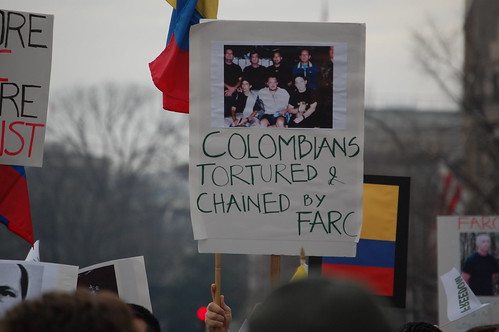
    There were a few thousand people, mostly Colombians from what I could tell, gathered in the chilly drizzle of Freedom Plaza, just a few blocks from the White House;

    The theme of the demonstration was to show opposition to the Armed Revolutionary Front of Colombia, a Marxist terrorist organization that has been murdering innocent Colombians for forty years.

    Many of the people at this rally are refugees of the conflict in their country between a democratic government they elected and the Marxist narco-terrorists of FARC. This is a YouTube of Laura Busche, the main organizer of the event explaining the demonstration in English and Spanish.

    Aside from the hundreds of Colombians being held hostage for ransom (that’s how FARC finances it’s anti-government operations in addition to drug dealings) there are also three Americans being held hostage for propaganda purposes. The Colombians at the rally demonstrated for their release, too.


    Many of the signs the Colombians carried were specific about who are the enemies of democracy in Colombia. For example, this one about Human Rights Watch, which ignores the atrocities of FARC while pressuring the Congress and Bush Administration on supposed Human Rights violations of the Uribe government.

    This one speaks for itself;

    “[Simon] Bolivar dreamed of a great Colombia, not a terrorist Venezuela”

    This turns out to be the author of Padre Hoyos Blog.

    Here’s a YouTube video of the crowd singing the Colombian national anthem. They began their demonstration by singing the US national anthem, though. Another YouTube video of the crowd.

    Try as I might, I couldn’t find any Communists or Socialists on the periphery of the protest like they are at so many others. There were no Code Pink showboats trying to steal the show. There were no Bushitler signs, no signs that called for us to end our war against some nebulous brown people or to release prisoners from invisible camps. It was a genuine outpouring of contempt for FARC and a call for the hostilities to end against the Columbian people.

    Kate at A Colombo-Americana’s Perspective has a worldwide round up of the international demonstrations today. We bumped into each other taking pictures in Freedom Plaza today so I’m sure she’ll have less Anglo-centric view of the event when she gets her pictures posted.

    Gateway Pundit has amazing pictures of the huge crowds in Colombia. Daniel at Venezuela News and Views has pictures of the march in Caracas.

    UPDATE: I was anonimously sent this YouTube link to very well done video record of the event in DC. Pictures and videos of the event in Toronto at Correo Canadiense.