Category: Historical

  • The wayback machine

    Today Real Clear Politics’ Morning Edition very slyly ran an Airpower article from 1972 titled The Press and the TET Offensive: a flawed institution under stress.

    The Tet offensive of 1968 must surely be regarded as one of history’s chameleon campaigns. When the North Vietnamese and Vietcong troops assaulted targets throughout the Republic of Vietnam at the end of January 1968, they expected to trigger an uprising of the South Vietnamese people against their government. Despite some spectacular early successes, the attacks failed. The South Vietnamese did not embrace the cause; thousands of sappers, assault troops, and cadres met their deaths before overwhelming allied counterattacks; and the insurgent infrastructure was so decimated at the end of the fighting that no large enemy offensives could be mounted for four years.

    Nonetheless, the Tet offensive was a turning point in the war, and the North Vietnamese were successful in altering the course of the war far beyond the accomplishments of their army. The American people were shocked that the Vietcong/ North Vietnamese Army (VC/NV A) possessed the strength to make the widespread strikes. In the public clamor that followed, President Lyndon Johnson announced a bombing halt and withdrew from the 1968 Presidential race. The policy of Vietnamization was launched, and many Americans concluded that the war was too costly to pursue.

    It has always been clear that the press played a vital role in this dramatic shift of opinion. It has been evident that dissatisfaction with the war among media opinion-makers helped form an American public attitude of discouragement.

    Written at the very tail end of our war in Vietnam the article details the ignorant and sometimes ideologically duplicitous role the media played in spinning the Tet Offensive. Of course a substantial amount of contemporary scholarship has covered this subject in great depth but to see that, even then, those in the know were well aware of the media’s role in shaping the vital public perception of our wars is quite the juxtaposition of the understanding of the war as portrayed by popular culture. There isn’t much new here but, as we fight out own wars at home against corrupted media institutions, perhaps it will serve as reinforcement of the very real, very tangible, stakes 40 years later.
  • Life of Duty: Battle of the Bulge: Dangerous Encounters

    The folks at the NRA and Brownells send us their latest video in the Life of Duty series, Battle of the Bulge: Dangerous Encounters, the story recounted by Walter Hughes of the confusion in the front lines at the Battle of the Bulge – the 67th anniversary of that epic battle is this week, by the way;

  • NOT Just Another Day.

    Commenter Doc Bailey and I have been swapping emails about this and that. I was rather surprised to learn that we have some things in common even though shifted 40 years in time.

    But he mentioned a coupla things I couldn’t directly relate to so I asked him to expand on them.

    Here is the first, in his words. Thanks Doc.

    —————————-

    Here is my account of 25 June 2007, and the events that happened to me that day. I have to put it out there because people have to know. please understand these events are painful for me to recount.

    It was a normal day like any other. We were all excited to be getting back, but i was exuasted having pulled a 6 hour gaurd shift right before getting off. We all sat around and joked. I could hear people laughing about the game “company of heroes” that Craig and WillieBo had played. They’d gone for 5 hours only to get their asses kickedby the germans. I was fretting over Jubi. I was a little upset, because he was supposed to have been evaced the night before for (what i would find out later) a slipped disk. I had given him morphine right before i thought he was going to go, he didn’t and i was bracing for the ass reeming i was going to get. I had spent all night fretting about a patient, and in the end i was pretty damm tired, everyone else on the otherhand were lively in a way only the loose cannons can be.
    Like always we had details to do, and things that needed to get done. Clean the pisser, sweep and mop, make the “gym” look pretty, Mop the mats, sweep the sleeping bay, and of course pick up cigarette buts. we did these, with the usual amount of bitching complaining and griping. It came time to load up and off we went.

    (more…)

  • A Clinton War

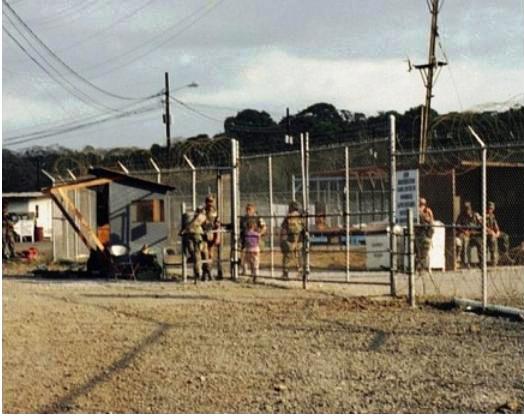
    This is the first I’ve read about this story of an American platoon of infantrymen in Panama in 1994 who tried to put down a riot by Cuban refugees at a containment camp on Empire Range in the Canal Zone. I was in college at the time, so I guess that’s why I missed it. But the whole story is at Stars & Stripes.

    Apparently, Clinton, who lost a gubernatorial bid after Castro flooded Arkansas with refugees during the Mariel Boatlift, so he was gun shy about letting Cubans into the country. Instead he sent hundreds to a concentration camp in Panama, and then, not learning his lessons from Somalia, refused to allow the infantrymen keeping order in the camps to be armed properly.

    When the Cubans rioted over rumors that they were being returned to Cuba, one infantry company of soldiers armed only with batons and plexiglass shields tried to quell the riot of hundreds of Cubans.

    Amerine is now a lieutenant colonel at the Pentagon. He saw combat in Afghanistan in 2001 and led the Special Forces team that brought Afghan President Hamid Karzai into the country.

    “When I saw real war later, at times I actually enjoyed it,” he said last week. “Being shot at was actually sometimes amusing. But when people are trying to stone you to death and people are falling and you’re just holding on to each other and marching through it, that’s totally different. It’s just primordial.”

    That Third Way bullshit really was dangerous. But you should read the whole story.

  • December 7th, 1941

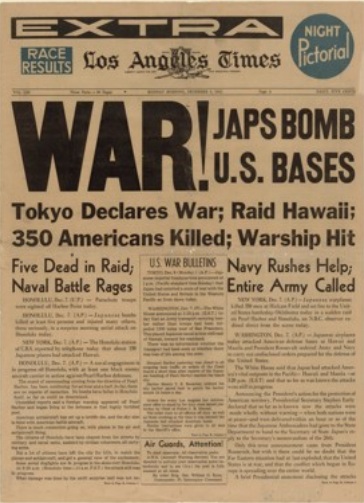
    From the Washington Post, memories are still strong 70 years later;

    Around 8 a.m. on Dec. 7, 1941, Army Private Francis Stueve sat down to breakfast with the rest of the 89th Field Artillery battalion, stationed at Pearl Harbor.

    “As quiet a day as you’ve ever seen,” Stueve remembers now. “Beautiful sunshine, nothing going on.”

    Suddenly, not far from his seat in the dining hall: bang, bang, bang.

    “Somebody says, ‘It’s the Chinese New Year,’ ” he said.

    But then, a bullet broke through the glass window of the dining hall. Another flew just past Stueve and knocked the butter dish off the table.

    Japan’s official declaration of war would come a day later, after the loss of 160 aircraft, 12 ships and 2,300 Americans, according to the Library of Congress — 70 years ago on Wednesday. Stueve, now 94, can describe his experience as if it were happening now:

  • 50th Anniversary

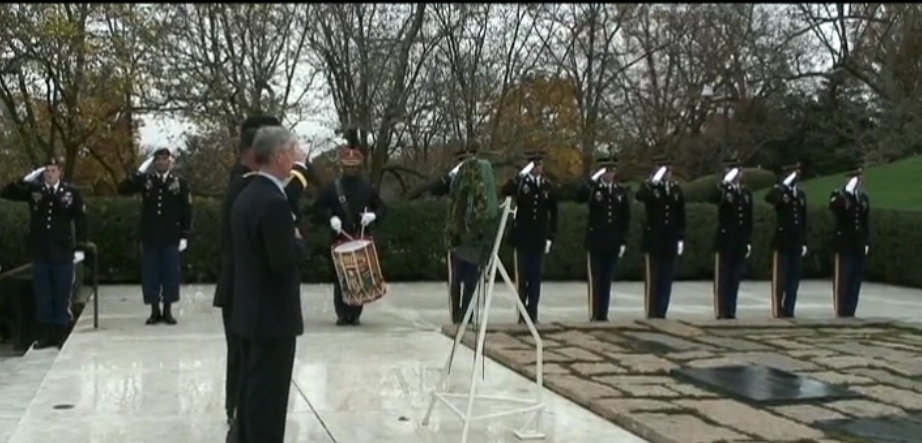
    The Secretary of the Army, my homeboy, John McHugh laid a wreath today at President Kennedy’s gravesite to commemorate the 50th anniversary of the Green Beret according to Stars & Stripes.

    Kennedy approved the green beret after visiting Fort Bragg, N.C., in late 1961. In a message to then-Special Forces Commander Brig. Gen. William P. Yarborough, Kennedy wrote: “The challenge of this old but new form of operations is a real one and I know that you and the members of your command will carry on for us and the free world in a manner which is both worth and inspiring. I am sure the Green Beret will be a mark of distinction in the trying times abroad.”

    Video of the ceremony

    Thanks to Jeff Schogol for the link.

  • LZ Albany: The forgotten battle

    Jeff Schogol, a journalist at Stars & Stripes, sends us a link to his reportage of the 1965 battle at LZ Albany in the Ia Drang Valley of Vietnam the anniversary of which is today. You’ve probably seen the movie “We Were Soldiers” which portrayed part of that battle, but Jeff goes on to tell us the rest of the story.

    …the 2nd Battalion, 7th Cavalry was nearly annihilated. Of the roughly 400 soldiers in the battalion, about 70 percent were killed or wounded.

    “What happened out there was just a shootout in the grass, and man oh man, the enemy was ready for that fight, we were not,” said Joe Galloway, a reporter at the time who co-wrote the book “We Were Soldiers Once … and Young,” upon which the film was based. He was also featured in “Vietnam in HD.”

    You should read the rest and get an idea as to why I’m so proud to have known and been trained by veterans of that battle and the war, in general.

  • Aviation fun

    Since we are on the topic of Navy, I thought that this would fit right in.