Category: Historical

  • Gothic Serpent; 20 years later

    This is republished from 2008, but Operation Gothic Serpent was 20 years ago today. It’s lessons live on and we’re still waging a war that has it’s roots in that battle;
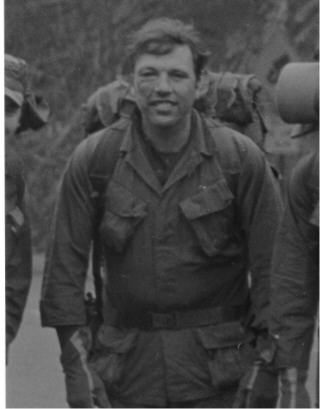
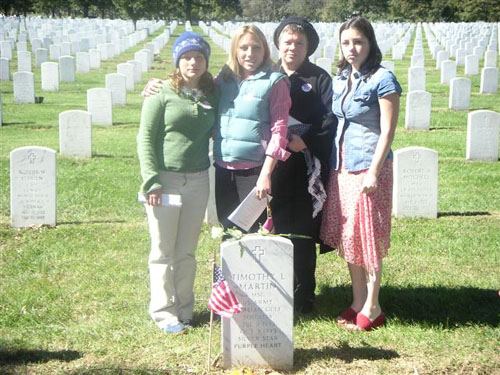
    15 years ago today I lost a dear friend. Tim Martin and I showed up at the Reception Station in Fort Polk Louisiana – I won’t mention the year, the fact that they were still doing Basic and Infantry AIT at Ft Polk should be enough to narrow it down for you. He was a huge, quiet and friendly guy and I felt lucky that we were attached alphabetically through those 16 weeks. I can’t count the times that I’d stumbled and looked up to see his outstretched hand to help me up.

    After those 16 weeks, then four weeks together at the Basic Airborne Course in Georgia then he went to the 2d Ranger Battalion at Lewis and I went to Fort Stewart (yes, the 1st Battalion was actually on Fort Stewart in those days). We went off in our separate directions for four years and then ended up in the same SFQC class at Fort Bragg – alphabetically attached once again. After that six months, we rarely saw each other, but each time we met, the conversation picked up right where it had left off the last time.

    I’ve never met anyone who ever met him that had a bad word for him. He loved the Army, and later I learned he loved his family more.

    I discovered his final fate on October 18th, 1993 while I was leaving my last duty station as a retired soldier when I read the casualty list from what is now known as the “Blackhawk Down” fiasco and found his name.

    I spent the next seven years trying to find out what happened to him. I became a member of the fine Paratrooper.net forum, run by my good friend Mark (back when Mark and I were the only participating members). As the forum grew, I put together bits and pieces of the story and some wonderful soul sent his wife, Linda, my email. She sent me pictures of him which I’ve put on my accompanying website as a memorial to Master Sergeant Tim “Griz” Martin.

    The movie Blackhawk Down did a great job capturing his personality and immortalizing his love for his daughters.

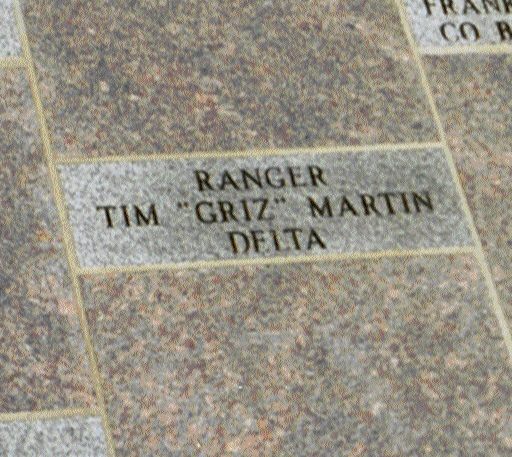
    Another friend at paratrooper.net, 509thTrooper, helped me get Tim a brick at the Ranger Memorial in Fort Benning. Then Trooper went and took a picture of the brick for me.

    I stop and visit with Tim at Arlington at least twice every year on Veterans’ Day and Memorial Day and every Christmas when I make my rounds there. And every day I give thanks for men like Tim Martin who are willing to put everything on the line for the rest of us. But today, especially, I save for Tim. And for Linda and their girls who sacrificed everything for us as well.
    And thanks to COB6 for reminding me to share it with you.
  • Beyond Bravery: an Addendum

    I’ve written a previous article about Captain Witold Pilecki, the Polish Army officer who volunteered to go to Auschwitz in order to gather intelligence and organize the inmates – and who stayed there for over 2 1/2  years, then escaped.  In that article, I noted that a book had been recently written about his time at Auschwitz:   The Auschwitz Volunteer:  Beyond Bravery.  It’s essentially an annotated English-language translation of Pilecki’s expanded 1945 report of his actions and observations while an inmate.

    At the time I wrote my first article about Pilecki, I’d not had a chance to read the book.  I’ve since obtained a copy and read it.

    The book deals almost exclusively with Pilecki’s time at Auschwitz and the period immediately following his escape.  It is not an easy book to read, nor is it a particularly enjoyable one.

    Find a copy and read it anyway.

    You owe it to yourself to force yourself to read it.  You also owe that to the millions who perished during the Holocaust – and to those who perished in other genocides and in other state-sponsored, industrial-scale organized murder campaigns that have occurred throughout human history.

    You will be appalled, amazed, disgusted – and uplifted. While reading the book, often you’ll be all of these at once.

    A sample:  here is an incident Pilecki reports from his time at Auschwitz during the summer of 1941.  The incident occurred after three inmates were discovered to have escaped.  Policy at the time in Auschwitz was to execute 10 other prisoners from the escapee’s “block” for each individual who attempted escape, presumably to act as a deterrent to future attempts.

    A “death selection” was held immediately following the roll call in which an escapee’s absence had been noted.

    The Camp Commandant and his retinue arrived in front of the block in which the escapee had been living, now standing in ten ranks, and walking down a rank he would point to inmates who appealed to him, or maybe to those who did not.

    This rank would then take “five paces forward” and the whole retinue then walked down the next rank.

    Some ranks had several people picked; others had none.

    Those who looked death bravely in the eye were usually not chosen.

    Not everyone could take the tension, and sometimes one would run forward, behind the inspecting team’s back, to the rank already inspected; these types were usually spotted and taken off to their death.

    It once happened that a young man was chosen, whereupon an old man, a priest, stepped out of the ranks and asked the Camp Commandant to take him and release the young man.

    This was a powerful moment and the block froze in amazement.

    The Commandant agreed.

    The heroic priest went to his death and the other inmate returned to the ranks.

    The translator, Jarek Garlinski, adds the following footnote:

    This was the famous case of Father Maksymilian Kolbe, who took the place of Franciszek Gajowniczek, who had a family.  Afterwards, camp authorities more or less left Gajowniczek alone and he survived.

    Father Kolbe was canonized by Pope John Paul II in 1982.


    “We should thank God that such men lived.”

  • History Rediscovered

    Most TAH readers have heard about Joshua Chamberlain, Commander of the 20th Maine and one of the many heroes at Gettysburg. Most probably also know he was awarded the Medal of Honor for his heroism that day.

    However, there’s a bit more to that story. And that little bit of extra was recently re-discovered.

    Chamberlain’s first Medal of Honor was awarded to him late in life, in 1893. In 1904, Medal of Honor was redesigned. Previous recipients were issued a new medal, but were allowed to retain the previous one if they desired (they were not allowed to wear both simultaneously). Chamberlain was still living and was issued a new Medal of Honor.

    Chamberlain’s new-issue Medal of Honor is on display at Bowdoin College (Chamberlain served as President of Bowdoin for years prior to his retirement from politics). However, for many years the whereabouts of his original were not known.

    Chamberlain’s original Medal of Honor has been located. It was found in a book purchased at a church sale following the death of his granddaughter. His granddaughter donated her estate to her church on her death in 2000. The medal was in one of the books later sold at a church fundraising sale.

    The medal was returned to the Pejepscot Historical Society in Brunswick, Maine by the purchaser of the books. It has been authenticated as genuine.

    Plans for public display have not yet been announced.

  • Beyond Bravery

    Everyone in our military volunteers to perform hazardous duty if and when ordered.  We all did that when we raised our hand and took that oath on enlistment or commissioning.

    Yet still, there are limits to what it’s reasonable to ask of anyone.  How would you react if someone came up with a mission that required an individual to:

    • allow themselves to be captured;
    • be imprisoned in a notorious concentration camp;
    • organize internal resistance and a spy network inside that camp;
    • send back regular reports of camp conditions;
    • stay there for 2 1/2 years; and
    • figure out how to escape if and when they ever wanted to come home.

    Certainly few would propose such a mission for themselves or any of their subordinates.  Indeed, on hearing such a proposal I’d guess most of us would probably react with some variation of the coarse line from the old Cheech and Chong routine about kamikaze pilots:  “You outa you f**king mind!”

    Now assume that someone had actually done the above.  How many of us believe that same individual would then afterwards:

    • voluntarily go behind enemy lines yet again to take part in an insurrection;
    • survive being captured a second time and held captive for another 9 months;
    • return to full duty yet again after being released; and then
    • voluntarily go behind enemy lines yet another time – this time to serve as a spy?

    Most of us would probably regard any story containing such a collection of accomplishments the plot outline for a horrible spy novel.  That is, we’d say it was so ridiculously preposterous as to be completely unbelievable.

    Except it isn’t preposterous.  It actually happened.

    And the place to which this man allowed himself to be sent and imprisoned for 2 1/2 years?  It was called “Auschwitz”.

    (more…)

  • Powstanie Warszawskie

    I’ve written an earlier article about a relatively unknown battle of World War II – the Warsaw Ghetto Uprising.  However, that was not the only great tragedy to befall Warsaw during World War II.

    A bit over 15 months later, a second and larger uprising occurred in Warsaw – the Warsaw Uprising.  Like the Warsaw Ghetto Uprising, it is today not well known.

    But unlike the Warsaw Ghetto Uprising, the later Warsaw Uprising was not simply a choice between dying in place and dying in a Nazi extermination camp.  While it was a desperate venture likely to end in failure, it was nonetheless a bona fide effort to liberate the city from Nazi control.

    It failed because the anti-Nazi Polish forces were callously abandoned – by some of their supposed Allies.  Soviet forces were at the time less than 10 miles away, in the eastern suburb of Wolomin.

    Until it was far too late, they made no attempt to assist.

    (more…)

  • Angels and Oxcarts – Addendum

    For what it’s worth:  I’ve finished reading the material found at the link in my previous article on the subject.

    Yeah, it was worth losing some sleep.  All I can say is . . . wow.  Just wow.

    • The operators:  package, granite and/or stainless, size XXL.
    • The designers and administrators:  simply magnificent.
    • The machinery:  absolutely awe-inspiring.

    If you have an interest in the history of aviation, intel, or photography – you’d do a helluva lot worse than to spend a day or two reading through that material.  It’s 400 pages plus, and the material redacted amounts to maybe 5 or 6 pages – much of which is in the last appendix.

    Enjoy.

  • Angels and Oxcarts

    Aviation and intel buffs probably already know what this article is about from the title.

    The GMU National Security Archive has posted a fascinating declassified document released earlier this year by the CIA.  It deals with the U2 and its successor, the A-12.

    The document is huge (390+ pages), and appears to have minimal redaction.

    Those interested can view the document in PDF format here.  Unfortunately, you’ll have to use torrent to download the whole document at once, or you’ll have to download the chapters individually.

    For those who didn’t already know:  “Angel” was Kelly Johnson’s in-house (e.g., Skunk Works) name for the U2.  “Oxcart” was the name given by the CIA to the project that developed the successor to the U-2, the A-12.

    If you’re drawing a blank on “A-12” – that was the initial, single-seat version of an airframe better known today as the SR-71.

    Amazing.

  • 73rd National Airborne Day

    COB6

    That’s COB6 giving you the six minute warning above.

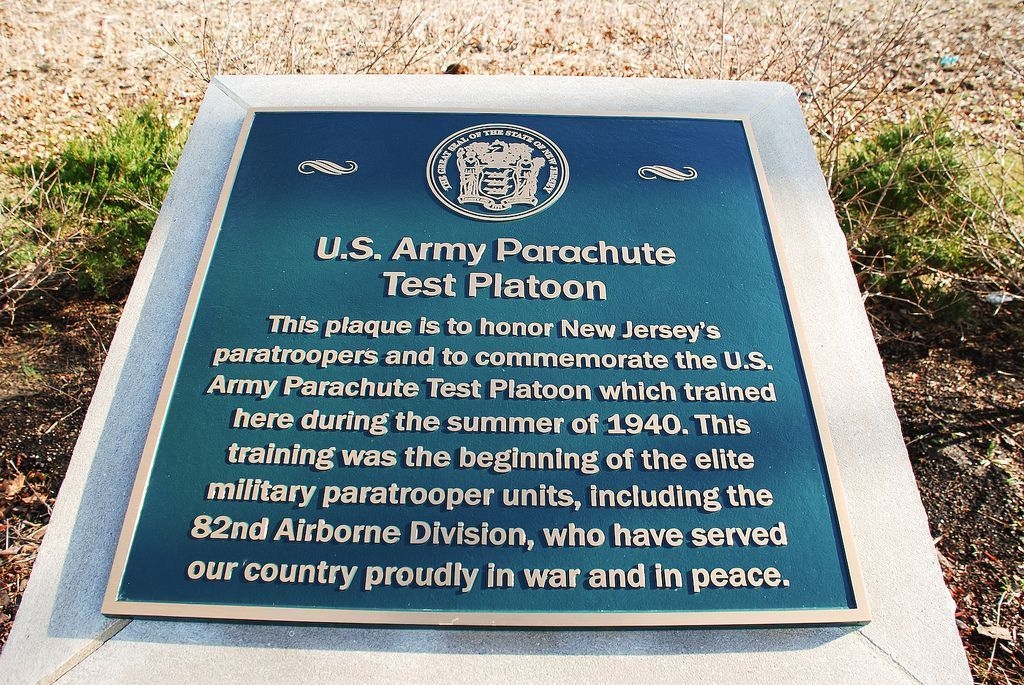
    National Airborne Day is set on the day of the first parachute jump conducted by the Army’s Parachute Test Platoon on August 16th, 1940.

    On the morning of 16 August 1940 the jump began. After the C-33 leveled off at 1500 feet and flew over the jump field, Lt. Ryder was in the door ready to jump. Warrant Officer Wilson knelt in the door waiting to pass the Go Point. When this was reached, he slapped Lt. Ryder on the leg and the first jump was made. Now Number One moved into position. Slap! “Go! Jump!”

    Still no movement.

    It was too late now to jump on this pass. Mr. Wilson motioned Number One to go back to his seat. As the plane circled Mr. Wilson talked to Number One. Number One wanted another chance. Okay, this time we’ll do it. Back into the jumping position and once again, slap!

    Sadly, no movement. Number One returned to his seat.

    Private William N. “Red” King moved into the jumping position in the door. Slap! Out into American military immortality leaped Red King… the first enlisted man of the test platoon to jump out of an airplane. Number One was transferred to another post and anonymity. Now there were forty-seven. Was Number One a coward? I don’t think many experienced jumpers would say so. There are things some men cannot do at a given time. Possibly another time would have been fine. He wanted to. He intended to. He just could not… at least that morning.

    The first US airborne operation was in support of Operation Torch, November 1942, in North Africa when 531 members of the 2nd Battalion 509th Parachute Infantry Regiment flew 1600 miles in 39 C-47s, of which only ten aircraft dropped their pacs, the rest landed because of navigation difficulties and low fuel.

    Ten years ago, 3rd Battalion, 75th Rangers secured an airfield in Kandahar in support of Operation Enduring Freedom on October 19, 2001. On March 23rd, 2003, A Company, 3/75th conducted an airborne operation to secure an airfield in Northern Iraq a few days before the 173rd Airborne Brigade parachuted into Northern Iraq when the Turks wouldn’t allow the 4th Infantry Division to off-load and invade Iraq from their borders.

    In years past, the 82d Airborne Division Association, mostly the DC Chapter, had to lobby to get recognition for National Airborne Day from the Senate every year, until 2009 when the Senate made it permanent.

    We used to get a Presidential Proclamation every year, but for some reason, we haven’t had any since 2008.

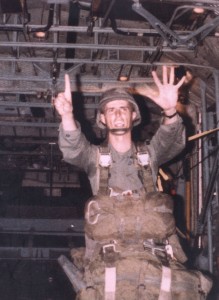
    That’s me, on my ass as usual, in the days before Eric Shinseki;