Firmly detached from reality, Hillary Clinton called the President pathetic for “begging” for lower oil prices among the OPEC nations last week. (Breitbart link);
Category: Economy
-
Spitting on a forest fire
Sometimes, I truly wonder what Democrats are thinking. In today’s Wall Street Journal, Jackie Calmes writes that the Obama and Clinton are trying to get ahead of the economic downturn and make it a campaign issue; (more…)
-
Moody’s; US T-Bills at risk
So if you won’t listen to Republicans that we need to cut spending instead of raising taxes, how about listening to Moody’s (Financial Times link); (more…)
-
NY Times; unemployment rate surges
According to the New York Times, the fact that the unemployment rate “surged” to 5% last week indicates we may already be in a recession;
The unemployment rate surged to 5 percent in December as the economy added a meager 18,000 jobs, the smallest monthly increase in four years, the Labor Department reported on Friday.
Economists viewed the report as the most powerful indication to date that the United States could well be falling into a recessionary downturn. Evidence of widening unemployment heightened anticipation that the Federal Reserve would further cut interest rates this month, perhaps by an unusually large half a percentage point, in a bid to prevent the economy from sliding into the muck.
Well, yes the unemployment rate rose to 5% in December, it’s .4% higher than it was a year ago. That’s hardly a surge. And it’s .4% lower than it was in October 2001 – the month after 9-11 attacks.
New York Times, characteristically misleads it’s readers with a faulty definition of what constitutes a recession;
“This is unambiguously negative,†said Mark Zandi, chief economist at Moody’s Economy.com. “The economy is on the edge of recession, if we’re not already engulfed in one.â€
A recession is typically defined as an extended period of at least several months during which economic activity shrinks and unemployment rises.
Investopedia (from the Forbes Company) defines a recession as;
The technical indicator of a recession is two consecutive quarters of negative economic growth as measured by a country’s gross domestic product (GDP).
“Two consecutive quarters of negative growth” is a bit more precise than “an extended period of at least several months”. If we are “engulfed” in a recession, where’s even one month of negative growth?
The closest event to a recession we’ve had in the last decade happened at the end of President Clinton’s term and at the beginning of President Bush’s (according to Wikipedia);
The U.S. economy shrank in three non-consecutive quarters in the early 2000s (the third quarter of 2000, the first quarter of 2001, and the third quarter of 2001). Strictly speaking, the U.S. economy was not in recession during this period — the common definition being “a fall of a country’s real gross domestic product in two or more successive quarters.”
Those using a less traditional definitions of the term deem part or all of this period to have been a recession and there remains some debate over the start and end dates.
The New York Times must be using the same “less traditional definitions” to write their story. But then the media uses terms they don’t understand to describe a lot of things these days – especially when they’re trying to influence public opinion against Republicans during an election.
Like when James Carville pronounced “It’s the economy, stupid” in the 1992 campaign, although Clinton admitted two years later that his staff knew the economy was recovering and they were afraid to lose an important issue to The Truth.
Similar to the laws of gravity, the laws of economics are governed by simplicity. When the stock market indexes reach new highs, they’re due to come down. When unemployment reaches new lows, it’s bound to go up. When interest rates are at historic lows, they’re going up soon. How hard is that to understand? Record highs and lows are records for reason.
-
A World With Oil at $100
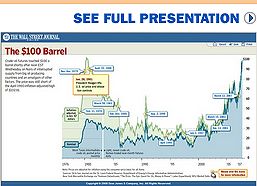
From the Wall Street Journal
At the Wall Street Journal this morning is a front page article that pronounces that oil reached $100/barrel yesterday. The article goes to illustrate how the financial markets have changed in the last ten years as oil’s price increased 10-fold;
The surging price of oil, from just over $10 a barrel a decade ago to $100 yesterday, is altering the wealth and influence of nations and industries around the world.
These power shifts will only widen if prices keep climbing, as many analysts predict. Costly oil already is forcing sweeping changes in the airline and auto sectors. It is intensifying the politics of climate change and adding urgency to the search both for fresh sources of crude and for oil alternatives once deemed fringe.
[Go to graphic.]The long oil-price boom is posing wrenching challenges for the world’s poorest nations, while enriching and emboldening producers in the Middle East, Russia and Venezuela. Their increasing muscle has a flip side: a decline of U.S. clout in many parts of the world.
Steep gasoline prices also threaten America’s long love affair with the automobile, while putting strains on many lower-income people outside big cities, who must spend an increasing share of their budgets just on fuel to get to work.
No one can say for sure whether sky-high oil — part of a price boom in a wide range of commodities, from gold to wheat — is here to stay. But most in the industry agree that a 20-year stretch in which oil was consistently cheap is long gone. The global thirst for oil shows little sign of retreating, and large new discoveries are few. Some in the industry say prices could go far higher; others suspect that speculators — or an economic slump in the U.S. or China — could send prices falling in the near term.
First of all, this “America’s long love affair with the automobile” has long ago passed – back in the 80s when Americans were paying $15,000 for what they tried to convince themselves were luxury cars – but were nothing more than Toyota crap boxes they wouldn’t have twenty-bucks for ten years earlier. America’s love affair is with gadgets in their cars – that’s what car manufacturers are selling these days – watch a car commercial tonight. It’s all about selling voice-recognition MP3 players, DVD players, talking GPS do-hickeys, little buttons that do all of things you could do yourself much easier.
In July 1979, Jimmy Carter promised that Democrats would;
From now on, every new addition to our demand for energy will be met from our own production and our own conservation. The generation-long growth in our dependence on foreign oil will be stopped dead in its tracks right now and then reversed as we move through the 1980’s, for I am tonight setting the further goal of cutting our dependence on foreign oil by one-half by the end of the next decade — a saving of over 4 1/2 million barrels of imported oil per day.
How did Carter promise this goal would be met?
To make absolutely certain that nothing stands in the way of achieving these goals, I will urge Congress to create an energy mobilization board which, like the War Production Board in World War II, will have the responsibility and authority to cut through the redtape, the delays, and the endless roadblocks to completing key energy projects.
We will protect our environment. But when this Nation critically needs a refinery or a pipeline, we will build it.
So what have Democrats done since? Not one oil refinery has been built in the United States since 1977, not one new oil field has been developed. In fact, China and Cuba are exploring and drilling off of our Florida coast. Oil reserves in Alaska remain untouched, oil off the coast of California lies fallow.
George Bush tried to develop oil fields in Alaska five years ago – that oil would be flowing towards our markets this instant, except that Democrats and weak kneed Republicans (many of whom are out of office today) blocked it to save some phantom caribou herds. When energy companies tried to build a wind farm off of Massachusetts’ coast, Jabba the Kennedy and John Kerry blocked the structures so as not to ruin the view from the mansions.
In fact, the Democrats have blocked every meaningful measure to move us away from dependence on foreign energy – except their wasteful “investment” of taxpayer dollars into useless and unproductive “alternate energy” boondoggles. Of course there is no incentive to develop “alternate” sources as long as their stream of free cash into the projects from the government – so the “search” goes on. And Democrats’ promises and posturing continues as well.
But this is an election year – things can change as long as people are willing to accept the truth about Democrats’ intentions.
Jack M at Ace of Spades has the story on the guy who drove the price up – briefly.
-
Happy New Year
A year ago, the media and the Democrats counted President Bush out. He was a lame duck and Congress was going to walk all over him. They were wrong. He kicked their asses while he was kicking al Qaeda’s ass in Iraq. He didn’t do that all by himself – he never lost hope that he was doing the right thing, and he knew a whole lot of us still had faith in his inner strength.
I hope we all learned a lesson – a lesson we’ll all take through the upcoming election season and the challenges we’ll no doubt face overseas and in our own country during 2008. I have faith in the American people to do the right thing this November, just like they’ve done the right thing over the last 200 years. I have faith in our new allies in Old Europe, I have faith in our new Iraqi allies. I have faith in those troops that sacrifice everything for us, asking so little, relatively speaking, in return.
Thank all of you for taking time out of your lives this last year to read my blog and for sending me tips. I hope I’ve lived up to your expectations and, even more, I hope you keep up your good work of keeping this blog and this nation going.
This first one is to all of you, America, and to my new friends across the world who stand with us and with whom we stand.

-
Number One Crapbox distributor
I really don’t understand why Toyota is the number one car manufacturer in the world, other than the fact that they make cheap deathtraps that they market in the third world to people who can barely afford the $9 thousand price tag price on crapbox cars that an American (or a Japanese) buyer wouldn’t look at twice.
On my trips south of our border, I’ve had the occasion to rent and borrow from relatives their various versions of Toyota’s finest. Remember when you could “feel” the floor boards in cars? Remember the tinny sound those imported Japanese cars made when you slammed the door shut? Well, those cheaply made crapboxes still exist in the third world – in fact if you’re nostalgic for those tiny little pickup trucks Toyota used to market here, you can pick up a 2008 version down there.
Toyota’s strategy for selling so many cars in the third world? Cheap spare parts compared to American spare parts. My brothers-in-law all own one of the countless versions and all tell me that the only reason is the price of spare parts. They all admit that American cars are more dependable and easier to fix, but down there, people actually BUY cars and those cars have to last ten or twenty years.
I rented a 2006 Toyota Camry in Panama last year and it was nothing like an American market Camry – except it’s shape. The doors were paper thin, the engine sputtered whenever the vehicle came close to 60/mph. You could almost feel the road through the floorboards. The same with my brother-in-law’s brand new Yaris this last year and the Nissan we rented two years before.
So, even though they may be selling a product in the US somewhat equal to the American equivalent, they can sell it cheaper here because they sell those crackerboxes on wheels in the third world, then steal marketshare in the US on the backs of those brown people.
Another thing I have against Toyota is the fact that next to the pill pushers of Cialis and Viagra, Toyota dealers are my biggest spammers.
-
Whatever Happened to “Talking Down the Economy”?
Remember that charge leveled by the Gore campaign in 2000? Anytime (then Governor) Bush mentioned that the economy was slowing and something needed to be done, the Gore campaign and the msm would caterwaul about how Bush was “Talking DOWN the Economy.”
Now, years later, talking down the economy is apparently no longer a concern.
See these two stories
The first is about how the GDP growth in the third quarter marked the fastest pace of growth since the third quarter of 2003.
While the second tells us that this can’t last and will, apparently all end in tears.So, are Republicans vested with some sort of economy slowing super power, or what?