Category: Blue Skies

  • Martin Milner passes

    Martin Milner passes

    martin milner

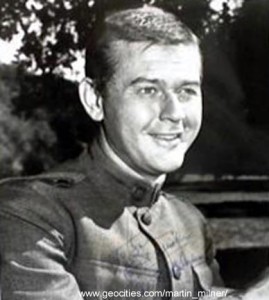
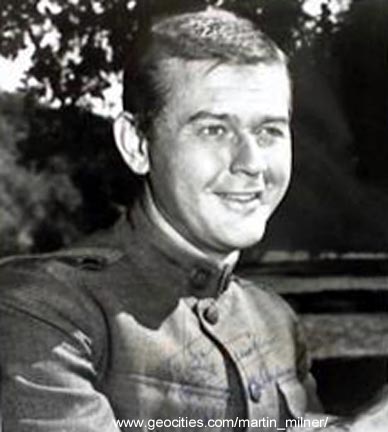
    The sad news comes to us that actor Martin Milner, best known for his portrayal of officer Pete Malloy in the Jack Webb series “Adam 12” has passed at the age of 84.

    Of course, Milner enlisted in the Army during the Korean War like most of his generation, but before he’d enlisted in 1952, he’d already appeared in movies as a Marine in “The Sands of Iwo Jima” (1949) and as a sailor in “Operation Pacific” (1951).

    In the Army he was assigned to Fort Ord, California, working in Special Services and making training films, where he met fellow soldier, Clint Eastwood, who reportedly encouraged him to pursue a career in film.

  • Ben Kuroki passes

    Ben Kuroki passes

    Ben_Kuroki

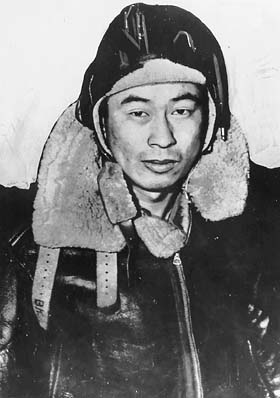
    From the New York Times comes the sad news that Ben Kuroki, the only aircrew member of Japanese descent to fly in his bomber over Japan during the Second World War has passed at the tender age of 98. According to the story, when the Nebraskan first tried to enlist for the war, he was rejected by the recruiter, so Kuroki went shopping for a recruiter who would sign him up.

    He flew missions over Europe for most of the war, Kuroki’s plane went down once in Morrocco and him and his fellow crew members were captured, but they escaped and returned to the business of war.

    [T]here were only a few Japanese-Americans who somehow slipped through the Army Air Forces’ enlistment ban and served in combat crews. And Sergeant Kuroki’s commanders had rejected his request to fly in raids over Japan, evidently reflecting a fear concerning the fate that would befall a Japanese-American, and any family members in Japan, if captured.

    But War Secretary Henry L. Stimson, citing Sergeant Kuroki’s “splendid record” in air combat, made an exception for him at the behest of a Nebraska congressman.

    “I have the face of a Japanese but my heart is American,” Sergeant Kuroki was quoted as saying by The Omaha World-Herald when he learned of the decision.

    He became a gunner in the 505th Bombardment Group, flying in B-29s based on the island of Tinian, and participated in 28 raids over Japan, including the firebombing of Tokyo in March 1945. His fellow crew members honored him by naming their bomber “The Honorable Sad Saki.”

    According to the Times, when he was in the States, during the war, he would tour the internment camps and speak to the detainees about service and patriotism, you know despite where they found themselves.

    Kuroki earned three Distinguished Fly Crosses, the Distinguished Service Medal and six Air Medals.

  • Rest In Peace, Forgotten Angel

    Rest In Peace, Forgotten Angel

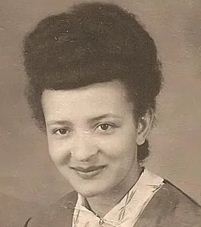
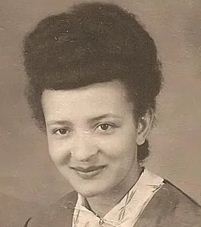
    In 1921 a child was born in the Belgian Congo. The child was a girl; her name was Augusta Chiwy.  She was the daughter of a Belgian veterinarian and his wife, who was native Congolese.

    At age 9, Chiwy moved to Belgium with her family – to Bastogne, her father’s hometown. In 1940, she turned 19. She went to the town of Leuven, and studied nursing.

    She was living in Belgium on 16 December 1944. She returned to Bastogne to be with her family during the Chiristmas holidays.

    Some would say that wasn’t the best choice she could have made given later circumstances. However, a number of US GIs would disagree.

    We all know what happened at Bastogne during the Battle of the Bulge. However, what’s not as well known is what happened in one of their medical stations – specifically, that of the 20th Armored Infantry Battalion, 10th Armored Division.

    That aid station was commanded by John Prior. It was critically short of medical personnel.

    Ms. Chiwy had been attending wounded civilian and military personnel with her uncle, a Belgian doctor. However, on 21 December she and a friend, Renée Lemaire, volunteered to serve at the 20th Armored Infantry’s aid station. She treated numerous wounded, and reportedly wore the US Army’s uniform and assisted in retrieving wounded from the field.

    Because of her race, some US soldiers were reluctant to allow Chiwy to provide them treatment. Indeed, Army regulations of the time actually forbid treatment of white soldiers by black nurses. (Yeah, that’s pretty stupid – but 1944 was a different, more prejudiced time.) The aid station commander put a stop to that nonsense; he told any troops who objected that Chiwy was a volunteer, and that their choices were “You either let her treat you or you die.”

    On 24 December, a German 500lb bomb hit the aid station. Chiwey and her friend were both working there at the time.

    Lemaire was killed; so were 30 wounded troops. Lemaire became widely known afterwards as the “Angel of Bastogne”.

    Chiwy was working with Lemaire in the same building, but was blown through a wall by the force of the explosion vice being killed. She was not seriously hurt. She returned to duty and continued to serve in the Battalion’s aid station until the Siege of Bastogne was lifted.

    It’s estimated that Chiwy’s care was instrumental in saving the lives of more than 100 US soldiers.

    Later, Chiwy continued her career in nursing. She worked at a hospital specializing in spinal injuries. She married a Belgian soldier. They had two children.

    Chiwy was reluctant to speak of her wartime experiences. She was thought by many who knew of her wartime service to have died in Bastogne. While researching a related project, British historian Martin King heard of her.

    He located her in a nursing home IVO Brussels. After extensive cross-checking with Prior’s wartime diaries, King confirmed that she was indeed the same lady who’d served with him at Bastogne.

    In 2011, the Army presented Chiwy the Department of the Army Civilian Award for Humanitarian Service. Earlier that year, she had been knighted by Belgium’s King Albert II.

    Augusta Chiwy died on 23 August 2015, aged 94. She was laid to rest this past Saturday. I’m guessing she was indeed in heaven well before the Devil knew she was dead.

    Rest in peace, angel. You certainly deserve that.


    Sources:

    http://www.nytimes.com/2015/08/26/world/europe/augusta-chiwy-forgotten-wartime-nurse-dies-at-94.html

    http://www.stripes.com/news/army-honors-wwii-nurse-for-aiding-u-s-troops-during-battle-of-the-bulge-1.163301

    http://www.newser.com/article/04abf43f14ea45e3bff7bdcc2342392b/belgium-lays-to-rest-heroic-nurse-who-saved-countless-american-lives-in-battle-of-the-bulge.html

    https://en.wikipedia.org/wiki/Augusta_Chiwy

    http://www.syracuse.com/kirst/index.ssf/2015/08/augusta_chiwy_dies_legendary_nurse_helped_syracuse_doctor_tend_wounded_at_the_bu.html

    A documentary film about Chiwy based on King’s research and efforts to find her can be viewed on YouTube.

  • Lieutenant General Frank E. Petersen Jr. passes

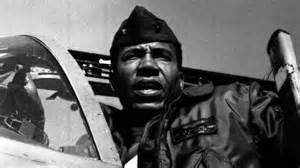
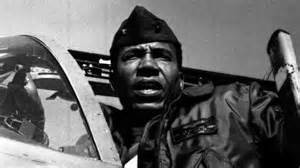
    Lieutenant General Frank E. Petersen Jr. passes

    Frank E. Petersen Jr.

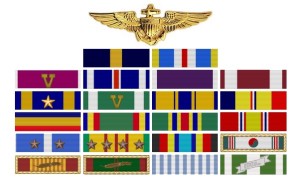
    Fox News reports the sad news that Lieutenant General Frank E. Petersen Jr., the first Black Marine Corps aviator has passed at the tender age of 83. Peterson began his career as a seaman and a electronics technician in 1950, then he entered the Naval Aviation Cadet program which he completed in 1952, in time to serve as a pilot in the Korean War and he went on to serve in the Vietnam War in 1968. In 1979, he was promoted to Brigadier General and he became the first Black general in the Marine Corps. Peterson retired from the Marine Corps in 1988.

    Peterson's awards

  • Remembering Master Sergeant Corey Hood

    Remembering Master Sergeant Corey Hood

    Hood memorial service

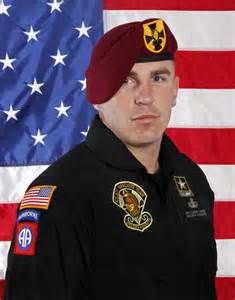
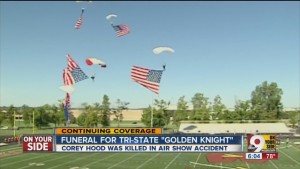
    Posthumously-promoted Master Sergeant Corey Hood, an Army Golden Knights parachutist, who died in a parachuting accident last week, was remembered on Lakota West High School football field by friends and family. From the Associated Press, his military parachute teammates parachuted into the memorial service;

    The military skydiver, joined by a team of professionals, fulfilled the wish of U.S. Army Master Sgt. Corey Hood, who had long wanted to parachute on to the field where he played as a youth, the Cincinnati Enquirer reported.

    “He was highly competitive and didn’t want to lose at anything,” Larry Cox, his high school football coach, told the hundreds of mourners who gathered in the stands at Lakota West High School. “I think it correlated with why he became such a great soldier.”

    From WCPO;

  • Army Golden Knight parachutist dies in collision

    Army Golden Knight parachutist dies in collision

    SFC Corey Hood

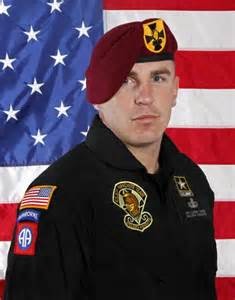
    The Chicago Tribune reports that Sergeant First Class Corey Hood an Army parachutist with the Army’s Golden Knights died yesterday, National Airborne Day, after he sustained injuries in a mid-air collision with a Navy parachutist on Saturday;

    He and a member of the Navy Leap Frogs jump team appeared to collide in the air after their teams performed a maneuver during a jump. The Leap Frogs member suffered a broken leg. The team members had formed a circle by holding hands in the air, then broke apart in different directions. It appears Hood and the Leap Frogs member collided at that time.

    SFC Hood then struck an apartment building. He went into surgery for a head injury.

    The Tribune reports that Hood survived five tours of Afghanistan and Iraq during his ten years of service.

  • Domo Arigato, Mori-sama

    On 6 August 1945, the US dropped the “Little Boy” nuclear bomb on Hirsoshima.  Within days, 140,000 Japanese had died at Hiroshima.

    So had 12 Americans.

    The 12 Americans who died at Hiroshima were POWs. They were all US airmen who had been captured after their aircraft had been shot down.

    They were being held POW in Hirsoshima on the day of the bombing. They’d all arrived there within the previous two weeks.

    Most of the US POWs killed at Hiroshima died immediately.  A few – the number seems to be 2 – initially survived, but died within days of the bombing from radiation sickness.

    The fact that US POWs died at Hiroshima wasn’t publicly acknowledged until the 1970s. Even today it’s not a widely known fact.

    That’s unfortunate. But one individual – an individual who you might not expect – has ensured those POWs end will be properly remembered.

    . . .    

    Shigeaki Mori is a hibakusha – a survivor of the nuclear bombings of Japan. He was a resident of Hiroshima on 6 August 1945. At the time, he was an 8-year-old schoolboy.

    Originally Mori attended a school across the street from the Chugoku Military Police HQ in Hiroshima. The Chugoku Military Police HQ was where the US POWs were held captive; it was approximately 820m from ground zero.

    Less than a week before the bombing, Mori was transferred to another school about 1.5 miles away from ground zero. That chance occurrence almost certainly saved his life.  All US POWs that were not killed outright during the Hiroshima bombing died within a week of radiation sickness.

    When the bomb detonated, Mori was crossing a bridge.  He was blown from the bridge into the water.  He was exposed to radiation then, and afterwards.

    However, unlike many in Hiroshima Mori was not fatally injured.  Mori survived, and grew to adulthood.

    He became a historian.

    During the 1970s, Mori learned that 12 US POWs had died in the Hiroshima bombing. As a hibakusha, one might expect Mori to have muttered something like, “Serves them right” – and gone on with his life.

    He did not. Mori also learned something else: none of those US POWs had been formally recognized as Hiroshima dead.

    Japan maintains a register of those who were killed at Hiroshima and Nagasaki, or who later succumbed to delayed effects from the bombings. This register is managed and maintained by the Mayor of Hiroshima.

    Much like the US Vietnam War Memorial, additional names are added as additional individuals are confirmed to have died in the bombing – and as people continue to die from effects related to the bombings. These names are added to the register on the anniversary of the bombing following either documentation of their death during the bombing or their later death from the bombing’s aftereffcts.  As of 6 August 2011, the register contained 275,230 names.

    Initially, all names on the register were Japanese; the POWs who died at Hiroshima were not listed there.  That was the case in the 1970s.

    Mori decided that the 12 Americans who had died at Hiroshima due to the bombing deserved the same recognition. Over a period of many years, Mori worked to make that a reality.

    The process was a slow one. Today, the registration of persons as Hiroshima dead requires documentation – as well as a request from the family of the deceased. Mori thus had to locate and contact the surviving family of each of the 12 US POWs killed at Hiroshima, then convince them to request their deceased relative be listed on the register.

    In 1998, Mori obtained permission and erected a small copper memorial plaque at the remains of the building at which the US POWs had been housed. In 2002, he completed the registration process for 2 of the US POWs killed at Hiroshima; their names were formally entered in the register of Hiroshima dead.

    By 2009, Mori had completed the registration process for all 12 US POWs killed at Hiroshima. Their names and photographs are now on file at the Hall of Remembrance, located at the Hiroshima National Peace Memorial Hall for the Atomic Bomb Victims.

    This year, Mori achieved another of his aims. At his invitation, Susan Archinski – a niece of Airman 3d Class Normand Brissette, who had been shot down and taken prisoner 10 days before the bombing, and who died at Hiroshima on 6 August 1945 – came to Japan.  This August, she and Mori visited Hiroshima.  I’m certain they each said a prayer for the souls of those US POWs killed at Hiroshima, and for the others who died that day as well.

    . . .

    Any member of the military comes to terms with the possibility of death, and accepts that possibility.  However, each member of the military fears being lost and forgotten. Thanks to Shigeaki Mori – a survivor of the Hiroshima bombing – the 12 US POWs who also died at Hiroshima will never be forgotten.

    Rest in peace, men.

    And though thoroughly inadequate:  Domo arigato, Mori-sama.

    . . .


    Author’s Notes

    1.   The following US POWs died at Hiroshima on 6 August 1945 or died of radiation sickness within days afterwards.

    Captured crew of USAAF B-24 Lonesome Lady:

    • Co-pilot, 2LT Durden W. Looper, 22, of Arkansas
    • Bombardier, 2LT James M. Ryan, 20, of New York
    • Radioman, SGT Hugh H. Atkinson, 26, of Washington State
    • Nose turret, CPL John A. Long, Jr., 27, of Pennsylvania
    • Engineer, SGT Buford J. Ellison, 22, of Texas
    • Ball turret, SSG Ralph J. Neal, 23, of Kentucky

    Captured crew of USAAF B-24 Taloa:

    • Pilot, 1LT Joseph E. Dubinsky, 27, of Pennsylvania
    • Gunner, SSG Julius Molnar, 20, of Michigan
    • Gunner, SSG Charles O. Baumgartner, 30, of Ohio

    Captured crew of USN SB2C Helldiver from the USS Ticonderoga:

    • Pilot, LT Raymond L. Porter, 24, of Pennsylvania
    • Gunner, PO3 Normand R. Brissette, 19, of Massachusetts

    Captured crew of USN F6F Hellcat from the USS Randolph:

    • ENS John J. Hantschel, 23, of Wisconsin

    2.  In 2008, Mori located wreckage from the US B-24 Taloa that had escaped Japanese wartime confiscation as scrap metal.  With assistance from the Asahi Shimbun Mori located and arranged to send portions of that wreckage to a surviving family member of SSG Charles O. Baumgartner, and to a close living friend of SSG Julius Molnar, as tangible keepsakes.   Both of these individuals died at Hiroshima.

    As of last report, Mori was still searching for relatives of the remaining Taloa crew members.

    3.  In addition to the 12 US POW’s killed at Hiroshima, one US soldier was being held POW at Nagasaki on 9 August 1945.  He survived the bombing.

    This individual was Joe Kieyoomia, a member of the 200th Coastal Artillery Unit, US Army – and a Navajo.  It is believed that the concrete walls of his cell provided enough protection to spare him serious injury from both the Nagasaki bomb’s blast and radiation.

    Kieyoomia had been taken prisoner in the Philippines in 1942. Before the Nagasaki bombing, he had survived the Bataan Death March; 3 1/2 years of captivity as a POW, including torture (the Japanese initially thought he was a Japanese-American vice Navajo); survived additional torture when he could not help the Japanese break the Navajo Code Talker codes.  He then survived both the Nagasaki bombing and being abandoned for 3 days afterwards.

    Kieyoomia died in 1997 – at age 77.  He was the only US POW who was also a recognized hibakusha.


    Sources:

    http://www.stripes.com/news/special-reports/world-war-ii-the-final-chapter/wwii-victory-in-japan/after-fight-to-recognize-hiroshima-s-american-victims-historian-meets-one-of-their-relatives-1.360327

    http://www.stripes.com/news/three-u-s-pows-added-to-roster-of-hiroshima-deaths-1.93398

    http://www.stripes.com/news/hiroshima-historian-returns-fragments-of-shot-down-bomber-to-loved-ones-in-u-s-1.85323

    http://www.stripes.com/news/historian-tells-of-americans-pows-killed-at-hiroshima-1.38375

    http://ajw.asahi.com/article/behind_news/social_affairs/AJ201205160089

    https://en.wikipedia.org/wiki/Joe_Kieyoomia
  • 22 More Are Properly Buried

    I’ve written before about the Missing In America Project (MIAP). (So had Jonn, but I apparently had forgotten his earlier article when I wrote mine.)

    MIAP IMO certainly seems to be an organization doing good things. And I apparently missed the fact that they recently “done good” once again.

    This time, MIAP’s good work occurred in Utah.  They were instrumental in arranging the interment of 22 unclaimed veterans’ cremains at Utah Veterans Memorial Park.  The oldest remains in that group had been unclaimed since 1996.

    The number of unclaimed veterans for which MIAP has arranged a dignified burial is now approaching 2,500. Unfortunately, MIAP also estimates that there are roughly 400,000 unclaimed veterans’ cremains nationwide – so their work is far from done.

    My previous article gives links a bit more information about MIAP, including a link to last year’s IRS 990 and what Guidestar has to say about them. FWIW: my impression from looking at those is that they’re actually using their limited resources well. CFC also allows them to participate.

    Kudos to the group, and may they keep on finding – and arranging internment of – unclaimed veterans ‘ remains.

    Everyone deserves a proper burial. Kudos to MIAP for seeing that these 22 vets received exactly that.