When I left the military in 1994, there was one camouflaged pattern for all of the services – the “woodland” pattern, and we also had a desert uniform for people who were living in the desert. But as the Washington Post reports, the Pentagon has ten different patterns that it’s paying for with tax payer dollars;
Today, there is one camouflage pattern just for Marines in the desert. There is another just for Navy personnel in the desert. The Army has its own “universal” camouflage pattern, which is designed to work anywhere. It also has another one just for Afghanistan, where the first one doesn’t work.
Even the Air Force has its own unique camouflage, used in a new Airman Battle Uniform. But it has flaws. So in Afghanistan, airmen are told not to wear it in battle.
In just 11 years, two kinds of camouflage have turned into 10. And a simple aspect of the U.S. government has emerged as a complicated and expensive case study in federal duplication.
Somehow, people think that their uniform is an essential part of fighting wars. It really isn’t. Especially if you look at the Navy’s and Air Force’s uniforms which don’t hide anyone from anything. The Stars & Stripes has a chart which tracks the uniform changes over the last few years;
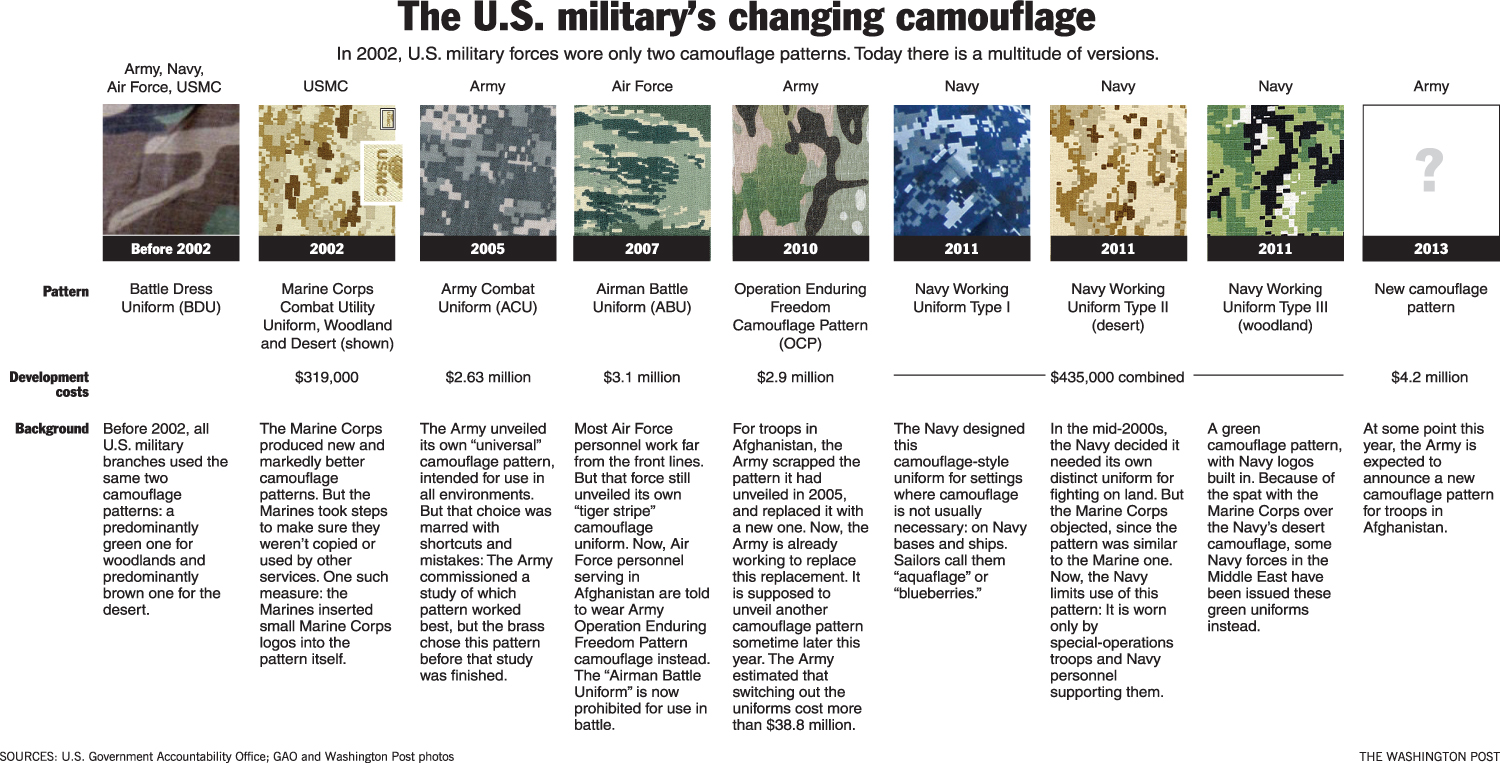
The Pentagon has spent billions of dollars going through the motions of picking “the best” pattern for their purposes and then changing their minds. But it’s all so much mental masturbation, since most of the wars we fought, the troops didn’t wear any camouflaged pattern and they still won the actual battles. The services are like a bunch of teenagers fretting over what cool new clothes they want to wear for the first day of school. But in the end, troops’ uniforms in combat all end up the same color – whatever color the dirt is in their particular area of operations. So all of that exercise that the pogues at Natick Labs go through has no real impact on the battlefield, but their jobs are secure for the next billion-dollar “back-to-school” shopping spree.