Category: Big Army

  • Those disappearing brigades

    So after I wrote the piece yesterday about the Army cutting 12 combat brigades, General Ray Odierno announced the exact location of the units that will disappear. From Stars & Stripes;

    Odierno said 10 BCTs would be cut from 10 Army installations: Fort Bliss, Texas; Fort Bragg, N.C.; Fort Campbell, Ky.; Fort Carson, Colo.; Fort Drum, N.Y.; Fort Hood, Texas; Fort Knox, Ky.; Fort Riley, Kan.; Fort Stewart, Ga.; and Joint Base Lewis-McChord, Wash. Another two BCTs used for soldier training will also be cut, officials said.

    An eleventh BCT in a location still undecided will be cut in the future, Odierno said.

    In other words, everyone is losing a trigger-pulling brigade. But luckily, there aren’t fewer flag officer spots, so we have that bright spot – the generals saved all of their jobs and lost only a few (comparatively) sergeant major positions. But there are still plenty of staff positions where everyone can hide out from those pesky command assignments. We’re going to need those staff positions since, in the middle of a war, our priorities have shifted to more important issues, like helping gays find their place among regular people, combating sexual assault committed by staff officers, and lowering the standards for the fewer combat soldiers so women can join their ranks.

    The Washington Times reports that Congress is promising that this castration of the combat forces is just the beginning;

    Rep. Howard P. “Buck” McKeon, California Republican and chairman of the House Armed Services Committee, said his panel will review the Pentagon’s decision.

    “We will carefully examine the implications of this initial restructuring, but we all must understand that this is only the tip of the iceberg. Much deeper cuts are still to come,” he said.

    Yeah, because there still might be some people left after this round of cuts who might have the necessary experience to fight our next war in leadership positions, so we need to nip them in the bud. I sure hope or next enemy has the courtesy to give us a nine-month advance notice so we have time to build the ranks of combat soldiers from the empty shell this Congress and Administration is leaving the next generation.
  • Army’s deep cuts

    Chief Tango sends us a link from Stars & Stripes which reports that the Army is making even more cuts to the security of our nation by slashing 12 combat brigades from the force and slashing manpower by nearly 10%;

    By reducing the number of headquarters and increasing the number of battalions per brigade, Odierno said the Army is “increasing our tooth to tail ratio.” He added that while there would be some civilian job losses, many civilian positions are in place to support the basic functions of a post, and won’t be affected.

    Odierno said 10 BCTs would be cut from 10 Army installations: Fort Bliss, Texas; Fort Bragg, N.C.; Fort Campbell, Ky.; Fort Carson, Colo.; Fort Drum, N.Y.; Fort Hood, Texas; Fort Knox, Ky.; Fort Riley, Kan.; Fort Stewart, Ga.; and Joint Base Lewis-McChord, Wash. Another two BCTs used for soldier training will also be cut, officials said.

    An eleventh BCT in a location still undecided will be cut in the future, Odierno said.

    So history is repeating itself, once again. Of course, we’ll have the reserve and Guard units to fill the holes, right? As long as the Guard and reserves don’t mind spending almost as much time in uniform as they would if they were active, then I suppose, retention and recruiting will suffer. Well, luckily, we can still depend on the draft, right? I’m sure no one would avoid the draft, despite the fact that the government has been largely unwilling to deal with draft dodgers and deserters in any meaningful manner.

    And, oh, yeah, I’m sure the impact won’t be felt by communities who largely depend on military presence like Fort Drum & Jefferson County, NY. Although the defense issues are primary, the economy will also take a hit. I wonder if we can get the Constitution changed so we can get four more years out of this administration.

  • House tells Pentagon “Pick one”, well…eventually

    Chief Tango sends us a link to the Washington Post which reports that the House has voted to make the services pick a camouflaged uniform to replace the ten different patterns that they currently use;

    The measure passed by a vote of 315 to 108.

    That idea needs the approval of the Senate, which is crafting its own version of the defense authorization bill. On Thursday, the Senate Armed Services Committee approved a measure that would also require the Pentagon to choose just one camouflage uniform, a committee spokeswoman said. The Senate’s time frame was unclear, however: A summary of the bill released by the Armed Services committee says the change should happen “eventually.”

    Enyart’s provision would require all armed services to share the same camouflage uniform by October 2018. It would still allow for variations in that shared uniform, adapted to different environments like woodlands and desert.

    Although it makes sense, I don’t see any of the services giving any ground to any other service. The Marines didn’t even want to share MarPats with the Army last year so I can imagine what kind of juvenile shit we’re going to see over the next five years while they sort this out – or spend a couple of billion bucks more coming up with a pattern the fashionistas in each service will approve.

  • Happy 238th Birthday, US Army

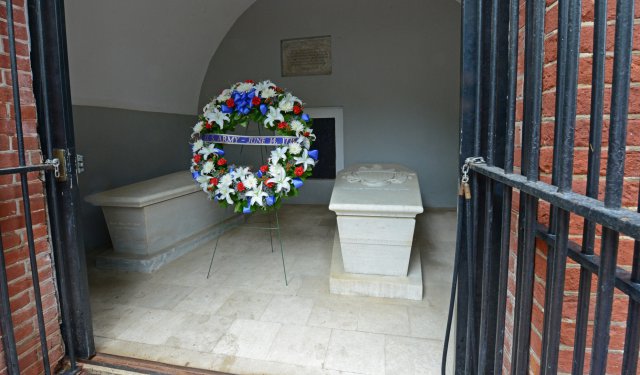
    Washington Tomb 238th birthday

    This year’s ceremonies for celebrating the 238th birthday of the US Army began by placing a wreath at the tomb of George Washington. our first commander, now General of the Armies, promoted to his sixth star on this date in 1976. From the Army News Service;

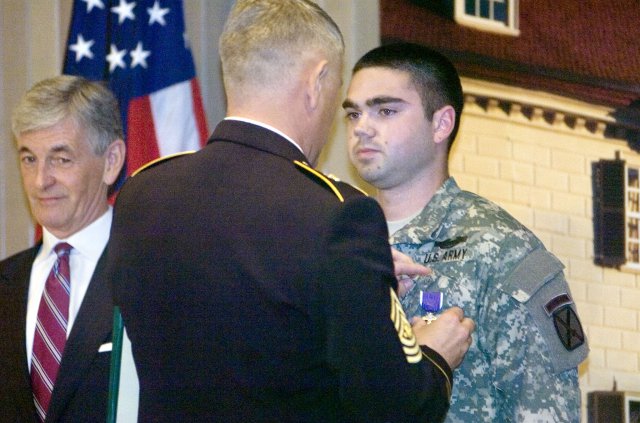
    Following the playing of Taps, McHugh, Sgt. Maj. of the Army Raymond Chandler, and Ann Bookout, the 20th regent of the Mount Vernon Ladies’ Association, gathered in the estate auditorium to present Purple Hearts to wounded Soldiers Sgt. Sean P. Karpf, Spc. Arael Lopez and Pfc. Cory A. Doane.

    Bookout opened the ceremony remarking that there was no better place for the Army to open its 238th birthday than at the home of the country’s first commander-in-chief.

    “Not only was George Washington first in war, first in peace and first in the hearts of his countrymen, he was the first military official to recognize Soldiers who served and sacrificed for what we now call the Purple Heart,” she said.

    Unlike European armies at the time which only awarded medals to officers, Washington was the first to acknowledge that courage and commitment were qualities which should be recognized and celebrated regardless of rank, Bookout noted.

    size0

    The three Purple Heart recipients were wounded in Afghanistan in 2011 and 2012. Sgt. Sean P. Karpf, C Company, 1st Battalion., 508th Regiment, 4th Brigade, 82nd Airborne Division was wounded in Kandahar, Afghanistan on June 15, 2012 while on a mission to train Afghanistan forces. Sgt. Cory A. Doane, C Co., 2nd Bn., 87th Infantry, 3rd Brig., 10th Mountain Division was injured on July 3, 2011 in Kandahar, Afghanistan while conducting combat operations. Spec. Aerial Lopez, B Battery, 4th Bn., 319th Airborne Field Artillery based out of Bamberg, Germany was injured in Wardak Province, Afghanistan on Aug. 8, 2012.

  • Oh, #$@&!, Not Again

    Looks like we have another senior military official possibly involved in a sex-related problem.

    The US Army-Japan (USAJ) commander – MG Michael T. Harrison – has been suspended from his duties by the CSA, GEN Raymond P. Odierno and Secretary of the Army John M. McHugh.  Allegations have been made that MG Harrison failed to report and did not properly investigate an alleged sexual assault within his command.  MG Harrison’s actions concerning the incident are now being investigated.  Further details have not been released.

    MG Harrison had been scheduled to leave command of USAJ next week.  His next assignment was to be as Deputy Commanding General, US Army Component, US Central Command (ARCENT).  That’s obviously now on hold.

    If the allegations against MG Harrison are true, they’re serious enough IMO to warrant disciplinary action for dereliction of duty.  If they’re unwarranted, just as obviously MG Harrison’s career should not be affected – though I’d guess it will be to some extent anyway.

    There’s certainly more to follow on this one.

  • An Udate on SGT Bowe Berghdal, POW

    Apparently SGT Bergdahl is indeed still alive.  His family received a letter recently through Red Cross channels indicating that he’s still alive and is “doing as well as can be expected” in captivity.  Details in the letter apparently convinced SGT Berghdal’s family that the letter is genuine.

    It is unclear where or by precisely whom SGT Bergdahl is being held captive.  He was at one point alleged to be being held captive by the Haqqani Network, a Pakistan-based group declared by the US government to be a terrorist organization.  However, that group’s leadership has stated publicly that they do not hold SGT Berghdal, and that he is being held by others.

    SGT Bergdahl has been a POW for nearly 4 years.  Regardless of the circumstances of his capture, I can only hope we can secure his freedom soon.

    If anyone reading this article wants to disparage SGT Berghdal or debate whether or not he deserves to be rescued – how about you do us all a favor and just grab a big steaming mug of STFU instead.  The time and place to debate the actions leading to his being taken prisoner is after SGT Bergdahl is repatriated, not while he’s still in captivity.

  • “But we couldn’t live with ourselves.”

    Jonn posted a brief story the other day on the guilty plea entered by Robert Bales – the guy who claims he “snapped” after a night of unauthorized drinking, then went out and murdered 17 Afghan civilians in their homes.  Even now there appear to be those who would excuse Bales’ actions, either partially or completely.

    I’d like to offer a short counterexample.

    What Bales did was nothing but thuggery.  What the following three Soldiers did, on the other hand, was IMO the epitome of correct, professional conduct.

    During the first Gulf War a small US Special Forces team of  3 persons was conducting strategic reconnaissance.  They were well behind enemy lines.  Indeed, they were north of the Euphrates river and were less than 100 miles from Baghdad.  Their mission was to observe one of the major roadways between Baghdad and Iraq for signs of enemy activity in order to screen the western flank of the planned allied “left hook” through southern Iraq.

    They had secreted themselves in a dug-in, “spider-hole” hide site.  (We’d studied the Viet Cong’s use of such during the Vietnam war, and had learned much.)  The site was well camouflaged; observation was by a small periscope-like device raised through a small opening in the camouflaged door to the hide site, described as a “slit”.

    Unfortunately, no camouflage is absolutely perfect; children are both inquisitive and observant.  Early one morning a small Iraqi girl – a child no more than 7, per later estimates – was out and about and saw something she though unusual.  She went over to investigate.

    She found the slit in the hide site’s trap door – then lifted it open.  In short order, she was staring down the muzzle of three silencer-equipped pistols.

    The three US soldiers had a choice.  They could kill the little girl, hide the body, and continue their mission.  Or they could let the child go, attempt an extraction with their cover blown – and maybe not get home.

    They chose the latter option.  The child ran and got her father.  Her father informed nearby Iraqi forces of what his daughter had found.

    The site was soon surrounded by around 100 Iraqi troops.  Amazingly, the team was successfully extracted – although it turned out to be a truly harrowing and narrow escape under fire.

    The most junior member of the team was later asked why they didn’t kill the child to preserve their mission, and perhaps their own lives.  The title of this article gives his response.

    Like Bales, he was a US Army Staff Sergeant.

    The story above is not apocryphal.   Details may be found at pages 4 and 5 of this article.  It’s a short but incredible read.

    Those three soldiers knew the difference between cold-blooded murder and collateral damage.  They chose to be military professionals instead of murderers, even though they knew it might cost them their freedom – or their lives.

    In contrast, Bales chose cold-blooded murder.  For that, there’s no justification.

  • Sixty-Nine Years Ago Today . . . .

    . . . the city of Rome was liberated by Allied forces. 

    More properly, it was occupied by forces of the US 5th Army commanded by LTG Mark Clark – or as he was sometimes referred to by those who found him self-centered and arrogant, “Marcus Aurelius Clarkus”. US forces entered Rome after most Nazi occupation forces had been withdrawn vice used to conduct a Stalingrad-style battle for the city. Only a smallish rearguard force was left to delay Allied entry into Rome.

    The Allied occupation of Rome was not without substantial controversy.  During the breakout from the Anzio beachhead, Clark’s forces had the opportunity to attack northeast into the Valmontone Gap instead. This would have severed Route 6 (the Appian Way), potentially cutting off and trapping the bulk of German forces then south of Rome between the 5th Army at Anzio and 8th Army forces to the south under British General Bernard Montgomery. 

    Indeed, in late May 1944 Clark’s initial orders to then-MG Lucian Truscott were to attack into the Valmontone Gap with his forces (VI Corps) during the breakout from the Anzio beachhead.  However, Clark shortly afterwards countermanded that order. His new orders directed Truscott to split his forces, with a large portion of VI Corps instead attacking northwest towards Rome while the remainder attacked towards Valmontone.

    The early liberation of Rome was uplifting and afforded the US 5th Army great PR, but was of little military utility. It is thought by many that Clark’s desire to gain publicity prior to the Normandy landings (scheduled for a few days hence) played a large role in his ordering the dash for Rome.  Clark indeed both knew the approximate date of the Normandy landings and actively sought publicity, so that theory is plausible.

    In any case: one of the more famous photographs related to the liberation of Rome is that of two GIs carrying what was essentially a “Rome City Limits” highway sign. The sign is pierced with a bullet hole – the small white dot below and slightly to the right of the letter “O” in the word “ROMA”.

    That sign has its own interesting story.  It very nearly changed history.

    During the dash to Rome, on 3 June 1944 US forces – specifically, the First Special Service Force under BG Robert Frederick – were briefly held up by Nazi rearguard forces on Rome’s outskirts.  Wanting to know what was causing the delay, LTG Clark and his II Corps Commander, MG Geoffery Keyes, went forward to meet with BG Frederick.

    They caught up with Frederick near the ROMA sign pictured above, while that sign was still in place on the road to Rome.  While chatting with Frederick, Clark noticed the “ROMA” sign. Clark then remarked that he’d like to have the sign for his office.

    About that time, a unknown German sniper nearly changed the course of history. That German sniper took the three US generals under fire – and missed.  His first round was high, striking the sign and leaving the bullet hole seen above.  That miss gave Clark, Keyes, and Frederick the chance to take cover.  They scrambled to safety, but were pinned down by sniper fire for some time.

    During the time they were pinned down by enemy fire, Frederick told Clark:  That is what’s holding up the First Special Service Force!”

    US forces liberated Rome the following day. And as the photo above shows, Clark got his sign.