By now, everyone has probably seen the memo wherein the CJTF-1 Chaplain banned distributing Qurans to service-members who don’t have “Muslim” on their dog tags. In order to get one, you need to either have a DA3161 declaring that is your religion, or get a letter from his commander detailing why the soldier wants/needs one. Is there a Constitutional Issue in play here?
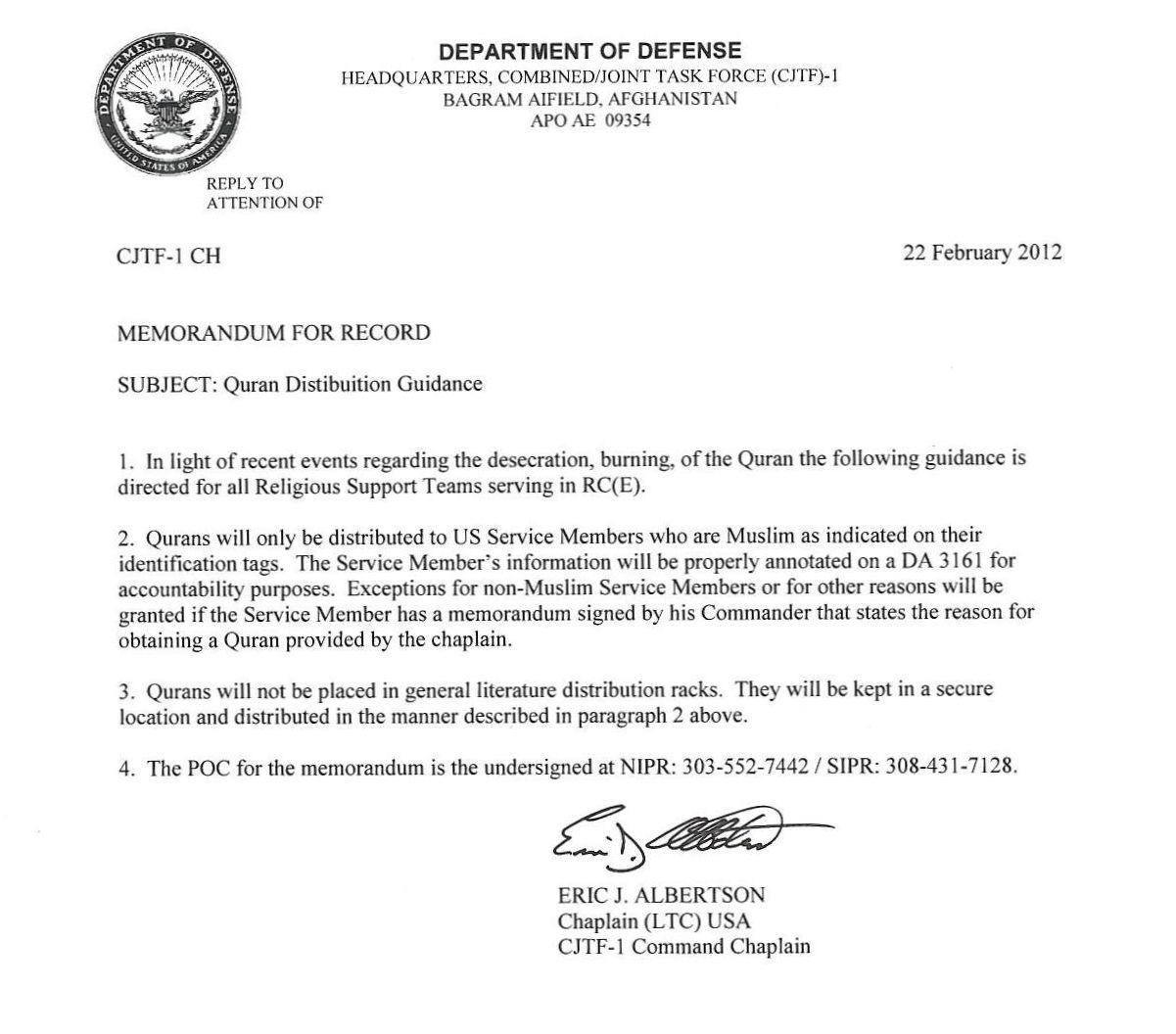
Frankly, I don’t know for sure, but it certainly seems to me that there are a few issues. The basic issue of military chaplains was resolved in the case of Katcoff v. Marsh, which essentially said that chaplains are allowed because the Free Exercise clause and the nature of military service essentially requires it. The case is about the conflict between the establishment clause and the free exercise clause, and the court seemed to weigh the merits and found while there was some trepidation about establishment, that you couldn’t offer free exercise to troops without having the religious personnel there to facilitate that. (Brief side note, the “Marsh” in the case name is Jack O. Marsh, who was the Sec Army at the time, and would later be a friend and professor of mine in law school.)
Establishment clause stuff is kind of in flux, but generally it is understood that the Lemon Test (Lemon v. Kurtz) is still controlling. Discussion of that would take more time or effort than you care to read, but baldly stated the Government has to try to avoid getting TOO entangled in religion. Of course, as noted above, in this case they can’t completely excise all religious stuff, or they run afoul of the free exercise clause. So you have to have Chaplains around, but the Government, or the military can’t choose winners and losers among those religions. Largely they do this by figuring out what percent of religious practitioners are say Roman Catholic, and then as closely as practical, assign that many Roman Catholic Chaplains.
The problem here is a sort of “equal protection” argument among the religions. You can’t allow the Baptists to have services in the chow hall, and relegate the Mormons to the latrines. Not that everything needs to be entirely equal, but disparate treatment needs to be made on the basis of something concrete. If there are 4,000 Episcopalians and 4 Unitarians, you don’t need to make sure they have equal access to rooms or funds, it should at least cognizably be relative to their numbers.
So what we have here is just head scratching. Now, I honestly don’t know, and hopefully someone can share with me, how the “imminent danger” aspect of this works in. I don’t believe for a second that this policy is aimed at either hindering or furthering the Islamic religion, it seems pretty clearly focused on stopping any future problems.
Nonetheless, facially this policy has some serious shortcomings.
1) It seems to discourage any non-Muslim from having access to the Quran, which would of course make it more difficult for anyone considering a change of faith from actually getting the info that they should have. I’ve wanted to read the Book of Mormon for a long time now, but I don’t ask for one because I know I will end up on a list. I don’t want to become a Mormon, but I do want to know enough to talk intelligibly on their religion. Likewise, serving in A-Stan, I am certain some Joes probably want to know more about the prevalent religion.
2) It treats Muslim service-members in a way different from any other religious practioners. This goes without saying. It’s not too far a leap in logic to see that there’s a short jaunt from requiring “Muslim” on a dog tag to get the Quran to some other identifying marking. And no one wants to envision the days of people wearing yellow stars to show their religious colors.
3) The “distribution” by the military of various holy books is now no longer content neutral. One can get a copy of the New Testament or perhaps the Hindi Vedas, but only by meeting certain pre-requisites can one get the Quran.
(As Matt rhetorically asked: “Does the chaplain refuse to give the bible to soldiers with Muslim on their dog tags?”)
Is the policy justified? I think from a security standpoint that might be the case. Clearly the military believes that to be the case, and I am loathe to dispute that, since I don’t have all the info I would need. Perhaps this was a prophylactic measure taken after much thought, in consultation with the ISAF headshed, Chaplains and JAGs. That would be my guess.
But from a Constitutional standpoint, this policy seems fraught with danger.