Author: Hondo

  • Ever Wondered What This Administration Would Do If US Forces Were Attacked?

    Well, we now have an answer.  Apparently Russian aircraft bombed one of our facilities in the Middle East last month.

    Twice.

    So, what did we do?  Apparently, we sent Vladimir Putin et al another “strongly worded protest” concerning Russia’s behavior.

    Seriously.

    After this, I’m thinking that the current administration’s self-assessment of “Most xxxxxxxxxxxxx Administration in history” may well be close to correct.  But in my view, for it to be truly accurate you need to replace xxxxxxxxxxxxx with a different word than they used in describing themselves.

    After all:  “transparent” isn’t a synonym for either “incompetent” or “cowardly”.

  • “Chicken Runs at Midnight”

    Ran across this article the other day; I then found the video at this link on the same subject.  IMO both are worth your time if you like baseball.

    If you do follow either or both of the links above, I’d recommend you grab a tissue or two before you start.

    Yeah, they’re from ESPN.  Can’t say I much like ESPN’s politics these days, but IMO they’re no better or worse than SI or most other sports media in that respect.  Or most other media, for that matter.

  • A Blast from the Past: The “Other” Fab Four

    The term “Fab Four” is well known as a reference to the Beatles.  But at one time, there was an aspiring “other” Fab Four – another English group linked to the Beatles, and at times seen as a Beatles “knock off”

    Most today don’t know of them; their popularity was fleeting.  But had things broken for them differently, they could have easily ended up being the “next big thing” from England.  Unfortunately, for the most part they ended up broke, forgotten – and in two cases, dead far too young.

    But they were talented as hell, and were far from being “Beatles clones”.  They deserve a bit better than that.

    Yeah, I’m about to go on another “walkabout”.   Consider yourself forewarned.

    . . .

    In the 1960s, a musical group formed in Swansea, Wales.  For years, they were poor and struggling.  They called themselves the Iveys.

    They were talented, if young.  And one night, they were seen by the right person.  They became the first act (other than the Beatles) signed by Apple Records.

    They sounded much like the Beatles, actually – understandable, since Liverpool is not far at all away from Wales, and weren’t far off from the Beatles in age.  (The singing voice of one in particular sounded similar to that of Paul McCartney.)  Their first hit was also written by Paul McCartney.

    This created an association between the band and the Beatles that was to persist.  Though a long-term detriment, it indeed helped their early rise.

    The band renamed itself before their first Apple release.  Their new name:  Badfinger.

    They were to prove much more than mere Beatles clones.  And they were fated to be both popular and short lived.

    Arguably, they invented the “power ballad”.    Don’t believe me?  Listen to the three below that are identified as such – and find an earlier example that “charted big”.  Not sure you really can.

    I’m not going to write a “blow-by-blow” about the band’s history.  Instead, I’ll just present a few of what I consider their better tunes – along with a few brief comments of my own.

    If you’ve never heard much of their music – or if you haven’t heard it in a while – grab a good set of headphones and listen.  I think it’ll be worth the time.  (For a couple of the tunes, depending your your own past close relationships you might want to grab a tissue, too,)

    . . .

    Come and Get It
    Paul McCartney tune, written for the movie “The Magic Christian”.  It got them started as their first hit.

    No Matter What
    First hit for the band written by Peter Hamm.  The tune established the band as independent, but was still very much “Beatle-esque” in sound.

    Without You
    Written by band members Peter Hamm and Tom Evans, and established the band as having their own unique style.  It’s perhaps the first rock “power ballad”.  Written by splicing two songs written by Hamm and Evans together, it’s become a modern-day standard.  (Harry Nillson’s definitive version can be found here..)

    (Short sidebar: the members of Badfinger ran into Nillson in the studio while he was recording the album to contain Without You. They heard Nilsson’s version – which was reputedly recorded in a single take – and were floored by it.  Nilsson’s version received a Grammy in 1973.)

    Day After Day
    Another truly beautiful power ballad by Peter Hamm.  Musicians who played on the tune include George Harrison (slide guitar solo) and Leon Russel (piano).  It was their biggest hit, chart-wise.

    Baby Blue
    Probably the best known of their tunes due to being featured as the finale (literally) of Breaking Bad.  It’s another absolutely gorgeous power ballad, also by Peter Hamm.  The song was based on real events – specifically, Hamm’s relationship with Dixie Armstrong on their final US tour.  It became popular again recently when it was featured in the final scene of Breaking Bad – where it fit perfectly.

    Apple of My Eye
    The band’s last well-known single, from their final Apple album.  It’s reputedly about the end of their contract with Apple records vice about a relationship.

    Perfection
    A tune you probably haven’t heard from their consensus best album, Straight Up.  Yeah, the lyrics today may seem a bit “hippy-esque” and a touch naive.  Hey, it was recorded in the early 1970s – what do you expect?  But it’s still a helluva tune that takes a far more realistic look at things than did many contemporary tunes of its genre.

    Name of the Game
    Another one you probably haven’t heard – it wasn’t a single, though it did get some airplay.  Great tune, and one of my favorites by the band.

    . . .

    By the early 1970s, the band was primed for stardom – hell, they were stars, coming off four straight multinational hits from three straight successful albums.  They’d also been the backing band for George Harrison at his “Concert for Bangladesh”.

    And then it all abruptly ended.

    So, what happened?  Bad timing, money – and dirty dealing.

    The bad timing:  Badfinger got caught up in the fallout over Apple Records going belly-up.  This tied up royalties for much of their early work for years.

    Plus, to put it bluntly:  the band got screwed.  They were somewhat naive, business-wise.  When they became big, knowing that fact, before touring America they signed with an American manager – Stan Polley.

    Exceptionally bad choice.

    Polley was later named in a Senate investigation as having mob connections, and years later was convicted of fraud.  He reputedly screwed the band royally, both financially and contractually. While the band was big, they were also damn near broke – their money was being “held for investment” and the band members were living on relatively paltry salaries.  The rest of their income was being “held” by Polley for their future use.

    In reality, the money was disappearing.

    The band’s first Warner Album didn’t do well. And their second Warner album, considered by some one of their two best, was also short-lived. Their new label (Warner) got wind that something shady might be going on with respect to the band’s finances.

    When Polley couldn’t answer (or, some accounts say, sidestepped if not outright refused to answer) Warner’s questions about what had happened to the band’s contract advances, Warner demanded an investigation into the band’s finances.  Warner also pulled the plug on both promotion and distribution of their albums released in 1974, withdrawing the second from sales entirely as it was rising in the charts. They also and blocked release of a third album the band had completed by refusing to accept the master tapes.

    Warner also began legal action against Polley.  And since he had control of the band’s finances, well, . . . .

    This cut off the bands’ income; it also prevented them from releasing any new work. It virtually put a stop to their public performances.  And the financial and legal wrangling dragged on for months – then years.

    Despondent, Hamm – the band’s primary creative force, who’d also apparently believed in Polley far longer than his bandmates before realizing the truth – hanged himself in April 1975.  (His suicide note effectively blamed Polley for driving him to suicide.)  The band for all practical purposes broke up afterwards, though survivor-led versions with different lineups persisted for years (one persists to this day).

    The legal wrangling (and financial standstill) over past recordings by the band continued on an on.  Evans hanged himself in 1983 for much the same reasons as had Hamm – continued legal wrangling over past band royalties.

    . . .

    Well, that’s a short version of the band’s story. It’s not pretty – but some of their music is truly timeless.

    A short (30 min) video history of the band from BBC – titled “They Sold a Million” – exists. If you’re interested in the band and its music, IMO it’s certainly worth a look.

    It’s a shame they weren’t able to carry on.

    ———-

    Postscript: the title for Badfinger’s last album released in 1974, which was pulled from sales due to investigation into the band’s finances, was “Wish You Were Here”. About 10 months later, Pink Floyd released an album by the same title.

    The English rock music world wasn’t all that large in 1974-1975. The members of Pink Floyd certainly would have heard about Pete Hamm’s suicide – and would have also certainly have heard the story behind Badfinger’s collapse. Word gets around in a smallish, closed community.

    Pink Floyd’s album title – and the entire album – was indeed a reference to former Pink Floyd founder Syd Barret. But I can’t help wondering if maybe the title was also a bit of a double-entendre.

    And I also believe I know who Roger Waters might well have used as the inspiration for the record producer character in his song “Have A Cigar” from that album.


    Multiple Internet sources were used in preparing the above.
  • More Return Home

    DPAA has identified and accounted for the following formerly-missing US military personnel.

    From World War II

    • Pfc. George H. Traver, Company K, 3rd Battalion, 8th Marine Regiment, 2nd Marine Division, USMC, was lost on 20 November 1943 on Tarawa Atoll. He was accounted-for on 24 May 2016.

    • Pvt. Dale R. Geddes, Company H, 2nd Battalion, 8th Marine Regiment, 2nd Marine Division, USMC, was lost on 20 November 1943 on Tarawa Atoll. He was accounted-for on 13 April 2016.

    From Korea

    • MSG Charles J. Brown, L Company, 3rd Battalion, 8th Cavalry Regiment, US Army, was lost on 2 November 1950 in North Korea. He was accounted-for on 29 June 2016.

    • SFC Lawrence Smith, A Company, 1st Battalion, 38th Infantry Regiment, US Army, was lost on 12 February 1951 in South Korea. He was accounted-for on 6 July 2016.

    Welcome back, elder brothers-in-arms. Our apologies that your return took so long.

    You’re home now. Rest in peace.

    . . .

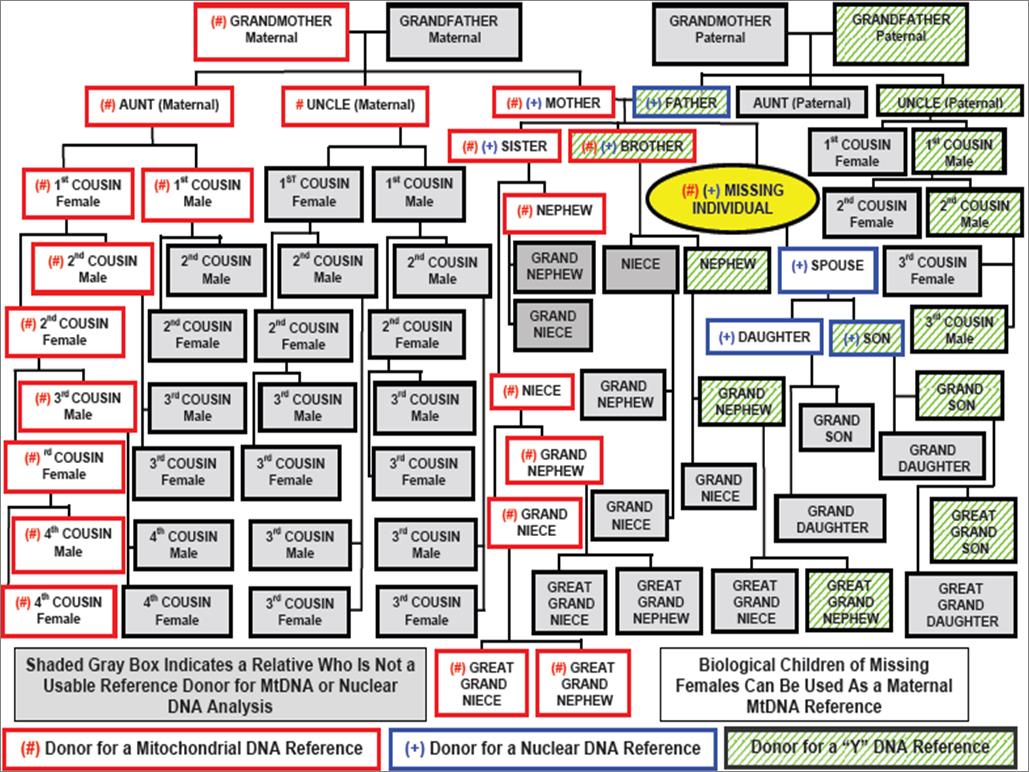
    Over 73,000 US personnel remain unaccounted for from World War II; over 7,800 US personnel remain unaccounted for from the Korean War; and over 1,600 remain unaccounted for in Southeast Asia (SEA). Comparison of DNA from recovered remains against DNA from some (but not all) blood relatives can assist in making a positive ID for unidentified remains that have already been recovered, or which may be recovered in the future.

    On their web site’s “Contact Us” page, DPAA now has FAQs. The answer to one of those FAQs describes who can and cannot submit DNA samples useful in identifying recovered remains. The chart giving the answer can be viewed here. The text associated with the chart is short and can be viewed in DPAA’s FAQs.

    If your family lost someone in one of these conflicts and you qualify to submit a DNA sample, please arrange to submit one. By doing that you just might help identify the remains of a US service member who’s been repatriated but not yet been identified – as well as a relative of yours, however distant. Or you may help to identify remains to be recovered in the future.

    Everybody deserves a proper burial. That’s especially true for those who gave their all while serving this nation.


    Notes:
    1. Hat-tip to TAH reader chindonya for links to DPAA’s FAQ page and the chart of eligible DNA donors.
    2. The delay in acknowledging the accounting-for of Marines Traver and Geddes here was due to delay in the public announcement of their change in status. Neither individual’s name appeared on the DPAA website until this week.

  • Are Minorities Treated More Violently by Police? Yes – and No.

    I’m guessing everyone is familiar with the Black Lives Matter group – and their contention that African Americans (and, by implication, minorities in general) are currently being treated with disproportionate and unnecessary violence by law enforcement.

    Years ago, in parts (maybe much) of the country that was indeed true.  But the recent BLM allegations raise an interesting question:  is it still true today?

    The conventional “wisdom” is that it is – and the media has done far more than its share to reinforce that conventional wisdom.  However, in reality it’s a surprisingly hard question to answer.

    One can’t simply count arrests, or even incidents of police use of force – because in some cases police use of force is clearly warranted, and arrests (and crime) are decidedly not distributed uniformly, either geographically or among racial and ethnic groups.  So determining whether one racial/ethnic group is being treated “better” or “worse” than another with respect to police violence is not an easy problem.

    . . .

    Indeed, one reason that the question hasn’t been studied is that meaningful data needed to study the problem wasn’t readily available.

    That’s no longer the case.  It seems as if one guy – a man named Roland G. Fryer, Jr. – decided to study the problem.  He and a group of people working with and for him have conducted a survey of data from multiple representative jurisdictions and data sources to attempt to extract such meaningful data.  They’ve also rigorously analyzed the extracted data.  The project took an aggregate of 3,000+ staff-hours of work.

    The conclusions of Fryer’s study are quite interesting.  Per his study, it turns out that minorities are more likely to be on the receiving end of police violence.  That is, they are . . . until they aren’t.

    I’ll explain.

    The study included data from three metro areas in Texas (Houston, Dallas, and Austin); six counties in Florida (Brevard, Jacksonville, Lee, Orange, Palm Beach and Pinellas – which include the St. Petersburg, Fort Myers, Jacksonville, and Orlando metro areas as well as a good portion of Florida’s east coast north of Miami); LA County in California; and NYC.   Arrests reports and NYC “stop and frisk” data from a fifteen-year period (2000-2015) were studied; the relevant data was extracted and characterized.  This extracted data was combined with public survey results concerning citizen perception of police use of violence.  Control measures to remove bias due to officer race, gender, experience level, precinct, and location of crime were also developed.

    After doing this, a rigorous statistical analysis of the resulting data set was conducted.  It sought to determine whether minorities taken in to custody by LE were more or less likely to receive varying degrees of violent treatment.  Violent treatment was defined as consisting of multiple escalating categories, beginning with being being pushed/shoved, and including being handcuffed, put forcibly on the ground, batoned, having a weapon drawn or pointed, being pepper-sprayed, and ending in being tazed or shot with a firearm by LE personnel.

    The results showed that yes – minority citizens did appear statistically substantially more likely to receive nonlethal rough treatment from LE.  But then they looked at more extreme levels of violence – and a curious result emerged.

    As the level of violence increased, the difference between treatment of minority subjects and the treatment of white subjects remained roughly constant.  That is, it remained roughly constant until the most extreme levels of police use of force (taser or firearms) were reached.

    At that point . . . the bias against minorities vanished.  In fact, it actually appears to have reversed.

    The study extensively studied the most extreme uses of police force – shootings and the use of a taser.   And when it came to being on the receiving end of a shooting, well  . . . Black Americans were statistically substantially less likely – specifically, greater than 20% less likely – to be shot during a police encounter than their white counterparts.  This seemingly aberrant result held true (though the magnitude was reduced) even after multiple corrective measures were applied to the data to correct for various sources of possible unrelated correlations leading to false indications of bias.

    The same appears to be true for incidents involving use of a taser (extensive data on that form of incident from Houston, TX, was available).  However, the study doesn’t directly address that issue in its conclusions.

    The result observed for raw data relating to these shootings was well outside the statistical standard error for the data on hand.  That means the result appears to be statistically significant – and thus real.

    These results also held true even when type of encounter was considered as a factor – e.g., when attempts were made to categorize police shooting incidents by whether or not police use of deadly force appeared clearly justified.  Even in events where a police officer would appear to have been clearly justified in shooting, minority offenders appeared to be statistically less likely to be shot than white offenders under similar circumstances.

    The study also found that both Black and white suspects involved in a police shooting were roughly equally likely to have been armed.

    The same general results, with smaller magnitude, for shootings were observed in the raw data for police shootings involving  Hispanic Americans – that is, Hispanics were also observed to be somewhat less likely to be shot (about 8.5%) during a police encounter than white Americans.  However, in the case of Hispanic Americans the difference appears to have been within the statistical standard error of the data set, so the result cannot be considered statistically significant.

    In short:  the study found no evidence of racial bias in police shootings.  When police were forced to shoot, race was apparently not a factor.  In fact, if anything white citizens seemed statistically a bit more likely to be the ones on the receiving end of police lead, statistically speaking.

    There may well be a problem with police using rough treatment inequitably.  But any inequity doesn’t appear to extend to shootings.  Those appear to be race-neutral.

    . . .

    So, you ask:  just who is this Roland G. Fryer, Jr.?  Is he some John Birch Society type, or perhaps a KKK or Aryan Brotherhood member?  This study is all just bogus claptrap cobbled together by some ignorant racist – right?

    Hardly.

    Fryer happens to be a university professor with a doctorate degree – a professor of economics, specifically.  So he knows a thing or two about data collection, data reduction, and statistical analysis.

    Fryer also isn’t some some second-rate academic teaching at some non-accredited college run by religious fanatics, or at some local community college or small, second-rate college.  The guy happens to be a tenured professor at Harvard.  Yeah, that Harvard.

    Finally:   Fryer happens to be African-American.  In fact, he’s the youngest African-American professor ever to receive tenure at Harvard – as well as the first to receive recognition as the most promising US economist under the age of 40, the John Bates Clark medal.

    Fryer has indicated that his result concerning shootings and minorities are “the most surprising result of my career”.  But he appears to be standing by his conclusions – though he does offer the standard caveats (i.e., incomplete data, possible data unreliability due to voluntary participation, etc . . .) one would expect regarding any such study.  He also indicates that more research is needed to reach a definitive conclusion regarding police use of violence nationwide.

    Fryar has offered a theory concerning the disparity, one which is supported by his data but which he admits that though descriptive may not be correct.  His theory is that police essentially “do what works”, and that some fraction of police are indeed racially biased.  But shooting or tazing someone impose high negative consequences on a policeman even if justified, so at that point reason takes over from bias in those individuals who are racially biased and they act responsibly.

    FWIW:  I think Fryar may well be on to something with his theory.  Racism does still exist, but IMO it’s hardly the pervasive conspiracy some claim.  Learning the truth – vice listening to BS from those with an agenda, or who profit from stirring up trouble – is the first step to improving the situation.  IMO Fryer has made a contribution to learning the truth here by creating the first data set suitable for detailed study, and for conducting the initial analysis.  I hope he manages to get the wherewithal to study the matter further.

    . . .

    You can read an article about Fryer’s study published by the NYT here.  (It’s the NYT, so if anything IMO it somewhat downplays Fryer’s conclusions.)  Or you can read the study for yourself here – and can read the appendix to the study, which gives additional details, here.  Fair warning:  there is indeed math involved.  (smile)

    Unfortunately, I’m guessing Prof. Fryer is about to become persona non grata among his leftist academic colleagues.  And I’m guessing those leftist colleagues will pull out all the stops in an attempt to block publication of his study or to convince him to change it substantially (it’s currently in pre-publication draft and has yet to be published).

    Sometimes the truth is indeed inconvenient.  Especially when it’s backed by hard data and doesn’t “support the agenda”.

  • In Honor of the Previous Article . . . .

    With apologies to someone once called by a comic the “butt-ugliest man in Rock and Roll”, the incredibly talented Tom Petty.

    Hat tip, Jonn. This one’s for what you do; hope you don’t mind me speaking for you – and likely for damn near everyone else here, too.


    Quit Lyin’ to Me

    Busted, caught in a corner
    Trapped up against the wall
    Liar got nowhere to go
    Liar got nowhere to fall

    No help from “old buddies”
    Your shame is guaranteed
    Take back your bogus claims
    All that drama we don’t need

    You’re lyin’ to me
    You’re lyin’ to me
    Quit lyin’ to me
    ‘Cause now you’re caught trapped in a corner
    Just stop lyin’ cause now it’s over

    Tool makes some angry threats when
    Someone questions his claims
    Of SF, and bein’ Ranger
    Turns out his lies are lame

    Jonn nailed another liar
    Tool’s named Chris Piscopo
    Exposed his phony tab and
    Told him just where he should go

    You’re lyin’ to me
    You’re lyin’ to me
    Quit lyin’ to me
    ‘Cause now you’re caught trapped in a corner
    Just stop lyin’ cause now it’s over

    Take back yer bogus Ranger
    Take back yer false SF
    Come clean about yer record
    Can’t stand to hear those lies no more

    You’re lyin’ to me
    You’re lyin’ to me
    Quit lyin’ to me

    See now, I got your FOIA
    I know just what ya did
    I know you were no soldier
    Just a boot camp washout squid

    You’re lyin’ to me
    You’re lyin’ to me
    Quit lyin’ to me
    ‘Cause now you’re caught trapped in a corner
    Just stop lyin’ cause now it’s over

    Oh, you’re lyin’ to me
    Quit lyin’ to me
    You’re lyin’ to me
    Quit lyin’ to me
    Quit lyin’ to me
    Yeah, you’re lyin’ to me
    You’re lying’ to me

  • Looking for An “ObamaCare” Health Co-Op? Good Luck.

    Remember that       truly asinine exercise in socialist idiocy        healthcare “innovation” called the Patient Protection and Affordable Care Act – AKA “ObamaCare”?  Remember how it was supposed to use “nonprofit healthcare cooperatives” as an integral part of its design?

    Well, as I’ve written before here those cooperatives haven’t exactly been doing that well.  As of March, roughly half of them had gone bankrupt.

    Last week, the axe fell on another two ObamaCare cooperatives:  HealthyCT and Oregon’s Health Co-Op.  The former is now operating under an order of supervision, having recently been ordered to pay the CMS risk adjustment program more than $13M.  The latter is being placed into receivership and liquidated.

    A third cooperative had already gone belly-up between March and last week.  This means that of the original 23 ObamaCare cooperatives, only 8 remain in operation.  The rest have all failed.  And those that are still in business aren’t doing so well.

    These new failures aren’t exactly a surprise, either.  Back in March – when 11 of the cooperatives still were in operation – only 1 was expected to finish the year “in the black”.   The rest were collectively expected to lose in excess of $200M total – and it looks like that may well turn out to be accurate.

    That’s not exactly a sustainable business model.

    And that’s not all.  We still haven’t seen the large expected premium hikes experts say we’ll see for next year – and which will be announced this fall.

    So if you need to use one of those ObamaCare cooperatives to procure health insurance – best of luck to ya.  Either way (no cooperative serving your area, or too expensive) you may well be SOL.

    Sheesh.  When it came to this ridiculous concept, even Stevie Wonder could have told Congress he could see failure down the road.

    Well, he could have had they let him read the bill before passing it.


  • Body of Airman Missing in Italy Recovered

    For  a number of days SSgt. Halex Hale, USAF, has been missing.  Unfortunately, his whereabouts are now known.

    Per Italian authorities, SSgt. Hale’s body has been recovered from a river near Sacile, Italy.  He is believed to have drowned.

    Hale had been missing since attending a cookout roughly 10 days ago.  He left the cookout – leaving behind his car, credit cards, and cell phone – to walk to a friend’s house nearby.  He was not seen again alive.

    Hale had approximately 6 years service in the USAF, including a tour in Afghanistan.

    Rest in peace, Staff Sergeant.  May God comfort your surviving friends and family.