Author: Hondo

  • Weekend Open Thread

    “Then there was that time a jet aircraft shot itself down . . . .”

    No, that’s not the beginning of a sea story, a “no sh!t” story, or a tall tale. At least once . . . it actually happened.

    And the pilot – though injured in the resulting crash-landing – lived to tell about it. He also later flew again.

    . . .

    The time frame: mid-1950s. Supersonic flight wasn’t new, but aircraft actually capable of same were still fairly uncommon. Manufacturers were still gaining experience in dealing with supersonic flight issues.

    Enter the Grumman F11F/F-11 Tiger.
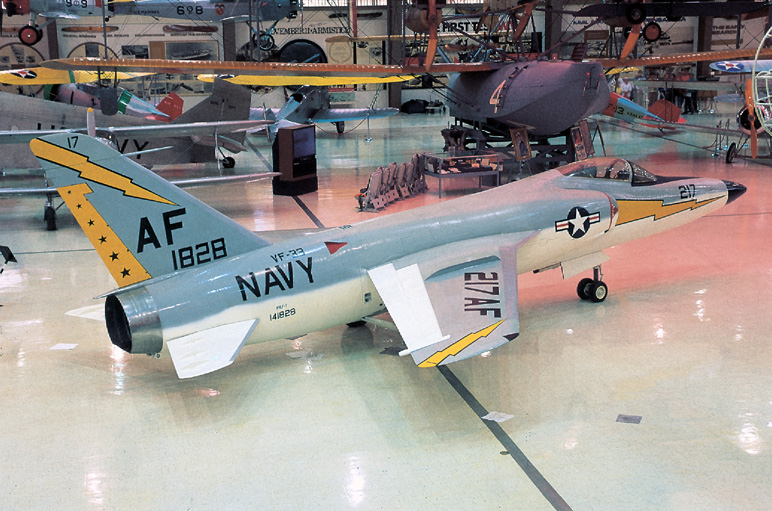


    The Grumman F11F Tiger was developed under the Navy’s pre-1962 numbering scheme; it was re-designated the F-11 under the 1962 Tri-Service numbering scheme. It was the Navy’s second supersonic jet aircraft (the F4D Skyray was the first); and it was fairly successful. A total of 200 were ordered by the Navy, and it was flown by the Blue Angels from 1957 to 1969.

    It also was armed with 20mm cannon. And that – coupled with the fact that it was also Grumman’s first supersonic aircraft and the company was still learning about supersonic flight peculiarities – led to the aircraft gaining a unique place in US military aviation history.

    How so? On 21 September 1956, a Grumman F11F Tiger became the first jet aircraft to shoot itself down.

    . . .

    Here’s what happened. On that date, Grumman test pilot Tom Attridge was flying a Grumman F11F Tiger – BuNo 138260 – off Long Island. He put the plane into a dive, and fired a 4-second burst (some sources say he fired two bursts) from the aircraft’s 20mm cannon.

    He was at approximately 22,000 feet altitude when he fired. He then continued his dive; some sources say that he increased his dive angle and accelerated as well.

    At an altitude of about 7,000 feet, Mr. Attridge got a rather nasty surprise. His windshield caved in, and his engine started losing power.

    Attridge thought he’d struck a bird, and tried to nurse his damaged aircraft back to Grumman’s Long Island airfield. Unfortunately his engine soon quit altogether. Since the F11F was a single engine aircraft, this was truly “bad news”.

    Attridge crash-landed the aircraft. He survived, but was injured and unable to fly for some time. However, he did eventually recover and return to flight status. (The aircraft did not; it was a total loss.)

    . . .

    What had happened? Well, as Attridge dove his aircraft was under power; some sources say he used his afterburners and increased his dive angle during the dive. His aircraft thus almost certainly picked up speed while in the dive.

    However, his 20mm cannon rounds didn’t; due to air resistance, their speed continually decreased. And since they were fired at around 22,000 feet altitude and at an oblque angle, they had a rather long time of flight.

    Bottom line: at some point after his firing run, the aircraft’s speed matched – then exceeded – the speed of the rounds he’d fired. And when that happens, it becomes possible for the two trajectories to intersect.

    On 21 September 1956, those trajectories intersected at approximately 7,000 feet altitude off the coast of Long Island. Post-crash investigation showed that Attridge’s aircraft was hit by three of his own previously-fired 20mm rounds. One of those rounds was recovered from his engine and was determined to be the cause of its failure.

    . . .

    OK, that’s enough “odd aviation history” for today. Enjoy the WOT, everyone – and the weekend.

    —–

    Sources:

    https://en.wikipedia.org/wiki/List_of_accidents_and_incidents_involving_military_aircraft_(1955%E2%80%931959)#cite_note-90

    https://en.wikipedia.org/wiki/Grumman_F-11_Tiger

    https://www.popularmechanics.com/military/aviation/a27967/the-fighter-plane-that-shot-itself-down/
    http://datagenetics.com/blog/august22017/index.html

  • Another Two Are Accounted For

    DPAA has identified and accounted for the following formerly-missing US personnel.

    From World War II

    St2c Felicismo Florese, US Navy, assigned to the crew of the USS Oklahoma, was lost at Pearl Harbor, HI, on 7 December 1941. He was accounted for on 20 December 2018.

    From Korea

    PFC James C. Williams, US Army, assigned to Medical Company, 34th Infantry Regiment, 24th Infantry Division, was lost in South Korea on 12 July 1950. He was accounted for on 2 January 2019.

    From Southeast Asia

    None

    Welcome back, elder brothers-in-arms. Our apologies that your return took so long.

    You’re home now. Rest easy.

    . . .

    Over 72,000 US personnel remain unaccounted for from World War II; over 7,600 US personnel remain unaccounted for from the Korean War; over 1,500 remain unaccounted for in Southeast Asia (SEA); 126 remain unaccounted for from the Cold War; 5 remain unaccounted for from the Gulf Wars; and 1 individual remains unaccounted for from Operation Eldorado Canyon. Comparison of DNA from recovered remains against DNA from some (but not all) blood relatives can assist in making a positive ID for unidentified remains that have already been recovered, or which may be recovered in the future.

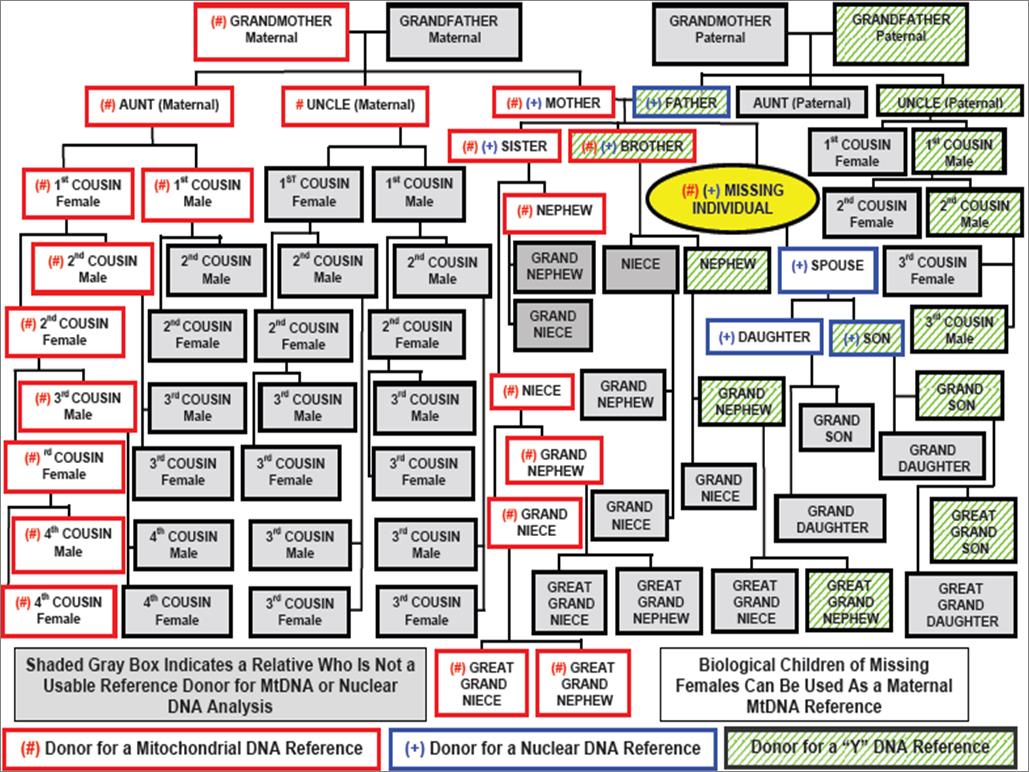
    On their web site’s Contact Us” page, DPAA now has FAQs. The answer to one of those FAQs describes who can and cannot submit DNA samples useful in identifying recovered remains. The chart giving the answer can be viewed here. The text associated with the chart is short and can be viewed in DPAA’s FAQs.

    If your family lost someone in one of these conflicts and you qualify to submit a DNA sample, please arrange to submit one. By doing that you just might help identify the remains of a US service member who’s been repatriated but not yet been identified – as well as a relative of yours, however distant. Or you may help to identify remains to be recovered in the future.

    Everybody deserves a proper burial. That’s especially true for those who gave their all while serving this nation.

    —–

    Author’s Note: St2c Florese was accounted for by DPAA on 20 December 2018. However, that fact apparently was not posted to their website’s “Recently Accounted For” listing prior to the end of the year.

  • A Pair of Tunes from a Pair of Masters

    Here ya go: a little musical entertainment for a Saturday morning. These are from their joint 2000 album “Riding With the King.”

    Enjoy.


  • Weekend Open Thread

    In honor of the fine photos of the King Tut Exhibit from this article earlier in the week, here ya go. (smile)


    The popping sound you hear is SJW snowflake heads exploding due to the lyrics. (smile) That skit probably couldn’t be broadcast today due to being deemed “too offensive” by the “Progressives” controlling the media.

    Don’t ya just love the Left’s hypocrisy today concerning artistic license and freedom of expression?

    Enjoy the Weekend Open Thread, everyone. And hey: be careful out there, OK?

  • DPAA – Nine More are Accounted For, and Year End Wrap-Up

    During 2018 DPAA identified and announced having accounted for the following formerly-missing US personnel. As is sometimes the case, these individual’s accountings were apparently not announced immediately and were later “slip-streamed” into DPAA’s “Recently Accounted For” listing. My apologies for not noting these individual’s accountings here at TAH earlier.

    From World War II

    GM3c Marvin B. Atkins, US Navy, assigned to the crew of the USS Oklahoma, was lost at Pearl Harbor, HI, on 7 December 1941. He was accounted for on 11 April 2018.

    Pfc Robert K. Holmes, USMC, assigned to assigned to the crew of the USS Oklahoma, was lost at Pearl Harbor, HI, on 7 December 1941. He was accounted for on 12 June 2018.

    TSgt Harry A. Carlsen, USMC, assigned to Company A, 2nd Amphibian Tractor Battalion, 2nd Marine Division, Fleet Marine Force, was lost on Tarawa on 20 November 1943. He was accounted for on 23 July 2018.

    ARM3c Walter E. Mintus, US Navy, assigned to Torpedo Squadron Fifty-One (VT-51), was lost in the Republic of Palau on 27 July 1944. He was accounted for on 28 June 2018.

    PVT Kenneth D. Farris, US Army, assigned to B Company, 22nd Infantry Regiment, 4th Infantry Division, was lost in Germany on 28 November 1944. He was accounted for on 26 April 2018.

    2nd Lt. Hulen A. Leinweber, US Army, assigned to 40th Fighter Squadron, 35th Fighter Group, US Army Air Forces, was lost in the Philippines on 10 June 1945. He was accounted for on 29 June 2018.

    From Korea

    SGT Eugene W. Yost, US Army, assigned to B Company, 2nd Battalion, 8th Cavalry Regiment, 1st Cavalry Division, was lost in South Korea on 3 September 1950. He was accounted for on 9 April 2018.

    MSG Carl H. Lindquist, US Army, assigned to Headquarters Company, 3rd Battalion, 31st Infantry Regiment, 7th Infantry Division, was lost in North Korea on 29 November 1950. He was accounted for on 5 June 2018.

    1LT Herman L. Falk, US Army, assigned to B Company, 38th Infantry Regiment, 2nd Infantry Division, was lost in South Korea on 12 Feb 1951. He was accounted for on 16 August 2018.

    From Southeast Asia

    None

    Welcome back, elder brothers-in-arms. Our apologies that your return took so long.

    You’re home now. Rest easy.

    . . .

    Over 72,000 US personnel remain unaccounted for from World War II; over 7,600 US personnel remain unaccounted for from the Korean War; over 1,500 remain unaccounted for in Southeast Asia (SEA); 126 remain unaccounted for from the Cold War; 5 remain unaccounted for from the Gulf Wars; and 1 individual remains unaccounted for from Operation Eldorado Canyon. Comparison of DNA from recovered remains against DNA from some (but not all) blood relatives can assist in making a positive ID for unidentified remains that have already been recovered, or which may be recovered in the future.

    On their web site’s Contact Us” page, DPAA now has FAQs. The answer to one of those FAQs describes who can and cannot submit DNA samples useful in identifying recovered remains. The chart giving the answer can be viewed here. The text associated with the chart is short and can be viewed in DPAA’s FAQs.

    If your family lost someone in one of these conflicts and you qualify to submit a DNA sample, please arrange to submit one. By doing that you just might help identify the remains of a US service member who’s been repatriated but not yet been identified – as well as a relative of yours, however distant. Or you may help to identify remains to be recovered in the future.

    Everybody deserves a proper burial. That’s especially true for those who gave their all while serving this nation.

    —–

    During 2018, DPAA accounted for 205 US personnel who had been declared MIA in various conflicts during the 20th Century. Of those, 156 were from World War II; 39 were from Korea; and 10 were from Southeast Asia.

  • Merry Christmas – Redux

    A paraphrased repeat from a year ago.

    Well, once again we’re “enjoying” participating in that annual ritual called “Holiday Travel” – and it’s now Christmas Day. So I decided to repost what I thought was some appropriate Christmas music for our readers.

    Yeah, the tune here was indeed written by one of the original hippies from the 60s – albeit one who did have at least a little common sense (see his tune “Taxman”). And yeah, the chorus is unrealistic and Polyannaish in the extreme.

    But for a military audience, the sentiment is apropos; many of us know just how bad war can be, having seen it firsthand. And today the song just seems apropos. The version below is IMO even better than Lennon’s original.


    Merry Christmas, all. Take care.

  • Christmas Eve Wishes

    I can remember seeing this years ago – I believe it was when it first aired (1977).

    An odd pairing, particularly given Bowie’s stage personae during the previous 5 years – but it nonetheless worked perfectly. It’s apropos for today, I think.


    Angelic voices, indeed. RIP, gentlemen.

    Have a wonderful Christmas Eve, all. And if you’re also traveling – take care.

  • Another Six Are Accounted For

    DPAA has identified and accounted for the following formerly-missing US personnel.

    From World War II

    MM1c George Hanson, US Navy, assigned to the crew of the USS Oklahoma, was lost at Pearl Harbor, HI, on 7 December 1941. He was accounted for on 19 December 2018.

    1st Lt. Burleigh E. Curtis, US Army, assigned to 377th Fighter Squadron, 362nd Fighter Group, US Army Air Forces, was lost in France on 13 June 1944. He was accounted for on 20 December 2018.

    PFC William F. Delaney, US Army, assigned to A Company, 1st Battalion, 22nd Infantry Regiment, 4th Infantry Division, was lost in Germany on 22 November 1944. He was accounted for on 17 December 2018.

    2nd Lt. Lynn W. Hadfield, US Army, assigned to 642nd Bombardment Squadron, 409th Bombardment Group, 9th Bombardment Division, 9th Air Force, US Army Air Forces, was lost in Germany on 21 March 1945. He was accounted for on 13 December 2018.

    Sgt. Vernon L. Hamilton, US Army, assigned to 642nd Bombardment Squadron, 409th Bombardment Group, 9th Bombardment Division, 9th Air Force, US Army Air Forces, was lost in Germany on 21 March 1945. He was accounted for on 14 December 2018.

    From Korea

    CPL John G. Krebs, US Army, assigned to L Company, 3rd Battalion, 21st Infantry Regiment, 24th Infantry Division, was lost in South Korea on 11 July 1950. He was accounted for on 19 December 2018.

    From Southeast Asia

    None

    Welcome back, elder brothers-in-arms. Our apologies that your return took so long.

    You’re home now. Rest easy.

    . . .

    Over 72,000 US personnel remain unaccounted for from World War II; over 7,600 US personnel remain unaccounted for from the Korean War; over 1,500 remain unaccounted for in Southeast Asia (SEA); 126 remain unaccounted for from the Cold War; 5 remain unaccounted for from the Gulf Wars; and 1 individual remains unaccounted for from Operation Eldorado Canyon. Comparison of DNA from recovered remains against DNA from some (but not all) blood relatives can assist in making a positive ID for unidentified remains that have already been recovered, or which may be recovered in the future.

    On their web site’s Contact Us” page, DPAA now has FAQs. The answer to one of those FAQs describes who can and cannot submit DNA samples useful in identifying recovered remains. The chart giving the answer can be viewed here. The text associated with the chart is short and can be viewed in DPAA’s FAQs.

    If your family lost someone in one of these conflicts and you qualify to submit a DNA sample, please arrange to submit one. By doing that you just might help identify the remains of a US service member who’s been repatriated but not yet been identified – as well as a relative of yours, however distant. Or you may help to identify remains to be recovered in the future.

    Everybody deserves a proper burial. That’s especially true for those who gave their all while serving this nation.