Author: Hondo

  • 21 August 2017

    Sorry for the delay in posting this article. I ended up spending substantially more time on the road today than originally planned.

    They say a picture’s worth 1000 words. So for the purists out there, here ya go.

    Taken IVO Sumter, SC, approx 1844 UCT

    Ausgezeichnet.

    I can’t claim credit for the photo – mine didn’t turn out that well.  An in-law took this one.

    The next total eclipse visible in the USA will occur in a bit less than 7 years – on Monday, 8 April 2024. That one will sweep SW to NE across the US, starting at the Rio Grande NW of Laredo, TX, and passing through San Antonio, Dallas/Fort Worth, Little Rock, small portions of OK and MI, rural Missouri and Illinois, Indianapolis, Cleveland, Buffalo, Syracuse, Rochester, Burlington (VT), northern NH, and Northern ME. Totality will also be visible in parts of Mexico and eastern Canada.

    If you missed this one, see the next one if at all possible. Yes, it’s a pain. But it’s well worth it.


    (C’mon – once you saw the photo, you had to know that particular tune would be featured in this article. [smile])

  • Seventeen More Return

    DPAA has identified and accounted for the following formerly-missing US personnel.

    From World War II

    • GM1c George Herbert, US Navy, assigned to the crew of the USS Oklahoma, was lost at Pearl Harbor, HI, on 7 December 1941. He was accounted for on 14 August 2017.

    • PhM1c John H. Schoonover, US Navy, assigned to the crew of the USS Oklahoma, was lost at Pearl Harbor, HI, on 7 December 1941. He was accounted for on 15 August 2017.

    • Tech 4 Pete M. Counter, Company C, 126th Infantry Regiment, 32nd Infantry Division, US Army, was lost on Papua New Guinea on 5 December 1942. He was accounted for on 7 August 2017.

    • Tech Sgt Earl P. Gorman, 718th Bombardment Squadron, 449th Bombardment Group, US Army Air Forces, US Army, was lost in Yugoslavia on 23 April 1944. He was accounted for on 9 August 2017.

    • 1st Lt. Frank A. Fazekas, 22nd Fighter Squadron, 36th Fighter Group, US Army Air Forces, US Army, was lost in France on 27 May 1944. He was accounted for on 8 August 2017.

    • ARM2c Albert P. Rybarczyk, Navy Torpedo Squadron Eighteen (VT-18), USS Intrepid, US Navy, was lost on Palau on 8 September 1944. He was accounted for on 14 August 2017.

    • AOM2c Ora H. Sharninghouse, Navy Torpedo Squadron Eighteen (VT-18), USS Intrepid, US Navy, was lost on Palau on 8 September 1944. He was accounted for on 14 August 2017.

    • 2nd Lt. Stanley F. Stegnerski, 370th Fighter Squadron, 359th Fighter Group, 8th Fighter Command, US Army Air Forces, US Army, was lost in Germany on 21 November 1944. He was accounted for on 16 August 2017.

    • PVT Rudolph Johnson, Company K, 3rd Battalion, 365th Infantry Regiment, 92nd Infantry Division, US Army, was lost in Italy on 21 February1945. He was accounted for on 10 August 2017.

    From Korea

    • PFC Walter W. Green, Company E, 2nd Battalion, 8th Cavalry Regiment, 1st Cavalry Division, US Army, was lost in North Korea on 2 November 1950. He was accounted for on 10 August 2017.

    • MSG Finley J. Davis, Company D, 2nd Engineer Combat Battalion, 2nd Infantry Division, US Army, was lost in North Korea on 1 December 1950. He was accounted for on 11 August 2017.

    • PFC James P. Shaw, Company G, 2nd Battalion 7th Infantry Regiment, 3rd Infantry Division, US Army, was lost in North Korea on 3 December 1950. He was accounted for on 10 August 2017.

    • SGT Philip J. Iyotte, Company E, 21st Infantry Regiment, 24th Infantry Division, US Army, was lost in North Korea on 9 February 1951. He was accounted for on 8 August 2017.

    • PFC Felipe A. Champion, Company K, 3rd Battalion, 38th Infantry Regiment, US Army, was lost in South Korea on 12 February 1951. He was accounted for on 17 August 2017.

    • CPL Ernest L.R. Heilman, Battery B, 15th Field Artillery Battalion, 2nd Infantry Division, US Army, was lost in South Korea on 13 February 1951. He was accounted for on 11 August 2017.

    From Southeast Asia

    • Col. Martin R. Scott, Headquarters, 8th Tactical Fighter Wing, US Air Force, was lost in Vietnam on 15 March 1966. He was accounted for on 13 August 2017.

    • 1st Lt. David T. Dinan, III, US Air Force Reserve, assigned to 34th Tactical Fighter Squadron, 288th Tactical Fighter Wing, 7th Air Force, US Air Force, was lost in Laos on 19 March 1969. He was accounted for on 7 August 2017.

    Welcome back, elder brothers-in-arms. Our apologies that your return took so long.

    Rest in peace. You’re home now.

    . . .

    Over 73,000 US personnel remain unaccounted for from World War II; over 7,700 US personnel remain unaccounted for from the Korean War; and over 1,600 remain unaccounted for in Southeast Asia (SEA). Comparison of DNA from recovered remains against DNA from some (but not all) blood relatives can assist in making a positive ID for unidentified remains that have already been recovered, or which may be recovered in the future.

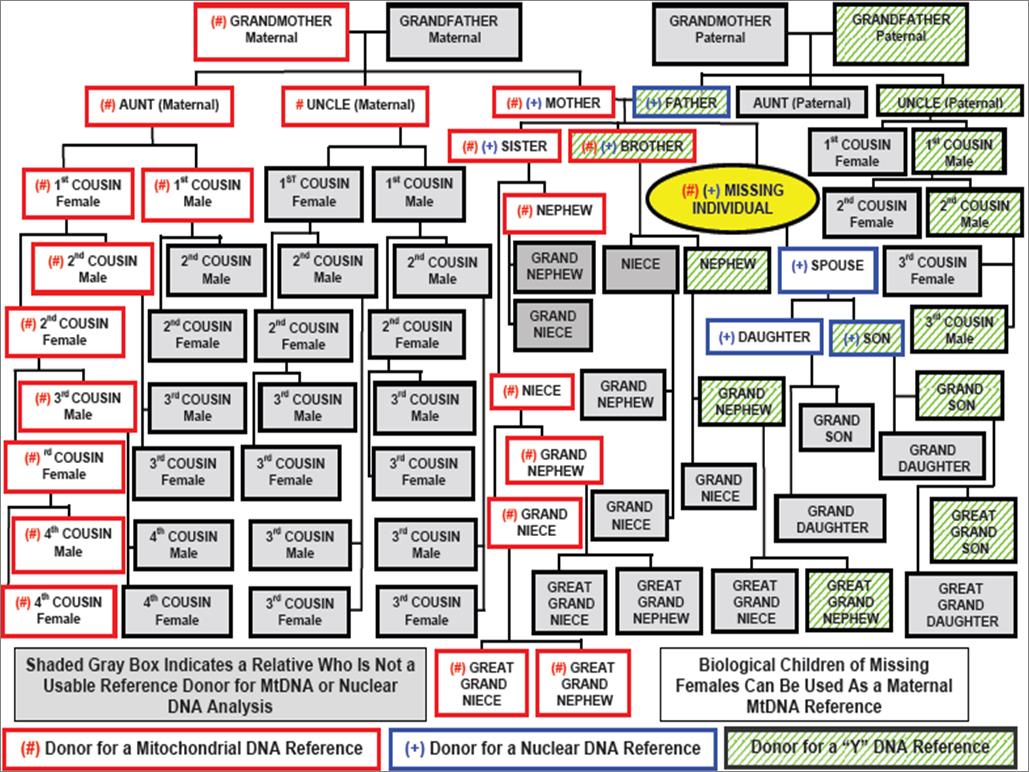
    On their web site’s “Contact Us” page, DPAA now has FAQs. The answer to one of those FAQs describes who can and cannot submit DNA samples useful in identifying recovered remains. The chart giving the answer can be viewed here. The text associated with the chart is short and can be viewed in DPAA’s FAQs.

    If your family lost someone in one of these conflicts and you qualify to submit a DNA sample, please arrange to submit one. By doing that you just might help identify the remains of a US service member who’s been repatriated but not yet been identified – as well as a relative of yours, however distant. Or you may help to identify remains to be recovered in the future.

    Everybody deserves a proper burial. That’s especially true for those who gave their all while serving this nation.


    (Author’s Note: While Jonn published an article announcing the recovery of SSG William Turner’s remains this past week, it appears that as of 18 August 2017 DPAA had not yet formally announced his accounting.

  • Five More Return

    DPAA has identified and accounted for the following formerly-missing US personnel.

    From World War II

    • RM2c Walter H. Backman, US Navy, assigned to the crew of the USS Oklahoma, was lost at Pearl Harbor, HI, on 7 December 1941. He was accounted for on 4 August 2017.

    • RM2c Quentin J. Gifford, US Navy, assigned to the crew of the USS Oklahoma, was lost at Pearl Harbor, HI, on 7 December 1941. He was accounted for on 31 July 2017.

    • 2nd Lt. Clarence E. Allen, 295th Fighter Squadron, 268th Fighter Group, US Army Air Forces, US Army, was lost in Germany on 12 October 1944. He was accounted for on 1 August 2017.

    From Korea

    • CPL Roy J. Hopper, Headquarters and Headquarters Company, 2nd Battalion, 19th Infantry Regiment, US Army, was lost in South Korea on 31 July 1950. He was accounted for on 7 August 2017.

    • PFC Walter C. Hackenberg, Company F, 2nd Battalion, 35th Infantry Regiment, 25th Infantry Division, US Army, was lost in South Korea on 25 April 1951. He was accounted for on 3 August 2017.

    From Southeast Asia

    • None

    Welcome back, elder brothers-in-arms. Our apologies that your return took so long.

    Rest in peace. You’re home now.

    . . .

    Over 73,000 US personnel remain unaccounted for from World War II; over 7,800 US personnel remain unaccounted for from the Korean War; and over 1,600 remain unaccounted for in Southeast Asia (SEA). Comparison of DNA from recovered remains against DNA from some (but not all) blood relatives can assist in making a positive ID for unidentified remains that have already been recovered, or which may be recovered in the future.

    On their web site’s “Contact Us” page, DPAA now has FAQs. The answer to one of those FAQs describes who can and cannot submit DNA samples useful in identifying recovered remains. The chart giving the answer can be viewed here. The text associated with the chart is short and can be viewed in DPAA’s FAQs.

    If your family lost someone in one of these conflicts and you qualify to submit a DNA sample, please arrange to submit one. By doing that you just might help identify the remains of a US service member who’s been repatriated but not yet been identified – as well as a relative of yours, however distant. Or you may help to identify remains to be recovered in the future.

    Everybody deserves a proper burial. That’s especially true for those who gave their all while serving this nation.


    (Author’s Note: Jonn published an article announcing RM2c Gifford’s accounting a few days ago. While DPAA’s “Recently Accounted For” page gives his date of accounting as 31 July 2017, that fact was not published on DPAA’s web site until on or after 7 August 2017.

  • Three More Return

    DPAA has identified and accounted for the following formerly-missing US personnel.

    From World War II

    • PFC Lloyd J. Lobdell, Company A, 192nd Tank Battalion, US Army, was apparently lost in the Philippines on 19 November 1942 (see note at end of article). He was accounted for on 26 July 2017.

    • LTJG Irvin E. Rink, US Naval Reserve, assigned to VF-27, US Navy, was lost in the Solomon Islands on 4 August 1943. He was accounted for on 25 July 2017.

    From Korea

    • CPL Dow F. Worden, A Company, 1st Battalion, 9th Infantry Regiment, 2nd Infantry Division, US Army, was lost in South Korea on 29 September 1951. He was accounted for on 24 July 2017.

    From Southeast Asia

    • None

    Welcome back, elder brothers-in-arms. Our apologies that your return took so long.

    Rest in peace. You’re home now.

    . . .

    Over 73,000 US personnel remain unaccounted for from World War II; over 7,800 US personnel remain unaccounted for from the Korean War; and over 1,600 remain unaccounted for in Southeast Asia (SEA). Comparison of DNA from recovered remains against DNA from some (but not all) blood relatives can assist in making a positive ID for unidentified remains that have already been recovered, or which may be recovered in the future.

    On their web site’s “Contact Us” page, DPAA now has FAQs. The answer to one of those FAQs describes who can and cannot submit DNA samples useful in identifying recovered remains. The chart giving the answer can be viewed here. The text associated with the chart is short and can be viewed in DPAA’s FAQs.

    If your family lost someone in one of these conflicts and you qualify to submit a DNA sample, please arrange to submit one. By doing that you just might help identify the remains of a US service member who’s been repatriated but not yet been identified – as well as a relative of yours, however distant. Or you may help to identify remains to be recovered in the future.

    Everybody deserves a proper burial. That’s especially true for those who gave their all while serving this nation.

    (Author’s Note: in their “Recently Accounted For” list, DPAA does not list a date of loss for PFC Lobdell. However, the DPAA News Release concerning Lobdell’s accounting indicates he was taken POW “after the surrender of Corregidor” (Corregidor surrendered on 6 May 1942). He was later moved to the Cabanatuan Prison Camp and is known to have died there of illness while a POW on 19 November 1942. The date of loss noted above is his known date of death, as it is unclear precisely which date PFC Lobdell was taken POW.)

  • Rest in Peace, Coach P

    Ara Parseghian died this past Wednesday.  He was 94.

    Most remember him for his days as head coach at Notre Dame University.  Others remember him for his post-coaching work supporting medical research aimed at curing multiple sclerosis (his daughter was a sufferer) and Niemann-Pick disease Type C (the genetic disorder that claimed 3 of his grandchildren).  By all accounts, he was a truly fine man.

    So, that’s all nice – but why this article?

    Like many if not most men of his generation, Parseghian was a vet.  He served in the US Navy during World War II.

    Rest in peace, Coach P.  Hopefully the Celestial Team has an opening for a coach.

  • Some F-35 Acquisition Projections

    A few days ago, Poetrooper wrote an article concerning foreign sales for the F-35.  In preparing comments to that article, I did a bit of research on the aircraft’s financials.

    The information I found was, to put it mildly, troubling.  So I decided I’d do a bit of “what-if” gaming to see what happens if reality intrudes on DoD’s plans with respect to the F-35.

    The basic financials for the F-35 program are not pretty.  Neither are the “what ifs”.  In fact, both are damned scary.

    So I decided to write this article.  I’ve tried to keep it as simple as possible, while still being as accurate as I can within the time I have available to chase facts.

    And no, PT – you’re not gonna like this article.

    . . .

    This article is structured into three parts.  The first part is a description of some the information I’ve found to date regarding F-35 financials, adjusted to 2017 dollars as necessary.  The second part is a “quick and dirty” analysis of what happens to the F-35’s unit and overall costs under several scenarios.  The third part is my attempt to put things in perspective – to answer the “So what?” question regarding the F-35.

    The article’s a bit long as it is.  So I’m not planning on presenting the details of my calculations in this article.  If there’s demand, I can edit the article to include a link to a “prettied-up” version of the spreadsheet I used to make the calculations.

    . . .

    Part I – Current F-35 Financials

    Wikipedia gives the following information regarding the F-35 program financials, as of 2015.  Though the immediate source is Wikipedia, their source was official program documentation from the F-35 PMO; I’ll thus take it as legit.

    • RDT&E Costs (2015):  $55.1 billion
    • MILCON:  $4.8 billion
    • Procurement:  $319.1 billion

    Now, this isn’t the breakout we need for projections – we need Development Cost and Procurement Cost instead.  And we shouldn’t simply use the RDT&E amount above as
    “Development Cost” without first determining whether or not that’s even close to correct.  Some portion of the RDT&E costs will be spent during production for follow-up testing, and some portion of the procurement costs will have been spent during development.

    However, since those portions in question will each likely be small, we probably won’t be too far off if we assume they balance each other.  So if we consider the RDT&E funding to be the F-35’s development cost and the combination of MILCON and Procurement funding the F-35’s Procurement Cost, we shouldn’t be too far off.  (The MILCON costs likely will go to setting up production and maintenance facilities associated with the aircraft, so they should fall under the Production Cost umbrella)  Hey – this is a “quick and dirty” estimate; it’s not a detailed budget projection.

    If we do that, that gives us the following starting point numbers:

    • Est Development Cost (2015):  $55.1 billion
    • Est Procurement Cost (2015):  $323.9 billion
    • Total Est Program Acquisition Cost (2015):  $379 billion

    Now, that’s in 2015 dollars (duh).  Converting to 2017 dollars ($1.00 in Jun 2015 had the purchasing power of $1.03 in Jun 2017, per the BLS CPI calculator), based on those Wikipedia numbers we get the following:

    • Est Development Cost (2015, in 2017 dollars):  $56.753 billion
    • Est Procurement Cost (2015, in 2017 dollars):  $333.617 billion
    • Total Est Program Acquisition Cost (2015, in 2017 dollars):  $390.37 billion

    However, it turns out those 2015 costs are no longer current.  The F-35 PMO publicly indicated last month that updated financials for the F-35 are now available.  Those new numbers indicate that the F-35’s Program Acquisition Cost has gone up to $406.5 billion in terms of 2017 dollars.

    That’s an increase, in terms of 2017 dollars, of $16.13 billion since 2015.  Since the F-35 PMO said that increase is split between RDT&E, MILCON, and Procurement funding, I’m going to assume the proportions of each in the increase are the same as they were in 2015. (They might not be in the same proportions, but since I don’t know one way or another that assumption seems reasonable.)  That yields the following

    • Updated Est Development Cost (2017):  $59.098 billion
    • Updated Est Procurement Cost (2017):  $347.402 billion
    • Updated Total Est Program Acquisition Cost (2017):  $406.5 billion

    Again:  these financial numbers probably aren’t exactly correct, but they’re probably close enough to do reasonable “what if” games to see what happens to program and unit costs if Congress or DoD decides to start reducing quantities.  Any errors should be reasonably small.

    The same Bloomberg article that gave the revised program costs seems to indicate a total planned production for the F-35 of 2,456 aircraft.  This yields an average Program Acquisition Unit Cost for the F-35 of $165.5 million – or over twice that of the F/A-18E/F.  And knowing the total number of F-35s projected to be produced is also the final piece of information we need to do reasonable “what if” games.

    What Happens If Quantities Are Reduced?

    Ok, the above are all based on the assumption that 2,456 F-35s will be produced.  So, what happens if the numbers to be built get cut?  Based on past DoD procurement history over the last 2 decades, we know that’s pretty damned likely.

    In broad terms, we already have a good idea of what should happen.  The overall Program Acquisition Cost will drop – but the unit cost will rise.  But by how much in each case?

    To figure that, we need to make some assumptions about the average flyaway cost of the F-35.  And we have the info to make some reasonable guesses about that, though we don’t have the details.

    The F-35 is expected to enter production in FY2018.  The PM has indicated he is confident he can make his flyaway cost target of about $85 million each for the F-35 in 2019 and (presumably) beyond.

    We don’t know what the add-ons to the flyaway cost will be needed to yield procurement cost will be.  But I can’t see them being more than about 5% of flyaway cost, so I’ll use that as a worst-case figure.

    Further, the flyaway cost tends to drop over time as I’ve discussed in an earlier article.  So the average flyaway cost of the last 1500 or so F-35s to be produced (231 have already been built) will likely be less than the 2019 figure.  How much less?  Dunno.

    Further, the F-35B and C models cost more.  I don’t have current figures for the flyaway costs of the B and C models, but most to be produced are the A model – so I’m going to assume it all comes out to a single figure “in the wash”.

    So for this part, I’m going to use 3 assumptions for flyaway cost of the items cut:  $85m average (the target cost for FY2019), $75M average (assumes the flyaway cost goes down substantially before we start cutting quantities), and $65M average (since that’s a nearly 25% reduction, this IMO essentially assumes the proverbial “. . . and a miracle occurs”).  I’m also going to assume the estimated Program Acquisition Cost of $406.5 billion is dead on target.

    Case 1:  Constant Flyaway Cost from FY2019 On

    This scenario is probably not terribly reasonable, as production costs tend to go down over time and I’m guessing the PMO is probably counting on that.  Nonetheless, it gives a good starting point.  That starting point is:

    • Program Acquisition Cost:  $406.5 billion
    • Total Produced:  2,456
    • Unit Acquisition Cost:  $165.5 million

    But what happens if either Congress or DoD cuts production?  After all:  recent history says that’s rather likely.

    Specifically, what happens if DoD or Congress says, “Nope – can’t afford those last 1,000.  Airforce, Navy, USMC:  you guys figure out how to split the 1,456 we actually will buy.”

    Now, as noted above the unit cost for the F-35B and C models is higher, so the mix will affect the overall average.  But I’m not going to attempt to deal with those complications on a quick-look analysis like this article.

    Anyway, here’s the impact, assuming a “salami-slice” cut (everyone gets an equal % reduction), based on an average flyaway cost of $85M per F-35 cut:

    • Program Acquisition Cost, 1456 total aircraft:  $317.25 billion
    • Unit Acquisition Cost:  $217.891 million

    Yep – the overall program’s acquisition cost goes down by $89+ billion.  But while the Program Acquisition Cost goes down, the unit cost for the aircraft goes up by $52+ million.  Why?  Because that $59+ billion in development costs (and the MILCON) are now spread over fewer items.

    So, what happens if we only end up producing, say, 1000?  Here ya go:

    • Program Acquisition Cost, 1000 total aircraft:  $276.552 billion
    • Unit Acquisition Cost:  $276.552 million

    Yep, the trend continues.  Program cost went down more – this time by nearly $130 billion.  But the unit cost for the bird has now grown by over $100M with respect to the original plan.

    Those numbers were ugly enough (in terms of unit cost) that I didn’t bother to run the 750 or 500 total production scenarios.

    And believe it or not, it gets worse.

    Case 2:  Flyaway Cost Reduced Moderately During Production

    I regard this as the most reasonable scenario.  Here, I project that we learn enough during the first 1000 F-35s produced that we can reduce the average flyaway cost from that point forward to $75M per aircraft.  I’m guessing I’m guessing the PMO is probably counting on something along those lines, though maybe not that exact amount.  I’m also assuming here that the $406.5 billion Program Acquisition Cost figure from the PMO released last month remains accurate.

    Here, there’s no impact if all 2,456 are built.  In that case, unit and total costs remain the same – $165.5M and $406.5B, respectively.

    But that’s not the case if DoD or Congress says, “Nope – can’t afford all of that.  Reduce the number produced.”  For a reduction to 1456 total aircraft, here’s what we get.

    • Program Acquisition Cost, 1456 total aircraft:  $327.75 billion
    • Unit Acquisition Cost:  $225.103 million

    Huh?  Wait a minute.  Both the program’s Acquisition Cost and the Unit Cost went UP with respect to the previous case?

    Yes, they did.  We removed the 1000 lowest-cost items produced – which cost less each than in the previous case.  Since we assume the total program cost of $406.5 billion is unchanged, that means the costs under this scenario were perforce proportionally more “front-loaded”.  The net effect is that we saved less overall (and ended up with an even higher unit cost to boot) by cutting the same number of items.

    It’s even uglier if production is cut to 1000 total:

    • Program Acquisition Cost, 1000 total aircraft:  $291.840 billion
    • Unit Acquisition Cost:  $291.84 million

    Under this scenario, we’re approaching a unit cost of $300M per aircraft.

    Case 3:  Flyaway Cost Reduced Substantially During Production

    I regard this as the least reasonable scenario.  Here, I project that we learn enough during production of the first 1000 F-35s that we could reduce the average flyaway cost from that point forward to $65M per aircraft, but that the $406.5 billion Program Acquisition Cost figure from the PMO released last month and remains accurate.  I don’t think we’ll see this happen, but you never know.

    As before, there’s no impact if all 2,456 are built.  In that case, unit and total costs remain the same as in the other two cases.

    Now, what happens if DoD or Congress says, “Nope – can’t afford that.  Reduce the number produced.”  For a reduction to 1456 total aircraft, here’s what we get.

    • Program Acquisition Cost, 1456 total aircraft:  $338.35 billion
    • Unit Acquisition Cost:  $232.314+ million

    Just like before, both Program Acquisition Cost and the Unit Cost went UP with respect to the previous case.  As before, we removed the 1000 lowest-cost items produced – but this time, what we removed cost even less than before.  So what we saw before in terms of rising program and unit costs got more extreme.

    It’s even uglier under this case if production is cut to 1000 total:

    • Program Acquisition Cost, 1000 total aircraft:  $307.128 billion
    • Unit Acquisition Cost:  $307.128 million

    There ya go.  Under this scenario, we now have a single-seat fighter aircraft that cost Uncle Sam $300+M each.  Isn’t that just dandy?

    Some Perspective, AKA the “So What?”

    So, what does all this mean?  Well, I’ve got a couple of thoughts along those lines.

    First:  the F-35 has been termed the most expensive weapon system ever.  That’s accurate.  We’re talking $406.5 billion just to buy it.  Operating and maintaining over its anticipated life span it will cost nearly 3x that (current estimate is somewhere around $1.1 trillion).

    To put that in perspective, I’ve seen various estimates for the cost of procuring a carrier battle group (CBG) – including both ships and aircraft – ranging from $20 billion to $40 billion.  Assuming a CBG procurement cost of $30 billion on average (CBGs vary in size, and $30 billion is the midpoint of the range), that means we’re planning to spend enough on the F-35 alone to replace all 10 existing Navy carrier battle groups – plus buy 3 additional CBGs, and still have $16.5 billion left over.

    Even at the higher end of estimated CBG cost ($40 billion), we’re still talking enough to replace all 10 Navy CBGs.  And that still leaves $6.5 billion to “play with”.

    That matters because we’ll need other new things too over the next 3 decades.  Obviously, F-35 is hardly the only new weapons system we need to develop during the next couple of decades.  Hell, it’s hardly the only new aircraft the USAF will need over the next 25+ years – which is how long the F-35 is projected to be in production (until 2044).  But if we’re going to spend $400+ billion on it . . . where do we get the $$$ for the others?

    The F-35 may end up being a great aircraft.  Or it might not be.  But it doesn’t matter how damn good it is if we can’t afford to procure enough of them to do the job – or if buying it means the rest of DoD is left Bravo Delta due to lack of money to train/operate/maintain, or due to obsolete equipment because we can’t afford to buy anything else new.

    I just don’t see how we can afford it.  Not if we’re going to have enough funding left to buy the other new stuff we need, plus train/operate/maintain.

    Second:  consider what this could do in terms of forcing leadership to be more risk-adverse.  (Arguably, we’re already too risk-adverse as it is.)  Let’s say the unit cost of a F-35 ends up being around $200M after all is said and done.  That could very easily happen if quantities procured fall significantly short of what’s projected today, and it’s my guess that it indeed will.  Remember:  best-case, they’re going to cost around $165M each anyway – and that’s only if we build all 2,450+ of them that are currently planned.  Build fewer, and the unit cost goes up.

    A typical squadron has between 12 and 24 aircraft.  Let’s say the average is 18.  That means a squadron commander now “owns” aircraft worth $3.6 billion dollars.  A wing commander will own probably 3 or 4 times that much in terms of aircraft cost.  Wow, that’s gonna look great on their OERs!

    Well, it certainly will – unless something happens to one of those aircraft due to an accident, bad maintenance, or even wartime losses. Then . . . who’s gonna be blamed?

    Now I’m not an aviator.  But last time I checked, the entire chain-of-command sometimes felt the pain of one dumbass decision (or honest mistake) by a relatively junior troop.  How’s that gonna play out for the chain-of-command when some wannabe sh!t-hot young and inexperienced fighter jock crashes a $200M aircraft by doing something foolish or reckless?  Or cuts a maneuver too close, and gets into a midair – and takes out $400M worth of Uncle Sam’s property?  Or when a maintainer misses something, and $200M ends up a “smoking hole” as a result?

    My guess is that it will be seriously bad news for both his squadron and wing commanders – hell, I think something like that already is bad news for the entire chain-of-command.  But I’d guess it will be far worse for the chain-of-command than it is today when the financial loss of such an incident is $200M (or $400M or more).  And I’m guessing that because of this possibility, a risk-adverse attitude (“Don’t take any chances with your equipment!”) will filter down to their subordinates, too – including their maintainers, who will find themselves being even more “under the gun” regarding aircraft maintenance than they are today.

    That’s not necessarily a good thing.  We don’t need timid or risk-adverse military leaders leading troops in combat any more than we need reckless fools doing the same.  Either can be a prescription for disaster.

    . . .

    As I said, I’m no aviator.  I could be wrong above.  But it seems to me that this bird is simply not affordable – even it ever it works as proponents claim it will “real soon now” in all respects.  And based on what I’ve seen to date, I’m damned pessimistic about it ever working “100% as advertised”.

    I think we need to cut our losses here, and go back to the drawing board.

    Any weapon system has to be affordable enough to buy in the first place – and to risk losing it while training or in combat.  Otherwise, it’s nothing but a wet dream made real for developers and manufacturers that’s of little military utility.

    I just don’t think we can afford this one – no matter how good it eventually may be.  It’s not the only new system DoD will need over the next 25 years.


    (Addendum:  for what it’s worth, assuming we’ve spent roughly 85% of the development cost of the F-35, or about $50 billion, so farper this Wikipedia article it appears that we’ve already spent roughly $96 billion on developing and procuring the F-35 through 2016.  [Spending for the F-35 for 2017 doesn’t seem to be available there.]  For production to date of 231 F-35s of all types, that works out to an average unit acquisition cost of around $415.4 million as of this year.

    And costs for the system continue to rise above projections as time goes by.)

  • Some More Thoughts on Weapons Systems Costs and Their Uses

    The other day, I published an article describing the 8 distinct (and different) costs DoD defines for weapons systems under development.  While I touched on the utility of some of them briefly, I didn’t really say much regarding how each of those costs can be used.

    They’re not meaningless bookkeeping exercises.  Each is useful – even if some are more useful than others.

    Today, I’ll discuss the uses of those 8 costs.  For ease of following along, I’ll follow the order used in my first article.  You can find that prior article here.

    Development Cost.

    It might seem as if examining development costs would be rather pointless.  And in truth, they are in general “sunk costs”.  Once they’re incurred, there’s no way to recover them.  Even if they program is cancelled, that money is gone. So why would we care about it?

    However, other than the obvious fact that the US taxpayer foots that bill, knowing a system’s development cost is useful in other ways.  The amount of development cost can be (and often is) an indicator of two things.  First, a high development cost in anything but a space system generally indicates one of three things:  (a) a program that is using “bleeding edge” technology, or is developing new technology altogether; (b) a program that is having difficulty and is having to “re-do” things, or (c) both.  Second, it often indicates that the system being produced may be a bit problematic – at least initially.

    A case in point is the B2.  It had a huge development cost – $29+B out of a total program cost of around $45B, though in fairness it’s production was curtailed by political action.  It indeed developed serious new technology (curved surface stealth) and made use of other highly advanced (for the day) technologies.   It also had a somewhat extended and troubled development, and is also reputedly somewhat difficult and expensive to maintain.  Draw your own conclusions regarding whether the those are related.

    Flyaway Cost.

    The flyaway cost (or sailaway or rollaway cost, if instead you’re talking about ships or ground systems) is actually a quite useful cost.  However, it’s not useful in perhaps quite the way you might think.

    For starters:  the flyaway cost does not give you the full cost to DoD of the system.  It doesn’t include development costs essential equipment that is required but not part of the system itself; initial spares; or a few other things.  So the flyaway cost isn’t the answer to the question, “How much did (or will) that (whatever) cost Uncle Sam?”

    Further, flyaway cost changes over time.  This is because as more of an item are produced production line efficiency improves.  The workforce gets more efficient; procedures get streamlined and improved, with “kinks” getting worked out; the management team gets more experience at managing the process; and the same all occurs with suppliers of components.  It’s not unusual to see the last of a particular weapon system produced have a far lower flyaway cost than the first.

    So, how is it useful?  It’s useful for projections.  Since the flyaway cost is the cost of producing one item, for systems near end of production the current flyaway cost is effectively the marginal cost of producing one more item than originally planned – or the savings associated with producing one less.  It can be used to answer such questions as, “How much would another 50 (whatevers) cost?” or “How much would cutting production by 25 save Uncle Sam?”  Decision-makers sometimes need to know this.

    Weapon System Cost and Procurement Cost.

    Weapons System Cost is simply Flyaway Cost plus the cost of other items (e.g., prime movers, system-unique test equipment and special tools, associated radios) that were not developed as part of the system under development, but which are nonetheless needed for its normal operation.  Procurement Cost adds to that initial spares and a couple of other things.  As such, the uses of these two costs – and the pitfalls associated with each – are effectively the same as for the Flyaway Cost.  Indeed, the Procurement Cost is actually what you want if you’re going to do accurate “what if” drills regarding changing numbers produced.

    Program Acquisition Cost.

    The Program Acquisition Cost is probably the most useful cost for answering the question, “How much will (or did) that (whatever) cost Uncle Sam to develop and field?”  This cost is the sum of Development Cost and Procurement Cost.  As such, it represents virtually everything DoD actually spends to develop a system and deploy it to the field.  So if that’s what someone wants to know the total cost to field a particular system – or wants to know how much each copy cost Uncle Sam to buy – that number is essential.

    What it does NOT include is the cost of actually operating the system.  So while it tells you how much $$$ is needed (or was spent) to buy it, it doesn’t tell you squat about how much you’ll spend to use the system for 10 or 20 or 30 (or more) years.

    For anything but a space system, Total Program Cost is generally only somewhere between 20% and 40% of the total cost of owning and operating the system.  So while you hear a lot about it for weapons being developed, it’s not even really the “biggie” in terms of overall $$$.

    Operations and Support Cost.

    Operations and Support Cost is what it costs to actually use the system after it’s fielded – e.g., fuel, maintenance, spare parts (other than initial spares), operator salaries, etc . . . .  While system developers determine these costs, their programs aren’t the one to pay for them – units operating the systems do.  So “Big Army”/HQAF/DoNavy/HQ USMC and their subordinate HQs are the ones who care about these.

    You have to know these costs in order to calculate future budget requests.  And as the bureaucrat from DC put it to the test pilots in the movie The Right Stuff:  “Funding. That’s what makes your ships go up . . . . No bucks, no Buck Rodgers.”

    Disposal Cost.

    Since this is the cost of demilitarizing and disposing of a system being retired, anyone involved in that activity needs to know this cost.  And while it’s usually a relatively small cost with respect to the overall system’s Life-Cycle Cost (next), it can still be substantial in absolute terms.

    It’s also an area that you really don’t want to neglect if you’re responsible for same.  Ask the folks who formerly worked at Edgewood Arsenal how not having enough funding to properly dispose of stuff worked out for them.

    Life-Cycle Cost.

    This is the total cost of ownership of the system – including buying, selling, and disposing of it when it’s no longer needed.  This is of keen interest to high-level policy makers in DoD who manage DoD’s budget and requests for funding.

    . . .

    That’s all for today.  In the next few days, I’ll take a bit more of an in-depth look at what we know about the F-35’s program costs  and production.  I’ll also do a bit of “what if” to project what might happen if (as is virtually certain to occur based on recent past history) the number currently planned to be produced is reduced due to lack of funding.

  • If You Want to See A Real Liberal Jerk in Action . . . (Part 2)

    Well, here ya go.  Different kind from that highlighted Poetrooper’s last article on the same subject, though.

    This one’s a CNN host – Fareed Zakaria.  Yeah, I know: that’s a “shocker”. (smile)

    Here’s the money quote from a recent interview (emphasis added):

    “The election of Donald Trump is really a kind of class rebellion against people like us, educated professionals who live in cities, who have cosmopolitan views about things.”

    In short:  according to      “Progressive” tools      those highly educated,      Metrosexual Euroweenie      “cosmopolitan” types like Lord Fareed here, anyone from the      peasant      working class – or who otherwise doesn’t agree with him – should just shut up and color.  Obviously, they should let their “betters” (AKA the     Socialist      “Progressive elite”) run the show.

    Oh, and later in the interview he plays the “racism” card, too. What a surprise.

    Sheesh. And his ilk claims that his side represents the interests of the “Little Guy”? That’s like an English Lord from the 1400s claiming he understands the peasants’ concerns and issues – when in reality he doesn’t give a damn about what happens to them at all, so long as he’s safe and comfortable in his Manor House.

    Yo, Zakaria:  did you ever think that maybe 8 years of failed      Socialism      Progressive policy under the previous SCoaMF – which Clintoon sought to continue – might have had something to do with Trump’s election? Along with the fact that Clintoon was one of the most personally disagreeable and seemingly financially corrupt Presidential candidates in history?

    Both Fox News and the Washington Free Beacon have short articles giving a few more quotes from Lord Foot-in-mouth here.  They’re worth a read.

    Sheesh.  What a freaking arrogant, elitist ass.