Author: Hondo

  • Out of the Mouths of Libidiots . . .

    . . . on rare occasion comes God’s honest truth – either by accident or design.

    This past Sunday Senator Dianne Feinstein, D-CA, appeared on multiple national news shows.  She was promoting new Federal legislation banning “bump stocks”.

    During that appearance, subject of the recent Las Vegas mass shooting came up.  Feinstein was asked if there might “have been any law passed that would’ve stopped” that recent massacre.

    Her answer,  rephrased in simple English:  “No”.

    And that wasn’t a slip of the tongue, either.  Feinstein reiterated essentially the same answer on another news program later in the day.

    Gee.  So Feinstein is promoting yet another gun control law that she knows won’t have any significant effect when it comes to preventing gun crimes.  No surprise there.

    No, what shocks me is that Feinstein – who never met a gun control measure she didn’t like – actually admitted something anyone with common sense already knows.  To wit:  gun control laws . . . don’t prevent gun crimes. All they do is limit the rights of law-abiding citizens.

    There’s simply no way to anticipate and prevent the actions of a loon – or a terrorist – if they keep a low profile and act within the law while planning their criminal acts.  The Las Vegas shooter did exactly that.

    Libidiot politicians telling God’s honest truth.  Perhaps the Millennium truly is at hand!  (smile)

  • Another Seven Return

    DPAA has identified and accounted for the following formerly-missing US personnel.

    From World War II

    • SK3c Wallace E. Eakes, US Navy, assigned to the crew of the USS Oklahoma, was lost at Pearl Harbor, HI, on 7 December 1941. He was accounted for on 3 October 2017.

    • SK3c Eli Olsen, US Navy, assigned to the crew of the USS Oklahoma, was lost at Pearl Harbor, HI, on 7 December 1941. He was accounted for on 29 September 2017.

    • S1c Clifford G. Goodwin, US Navy, assigned to the crew of the USS Oklahoma, was lost at Pearl Harbor, HI, on 7 December 1941. He was accounted for on 29 September 2017.

    • S1c Joseph M. Johnson, US Navy, assigned to the crew of the USS Oklahoma, was lost at Pearl Harbor, HI, on 7 December 1941. He was accounted for on 2 October 2017.

    • Pfc Harold P. Hannon, Company E, 2nd Battalion, 8th Marines, 2nd Marine Division, Fleet Marine Force, USMC, was lost Tarawa Atoll on 20 November 1941. He was accounted for on 4 October 2017.

    From Korea

    • PFC Willie E. Blue, K Company, 3rd Battalion, 9th Infantry Regiment, 2nd Infantry Division, US Army, was lost in South Korea on 31 August 1950. He was accounted for on 29 September 2017.

    • Sgt Johnson McAfee, Jr., USMCR, assigned to Company F, 2nd Battalion, 7th Marine Regiment, 1st Marine Division, Fleet Marine Force, USMC, was lost in North Korea on 28 November 1950. He was accounted for on 3 October 2017.

    From Southeast Asia

    • None

    Welcome back, elder brothers-in-arms. Our apologies that your return took so long.

    Rest in peace. You’re home now.

    . . .

    Over 73,000 US personnel remain unaccounted for from World War II; over 7,800 US personnel remain unaccounted for from the Korean War; and over 1,600 remain unaccounted for in Southeast Asia (SEA). Comparison of DNA from recovered remains against DNA from some (but not all) blood relatives can assist in making a positive ID for unidentified remains that have already been recovered, or which may be recovered in the future.

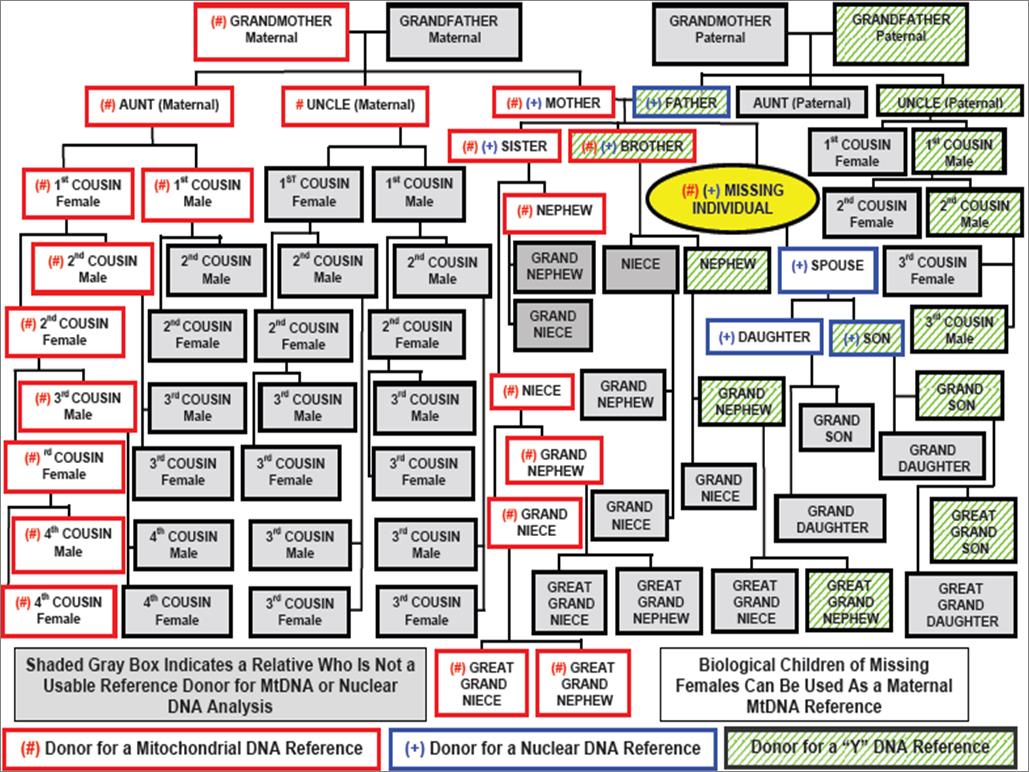
    On their web site’s “Contact Us” page, DPAA now has FAQs. The answer to one of those FAQs describes who can and cannot submit DNA samples useful in identifying recovered remains. The chart giving the answer can be viewed here. The text associated with the chart is short and can be viewed in DPAA’s FAQs.

    If your family lost someone in one of these conflicts and you qualify to submit a DNA sample, please arrange to submit one. By doing that you just might help identify the remains of a US service member who’s been repatriated but not yet been identified – as well as a relative of yours, however distant. Or you may help to identify remains to be recovered in the future.

    Everybody deserves a proper burial. That’s especially true for those who gave their all while serving this nation.


    (Author’s Note: While Jonn published an article announcing the recovery of SSG William Turner’s remains some time ago, as of 6 October 2017 DPAA has yet to formally announce his accounting.

  • Alton Nolan Convicted

    Longtime readers may remember Alton Nolen from about 3 years ago.   For those who don’t:  he was the guy from Oklahoma City who got fired from his job at a food packing plant – then went back with a knife,  beheaded one lady who worked there, and seriously injured another.  He was apprehended after being shot by one of the plant’s executives.

    Nolan was convicted of first-degree murder Friday.  The projected date for sentencing is not available.

    While Nolen was apparently a convert to Islam, there’s still no definitive link between his crimes and terrorism (or at least the media and authorities aren’t making that info public, if that’s the case).  His attorneys claim he’s crazy, and he repeatedly attempted to plead guilty and asked for the death penalty.

    Regardless:  hopefully in this case, the judge – and the State of Oklahoma – will give him exactly what he says he wants.

  • Five More Return

    DPAA has identified and accounted for the following formerly-missing US personnel.

    From World War II

    • 2nd Lt Elwood R. Bailey,USMC Reserve, assigned to Marine Fighting Squadron 223 (VMF-223), Marine Aircraft Group 23, (MAG-23), USMC, was lost in the Solomon Islands on 24 August 1942. He was accounted for on 27 September 2017.

    • Pvt John M. Tillman, Company F, 2nd Battalion, 2nd Marine Regiment, 2nd Marine Division, USMC, was lost on Tarawa Atoll on 20 November 1943. He was accounted for on 27 September 2017.

    From Korea

    • CPL Donald L. Baer, K Company, 3rd Battalion, 34th Infantry Regiment, 24th Infantry Division, US Army, was lost in South Korea on 20 July 1950. He was accounted for on 28 September 2017.

    • MAJ Stephen T. Uurtamo, Headquarters Battery, 82nd Anti-Aircraft Artillery Automatic Weapons Battalion, 2nd Infantry Division, US Army, was lost in North Korea on 1 December 1950. He was accounted for on 28 September 2017.

    • PFC Leroy W. Bryant, C Company, 1st Battalion, 9th Infantry Regiment, 2nd Infantry Division, US Army, was lost in South Korea on 6 February 1951. He was accounted for on 27 September 2017.

    From Southeast Asia

    • None

    Welcome back, elder brothers-in-arms. Our apologies that your return took so long.

    Rest in peace. You’re home now.

    . . .

    Over 73,000 US personnel remain unaccounted for from World War II; over 7,800 US personnel remain unaccounted for from the Korean War; and over 1,600 remain unaccounted for in Southeast Asia (SEA). Comparison of DNA from recovered remains against DNA from some (but not all) blood relatives can assist in making a positive ID for unidentified remains that have already been recovered, or which may be recovered in the future.

    On their web site’s “Contact Us” page, DPAA now has FAQs. The answer to one of those FAQs describes who can and cannot submit DNA samples useful in identifying recovered remains. The chart giving the answer can be viewed here. The text associated with the chart is short and can be viewed in DPAA’s FAQs.

    If your family lost someone in one of these conflicts and you qualify to submit a DNA sample, please arrange to submit one. By doing that you just might help identify the remains of a US service member who’s been repatriated but not yet been identified – as well as a relative of yours, however distant. Or you may help to identify remains to be recovered in the future.

    Everybody deserves a proper burial. That’s especially true for those who gave their all while serving this nation.


    (Author’s Note: While Jonn published an article announcing the recovery of SSG William Turner’s remains some time ago, as of 30 September 2017 DPAA has yet to formally announce his accounting.

  • Four More Return

    DPAA has identified and accounted for the following formerly-missing US personnel.

    From World War II

    • WT2c Porter L. Rich, US Navy, assigned to the crew of the USS Oklahoma, was lost at Pearl Harbor, HI, on 7 December 1941. He was accounted for on 15 September 2017.

    • S2c George J. Wilcox, US Navy, assigned to the crew of the USS Oklahoma, was lost at Pearl Harbor, HI, on 7 December 1941. He was accounted for on 15 September 2017.

    • 1st Lt. Homer A. Spence, 96th Fighter Squadron, 82nd Fighter Group, US Army Air Forces, US Army, was lost in Italy on 20 July 1944. He was accounted for on 21 September 2017.

    • PVT Shirley E. Bailey, G Company, 8th Infantry Regiment, 4th Infantry Division, US Army, was lost in Germany on 29 November 1944. He was accounted for on 20 September 2017.

    From Korea

    • None

    From Southeast Asia

    • None

    Welcome back, elder brothers-in-arms. Our apologies that your return took so long.

    Rest in peace. You’re home now.

    . . .

    Over 73,000 US personnel remain unaccounted for from World War II; over 7,800 US personnel remain unaccounted for from the Korean War; and over 1,600 remain unaccounted for in Southeast Asia (SEA). Comparison of DNA from recovered remains against DNA from some (but not all) blood relatives can assist in making a positive ID for unidentified remains that have already been recovered, or which may be recovered in the future.

    On their web site’s “Contact Us” page, DPAA now has FAQs. The answer to one of those FAQs describes who can and cannot submit DNA samples useful in identifying recovered remains. The chart giving the answer can be viewed here. The text associated with the chart is short and can be viewed in DPAA’s FAQs.

    If your family lost someone in one of these conflicts and you qualify to submit a DNA sample, please arrange to submit one. By doing that you just might help identify the remains of a US service member who’s been repatriated but not yet been identified – as well as a relative of yours, however distant. Or you may help to identify remains to be recovered in the future.

    Everybody deserves a proper burial. That’s especially true for those who gave their all while serving this nation.


    (Author’s Note: While Jonn published an article announcing the recovery of SSG William Turner’s remains some time ago, as of 23 September 2017 DPAA has yet to formally announce his accounting.

  • “Helden”

    The late David Bowie was a musical icon.  He wrote some of the most creative and lasting popular music of the last several decades.

    This is about one of his works – one that I believe resonates particularly strongly with veterans of a certain part of the Cold War.  I know it certainly does with me.

    And I think I may have finally figured out why.

    Yep, you’re right – this is yet another verbal “walkabout” off the normal TAH “res”.   Better hit yer browser’s back button before it’s too late to escape yet another trip down the proverbial rabbit hole.  (smile)

    . . .

    The four years from 1972 to 1976 were hugely commercially and artistically successful period for Bowie.  But the personal cost was substantial.

    As a young man, Bowie had been advised to stay away from drugs – he was later to call this the best advice he’d ever received.  Yet like many of that era in the music business he ignored the advice.

    Ignoring that advice nearly killed him.

    Reputedly, his longtime assistant convinced him to leave the LA music and cocaine scene in the mid-1970s and get clean.  He did so – first moving to Paris, then to Switzerland, and finally settling in a small, shabby apartment in a working-class (and at the time, mostly Turkish) neighborhood near the Berlin Wall.  Doing this probably saved his life – though not his marriage.  He and his first wife divorced a few years later, in 1980.

    Here, Bowie regained control of his life and recovered.  And working with some of the musical luminaries of the day (e.g., Tom Visconti, Brian Eno, David Fripp, and others) he recorded three of his most critically acclaimed albums – Low, “Heroes”, and Lodger, collectively termed his “Berlin Trilogy”.  The album “Heroes” was the only one of these that was written and recorded entirely in Berlin.

    This background is IMO significant, because it affected the music Bowie produced during the period.  And that ties directly into why I think one of those songs resonates with those who served during that part of the Cold War.

    . . .

    OK, that’s the background about Bowie.  Now, some about the tune.

    The song in question is “Heroes” (the quotes are part of the title).  The music seems upbeat, with perhaps a bit of wistfulness added.  Though initially not particularly well-received, it’s become recognized as one of Bowie’s signature works – perhaps his finest.

    Live, it’s anthemic and stirring.  It appears to be a triumphant and joyful song – a musical reminder that one can “be all that you can be” if one seizes the day.

    That interpretation is IMO absolutely wrong.  The song isn’t about improving oneself or one’s state in life.  Rather, it’s about being caught in a no-win situation.

    And that – plus the timing – is why I believe the song resonates with those who served during and for a few years after the period in which the song was written.

    . . .

    On the surface, the song is about 2 lovers, told from the man’s perspective.  That much is obvious.  But the reality of the circumstances inspiring the song is hardly triumphant or inspiring.

    In truth, the surface impression is fairly on the mark.  An illicit love affair was the inspiration for the song.  Bowie wrote it after seeing, from his apartment’s window, the album’s producer embrace his mistress near the Berlin Wall.  (Bowie for years claimed it was an anonymous couple, until the man involved – Tom Visconti – publicly acknowledged the truth years later.  Bowie then confirmed Visconti’s account in 2003.)

    Bowie had been around the block enough by then to know how unlikely such a relationship was to last – he’d gone through many himself by that point.  So the song’s inspiration was something Bowie knew was almost certainly doomed to fail.

    Those two factors influence the original song’s lyrics, flow, and tone.  They’re also essential in understanding it.

    Bluntly put, IMO the song is about being in a relationship that’s doomed to fail.  And it captures that feeling, both musically and lyrically, exquisitely well.

    The original English-language version of the tune can be found here; an English-German version, released a few weeks afterwards, can be found here .  (The historical images accompanying the latter version are worth the time it takes to watch, though a few misguided Photoshopped images also appear in the mix.  Be forewarned:  the images will likely provoke various emotional reactions – among them nostalgia, sadness, anger, disgust, euphoria, and pride.)  Many live versions of the tune are also excellent (here is a representative sample).

    But for those who served in the US military during the mid/late 1970s and early 1980s, I believe there’s another reason behind the tune’s appeal.

    . . .

    IMO, in “Heroes” Bowie unintentionally captured something bigger than the song’s obvious storyline.  By accident or design Bowie captured the  mood of a short period of time – a time where Western civilization as we know it today could well have ended.

    The song was recorded at the depth of the Cold War.  It was recorded at the West’s Cold War nadir:  during the post-Vietnam period.

    That was a time, frankly, when it seemed the West might lose the Cold War.

    It was written and recorded in West Berlin – an enclave of the West 100 miles inside Communist East Germany.  A city that knew it was lost if the organic fertilizer ever indeed hit the rotary air movement device.  (smile)

    It was written while the Berlin Wall still existed as a de facto international border.

    The historical accounts do not exaggerate.  The Berlin Wall (and the rest of the IGB) was indeed monitored by  Grenztruppen der DDR (East German Border Troops, often inaccurately called “Volkspolezei” or “VoPo”) guards with orders to shoot those attempting escape.  Nearly 140 individuals died at the Berlin Wall between 1961 and 1989.

    So those “shots above our heads” Bowie was talking about . . . weren’t just figures of speech.  They were all too real.

    Korea along the DMZ wasn’t much different.  The APF there was damned high, too.  And there were periodic incidents there as well.

    Bottom line:  during the mid/late 1970s and early 1980s, that Soviet bear and its allies at the time seemed 10 feet tall.

    . . . 

    So here’s my theory about why the song affects me, and I’d guess many who served during the late 1970s and early 1980s.   Anyone who served in Europe then, or in Korea – or, well, pretty much anywhere  during the same period – at times felt much ­­like the song’s hypothetical “hero”.

    Why?  Simple.  Those of us anywhere near the IGB or Korean DMZ knew that if the balloon went up . . . we probably weren’t coming home.  We knew that many, and probably most if not all, of us were going to die in place doing what we could to stop the enemy.

    And we weren’t sure we could.

    So, yeah:  we understood what Bowie was saying, albeit maybe subconsciously.  Like the song’s protagonist we were putting on a brave face – most of the time.  We were whistling as we walked past the graveyard.

    But we knew the score, even if we didn’t often speak the truth plainly. We couldn’t deceive ourselves all of the time.

    We knew, deep down, if push came to shove . . . we were toast.  We just hoped we could buy enough time to preserve something worth saving before we bought the farm.

    None of us really wanted to end up in a position to be “heroes” – not even just for one day.  (smile)  We knew that often those in such a situation often didn’t come home.  But we also knew full well exactly that might happen.

    And as strange as it might seem . . . for the most part, we were OK with that.

    Thank God those days are past.

    . . .

    David Bowie passed away over a year ago.  And it’s a bit ironic to me that he was the one to so nearly perfectly capture the US military’s mood of that time frame.   His public persona was anything but military.

    Still  . . . he IMO he did capture that era and that feeling damn near perfectly.  So, wherever you are today, Mr. B:  an old Cold Warrior sends his thanks.

    IMO you certainly “got it right” with that one.
  • Debunking Yet Another False Claim

    Something happened recently that bothered me.  And since it may have happened to other TAH readers, I decided to write this article detailing the facts – just in case someone else might need them.

    The other day, I was conversing with a friend who’s more liberal politically than I am.  They informed me I shouldn’t use the term “special little snowflake”, as it had a dark history.  They weren’t much more specific.

    Now, unlike some I tend to do a bit of homework before running my yap.  But something about that claim just didn’t sound right to me.  I decided to check into it.

    What I found leads me to believe that someone is trying to create a false meme for political purposes.  Once again, the political left is trying to redefine language – this time through blatant falsehood.

    If you search the Internet, you’ll see claims that the term “special snowflake” or “snowflake” is of Nazi origin and is a racial slur.  The claim is that the Nazis used it to refers to Jews – more specifically, their remains in the form of crematoria ash from Nazi concentration and/or death camps that “fell to the ground like snow”.  There’s even an Urban Dictionary entry to that effect.

    Well, that means it must be true, right?

    In a word:  no.  Those claims are absolute bullsh!t.

    There is no evidence that the Nazis ever used the terms “snowflake” or “special snowflake” to refer to Jews or crematoria ash.  Those claims are a baldfaced lie.

    The US Holocaust Museum’s Holocaust Encyclopedia does not contain the terms.  Their archives do not show the terms used in that manner.  Museum officials are unaware of Nazi soldiers routinely using the term “snowflake” or “special snowflake” with that meaning.

    The same is true of the education team at the Illinois Holocaust Museum.  They were also unaware of that use of the term “snowflake” or “special snowflake” by Nazis during the Holocaust to refer to crematoria dust or Jews.

    Don’t believe me?  Well, don’t take my word for it.  Check out Snopes – who actually researched the claim and found it to be BS.  Snopes may lean a bit left, but they’re generally extremely good at fact-checking questionable claims like this.  And they’re honest about what they find.

    As far as Snopes could find, the sole purported source allegedly “documenting” Nazi origin for the terms is an entry in an Internet site called the “Racial Slur Database”.  To put it charitably, the “Racial Slur Database” is unreliable as a source.  As Snopes states in their entry I linked, the “Racial Slur Database” site freely admits that their entries are “entirely from data gleaned off the ‘net and via submissions from people like you and your parents.”  In plain language, that means they just put any and everything they find on the Internet or that someone sends them in their database – NQA, and without fact-checking.

    In reality the sarcastic phrases “special snowflake” and the variant “special little snowflake” probably gained popularity as a variation on the following quote from the 1990s book and movie The Fight Club.

    “You are not special. You are not a beautiful and unique snowflake. You are the same organic and decaying matter as everyone else.”

    Couple that with the common knowledge that every snowflake is unique, and the phrases “special snowflake” and “special little snowflake” – used sarcastically – practically suggest themselves.  Indeed, one commonly accepted definition of the phrase “special little snowflake” is as follows:

    A below average kid who is coddled and rewarded for mediocrity, usually by an overprotective mother, a ‘sensitive’ dad, or the public education system. The term stems from the concept that, like a snowflake, all children are special and unique and thus they should be treasured just the way they are so as to build their self-esteem.

    Use of the phrases are so ubiquitous today that they’ve spawned a related term, Special Snowflake Syndrome:

    A malady affecting a significant portion of the world’s population wherein the afflicted will demand special treatment, conduct themselves with a ludicrous, unfounded sense of entitlement, and generally make the lives of everyone around them that much more miserable.

    . . .

    So how did the term become falsely associated with the Nazis?  Dunno for sure, but I’ll hazard a guess.

    Here’s what I think happened.  One day, some bozo was acting like an immature, conceited, childish twit – a “special little snowflake”, if you will – carrying on and acting as if they were the center of the universe while demanding special treatment they didn’t rate.  When they got called on it, the person calling them out used the term “special little snowflake”.

    The jackass in question didn’t like being called out – and particularly didn’t like the perfectly descriptive term used in calling them out.  So they decided to try and “poison the well” regarding the use of the term by creating the false entry in question in the “Racial Slur Database”.

    What they apparently didn’t count on was the fact that although the Internet makes it easy to spread lies, it also makes it easy for someone who wants to fact check bogus claims.  And there are reputable sources out there that do the latter.

    In other words:  someone tried to pull a fast one using the Internet and got caught lying.

    So if you run across someone who tries to tell you that the term “snowflake” or “special little snowflake” is “racist” or has a Nazi past, tell them they’re full of it.  And then tell them to check Snopes for verification, since they probably won’t believe the truth from you.


    Author’s Note:  Definitions above for Special Little Snowflake and Special Snowflake Syndrome are also from the Urban Dictionary.  I won’t repeat their thoroughly-debunked-as-bullsh!t definition that falsely associates the term Special Snowflake with Nazism, as it’s been proven bogus and was obviously written by someone on the Left with a political agenda.

  • Eleven More Are Accounted For

    DPAA has identified and accounted for the following formerly-missing US personnel.

    From World War II

    • CWT Paul R. Wright, US Navy Reserve, assigned to the crew of the USS Oklahoma, was lost at Pearl Harbor, HI, on 7 December 1941. He was accounted for on 1 September 2017.

    • FM1c Charles R. Ogle, US Navy, assigned to the crew of the USS Oklahoma, was lost at Pearl Harbor, HI, on 7 December 1941. He was accounted for on 11 September 2017.

    • FM1c Gerald H. Pirtle, US Navy, assigned to the crew of the USS Oklahoma, was lost at Pearl Harbor, HI, on 7 December 1941. He was accounted for on 31 August 2017.

    • FM2c John D. Wheeler, US Navy, assigned to the crew of the USS Oklahoma, was lost at Pearl Harbor, HI, on 7 December 1941. He was accounted for on 11 September 2017.

    • S1c John E. Savidge, US Navy, assigned to the crew of the USS Oklahoma, was lost at Pearl Harbor, HI, on 7 December 1941. He was accounted for on 1 September 2017.

    • S2c Frank Wood, US Navy, assigned to the crew of the USS Oklahoma, was lost at Pearl Harbor, HI, on 7 December 1941. He was accounted for on 7 September 2017.

    • Pvt George F. Patrick, Company D, 1st Battalion, 8th Marine Regiment, USMC, was lost on Tarawa Atoll on 20 November 1943. He was accounted for on 1 September 2017.

    • 2nd Lt. Donald E. Underwood, 38th Bombardment Squadron (Heavy), 30th Bombardment Group, US Army Air Forces, US Army, was lost on Tarawa Atoll on 21 January 1944. He was accounted for on 9 September 2017.

    • 1st Lt. Robert L. Mains, 714th Bombardment Squadron, 448th Bombardment Group, 2nd Bombardment Division, US Army Air Forces, US Army, was lost in Germany on 4 April 1944. He was accounted for on 4 September 2017.

    • Sgt. Charles H. Daman, 714th Bombardment Squadron, 448th Bombardment Group, 2nd Bombardment Division, US Army Air Forces, US Army, was lost in Germany on 4 April 1944. He was accounted for on 14 September 2017.

    From Korea

    • None

    From Southeast Asia

    • CAPT James R. Bauder, US Navy, assigned to Fighter Squadron Twenty One, USS Coral, was lost in Vietnam on 21 September 1966. He was accounted for on 8 September 2017.

    Welcome back, elder brothers-in-arms. Our apologies that your return took so long.

    Rest in peace. You’re home now.

    . . .

    Over 73,000 US personnel remain unaccounted for from World War II; over 7,800 US personnel remain unaccounted for from the Korean War; and over 1,600 remain unaccounted for in Southeast Asia (SEA). Comparison of DNA from recovered remains against DNA from some (but not all) blood relatives can assist in making a positive ID for unidentified remains that have already been recovered, or which may be recovered in the future.

    On their web site’s “Contact Us” page, DPAA now has FAQs. The answer to one of those FAQs describes who can and cannot submit DNA samples useful in identifying recovered remains. The chart giving the answer can be viewed here. The text associated with the chart is short and can be viewed in DPAA’s FAQs.

    If your family lost someone in one of these conflicts and you qualify to submit a DNA sample, please arrange to submit one. By doing that you just might help identify the remains of a US service member who’s been repatriated but not yet been identified – as well as a relative of yours, however distant. Or you may help to identify remains to be recovered in the future.

    Everybody deserves a proper burial. That’s especially true for those who gave their all while serving this nation.


    (Author’s Note: While Jonn published an article announcing the recovery of SSG William Turner’s remains some time ago, it appears that as of 16 September 2017 DPAA has yet to announce his formal accounting.

    Some of the above individuals were identified by DPAA in time to have been included in last week’s article. Unfortunately, pressing personal matters prevented my updating the draft version of last week’s article to include those individuals prior to publication.