Author: Hondo

  • Two More Return

    DPAA has identified and accounted for the following formerly-missing US personnel.

    From World War II

    • Ml1c Kenneth B. Armstrong, US Navy, assigned to the crew of the USS Oklahoma, was lost at Pearl Harbor, HI, on 7 December 1941. He was accounted for on 8 February 2018.

    From Korea

    • PFC David Baker, Company I, 3rd Battalion, 24th Infantry Regiment, 25th Infantry Division, US Army, was lost in North Korea on 28 November 1950. He was accounted for on 8 February 2018.

    From Southeast Asia

    • None

    Welcome back, elder brothers-in-arms. Our apologies that your return took so long.

    You’re home now. Rest easy.

    . . .

    Over 73,000 US personnel remain unaccounted for from World War II; over 7,800 US personnel remain unaccounted for from the Korean War; and over 1,600 remain unaccounted for in Southeast Asia (SEA). Comparison of DNA from recovered remains against DNA from some (but not all) blood relatives can assist in making a positive ID for unidentified remains that have already been recovered, or which may be recovered in the future.

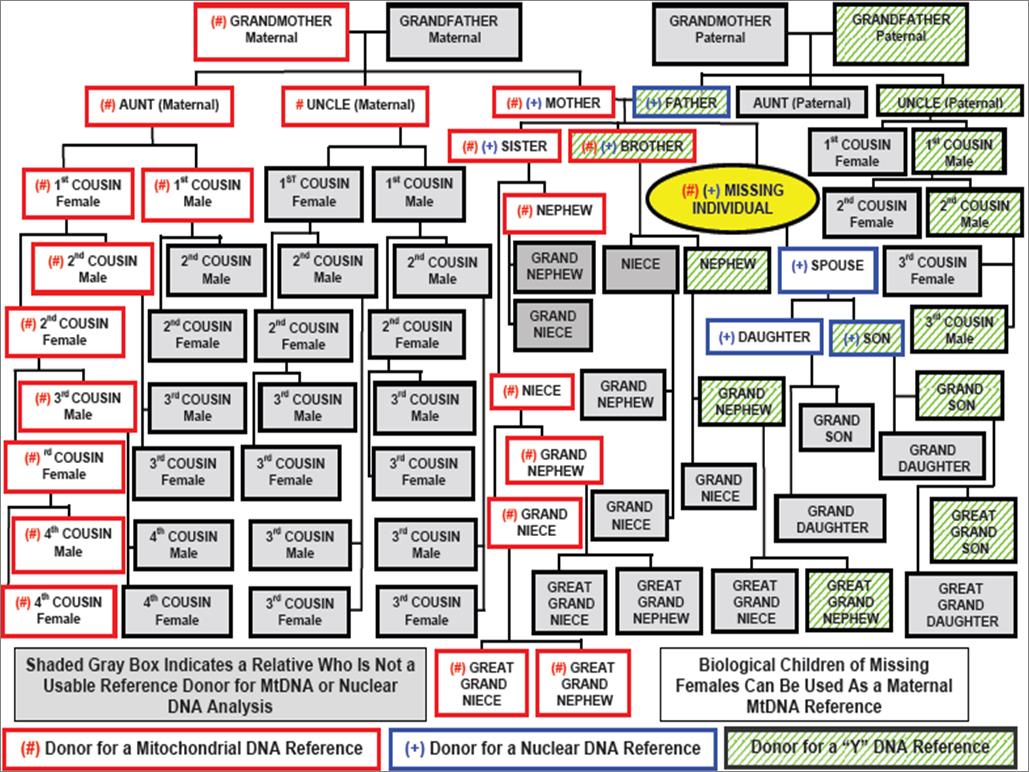
    On their web site’s “Contact Us” page, DPAA now has FAQs. The answer to one of those FAQs describes who can and cannot submit DNA samples useful in identifying recovered remains. The chart giving the answer can be viewed here. The text associated with the chart is short and can be viewed in DPAA’s FAQs.

    If your family lost someone in one of these conflicts and you qualify to submit a DNA sample, please arrange to submit one. By doing that you just might help identify the remains of a US service member who’s been repatriated but not yet been identified – as well as a relative of yours, however distant. Or you may help to identify remains to be recovered in the future.

    Everybody deserves a proper burial. That’s especially true for those who gave their all while serving this nation.

  • Six More Return

    DPAA has identified and accounted for the following formerly-missing US personnel.

    From World War II

    • F1c Leonard R. Geller, US Navy, assigned to the crew of the USS Oklahoma, was lost at Pearl Harbor, HI, on 7 December 1941. He was accounted for on 31 January 2018.

    • S1c Leon Arickx, US Navy, assigned to the crew of the USS Oklahoma, was lost at Pearl Harbor, HI, on 7 December 1941. He was accounted for on 1 February 2018.

    • S1c Donald G. Keller, US Navy, assigned to the crew of the USS Oklahoma, was lost at Pearl Harbor, HI, on 7 December 1941. He was accounted for on 26 January 2018.

    • S1c Eugene W. Wicker, US Navy, assigned to the crew of the USS Oklahoma, was lost at Pearl Harbor, HI, on 7 December 1941. He was accounted for on 1 February 2018.

    • Pfc Jack H. Krieger, Company A, 1st Battalion, 18th Marine Regiment, 2nd Marine Division, Fleet Marine Force, USMC, was lost on Tarawa on 20 November 1943. He was accounted for on 31 January 2018.

    • 1st Lt. Eugene P. Ford, 765th Bombardment Squadron, 461st Bombardment Group, 15th Air Force, US Army Air Forces, US Army, was lost in Croatia on 17 December 1944. He was accounted for on 19 January 2018.

    From Korea

    • None

    From Southeast Asia

    • None

    Welcome back, elder brothers-in-arms. Our apologies that your return took so long.

    You’re home now. Rest easy.

    . . .

    Over 73,000 US personnel remain unaccounted for from World War II; over 7,800 US personnel remain unaccounted for from the Korean War; and over 1,600 remain unaccounted for in Southeast Asia (SEA). Comparison of DNA from recovered remains against DNA from some (but not all) blood relatives can assist in making a positive ID for unidentified remains that have already been recovered, or which may be recovered in the future.

    On their web site’s “Contact Us” page, DPAA now has FAQs. The answer to one of those FAQs describes who can and cannot submit DNA samples useful in identifying recovered remains. The chart giving the answer can be viewed here. The text associated with the chart is short and can be viewed in DPAA’s FAQs.

    If your family lost someone in one of these conflicts and you qualify to submit a DNA sample, please arrange to submit one. By doing that you just might help identify the remains of a US service member who’s been repatriated but not yet been identified – as well as a relative of yours, however distant. Or you may help to identify remains to be recovered in the future.

    Everybody deserves a proper burial. That’s especially true for those who gave their all while serving this nation.

  • Another Four Come Home

    DPAA has identified and accounted for the following formerly-missing US personnel.

    From World War II

    • F2c Lowell E. Valley, US Navy, assigned to the crew of the USS Oklahoma, was lost at Pearl Harbor, HI, on 7 December 1941. He was accounted for on 19 January 2018.

    • F3c Warren H. Crim, US Navy, assigned to the crew of the USS Oklahoma, was lost at Pearl Harbor, HI, on 7 December 1941. He was accounted for on 19 January 2018.

    From Korea

    • SFC Pete W. Simon, G Company, 8th Cavalry Regiment, US Army, was lost in South Korea on 5 September 1950. He was accounted for on 19 January 2018.

    • PFC Lamar E. Newman, B Company, 1st Battalion, 9th Infantry Regiment, 2nd Infantry Division, US Army, was lost in North Korea on 27 November 1950. He was accounted for on 19 January 2018.

    From Southeast Asia

    • None

    Welcome back, elder brothers-in-arms. Our apologies that your return took so long.

    You’re home now. Rest easy.

    . . .

    Over 73,000 US personnel remain unaccounted for from World War II; over 7,800 US personnel remain unaccounted for from the Korean War; and over 1,600 remain unaccounted for in Southeast Asia (SEA). Comparison of DNA from recovered remains against DNA from some (but not all) blood relatives can assist in making a positive ID for unidentified remains that have already been recovered, or which may be recovered in the future.

    On their web site’s “Contact Us” page, DPAA now has FAQs. The answer to one of those FAQs describes who can and cannot submit DNA samples useful in identifying recovered remains. The chart giving the answer can be viewed here. The text associated with the chart is short and can be viewed in DPAA’s FAQs.

    If your family lost someone in one of these conflicts and you qualify to submit a DNA sample, please arrange to submit one. By doing that you just might help identify the remains of a US service member who’s been repatriated but not yet been identified – as well as a relative of yours, however distant. Or you may help to identify remains to be recovered in the future.

    Everybody deserves a proper burial. That’s especially true for those who gave their all while serving this nation.

  • Eight from Don Juan’s Reckless Daughter

    Recently, I’ve been on the road quite a bit. That has its disadvantages.

    However, road travel also has its benefits. It allows you time to think – and to get reacquainted with music you love. And there’s simply something quite enjoyable about heading down the highway, dawn in the rear-view mirror, with music you love and haven’t heard in years playing in the background.

    And yeah – that means you’re about to get another musical “walkabout” from me. You’ve been warned. (smile)

    . . .

    Before this trip, I took another look through the music library – after all, you can only listen to the same set of tunes so long before you begin to get tired of them. And I found something there that I’d put aside and forgotten over the years.

    In previous articles here at TAH, I indicated there were two ladies I’d pay serious money to hear play in a small venue. I was wrong; add a third to that list. That third lady is Don Juan’s Reckless Daughter – AKA Ms. Roberta Joan “Joni” Mitchell.

    Here are eight tunes by the lady, along with some brief comments. They showcase a truly wonderful voice and songwriting talent. All are her compositions; the first three were made famous by other performers.

    The last tune is a particular favorite of mine. FWIW: I think that anyone who’s ever taken on significant responsibilities – be they of national import, at work, for one’s family, or of any other type – can identify with the tune’s sentiment.

    Both Sides Now (Judy Collins recorded this in 1967.)

    Big Yellow Taxi (Mitchell recorded and released it in 1970, but it didn’t do as well as the version recorded and released that same year by “The Neighborhood”. Mitchell later had a bigger hit with a live version of the song released in 1974.)

    Woodstock (Crosby Stills Nash and Young recorded the definitive version of this tune, but Mitchell wrote it.)

    Help Me (Mitchell’s biggest and only top 10 hit. Nice tune.)

    Raised on Robbery (Minor hit and fun tune.)

    Court and Spark (Gorgeous title tune from the album marking her commercial high-water mark.)

    Twisted (This tune is simply hilarious – and yes, that IS Cheech and Chong you hear doing spoken background vocals somewhat over midway through the tune. [smile])

    Free Man in Paris (Written by Mitchell about her observations of music industry figure David Geffin during a trip they took to Paris with Robbie Robertson and his wife, Dominique. As noted above, anyone who’s ever taken on significant responsibilities IMO can identify with this one.)

    . . .

    Joni Mitchell suffered a brain aneurysm in March 2015. She survived and has made a reasonable recovery, but apparently has significant residual health issues. Sadly, I’d guess her career as a performer has ended.

    But her existing recorded work still showcases her immense skill as a composer and singer. And the above only covers a smallish part of her career.

  • Four More Return

    DPAA has identified and accounted for the following formerly-missing US personnel.

    From World War II

    • F1c Chester E. Seaton, US Navy, assigned to the crew of the USS Oklahoma, was lost at Pearl Harbor, HI, on 7 December 1941. He was accounted for on 17 January 2018.

    • S1c Willard H. Aldridge, US Navy, assigned to the crew of the USS Oklahoma, was lost at Pearl Harbor, HI, on 7 December 1941. He was accounted for on 8 January 2018.

    From Korea

    • CPL William C. McDowell, D Company, 1st Battalion, 32nd Infantry Regiment, 7th Infantry Division, US Army, was lost in North Korea on 2 December 1950. He was accounted for on 17 January 2018.

    From Southeast Asia

    • Col. Edgar F. Davis, 11th Tactical Reconnaissance Squadron, 432nd Tactical Reconnaissance Wing, US Air Force, was lost in Laos on 17 September 1968. He was accounted for on 30 December 2017.

    Welcome back, elder brother-in-arms. Our apologies that your return took so long.

    You’re home now. Rest easy.

    . . .

    Over 73,000 US personnel remain unaccounted for from World War II; over 7,800 US personnel remain unaccounted for from the Korean War; and over 1,600 remain unaccounted for in Southeast Asia (SEA). Comparison of DNA from recovered remains against DNA from some (but not all) blood relatives can assist in making a positive ID for unidentified remains that have already been recovered, or which may be recovered in the future.

    On their web site’s “Contact Us” page, DPAA now has FAQs. The answer to one of those FAQs describes who can and cannot submit DNA samples useful in identifying recovered remains. The chart giving the answer can be viewed here. The text associated with the chart is short and can be viewed in DPAA’s FAQs.

    If your family lost someone in one of these conflicts and you qualify to submit a DNA sample, please arrange to submit one. By doing that you just might help identify the remains of a US service member who’s been repatriated but not yet been identified – as well as a relative of yours, however distant. Or you may help to identify remains to be recovered in the future.

    Everybody deserves a proper burial. That’s especially true for those who gave their all while serving this nation.

  • Saving the World, Quietly – Part 2

    Over ten months ago, I wrote an article about an incident during the Cuban Missile Crisis. In that article, I discussed how then-Captain Vasili Alexandrovich Arkhipov of the Soviet Navy may have literally saved the world from global thermonuclear war during the height of that crisis.

    History has a way of repeating themes from time to time. And in an incident nearly 21 years later, another relatively senior military officer – again, one from the Soviet Union – may well have prevented global thermonuclear war a second time.

    . . .

    The time: late September 1983. Relations between the US and USSR were strained – probably at their lowest point since the Cuban Missile Crisis.

    Andropov was the Soviet Premier; Reagan was POTUS. The US Reagan-era defense buildup was in high gear. Reagan’s rhetoric towards the Soviet Union was harsh; it was largely taken at face value by Soviet leadership. SDI (AKA “Star Wars”) had been announced. USAF and USN operations near the borders of the Soviet Union were at high levels, and were often intentionally provocative. Deployment of GLCMs and Pershing missiles – each capable of hitting targets in the Western USSR with nuclear warheads – in Europe were scheduled to begin within the next 2 months.

    And roughly 3 weeks previously, a civilian Boeing 747 airliner (KAL 007) had strayed over Sakhalin Island. It had been intentionally shot down by Soviet air defense forces.

    The bottom line: Soviet leadership was seriously tense. They may have in fact believed that the US was preparing for a surprise attack on their nation. Consequently, the Soviet military – including Soviet strategic nuclear forces – was in an enhanced state of readiness; some have termed it being on “hair-trigger alert”.

    It was at this point – on 26 September 1983, to be precise – that the world as we knew it could have ended. One man’s level-headed actions prevented that possibility.

    . . .

    The man in question was Lt Col Stanislav Yevgrafovich Petrov of the Soviet Air Defense Forces. On that date, he was the watch officer at Serpukhov-15 – the Soviet Air Defense Forces command post charged with monitoring the Soviet Union’s then-new ballistic missile warning satellite system, Oko.

    Lt Col Petrov received an Oko alert noting the launch of a US Minuteman missile. The impact was projected to be within the USSR.

    A short time later, he received a second alert. This second alert indicated the launch of up to 5 additional missiles.

    Lt Col Petrov considered the situation. This didn’t make sense to him. A US nuclear first strike would be expected to launch literally hundreds of missiles, not 5 or 6. Launching that few missiles as an initial attack would be nonsensical; it would not destroy the Soviet Union’s land-based missiles and would thus allow full retaliation by the Soviet Union.

    So Lt Col Petrov advised his superiors of the alert, and stressed that in his opinion it was a false alarm. He convinced them. (Some accounts indicate he sat on this information instead of notifying his superiors. I tend to disbelieve this, as Soviet procedures would have required him to advise superiors of a launch indication; he’d have been disciplined for failing to follow those procedures had he intentionally withheld information concerning a launch warning.)

    Why was this critical? Because Soviet strategic doctrine at the time apparently endorsed “launch on warning” in order to prevent destruction of Soviet land-based missiles in the event of a US preemptive strike. The time window between Soviet detection of a US attack and the time retaliation would be ordered by Soviet leadership was thus quite short. And due to the strained relations between the US and USSR, people who knew Andropov well indicated years later that Andropov indeed thought the US was preparing to launch a preemptive attack on the Soviet Union in late 1983 – and was fully prepared to retaliate immediately if he was notified such an attack was inbound.

    . . .

    Lt Col Petrov’s assessment proved correct; the incident was in fact a false alarm. A previously-unknown combination of high clouds (reflecting sunlight) and the exact position of the particular Oko satellite raising the alarm in its high-angle orbit (the Oko constellation used Molniya orbits) combined to mimic a missile launch signature. The Soviets then developed a work-around procedure to screen out this type of false indication.

    . . .

    Lt Col Petrov was not commended for his actions during the incident. Instead, while he was held to have “acted properly”, he also received a minor reprimand for having “insufficienly documented his actions” during the incident in the command center’s duty log. As Petrov put it, this was because he had only two hands – and one was holding a telephone while the other was operating an intercom during the incident. He had no third hand with which to write. (smile)

    Petrov chose to leave the Soviet military the next year, and went to work for the agency that had developed Oko. Some years later, he retired in order to care for his terminally ill wife.

    The incident was not generally known in the West until it was disclosed in a senior Soviet general’s memoirs published in the 1990s. Afterwards, Petrov indeed received many accolades from foreign entities for his actions during the September 1983 incident. And in 2014, a Danish film about the incident was made. The film’s title? Appropriately, it was called, “The Man Who Saved the World”.

    Stanislav Yevgrafovich Petrov passed away on May 19, 2017. His death received little public notice until September of last year.

    Rest in peace, Stanislav Yevgrafovich Petrov. The world owes you much.

    And though you were an adversary, you have my thanks – and my respect.

    . . .

    (Author’s Note: the Wikipedia articles concerning Petrov and the 1983 incident contain some additional information. Both appear to be decent articles; they’re linked above.)

  • Coming Soon to Grocery Stores Near You!

    What new product am I talking about? Well, here ya go – it’s called “Unicorn Fruit Loops”:


    No, I’m not joking – I’m serious.

    It’s already available in the UK. Supposedly it will be available in the US in March.

    I’d guess it will be quite popular with college students and recent grads – at least, until reality smacks them “upside the head” – as well as among       Leftists       Socialists        Progressives in general. I’d also guess it will be especially popular in Greenwich Village and the Castro District.

    No word on whether it comes with “mini-Skittles” mixed in the cereal, though. (smile)

  • Two More Return

    DPAA has identified and accounted for the following formerly-missing US personnel.

    From World War II

    • Pfc Harry C. Morrissey, Company B, 1st Battalion, 7th Marines, 1st Marine Division, USMC, was lost in the Solomon Islands on 9 October 1942. He was accounted for on 11 December 2017.

    From Korea

    • PFC Albert E. Quintero, D Battery, 15th Anti-aircraft Artillery Automatic Weapons Self-propelled Battalion, 7th Infantry Division, US Army, was lost in North Korea on 2 December 1950. He was accounted for on 14 December 2017.

    From Southeast Asia

    • None

    Welcome back, elder brothers-in-arms. Our apologies that your return took so long.

    You’re home now. Rest easy.

    . . .

    Over 73,000 US personnel remain unaccounted for from World War II; over 7,800 US personnel remain unaccounted for from the Korean War; and over 1,600 remain unaccounted for in Southeast Asia (SEA). Comparison of DNA from recovered remains against DNA from some (but not all) blood relatives can assist in making a positive ID for unidentified remains that have already been recovered, or which may be recovered in the future.

    On their web site’s “Contact Us” page, DPAA now has FAQs. The answer to one of those FAQs describes who can and cannot submit DNA samples useful in identifying recovered remains. The chart giving the answer can be viewed here. The text associated with the chart is short and can be viewed in DPAA’s FAQs.

    If your family lost someone in one of these conflicts and you qualify to submit a DNA sample, please arrange to submit one. By doing that you just might help identify the remains of a US service member who’s been repatriated but not yet been identified – as well as a relative of yours, however distant. Or you may help to identify remains to be recovered in the future.

    Everybody deserves a proper burial. That’s especially true for those who gave their all while serving this nation.

    Note: The dates of accounting noted above are correct, though they are roughly a month ago. These accountings were not announced on DPAA’s website until on or after 10 January 2018.