The history of the Sears & Roebuck catalog is here: http://www.searsarchives.com/catalogs/history.htm
First published in 1888, it evolved into the ‘everything’ catalog. House plans and kits were introduced in 1930. Mail order chickens were also introduced in 1930, and other farm animals, too, such as draft horses and riding horses and equipment..Any kind of livestock came directly from the breeder, through Sears and Ward’s. You could literally order anything available from these companies. This was the post-Civil War era, which is also referred to as the Gilded Age.
This article on the US economy prior to and during WWI http://eh.net/encyclopedia/u-s-economy-in-world-war-i/ includes info on taxes, what they covered and how high they went, in regard to real income in 1916.
If there was a mild recession prior to WWI, was it truly ended by the US entry into the war in Europe, with the US government raising cash through the newly-created Federal Reserve? That was followed by a rapidly rising economy, a regular boom-time post-war job market, and a massive implosion in 1929 in the stock market (and there were warnings about it well ahead of the Crash).
The question comes up logically: does what happened 90 to 100 years ago parallel the present?
Financial markets everywhere crashed eleven years after the end of WWI. It sent economies everywhere into a downward spiral that took up to 10 years to recover, but was it prefaced by the US government’s bolstering increased production, including energy production, for WWI? Note that WWI was the first time mechanized artillery (tanks) and aerial bombing (two-seater airplanes) were used. If energy production supports, boosts, and/or parallels a rising economy, that could explain the boom-bust cycle that began after WWI and ended in the fall of 1929.
I think there is a parallel here, but it’s not quite as plain as the most recent government bailouts have been. The probability is that, with this predicted recession looming, we’ll see a long, slow slide into it everywhere, including Europe, the UK, China, Japan, and Russia.
Can it be falsely propped up by another global war? And should that be done? In our current, very peculiar political and economic climate, it might be a bad idea. Aside from ISIS, which is crumbling now, and a bunch of unwashed lefties, who is a tangible enemy?
When energy prices/consumption/production drop too low for producers to sustain employment, flagging recession and lost jobs/wages follow. The original article is at Gail Tyverberg’s blog: https://ourfiniteworld.com/2017/07/02/the-next-financial-crisis-is-not-far-away/
From Tyverberg’s article: “In fact, affordability is the key issue. When the world economy is stimulated by more debt, only a small part of this additional debt makes its way back to the wages of non-elite workers. With greater global competition in wages, the wages of these workers tend to stay low. The limited demand of these workers tends to keep commodity prices, especially oil prices, from rising very high, for very long.” Plainly, bailouts are simply more debt.
In plain words, an increase in energy production is directly tied to jobs, wages, and a rising economy. Major warfare includes increased energy production. ‘Stimulated by more debt’ refers to government bailouts, engineered to artificially prevent economic crises from occurring.
From Bloomberg News: https://www.bloomberg.com/view/articles/2017-06-30/china-still-poses-a-risk-as-source-of-the-next-u-s-recession
China’s debt load is considerably higher than that of the US at 250%. This is supported by the following article from Market Watch, back in March 2017: http://www.marketwatch.com/story/heres-where-the-next-financial-crisis-is-lurking-2017-03-20
Quote from Market Watch article: “ China’s national and provincial governments have subsidized inefficient state-owned enterprises and exporters with easy credit and propped up growth through excessive borrowing for wasteful public works and urbanization projects. Government deficits are estimated at least 15% of gross domestic product, and cumulative public and private debt at 250%.”
From Anne Pettifor, back in January 2017: http://www.independent.co.uk/voices/brexit-economy-economists-predict-financial-crash-recession-2008-michael-fish-austerity-cant-solve-a7513416.html
Basically, the problems that caused the 2009 financial market crash and recession were not repaired or erased. They were blunted and bandaged by government bailouts. They still exist and will cause another recession. If we view this correctly, precisely the same signs that should have alerted people to a coming financial crisis in the mid-2000s are showing up again.
New home construction has returned to the overpriced McMansion state; rents in large cities such as New York and Chicago have skyrocketed; public transit fares have increased substantially; local taxes have increased as well. Food prices in large cities, e.g., Chicago, have risen not just because of production, location, and transportation costs, but also because taxes on products have risen. This is why I shop where I can get better prices for the same products I’d buy at larger chains. I notice in the sale papers that Jewel, which is owned by Albertsons, has dropped its prices on some produce items – but not all – and cut full-time jobs to part-time only, back in 2009, when the market crash occurred.
Bailouts were the answer then, but we simply cannot afford bailouts and handouts any more. Those are a huge mistake that will cause more financial harm than anything else, including the predicted loss of funds in the Social Security Trust Fund and the constant manipulations of military retirement pay and veterans’ benefits, among other things.
The symptoms of a coming recession are clear. They are the same as they were in the 2000s, and are being ignored by the general public, by people who should have learned the first time around, but apparently did not. If this looming recession is exacerbated by the ignorant silliness of demands for higher wages by low-level labor, those people may find themselves out of work all over again and other people will find themselves using whatever savings they may have set aside, solely to pay the bills and put food on the table.
The mordant idiot spendthrift who was in the White House for eight years had more than enough time to solve the problem, but did not. He left it for the next sucker to get the job, and probably snorted with laughter on the way out the door, so I blame him for this next financial crisis. Frankly, I don’t think he gave a damn.
Whatever is going to happen is going to be a long, slow slide and it won’t be just us. The UK is also facing it, thanks to Gordon Brown’s ineptitude. Europe has had Merkel to drag it down into the mud with her dimwitted policies. China, as I said above is, quite frankly, in worse financial trouble than the US and may have no way to get out of it.
And the Queen Bee of financial stupidity? Venezuela. What has happened down there was inexcusable, but as Pettifor says, it was driven by ideology and stupidity, not by a sense of how to manage money and prepare for a financial crisis.
Boom is always followed by a bust.
Trump will get blamed for this mess, of course, even though it was not of his making. It will take too long to correct Da Stupid Mistakes that were made before he was elected. They could have been resolved by his predecessor and were not, because social justice policies and bailouts were more important, no matter how damaging they may be in the long run, to future generations.
The same thing holds true in all other countries that will be affected by this. As I indicated at the beginning of this article, it was the United States’ entry into the War in Europe that stimulated the US economy by the creation of the Federal Reserve, and the use of an account for the US government to withdraw funding to pay for war materiel production and wages, which included increased energy production. It was a government-sponsored economic boom early in the 20th century, funded by borrowed money to the tune of $40 billions.
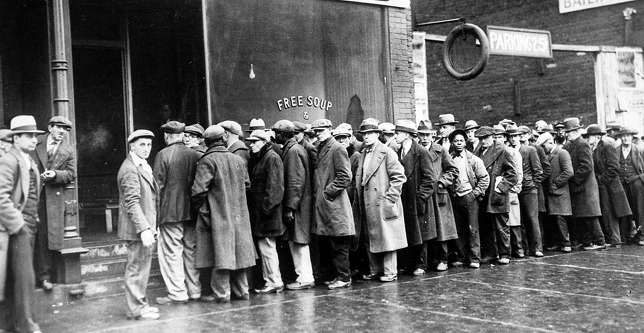
Unfortunately, that boom faded and a panic and crash followed in 1929, which fed into a worldwide economic Depression that drove Germany and the rest of the world into the same financial crisis now going on in Venezuela and beginning to show itself elsewhere. The United States’ entry into World War II followed on the heels of government-sponsored work programs, e.g., CCC, PWA, and WPA.
World War II was bad enough. Was it the last War of Conquerors? Do we cascade into warfare to solve this problem?
It appears that we may be heading in that direction.