243 years young, and let there be many more.
An analysis by Gary Anderson, who is a retired Marine Corps colonel. He lectures in Alternative Analysis at the George Washington University’s Elliott School of International Affairs.
243 years young, and let there be many more.
An analysis by Gary Anderson, who is a retired Marine Corps colonel. He lectures in Alternative Analysis at the George Washington University’s Elliott School of International Affairs.
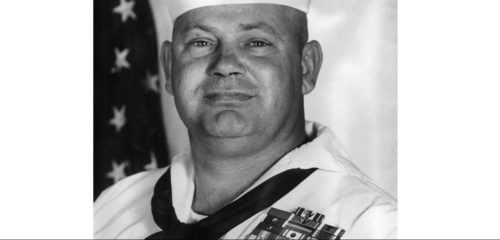 Willy Williams, the most decorated enlisted sailor in Navy history
In the history of the U.S. Navy only seven men have earned all of the “Big Three” valor awards: Medal of Honor, Navy Cross and Silver Star Medal. Six were World War II officers, including one aviator and four submarine commanders. The seventh was enlisted sailor James Elliott “Willy” Williams in Vietnam.
In 1947, Williams, a 16-year-old from Fort Mill, South Carolina, enlisted in the Navy with a fraudulent birth certificate. His first 19 years in the Navy included service aboard the destroyer USS Douglas H. Fox during the Korean War and tours on a variety of naval vessels from 1953 to 1965.
In May 1966 Boatswain’s Mate 1st Class Williams was assigned to River Squadron 5 in South Vietnam to command Patrol Boat, River 105. The approximately 30-foot fiberglass boat usually carried a four-man crew who patrolled inland waterways to prevent the Viet Cong from using them to transport troops and supplies.
On July 1 Williams led a patrol that came under fire from a Viet Cong sampan. His deft maneuvers and accurate fire killed five VC and resulted in capture of the enemy boat, earning Williams a Bronze Star Medal with a “V” for valor. Twenty-two days later the capture of another sampan brought Williams a second Bronze Star for valor. Less than a month later, he received a Silver Star and his first Purple Heart.
On Halloween, Oct. 31, 1966, Williams was commanding a two-boat patrol on the Mekong River when he was fired on by two sampans. He and his crew killed the occupants of one and then went after the other. That pursuit put the Navy boats into a VC staging area containing two junks and eight sampans, supported by machine guns on the river banks. Williams called for helicopter gunship support while holding the enemy at bay. During this movement he discovered an even larger force. Not waiting for the armed helicopters, Williams attacked. Maneuvering through devastating fire from enemy boats and the shore, his two-boat patrol fought a three-hour battle that destroyed or damaged 65 VC boats and eliminated some 1,200 Communist troops. For his actions, Williams was nominated for the Medal of Honor.
On Jan. 9, 1967, the Navy dredge Jamaica Bay was blown up by mines in the Mekong Delta, and PBR-105 arrived to pick up seven of the survivors. Another man was trapped in the rapidly sinking dredge. Williams dove into the water and, with a rope attached to a nearby tug, pulled clear an obstruction, then swam through a hatch to recover the sailor.
Six days later Williams was wounded while leading a three-boat patrol that interdicted a crossing attempt by three VC heavy-weapons companies of 400 fighters. He and his boats accounted for 16 VC killed, 20 wounded and the destruction of nine sampans and junks. Williams was awarded the Navy Cross.
When Williams returned home in spring 1967, he had a list of awards unmatched by any enlisted man in Navy history. He retired after 20 years of service and began a career in the U.S. Marshals Service.
During his last seven months in the Navy, Williams received every sea-service award for heroism including the Legion of Merit with “V,” two Navy Commendation Medals for valor and three Purple Hearts.
Williams died on Oct. 13, 1999, and in 2003 his widow, Elaine, watched the launching of the Arleigh Burke class destroyer, USS James E. Williams.
MEDAL OF HONOR CITATION:
For conspicuous gallantry and intrepidity at the risk of his life above and beyond the call of duty. BM1 Williams was serving as Boat Captain and Patrol Officer aboard River Patrol Boat (PBR) 105 accompanied by another patrol boat when the patrol was suddenly taken under fire by 2 enemy sampans. BM1 Williams immediately ordered the fire returned, killing the crew of 1 enemy boat and causing the other sampan to take refuge in a nearby river inlet. Pursuing the fleeing sampan, the U.S. patrol encountered a heavy volume of small-arms fire from enemy forces, at close range, occupying well-concealed positions along the river bank. Maneuvering through this fire, the patrol confronted a numerically superior enemy force aboard 2 enemy junks and 8 sampans augmented by heavy automatic weapons fire from ashore. In the savage battle that ensued, BM1 Williams, with utter disregard for his safety exposed himself to the withering hail of enemy fire to direct counter-fire and inspire the actions of his patrol. Recognizing the over whelming strength of the enemy force, BM1 Williams deployed his patrol to await the arrival of armed helicopters. In the course of his movement he discovered an even larger concentration of enemy boats. Not waiting for the arrival of the armed helicopters, he displayed great initiative and boldly led the patrol through the intense enemy fire and damaged or destroyed 50 enemy sampans and 7 junks. This phase of the action completed, and with the arrival of the armed helicopters, BM1 Williams directed the attack on the remaining enemy force. Now virtually dark, and although BM1 Williams was aware that his boats would become even better targets, he ordered the patrol boats’ search lights turned on to better illuminate the area and moved the patrol perilously close to shore to press the attack. Despite a waning supply of ammunition the patrol successfully engaged the enemy ashore and completed the rout of the enemy force. Under the leadership of BM1 Williams, who demonstrated unusual professional skill and indomitable courage throughout the 3 hour battle, the patrol accounted for the destruction or loss of 65 enemy boats and inflicted numerous casualties on the enemy personnel. His extraordinary heroism and exemplary fighting spirit in the face of grave risks inspired the efforts of his men to defeat a larger enemy force, and are in keeping with the finest traditions of the U.S. Naval Service.
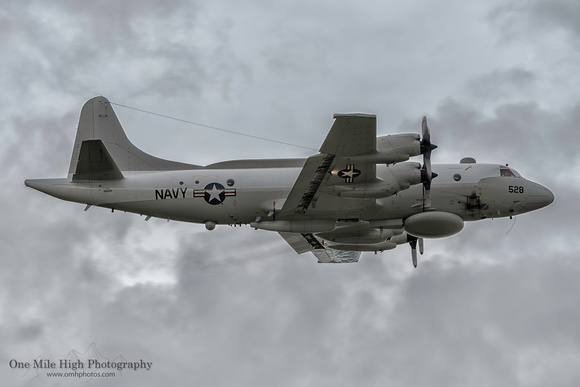 On Nov. 5, 2018, a U.S. EP-3 Aries aircraft flying in international airspace over the Black Sea was intercepted by a Russian SU-27.
Russians, who consider the Black Sea as their personal pond, are returning to Cold War Era confrontations. This time they proved a 50 year old turboprop powered aircraft is no match for a 4th Gen fighter.
A Russian fighter jet flew dangerously close to a U.S. Navy reconnaissance plane on Monday over the Black Sea, the latest incident showcasing simmering tensions in Eastern Europe between Moscow and Washington.
A Navy EP-3E Aries II reconnaissance aircraft was flying in international airspace when it was intercepted by a Sukhoi Russian Su-27 “Flanker”fighter in an interaction that lasted about 25 minutes, according to a Navy release and interviews with senior officials.
The Russian jet conducted “a high speed pass directly in front of the mission aircraft, putting at risk the pilots and crew,” according to the written statement from the 6th Fleet emailed to Navy Times.
“They buzzed us,” added Pentagon spokesman Eric Pahon during a Monday press briefing. “They got a little too close.”
The Russian pilot then made an additional pass, zipping close to the U.S. plane’s right side before banking away and applying its afterburner, according to a video of the encounter released by the Navy.
“They engaged the afterburners and the whole aircraft shook,” Pahon said.
There’s an IR video in the article showcasing the too close pass and banking maneuver. Bad form, Ivan.

Fences make for good neighbors. Of course, there wasn’t one.
CBS Austin News
Drunk brother grabs sister, and it gets all stabby.
Muskegon Live
Don’t bring pepper spray to, well, you know.
Delaware On Line
Here liberals become pro-gun after getting mugged. In Romania it takes a house breaking.
Romania Insider
Adding insult to injury, same Romanian fined.
Romania Insider, Again

Police have identified two Florida women accused of nabbing a service dog from a Vietnam veteran last month.
The Osceola County Sheriff’s Office responded to a call on Oct. 28 that a Pomeranian service dog had disappeared without a trace. Its owner: a 67-year-old Vietnam veteran with post-traumatic stress disorder.
Surveillance video shows one woman starting an altercation with the victim, while the other comes from behind, unleashes the dog, named Kira, and walks off with her, according to a press release from the sheriff’s office.
 Two Florida women were captured on surveillance video stealing a service dog from a Vietnam veteran on Oct. 28. (Osceola County Sheriff’s Office)
Jennifer Gotschall, 53, and Monique Cosser, 51, were identified Wednesday after a tip to police from a “concerned citizen” led them to the pair. Kira was also recovered “in good health,” police say.
The victim, who has not been identified, was in Old Town with his two Pomeranian service dogs at the time of the incident.
Gotschall and Cosser have been charged with grand theft, a third-degree felony punishable by up to five years’ incarceration. Officials said they are thought to have been released on bond.
Book ’em Danno. Scum like this needs to be put under the jail.
More at Fox News


Don’t marry crazy.
Truth About Guns Link Fixed
From the Department of Frivolous Lawsuits…
TTAG Again.
When Massad Aayoob speaks, I listen.
Mas on Self Defense Training Video
End of an era, again.
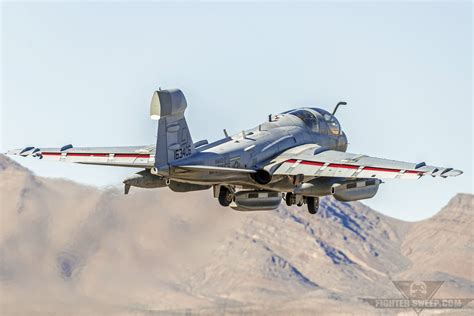
Marine Corps’ Last Prowler Aircraft Return from Final Combat Deployment
The last of the Marine Corps’ remaining EA-6B Prowlers have wrapped up their final mission in the Middle East, where they supported troops taking on the Islamic State group. Now, the electronic-warfare aircraft will soon be headed to the boneyard.
More than 250 members of Marine Tactical Electronic Warfare Squadron 2 are returning to North Carolina after spending seven months operating out of Al Udeid Air Base in Qatar. The squadron — the last to fly the service’s decades-old electronic-warfare aircraft — is only about four months away from being deactivated.
But that didn’t slow the Death Jesters downrange, where they were tapped with supporting two campaigns simultaneously: Operation Inherent Resolve in Iraq and Syria, and Operation Freedom’s Sentinel in Afghanistan.
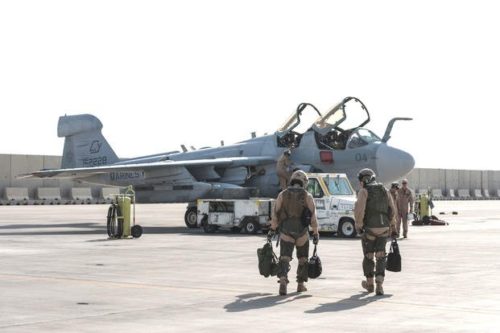 Marines deployed with Marine Tactical Electronic Warfare Squadron 2 walk to their EA-6B Prowler at Al Udeid Air Base, Qatar on Sept. 12. VMAQ-2 has completed its final deployment, and the last six Prowlers in the U.S. military’s inventory are being retired. (US Air Force photo/Ted Nichols)
“The mission of the Prowler is and always has been to deny, degrade and disrupt the enemy’s use of the electromagnetic spectrum,” said Capt. Robert Ryland, an electronic-countermeasures officer with VMAQ-2. Being based in Qatar, he added, allowed them to respond to missions for both operations.
Ryland declined to specify how many flight hours the crews flew throughout the deployment, due to operational security concerns. But the operational tempo remained high throughout the deployment, he said.
“The presence of electronic warfare is extremely important to the supported unit,” he said. “Though this is the final EA-6B deployment, the need for electronic warfare will remain high worldwide in the
future.”
The aircraft of my misspent youth are going to the boneyard at Davis-Monthan AFB. The H-2s and P-3s I crewed in, and all the others of the era too numerous to list, are already there. Now it’s the last hurrah for the Marine’s EA-6B as well. I wouldn’t worry too much, the EA-18 “Growler” will fill the void left by the bird affectionately known as “The Queer” (see below) by all who served with her.
The article is a pretty good read, a mix of pride and bittersweet. I know that feeling well. It can be found here at Military Daily
So named because of the gold film layered into the canopies to protect the crew from the fierce RF radiation emitted by the ECM suite. They also had fangs with the AGM-88 HARM anti-radiation missile to take out offending emitters.

Man attacked, then it gets all stabby.
Twin Cities
Poor victim selection skills.
Montgomery Advisor
Free AR-15s, Oy!
America’s First Freedom