Author: Adam Fenner

  • Why So Few Choose to Serve

    I was asked to talk about what drives a someone to join the military. Great idea Andrew, I really appreciate it. I am going to focus the question toward why so few join the military, however. The reason I am doing this is because to some degree the decision to join is very personal and I very much do not want to leave anyone out.

    Just to establish a few key understandings before I answer this question:

    1. I’m going to focus on the bigger picture.

    2. I am going to utilize an economic model.

    3. I understand that this is a very complex issue, and is ultimately a personal decision that each person makes before signing on the dotted line.

    Here are some assumptions to make about this model.

    1. Everyone in the market is applying for one generic job in the military.

    2. Everyone has perfect information about the costs and benefits of military service, recruiters don’t have any impact on the amount of people enlisted.

    3. It is understood that the government has the monopoly on jobs available. They are the only place where someone can enter into military service. (Which will be another blog.) Why so Few Choose - Figure 1.jpg

    Remember that this is a simple model.

    There is a video at the end of this explaining the finer points of this figure. But I do want to offer a quick walk around of this model.

    The vertical axis is Wage, the horizontal is the quantity of labor. The curved line is the Supply line, it begins past 0 because there are individuals who regardless of the cost will serve in the military. For whatever reason, I’ll simply call it patriotism, these individuals will enter the military for free. Now, there comes a point where the supply of individuals, fueled by patriotic fervor will be exhausted and we will need to begin compensating people for the labor they provide. That is the Demand line, the amount of individuals that the US government wants for various wages.

    As you can see, the cheaper the cost the more they want, sounds just like our government. Where that Demand line crosses the supply line is the wage that the government is going to pay, that is W1, the horizontal line running across. But for those patriotic individuals, they are receiving a greater wage than what they really wanted. Because they would work for free, they are receiving a higher pay.

    For some, it is patriotically motivated, an altruistic decision focused heavily on the greater social good. Others are motivated by family history, a role model who had served, who they are now following in their footsteps. Some are motivated by a personal experience. Then, there are those who want to better themselves and feel as though the military is a place where they can do that, by virtue of a career, or a step toward their goals, regardless of the risk. There are as many different reasons as there are veterans in and out of uniform. (How this may apply to recruiting is an issue I’ll address in another blog.)

    Now, looking at if from this perspective it seems as though we veterans are less a labor force and more individuals soliciting our labor. We want to serve. We want to do our part, to protect our families and our nation. Very few of us would do that for free, but there is a population among us that would. If there is any question of that, remember what costs many have paid and continue to pay in order to provide that service. Because no government, corporation or man can compensate those men and women for what they have paid.

    So, why do we serve? Why do we few choose to serve? I believe that it is the deeply held belief that we can make a difference, that our sacrifice is worth it. And our nation will be a better place for it.

    Why So Few Choose to Serve?

    As a footnote. Anything I have said that could be considered accurate or correct about this model came from Prof Waddoups of the UNLV Economics department. Anything wrong was because I misunderstood something, it happens a lot.

  • The Value of Education

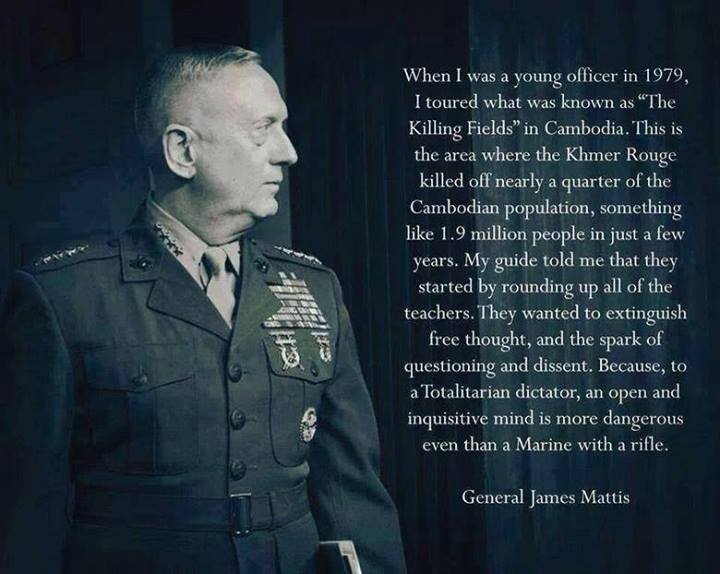
    I was cruising through the internet yesterday when I stumbled across this great meme of General Mattis.

    General James Mattis on his experience in Cambodia.
    General James Mattis on his experience in Cambodia.

    It is simple, and ultimately better said by “Mad Dog” himself. I just want to throw it up there to continue to stress how important education is. Whether it be institutional or otherwise. An institutional education signals to employers that you have accomplished the base level requirements to enter into a specific field of employment. Which is huge, it is also the single greatest investment anyone can ever make.

    The most important thing that anyone should learn from any education, wherever they received it, is the ability to learn. It is the ability to absorb information and analyze it in a way that promotes understanding, not simply retention. That is the kind of weapon that all governments should fear. When we, as an educated population, have the ability to ask questions–that is power.

    Promote education, regardless of age, if we want to ensure that those we leave behind are a truly free people, that is how we do it.


  • You Get What You Pay For

    The effects of Defense wide cuts is far reaching. As this US News Article discusses.

    “We’re an 11-carrier Navy in a 15-carrier world.” Army General Martin Dempsey said.

    According to Marine General John Kelly, his command is, “unable to get after 74 percent of suspected maritime drug smuggling.”

    Our budgets are being cut so tight that we are unable to accomplish the ever increasing global missions that we are being tasked to accomplish. This is an ultimate consequence of the success of our military and the generations that came before. They have established a sense of security within our borders that fosters the idea that we no longer need the military. That is a nice idea, and 9/11 should have been a reminder of that, but as a nation we have a short term memory.

    There will come a point when we as a nation are again reminded that the world is not a friendly place and we can’t solve problems by throwing money at them. Well, throwing money at other people, while failing to invest in ourselves, our infrastructure and our ability to defend it. The issues in Crimea are highlighting the failure of that thought process, and I hope that we won’t have to solve that problem with physical intervention. Stalin, however, does seem to be trying the west/America’s patience, just to see what he can get away with.

    At the rate we are going, however, with more budget cuts, we won’t have much left to fight with. Our military will be poorly equipped, understaffed and under trained. Hopefully, our enemies will just be happy that we keep developing new iPhones and still make great movies, and just leave us to our own devices.


  • The Economics of Veteran Unemployment

    Veteran unemployment rates are 9.2% for those serving after 9/11. That statistic is from the Bureau of Labor Statistics as of February 2014. Last year at the same time it was 9.4%. Comparatively, the unemployment rate for non-veterans is 6.9%, and was 7.9% the previous year. For veterans of other eras, their unemployment rate is 6.3% and was 6.9%.
    It is a startling statistic–as well as deeply disturbing. Why do our veterans leave the military, only to find themselves less employable than their civilian counterparts, especially our newest generation?
    The problem was glaringly obvious to me when I returned home from my third tour to Afghanistan and I found myself working at a food court serving pizza. I was happy for the opportunity and glad that someone was willing to hire me. I worked hard and tried to reduce the impact of my National Guard obligations on them as best I could–even if it was just a cashier position. But it burned. Six months prior I was managing repair and installation projects for cellular and data networks. I was a Staff Sergeant during my drill weekends, managing a platoon of combat medics, who supported a cavalry squadron. And then I took off my uniform, grabbed my visor and apron and always made sure to ask if the customer wanted a caesar salad with their order.
    My situation wasn’t unique, and it wasn’t until I connected two very important lessons that either the veterans need to accept or civilian employers need to educate themselves about. (Sadly, my guess is that capitalism will win and Veterans will need to accept their fate.) First, was when a friend, who had never served and had worked in the civilian market in an executive position, made this casually ignorant comment about military leadership. “Your experience doesn’t translate. You just tell your guys what to do and they do it. Things don’t work like that in the civilian world.”
    I wish. I wish it were that easy, but he didn’t know any better.
    Second, was when I was studying my Labor Economics textbook. It discussed the amount of experience that a person gains while working in a position, and how that experience makes them more valuable. This experience is only applicable to that position, however.
    That is the problem. That is the barrier that we can’t overcome: the combination of the belief that our experience doesn’t translate, and the simple fact that we don’t have experience in the civilian market. Many of our skills can be translated, but a civilian employer doesn’t know which ones. In addition, we are simply entry level employees in the eyes of those organizations seeking qualified applicants. There is no doubt that we have gained skills and experience, but rarely in the fields of employment we are attempting to gain access to, which is why so many of us must behave like someone freshly entering the market, with no job skills, because that is what we are–at least in the eyes of the hiring managers.
    The hard part for us is that we know we do have skills, the kind of skills that civilian employers are demanding. I can see it, as I push through college. I’m forced to take classes dedicated to speaking in front of a group, writing professional correspondence, and simply working in a team. That was three separate courses–summarized, two 100 level courses, and a 400 level course. Taking these courses, is to simply prove to my future civilian employer that I am capable of functioning and communicating in a professional environment. All of these were things I learned in the military: teaching classes to my peers and subordinates, briefing my superiors, and working in a team.
    Many of the issues have to do with our pride. Every veteran I know complains about attending college with these “kids.” It is a perfectly understandable frustration. We now operate under completely different frames of reference than most of America. Why should we have to stand in line with all these kids, people who didn’t serve, and be treated as their equals? We shouldn’t, but then again, in the eyes of the greater capitalist machine–those firms that would hire us–we are viewed simply for what production value we can offer. The hiring manager as a human being appreciates and perhaps, even sympathizes with our plight, but they have a job to do, and that job is to hire as many qualified applicants as they can for the lowest cost.
    To do this, they have pre-established requirements that an applicant must meet, simple easy to assess criteria to determine what our production value is to the hiring firm. Veterans are not easily assessed. We don’t have the same certifications, and our experience doesn’t translate well onto paper to fill in their check boxes. As a result, we aren’t hired.
    Why doesn’t the military simply support us with these civilian certifications? We do the same jobs right? Two reasons: cost and retention. Many certifications require training that goes beyond the scope of the job that the military requires of the veterans. Why would they train us, so that we could leave? Training is expensive, and it would be a waste of taxpayer money to train us then let us go. It sucks, but it is reality.
    So there we are: the veterans of foreign wars, combat proven individuals capable of thinking critically and performing under the kind of stress that the civilian market can’t reproduce. This, my generation of veterans, is the same experience as those veterans who came before us. But none of that matters. What we need to do is gain the credentials which the civilian market has established to ease the burden on their hiring managers. Then, once we have entered those positions, we, as human beings, can be evaluated more closely. Our productivity can be measured and our experience can be really put to the test against our civilian counterparts. That is where we will show the value of our experience and our productive capabilities.

  • Stolen Valor: What it Should be Teaching America about its Veterans

    I am going to open up with this link to a young man explaining why he donned an Army Combat Uniform and wore it around campus, until several young veterans called him out and asked him to remove the garment. (This is the link to the original video) The Veterans were arrested for Disturbing the Peace and making threats. The young man who was wearing that uniform has now become the victim in the eyes of his local news organization–in this act of bullying–as they portrayed it.

    Here are some simple facts to warm this conversation up:

    • The young man is well within his rights to wear that uniform as he pleases. It is a first amendment right.

    • The news organization can say whatever they want as long as it does not endanger the public. It is a first amendment right.

    • Disturbing the Peace is defined as: “a crime generally defined as the unsettling of proper order in a public space through one’s actions. This can include creating loud noise by fighting or challenging to fight, disturbing others by loud and unreasonable noise (including loud music), or using offensive words.” These young veterans legally violated this law.

    I’m not disputing any of this. That is the country we live in. What this case does do is highlight the differences between the veteran class and the non-veteran class.

    I am going to focus on two key points. The first being, why Stolen Valor means so much to us as Veterans, and why civilians don’t understand. The second being, a highlight of the behavior differences between Veterans and civilian personalities as highlighted in this case.

    Why Stolen Valor matters.

    Lawyers, doctors, and accountants are all professional fields in which you have to meet a series of minimum requirements to be able to participate. And all of those careers carry felony charges for impersonating and practicing the profession without proper licensure. There are no laws supporting the impersonation of a service member. Why? Because it poses no risk to the public for the impersonation. It isn’t fair, but it is the truth.

    All of those jobs carry with them a high amount of effort to enter into those fields. They also carry high financial rewards compared to the Military, which has high costs and fewer rewards, which is why Stolen Valor has become such a hotly contested issue for us. The civilian population doesn’t understand that we don’t put any piece of our uniform on without earning it, not the stripe down my Dress Blue pants, the bars on my sleeve, or the ribbons and badges on my chest. Every one of those items is a representation of a cost paid, either by myself, those beside me, or those that came before me, individuals who I am now able to call my brothers and sisters. All of that said, those ribbons, badges, bars and stripes when added together don’t amount for anything of marketable value.

    They represent something.

    The licensure attained by doctors, lawyers and accountants has a marketable value. They will attain a higher wage. That licensure, which they worked so hard for, does have value after they earned it.

    I have only placed my awards onto one resume (by request of a military provided resume coach), and I was offered an entry level position.

    I understand, it is capitalism. But when we remember the blood, sweat, and tears that go into everything that makes up our uniforms, and all that we got from it was a strip of cloth or a shiny badge . . . that is why we get so emotional about them. That is why you can hear that Ranger’s voice cracking when he fended off the passive-aggressive assaults from the crowd, while he defended something he earned, which was being portrayed by someone as cheap trinkets that the young man wanted to earn.

    The difference between veterans and civilians.

    75% of Americans do not meet the minimum requirements for military service according to a report titled: “Ready, Willing, and Unable to Serve,” published by Mission Readiness (You can find more information about them at www.missionreadiness.org). According to this article in the NY Times (which also addresses the divide between the military and civilian class) less than .5% of Americans are presently serving. That means that only 2% of those eligible to enter military service do so currently. There was a time, WWII, when 12% of the US population served in the military, which was in a time of the draft. This is important, because in an all-volunteer military we need to consider the types of people that it will attract, especially in a time of war. Whereas, during draft time, those able were obligated to serve, capturing a more diverse (not demographically, but value-wise) segment of the population as opposed to today. That, is actively serving, including guard and reserves.

    The total population of Americans who are veterans is about 10% now. I want to throw this number out there, although it is less important for my argument.

    Today, when America is still technically at war, there is no hiding the potential consequences of military service. This is a spectacular filtering process. By virtue of the War on Terror, we only recruit those who understand that going to war is a distinct possibility. Those people are more devoted toward personal and national values, hard working, and risk averse, which is also an important consideration.

    We don’t see the world the same way, and we are quite willing to step outside of our comfort zones, which is important when we consider how insulated America is from the reality of the struggle to survive. We pay lip-service to daily struggles, but in the developed world, if we completely quit trying, there is a government sponsored safety net to help us meet our daily needs. Only by stepping outside of that net, which is a substantial effort, can we find within our nation the daily struggle to survive.

    The consequence of this insulation is our transition up Maslow’s Hierarchy of Needs. We no longer need to concern ourselves with the physiological or the safety levels, and have moved into a mixture of the love/belonging and esteem levels. If you want proof of this, go onto your Facebook page. You will find it all over, watching how friends and family interact and what they talk about. Or, for that matter, look back to the News 10’s representation of the interaction between the young man and the veterans who called him out. Their focus wasn’t on the safety afforded the country by those veterans who have put themselves into harms way, it was on the young man’s need to belong to an organization he is unable to join–because he is unfit.

    Unfit.

    In a nation where everyone wants to belong, there are organizations in which we are unfit to join. You simply don’t meet the minimum requirements. These requirements aren’t set forth by any small measure. The consequence of us loosening the standard on the physical and mental capabilities of an applicant has a far greater consequence compared to that of most civilian sector jobs. In the most extreme of positions–which makes up approximately 12% of the military population, the remainder being in support roles–the consequence of being unfit may potentially have deadly consequences. Now, this isn’t having to come in on Saturday to finish a report, or receiving a lower tip from an unsatisfied table. In the combat arms community, being unfit is a gross liability to one’s self and those around them. Even our support elements, which are less in the direct line of fire by the nature of their duties, understand that their failure to act isn’t a late shipment and an unhappy customer. It is a nineteen-year-old who doesn’t have ammo or chow.

    These types of extreme circumstances, paired with having a military raised in a time of war, create a culture of doers. Within the ranks, we don’t have a culture that promotes conversation. I promotes action. We need to get things done now, or this will be the consequence. That isn’t true for the better part of our country, which has a heavy focus on conversation, which was why in this video we heard several people asking those Rangers why they were going after the civilian impersonator. They asked the question, confused at the veracity in which these Rangers addressed the problem in front of them, and when they got an answer they walked away or called the police (Because public safety is not the responsibility of every citizen, it is the duty of the police officer).

    The sad part is our voices are being drowned out, because the indifferent, unaffected class of civilian Americans who are untouched by war are a growing population, while the population of veterans is dwindling.

    US Population 317,736,457 (Taken on Mar 22, 2014 at 2127 UTC US Census Bureau)

    Post 9/11 Vets 1,761,446  (Taken from US Census Bureau)

    It is only a matter of time before the .5% of veterans is all that remains of our veteran population. And this nation’s perspective only further alienates their veterans, a class of people who have dropped down a level on the Hierarchy of Needs on behalf of others, those who are currently portraying us as bullies and impersonating us to gain recognition for acts that were not their own. We have foregone the safety level, and sometimes physiological level, and have stepped down the pyramid. It wasn’t for our own sakes, the economic return wasn’t there, especially compared with the opportunities that exist in the civilian sector–at a much lower cost. We did this because we believe in something, that it was worth it for others for us to do these things.

    The hard part is awareness. There is only one way to educate a person about the differences in perspectives to truly make them understand. But that was why we did it, so that those who we left behind wouldn’t have to endure what we did. The consequence of our own actions is the ignorance of the civilian population. As a result of these differences, the insurmountable divide that is ever growing between a population of ignorant individuals and a dwindling population of the aware will only get worse. They will segregate themselves from us and us from them.