Author: Adam Fenner

  • What They Mean – Combat Medic Badge

    CombatMedBadge.gif

    The Combat Medic Badge (CMB), like any combat badge, is highly coveted within the community, but I have always felt that the CMB has a distinct spirit, something inherently different from the Combat Infantry Badge (CIB) and the Combat Action Badge (CAB), by the nature of the jobs associated with each one.

    When my unit was first told we were deploying it was like ripping a band-aid off. “I look forward to serving with you in Afghanistan,” was all the commander said, before turning it over to the 1SG. The first conversations that took place were done by the elated junior enlisted, who had never been to war, and were all excited to earn their badges.

    The scouts and the forward observers chattered in formation beside us about their CABs, and I remember a junior medic saying that he was excited to get his CMB. There are those little moments when you view the world differently after hearing what someone says. This was one of those for me. One of our medics had just returned from Iraq, where he had done convoy security, which is a job I want no part in. With his CMB on his chest, he snatched that young medic (not me) out of formation and dragged him over in front of our own formation, just enough to show him the rest of the troop. The senior medic pointed at all the soldiers and asked the junior medic, “Who gets the Purple Heart to go along with your CMB?”

    The kid froze.

    They returned to formation, the junior medic and all the other medics in the platoon who had seen this exchange, sufficiently humbled.

    The CMB was created in January of 1945. To be eligible for this award, a soldier must first be a medical professional and below the rank of colonel. They must also, “Satisfactorily perform medical duties while the unit is engaged in active ground combat, provided they are personally present and under fire.”

    Now, if there is a way to cheat the system and water a badge down, people will find a way to do it, because that is what people do. They want the maximum return for the least amount of effort. The trick to this one is to perform medical duties. To give you an idea of how this badge can be potentially earned, here is a conversation that took place one night on my base in Afghanistan. Our eight-man building had just been rocked by some incoming fire that had landed near by.

    “Holy shit, are you guys ok?” one of the Sergeants yelled in the dark room.

    Everyone ‘rogered up,’ still half asleep.

    “I’ll go check on the rest of the platoon,” another Sergeant said, stumbling out of bed and out the door.

    “Congrats, Doc, you just earned your CMB,” a sergeant said.

    “What the fuck for?” I asked.

    “You asked if we were ok. That is the first step in a patient assessment.”

    “I didn’t ask if you were ok,” I replied.

    “No, he didn’t,” the platoon sergeant said.

    “Wait, no you didn’t. You are the worst medic ever,” he replied.

    “Fuck you, too. How about that?” I replied, while we all laughed.

    Now, the rest of the platoon was fine, and we all went back to sleep while mortars pounded the point of origin. The important takeaway from this–aside from me being a terrible medic–is how little effort it can take to potentially earn this badge based upon the written criteria. Is that how everyone earns it? No, definitely not. But, as we all know, there are always a few.

    Before I joined the military, all I wanted was experience, to be a hardened combat veteran with a chest full of medals. After my first tour, I lost interest in that idea and matured a bit, eventually losing interest in badges and awards completely. Finally, I had a CMB of my own, but those few who watered it down made it difficult for me to put it on.

    This was where I was humbled again, this time by a soldier who had received two Purple Hearts. He stopped me while we were out-processing from our mobilization site and stuck his finger in my chest in the empty spot where my CMB should have been. “Where is yours? Are you too good to wear it?”

    I didn’t have a response, but the next time he saw me, I was wearing it.

    His two Purple Hearts were attached to my CMB, along with several of the other soldiers who were walking around. A cheap CMB recognizes a soldier’s actions, regardless of how strong or weak they had been. When a CMB is earned, it is by the sacrifices of others, and all the medic can do is try to keep them together, until they are in the more capable hands of a doctor.

    That is what a CMB is. It is bought with the blood of our friends and comrades. It isn’t about the fight. It is about the sacrifice. Thankfully, it is far less recognizable outside of the military community.

    Stolen Valor individuals don’t know it exists for them to slap it on their fake uniforms.

    Which I appreciate.


    If you haven’t already don’t forget to follow This Ain’t Hell and myself on Facebook.


  • What They Mean – Combat Badges

    Combat Infantry Badge.svg

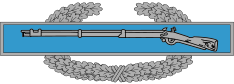
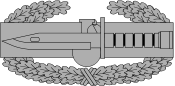
    When I first deployed to Afghanistan, there were two badges that were highly sought after: the Combat Infantry Badge (CIB), and the Combat Action Badge (CAB). In the interests of riling up those that may believe one to be superior to the other, I’m going to pair them together and talk about them as if they are the same. Ha. I am going to set the Combat Medic Badge aside because its meaning is separate and distinct from the two above. Also, I don’t have either the CAB or CIB. I’m a medic. We have our own badge. But that is another blog.

    Combat Action Badge.svg

    The CIB was established October 27, 1943 and was designed to recognize those Infantryman who had served in combat. There are a lot of retroactive issuance and non-availability information, as is outlined in AR 600-8-22, but I’m not going to go into those. The important three criteria must be met to receive this badge. They are:

    (1) Be an infantryman satisfactorily performing infantry duties.

    (2)  Be assigned to an infantry unit during such time as the unit is engaged in active ground combat.

    (3) Actively participate in such ground combat. Campaign or battle credit alone is not sufficient for award of the CIB.

    The CAB was established May 5, 2005, but only covers the periods of this most recent conflict. It was designed to recognize the actions of those who have served in combat, but can’t be doubled up with the CIB or the Combat Medic Badge. The three criteria must be met to receive this badge. They are:

    (1) It may be awarded to any Soldier.

    (2) The soldier must be performing assigned duties in an area where hostile fire pay or imminent danger pay is authorized.

    (3) The soldier must be personally present and actively engaging or being engaged by the enemy, and performing satisfactorily in accordance with the prescribed rules of engagement.

    Now, the army has rated the CIB as a Group 1 skill badge and the CAB a Group 2, which means if you have been awarded both, then you wear your CIB above your CAB.

    I refuse to believe one to be better than the other. After serving on a small base with both mortars and scouts in the same platoon and working together to accomplish the same mission, the only difference between two guys in the same team was that one was a mortarman patrolling as a rifleman, and the other was a scout doing a rifleman’s job. The mortarman receives a CIB and the scout receives a CAB. I don’t see a difference between the two badges. Your MOS doesn’t mean anything;  it’s only what you do when it counts.

    Here is where the criticism and debates really begin. The two most recent conflicts have created a watered-down image of these badges, leading many who have truly met all the requirements to stop wearing it, while those who barely made the minimum requirements, wear them with pride. Of course, I say the most recent two conflicts, but I don’t believe in the slightest that the previous generations had any fewer badge chasers than we have now, who are willing to fight harder to be awarded their badge, than they were willing to fight to earn it. Anyone who has been in a combat environment knows what I am referring to: that Captain hiding under his desk during an indirect fire attack, who then stands up after the attack is over and adds the dates to his template award that he had waiting for such an occasion.

    I was one of those protesters, refusing to wear my badge because it had been watered-down, and because I thought it carried little meaning–until I was corrected, for two reasons. First, my refusal to wear it in the face of those who hadn’t truly earned it, only watered it down more. If you earned it, wear it. By your silent professionalism, you humble those who think that little badge makes them a better soldier. Second, it isn’t about you. It is about those who were with you. By wearing that badge, you demonstrate pride in those who you stood beside during your conflict. You never do anything alone. Have some pride in that fact.

    Now here is the reason that many people forget, while being taken in by the glitz and glamor of badges, that is their original purpose–to identify skill and experience. The idea behind badges is for a commander to walk up to a formation of soldiers, who he doesn’t know, and by looking at them be able to identify their level of experience and responsibility by their rank, and also to be able to identify who his seasoned veterans are. Those who had been tested, the CIB and CAB, tell a commander that you have valuable experience and allow him to potentially utilize you for a better result.

    How does this apply to Stolen Valor individuals? The same way it does with everything else. It makes them assholes. If you wear it and you didn’t earn it, you are an asshole. That is all.

    For those who have worn out their joints, shed blood, and fired rounds downrange at the enemy, and as a result have been awarded one of these badges, they are a reflection of our experience and our actions when it mattered most.

    If you haven’t already don’t forget to follow This Ain’t Hell and myself on Facebook.
  • I’m With Staff Sergeant on #bringbackourgirls

    It is no secret at this point that a Muslim terrorist organization named Boko Haram kidnapped 239 girls on April 14th. This was done for two reasons: the first to protest their attendance of a school where they were receiving education in something other than the Qu’ran. And the real reason: to gain funding through two methods, the sale of these girls, and access to more funding through terrorist networks once they have officially been branded a terrorist organization by the US.

    What does this have to do with Ol’ Staff Sergeant (SSG)? SSG makes a good point, and that is that nothing we say in the U.S. or more specifically on our Facebook pages, matters. Sorry, Miss Hathaway. Hashtags don’t matter. Reposts don’t matter. And a trending topic doesn’t matter. Even if the American and Western governments poured money into Nigeria, it wouldn’t save these girls. Unless. of course we did the unthinkable, which would be to use our intelligence networks to buy these women back, but that is a short-term solution which would only encourage kidnappings in the future.

    We certainly can’t trust their own army to bring these women home, especially if they behave anything like the Ugandan army did in 1996 with the Aboke girls. If you want to know more about that check out Jane Bussman’s book, “A Journey to the Dark Heart of Nameless Unspeakable Evil,” or another title specifically concerning the incident, “Aboke Girls.” Simple summary: 139 were kidnapped.  A nun working at the school, from which they were kidnapped, went after them and negotiated the release of 109. The Ugandan army later made an attempt to retrieve the other 30. They came home with 1. Why do I bring that up? Other than to show the difference in the power of a nun and an army, was to show that words don’t mean shit. Lots of words mean the same amount, but doing something, physically going out and doing something, matters.

    This was my issue with the entire Kony 2012 deal. It was a video designed to spread awareness. There was a young man Jacob, in the video, who I had the opportunity to meet, when I visited Gulu, Uganda. No one brought him home. Our well wishes didn’t rescue him from the clutches of Joseph Kony, he did. He escaped by his own force of will.

    To a population that loves to donate money, but hates to get off their asses and actually sacrifice, were now asking for action. Someone needed to do something, not them, of course, but someone–those people that fix things. The end result was just under 100 special forces operators were deployed to that region of the world to train an army that has been known for its corruption and participation in the human rights violations that they were being trained to prevent. Again, check out Jane’s book.

    Are these complex issues? Yes. Very. But in the end, what people wanted, was for us to put boots on the ground and to take care of the bad guys in a way that the Western World could stomach.

    That is where we hit a wall. We want justice, but we don’t want to act in a manner that forces us to question morality and the thin gray line separating good from evil. Hollywood drew that line so crystal-clearly. How could we deviate from it? This is the same Hollywood that is supporting these child molesters. The same Americans screaming for action and #bringbackourgirls, would be the same ones spitting on our returning service members for fighting a war against the children that make up the African militias. Because they see our 15-year-old children’s faces in the faces of those 15-year-olds, who are hardened veterans with over five years of jungle war-fighting experience.

    This isn’t an easy issue. It isn’t clean, and unless someone who is willing to face some decidedly harsh criticism for how they solve this problem, steps up to the plate, these girls are never going to be seen again, at least not in the condition that they were in when they left the school. Do I have a solution for this problem? Not a PC one. Am I asking for silence, to just stop talking about it? No. I am asking that we truly identify our goals and what we are willing to do to accomplish them, not waste our time and energy thinking that by spreading awareness we are actually accomplishing something.


    If you haven’t already don’t forget to follow This Ain’t Hell and myself on Facebook.

  • Winter Soldier and the Question of Freedom

    I am not particularly a Marvel fan, but have always been a Captain America fan; because I’m an American, and it is the right thing to do. I went to the movie with the simple plan to see ol’ Cap punch people really hard and throw his shield around. If you are interested in my idea of the movie, the eleven-year-old who lives inside of me, and who is also very excited for Godzilla and the TMNT (but is disappointed Megan Fox isn’t a redhead), loved the movie. The adult and veteran in me was impressed by the method in which the question of freedom was asked and addressed.

    Captain America

    No spoilers here, unless you have yet to see the trailer, in that case–your bad.

    The biggest threat in the movie which Captain America needs to address is a program which SHIELD is putting into place, where perceived threats to American security are taken out before they ever act.

    Captain’s immediate response was, “I thought the punishment usually came after the crime,” and “This isn’t freedom.”

    This is to show the difference between these two ideologies: the Captain’s, who believes in the freedom to live our lives as we choose, and Shield’s, who wants everyone to live in safety and security. Both are founded in merit, but SHIELD is missing an essential point, or they understand it better than many are uncomfortable to admit. Freedom comes with responsibility, more freedom means more responsibility. Every time we ask someone to take care of something for us, we relinquish our decision making power regarding that something, in favor of reduced responsibility: less freedom, less responsibility. However, many people don’t want freedom, they want safety. There is a Benjamin Franklin quote about that.

    It isn’t hard for any one of us to see the little points where we have allowed this to happen in our own lives. The big government example being the Patriot act. We have given up privacy in favor of security. The corporate example is similar. We give Facebook and Google that same privacy in favor of the ability to utilize their platforms.

    Many people simply don’t mind, or are ignorant. Either way, they have consciously, and many times happily, foregone their freedoms in favor of personal security. This has allowed many to go about their lives, with one, or many less things to worry about.

    But, as the Captain said, “This isn’t freedom.” Freedom comes with inherent responsibility, and with that responsibility there exists an assumption of risk. Whether it be the freedom of speech or the second amendment, these freedoms come with an unspoken responsibility. These are responsibilities that, for many, are too great a burden to bear. This is also a part of freedom: the ability to choose to exercise the individual freedoms available. You can speak, but will you? You can choose to defend yourself and others, but will you? Each has an inherent cost and a benefit.

    In the end, the battles we fight every day aren’t nearly as exciting as the one Captain America and his friends had to deal with. But this is Hollywood, and who else is going to entertain our inner eleven-year-olds. Our battles are small, but no less important. We also have to understand that Scarlett Johansson, who is probably a really nice person, isn’t going to come save us.


  • Why I Love Their Job – Forward Observer

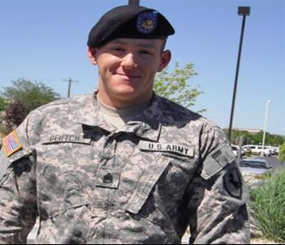
    On the fourth anniversary of a close friends death. SSG Ian Deutch was killed on duty, as a Nye County Sheriff–27 days after returning home from Afghanistan. SSG Deutch was a skilled forward observer, whom I had the privilege to serve alongside while in Afghanistan.

    SSG Ian Deutch, EOW 4-26-2010
    SSG Ian Deutch, EOW 4-26-2010

    Forward observers are the link between the units on ground and various fire assets available to those units. These could include anything from 60mm mortars to fixed wing, artillery, and naval guns. In our area of operations our greatest assets were our 81mm mortars. A platoon of fast acting, highly accurate mortarman, who stood ready at their guns 24 hours a day, every day until we all came home. Our mortars could put a round on target in a matter of minutes, but it was our forward observers who told them where those targets were.

    Our forward observers, were all trained by SSG Deutch. If it wasn’t his Hamburglar sounding voice over the radio, it was one of his soldiers. The standard which he held himself to, and he held his soldiers to, shaped the battle space. It had a positive effect on our missions, and capabilities. It also had a dramatic effect on the capabilities of the enemy forces within the area.

    Our enemy, never attempted to stand and fight, which isn’t unusual for the modern enemy faced. But having spoken to the units we relieved, and the units who relieved us. The enemy adjusted their techniques based on the unit on ground. They stayed and fought the preceding unit. They never stuck around more than a few minutes with us, because that was all they had. Within three minutes 81mm mortar rounds were landing within 100 meters of their position, the adjustments to follow were always fast and deadly accurate.

    The psychological effect of this was damning. And the effects were obvious. A skilled forward observer can save lives by reducing the enemy’s offensive capabilities.

    The forward observer; with a radio, map and compass is the single most damage producing individual on the battlefield. Do I want to do this job? No, lots of map reading and math, and I am simply not that good at it. But I am always happy to have one around.

    We all miss you brother, thank you.


  • To Support Our Patriots–Privatize the Military

    It occurred to me in the last blog I put together, “Why So Few Choose to Serve,” that the government has a distinct advantage over American patriots, and because we have a Sergeant Major of the Marine Corps talking about why marines should be paid less. The reason for this is that the US government, and ultimately most world governments, have what is called a monopsony. A monopsony is where there is only one buyer in the market. American patriots want to serve their country–or in this situation, sell their labor. However, there is only one buyer of that labor, putting the Patriot at a distinct disadvantage. What is one simple way to reduce the problems caused by this? Bring more buyers into the market by privatizing the military.

    Do I completely believe in privatization of the military? No, but for the sake of healthy debate, I’m going to argue that it is to the benefit of the American patriot to privatize the military because it will allow them to be properly compensated for their service.

    I am going to start out with some very simple assumptions:

    1. The government is the only purchaser of a patriot’s labor.
    2. The only motivation for patriots to supply their labor is to serve their country. No other form of compensation, initially, affects their decision to serve.
    3. The wage provided by the government is unrelated to services provided or productivity of the patriot.

    I have also chosen for the simplicity of this conversation to ignore the following:

    1. The efficiency benefits of a privatized military.
    2. The potential evils of allowing greed driven decisions to be attached to military power.

    With these assumptions in place, we can look at the ways that the government takes advantage of the patriot. The first being wage. Wage is the collection of all financial benefits paid: paycheck, insurance, and retirement benefits.  The Government, employing laborers who are only motivated by patriotism, can set the wage wherever they desire, which is why pay is considered to be so low. In a situation like this, the only factor driving the decision for what to pay a patriot would be a minimum livable wage. There are also pay raises to account for changes in family structure, but not because of a caring for the patriots’ families. It’s merely because, without these pay increases the patriots would no longer be able to supply their labor.  If the military wanted you to have a family, they would have issued you one, hopefully in better condition than the gear I have already been issued.

    The additional wage requirements for patriots with families,, and the cost of more mature patriots, is one of the many reasons that recruitment targets the younger patriots with the glitz and glamour of the job, not the wage, as in other civilian fields of employment. Young people join for the experience and the opportunities, not the financial return, or as it applied to me at seventeen years old, I wanted to blow shit up.

    Now, with these wages intentionally kept low, this is a method of controlling enlistment numbers for more senior individuals–those with the additional responsibilities that a person gains while they get older and are no longer able to remain within the military because the cost to maintain their household requirements no longer matches with the pay and benefits they receive from the military. This leaves only those who are willing to sacrifice pay to continue to provide service to their country.

    I was told by my Battalion Commander, “The Marine Corps gives you everything money can’t buy.” Fellow service members have also looked down upon me when I pointed out that one of the driving factors to remain within the military is my educational benefits.  The culture of the military pushes out those mercenary thoughts, while promoting patriotic service for its own sake.

    Why would a privatized military support the patriot? By providing the patriot, who is willing to supply their labor, regardless of wage, additional options as for whom to provide their labor. For example, Company A and Company B have both been contracted out to perform military operations to support America. The missions being equal, and the pay being the only difference, the patriot will have the option to choose the higher paying company.

    Is this mentality mercenary, yes, but it is a means of compensating our patriots with more than a slap on the ass and a thank you for your service.

    Now, the final question remains: Why do patriots deserve a higher pay? In the civilian market, a person is paid based upon the services they provide. A factory line worker is paid an hourly wage based upon their value to the company. If only ten widgets are created an hour by that worker, then their impact is ten widgets per hour. If a musician puts on a concert for twenty thousand people, their impact is the entertainment of twenty thousand people.

    The patriot provides security, either through defensive or offensive operations, to three hundred and seventeen million people, producing a collective GDP of $16.8 trillion against violent threats. That responsibility is spread among the 2.3 million patriots who have decided to serve. That is the impact of the patriot’s service.

    The American patriot is going to provide their service regardless of their pay, but with such a high level of impact, why not compensate them in a similar manner as we do so many others? By allowing the patriot the option to provide their patriotic service to the highest paying organization, we recognize their impact upon our nation.

  • Our Right to Choose

    10011410_681259908586761_992099651_n

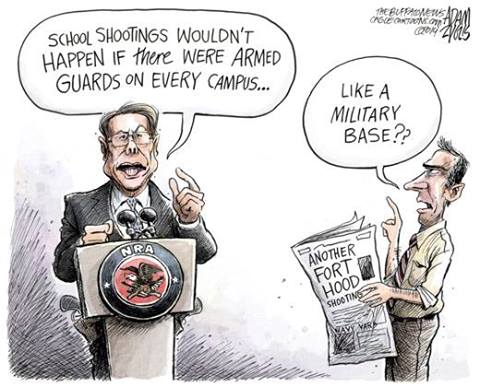
    I am not particularly fond of participating in the “Gun debate” not for lack of passion but on the grounds of the almost insurmountable communication barrier. A barrier built of irrational fear (on both sides), failures of logic, and judgment clouded by emotion. Both sides are convinced those participants on the other side are either crazy or cowards to the point of excess, and communication has become nigh impossible. However, I found this comic and I thought it so clearly highlighted the ignorance of both debates I would throw in my two cents, for what it is worth.

    The NRA gentlemen is talking about armed guards, the idea of this would be there are designated professionals who are there to protect us citizenry from those who would do us harm.

    The gentleman with the newspaper is using a military base as an example of how guns can’t protect people. This is based on the flawed idea that every service member on these bases is armed. When in fact, there are more casually armed individuals walking around Wal-Mart than your average military base. Only MPs are allowed to carry, and only while on duty. Much like Campus police.

    The flawed logic on both sides is ultimately a failure of thought that sweeps America as a culture. It is the failure to accept personal responsibility, and the willingness to have someone else solves our problems for us, while firmly believing that we are the only ones who could do it right.

    The most extreme of those on the left, believe that widespread confiscation of guns would reduce gun violence, because we PUBLIC can’t be trusted and someone else should be responsible for our safety.

    The most extreme on the right believe that every citizen should be armed at all times.

    At least these are the perceptions perpetuated by the media. Which doesn’t help to bridge the communication gaps in this debate, but why would they MEDIA want to support the end of this debate, they make their money on the conflict.

    What the 2nd Amendment, which is at the core of this debate offered, was every citizen the right to defend themselves from any threat. This is a right, I purposely stress that word, it means it is a choice, if a citizen does not want to carry–that is their choice. If they do, it is again their choice as well. But few talk about the responsibility associated with that right. Military personnel are rigorously trained on weapons safety, before they are trained on how to properly employ their weapon. Does this prevent all problems, no, but it reduces them. No solution is 100%. That is a fact of life. The CCW (Concealed Weapons Permit) programs are an excellent step in the right direction, they are optional and offer the average person a base of knowledge to make good decisions.

    One other thing that CCW programs offer is the option of defense, in a concealed weapon state an attacker never knows who in the area may be armed. That question is a preventative measure. Everyone, regardless of their stability level conducts a cost/benefit analysis before they act. Will they choose to hold up a gun store or a liquor store? But again, no answer is 100% and there are always outliers.

    There is a great power in the question of who may or may not be armed and that provides greater security than an armed guard. An armed guard is an advertised defensive position, they are a target. But an average citizen carrying concealed hides in plain sight. Schools, government buildings, and military bases don’t have that option.

    What us advocates of the 2nd Amendment debate are asking for is the option to defend ourselves through the ability to carry. Just the option, let us decide where we can conceal carry. We don’t want armed guards. We understand that there is responsibility associated with that right. But by denying us that option, by pretending that outlier behavior is the norm the conversation only gets more convoluted.

    What really needs to happen, is either the end of this conversation, just simply stop talking about it as if the guns are the problem, not the operators. Or establish what our goals are and establish rational policies to support those goals, ignoring outliers and focusing on the macro impacts of a simple logical policy.

  • What They Mean – Combat Action Ribbon

    Combat_Action_ribbon

    In the grab-bag of ribbons that a Stolen Valor participant would be putting on his uniform, if he were to be representing a Marine or Sailor, the Combat Action Ribbon is a must have. Why this one? Why this modest ribbon of blue, gold and red? It isn’t even a medal after all.

    First a bit about it.

    The Combat Action Ribbon, affectionately called the CAR was authorized under SECNAVNOTE 1650 of 17 February 1969 (If you are searching for it, it is important to include the date). It was awarded to members of the Navy, Marine Corps, Coast Guard (until the Coast Guard created their own in 2008), or units falling under the control of the Navy. It also retroactively awarded it to those who who had met the requirements in prior engagements.

    This ribbon was awarded to those who had seen ground combat, and performed satisfactorily. That is the beginning of why this ribbon is so special to those who have earned it. It is the base of all higher awards for valor in combat, and is not even a requirement to receive the Purple Heart. An individual can receive the Purple Heart but not the CAR.

    The CAR signifies not only that a person was sent to war, but they had the opportunity to fight. And they did. At least satisfactorily, which is all anyone can ask. It isn’t glamorous, it isn’t publicized, but it is coveted. I was too young when I first got mine, none of my Senior Marines had theirs before I did. But that was early on in Iraq. Since no one had it around us there was no one to be envious of.

    I remember my Sergeant Major talking to several young Marines and myself when I first arrived at my unit. I had been in for just over six months at the time, he over 22 years. He told us that he had never had the opportunity to see combat, and here we were just showing up and getting the chance. 22 years before he had the opportunity to try. That was what this ribbon meant to him. It is the culmination of everything we did at home. All the training, all the sweat and time in the field. It was preparation for the opportunity to be under enemy fire, and to perform satisfactorily. That is what it is all about after all. If we aren’t in combat it is just practice.

    That is what the CAR is, a simple ribbon of fabric to say that we were tested, and our “performance under fire was satisfactory.”

    That is why someone who hasn’t earned this ribbon, wears it, they disrespect it. They didn’t pass the test, they didn’t even show up. But that is also why, if they are going to grab some ribbons and medals to throw on their chest, the Combat Action Ribbon is a must have.