A little over a week ago, a bomb rocked the city of Kabul. As of April 25th, 64 are dead and over 300 were injured. Despite the fact that the target of the attacks was a security team that protects government VIPs, the majority of the victims are reportedly women and children.
In response to the attack, The commander of NATO forces in Afghanistan, Gen. John W. Nicholson, stated:
“Today’s attack shows the insurgents are unable to meet Afghan forces on the battlefield and must resort to these terrorist attacks,”
Similarly, Afghan President Mohammad Ashraf Ghani condemned the attack and tweeted this.
“Today’s terrorist attack…clearly shows the enemy’s defeat in face-to-face battle.”
Finally, to further “control” the narrative, the U.S. Embassy in Kabul released the following statement:
“Afghanistan deserves peace and security, not attacks that victimize parents taking their children to school, workers on their morning commute, and people who have stepped forward to help defend their fellow citizens,”
With the continued withdraw of a military presence from Afghanistan, no one should be surprised that soft targets, which used to take the form of military supply convoys in rural Afghanistan, are now Afghan security units inside the Afghan Capital.
The attack came a week after the official start to “Operation Omari” (named after the late Taliban founder Mullah Mohammad Omar) which also coincided with the annual spring offensive AKA the fighting season.
The Taliban described the operation as “[employing] all means at our disposal to bog the enemy down in a war of attrition that lowers the morale of the foreign invaders and their internal armed militias.”
I think this statement perfectly defines what this war, from the Taliban’s perspective, has always been about.
From the very beginning, as U.S. aircraft bombed the hell out of the Taliban, the enemy knew they could never defeat a Western military on the field of battle. Instead, they adopted a strategy that focused on bogging us down, attrition and lowering morale.
Afghan history taught the Taliban that whether it was the Brits, Soviets or Americans, foreign invaders would eventually tire of war and leave.
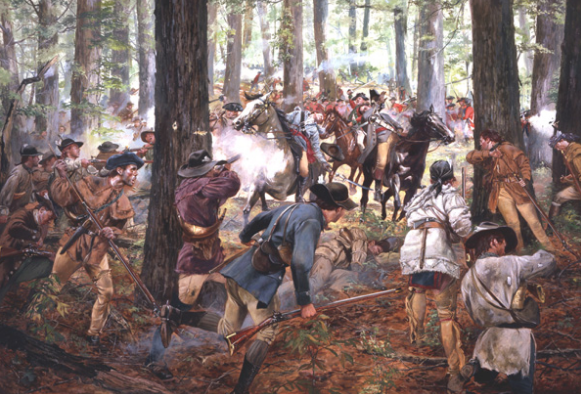
As an American who has both a reverence for war and military history, I can appreciate the commitment to the enemy’s strategy because it is the same one General George Washington implemented to defeat the British Army during The American Revolutionary War.
The strategy employed by both the Taliban and American revolutionaries is very reminiscent of the approach that Fabius Maximus utilized to defeat Carthaginian general Hannibal during the Second Punic War—dubbed The Fabian Strategy. The Fabian strategy avoided decisive engagements, utilized terrain to nullify the enemy’s superior Cavalry, and focused on softer targets like foraging units.
Of course, I’m not arguing that there was a moral equivalency between American revolutionary soldiers and the Taliban. On the contrary, the Taliban has repeatedly demonstrated that they have no qualms about killing innocent civilians while fighting their war. However, both insurgencies were determined to endure and banked on the enemy’s weariness of battle. I also realize outside support from the French (for American insurgents) and Iran, Pakistan, and foreign Jihadists (for the Taliban) also facilitated in both insurgency’s ability to “go the distance.”
My main point is to highlight that after 15 years, we have the NATO commander in Afghanistan—an American Army General—attempting to underscore that the Taliban’s terrorist attacks are a sign of weakness.
No, it does, however, demonstrate that the insurgency is launching attacks inside an area that was previously considered a hard target and inaccessible in earlier stages of the war.
With all due respect sir, the Taliban is not “unable” to meet Afghan forces on the field of battle; they simply are—strategically—choosing not to. Americans are beyond exhausted with the Afghan war, and the enemy knows it.
Like the British before us, time has become our greatest enemy and their greatest commodity.