Category: War Stories

  • 20 years ago today; USS Princeton and Tripoli strike mines

    One of our readers, Thor, writes a guest post for us about his experiences aboard the USS Tripoli when it struck a mine in the Persian Gulf 20 years ago today. Here’s what he saw;

    Today is the 20th anniversary of the USS Tripoli & USS Princeton mine strikes. Being “sick in bed” due to an infection in my leg, I felt very fortunate to have not been in my shop that morning as I normally worked from 1800- 0600. The berthing compartment was fairly quiet as half of the HM-14 Maintenance Crew & Aircrew were asleep, as was I.

    The loud thunderous explosion of the mine immediately woke me up as the bow of the ship was lifted out of the water and SLAMMED back down. I wondered what the hell had happened? Did we get hit with a Silkworm missile? Since my rack was immediately beneath the flight deck, I reached up to feel for any heat, thinking that if the flight deck got hit, I would feel something. No, nothing abnormal. I then quickly considered what other things could have happened. Did something blow up below decks?

    The next thing I heard was the General Quarters klaxon sounding and General Quarters being called over the 1MC, the ship’s intercom. I hopped out of my rack, got my uniform on and as I was doing so, I remember a young Sailor, Odie, with a wide eyed look, kind of running to and fro, scared out of his mind, wondering what to do. I grabbed him by the shoulders, looked him in the eye, and firmly told him, “Odie, you’re OK. Get dressed and let’s get to our GQ stations.” He calmed down and followed my instructions. Now I had to remember what was it? Down and aft on the port side and up and forward on the starboard? Yes, that was it. I, among the others in the berthing compartment, all headed down and aft to our GQ station, the hangar deck.

    As I got to the hangar deck, I was looking around for my “guys”, the ones I normally worked with throughout the night. “Where’s Dag?”, I asked another shipmate? “Has anybody seen Andy?” What about Fowler?” Nobody knew. I was heavy with worry and fear for my guys, hoping that they were OK. It seemed like several minutes had passed before they slowly started showing up, one by one. I asked them what took them so long to get to their GQ station? They said that they were trapped in the maintenance compartment.

    As it turned out, the explosion had hit athwartships and one deck below the aircraft maintenance shops at the paint locker. Because of that, it blew the hatch closed and my shipmates were stuck there until the pressure released and they could open the hatch. Fortunately, the subsequent vacuum that helped release the pressure on the hatch also extinguished the fire in the paint locker. I took a muster of my men and reported to the Division Chief that everybody was present. Thank God!!

    The next thing I remember was that the embarked news crews started filtering into the hangar deck, camera were rolling and reporters were talking into their microphones. The Skipper wanted to send the embarked SEAL team below to assess the damage. The smell & odor of paint & paint remover or thinner permeated the hangar deck. It was almost dizzying.

    Reports started coming in of people that were killed or injured. Nobody killed. If I recall, a couple of Marines were on Mine Watch, one of which was thrown overboard, the other was thrown into the forecastle. A Sailor that was near the paint locker was overcome by fumes. No casualties and only minor injuries!! Again, THANK GOD!! I remember assisting with the lines to help them get the SEAL team down to the water. A little later, reports started coming back that there were three other mines under the ship. The intensity & gravity of the situation increased ten-fold.

    People were wondering just what the heck were we going to do now? One idea was to hook up the Helicopters, the MH-53Es that we had onboard and tow the ship out of the minefield. It seemed possible, but configuring the hook ups would have been problematic. It was damned sure that the ship wasn’t going to attempt to get underway for fear of setting off the other mines that were below her. Finally, some sense came down from above, the minesweepers would tow us out of the area. As the minesweepers approached the Tripoli, the air was very tense. We were all hoping and praying that none of those other three mines activated.

    As the lines were attached and secured, we finally felt some movement of the Tripoli . It seemed as if everybody was holding their breath for the next half an hour. After we got out of the minefield, some of us went down to the maintenance shop to assess the damage. The floors were buckled, paint was all over EVERYTHING, tools & radios, etc, were all scattered about the shop and our paperwork was all over the place. We were organized enough that we were able to go to flight quarters by 1630.

    We kind of got our stuff back in order and relocated everything to the O-2 level as a temporary workspace. Ventilators were placed throughout the second deck, the main deck and the hangar deck in order to minimize the paint & chemical fumes. The smoking lamp was out throughout the ship. After the damage was assessed, it was determined that we could stay on station and complete our mission. We stayed on station for an additional seven days, with a slight starboard list, which made it difficult to walk and operate about the ship. After our mission was completed, we pulled into Al Jubayl to crossdeck to a fully operational ship, the USS New Orleans. Then the Tripoli made way to Bahrain for repairs.

    Both the USS Princeton and the USS Tripoli were awarded Combat Action Ribbons for the incident.
  • Twenty years ago

    Twenty years ago, 1st Battalion, 41st Infantry attached to the Third Brigade of the 1st Infantry Division (from the Third Brigade of the 2d Armored Division (Forward)), was the only US unit in Iraq. We were fifteen clicks from the Saudi border, screening for the sweep east of Schwartzkopf’s “Hail Mary” strategy. For two days we had been watched by Iraqis and had a little contact. with some reconnaissance elements. However on February 17th, my gunner spotted 5 T-55s about 1500 meters in front of our defilade position and I called for indirect fire. The first response came from an Apache unit. The pilot ignored his instruments and fired the wrong grid coordinate, directly to my west, striking two vehicles in our own Scout platoon anchoring our far west flank.

    COB6 was the platoon leader of the platoon between my platoon and the Scout elements. Despite the orders of our company commander (a phrase that I use in several other stories involving COB6 and our commander), COB6 pulled his vehicle off the line and rushed to the burning vehicles (An M3 and and an M113 from the GSR unit). COB6 and his crew pulled the broken bodies from the vehicles with burning ammunition exploding around him and shielded the injured Scouts with his own body. Two of those scouts were dead, but three others owe their lives to COB6 and his crew.

    Needless to say we stopped calling for Apaches and after slamming two TOWs into a berm about a hundred meters in front of us, we used artillery fire. My first ever call for indirect fire in total darkness. The following morning, M1s found the T-55s 5000 meters north of the spot my gunner had spotted them.

    And, oh, yeah, my granddaughter celebrates her 20th birthday today, too.

  • Vietnam love story

    Tman sends us a link to a sad love story of a journalist headed to Vietnam, a Virgin Mary medallion and the woman he left behind;

    It was Feb. 10, 1971. Huet, 43, had boarded a South Vietnamese military helicopter in the town of Khe Sanh, near the border with Laos, with a mission to inspect efforts by U.S.-backed forces to sever Viet Cong supply lines.

    With him were three other legendary news photographers: Larry Burrows of Life magazine, Kent Potter of United Press International and Keisaburo Shimamoto of Newsweek.

    In a flash of anti-aircraft fire, the chopper was gunned down. All four photographers were killed, along with seven Vietnamese troops, one of them a military photographer.

    Along with the men, the camera equipment, and the military hardware, a tiny disc of gold also tumbled down from the skies above Laos. On one side was a relief of the Virgin Mary; on the other was etched, “Cecile, nee le 16-6-1947” — French for “born on June 16, 1947.”

    The Washington Times also memorializes Huet’s work with a gallery of photos he took before that fateful day.

  • Marine receives Navy Cross 45 years after saving his battalion

    Ned Seath finally got his just reward 45 years and thousands of miles away from the battlefield;

    On the night of July 16, 1966, Lance Cpl. Ned Seath saved Kilo Company, 3rd Battalion, 4th Marines. He had been painfully wounded by mortar fire in the leg and hand but frantically worked to assemble an M60 machine gun from the fragments of two badly damaged weapons.

    Hundreds of North Vietnamese Army soldiers bore down on his unit’s position, but he was unshakable. With only the occasional flicker of illumination rounds to light his work, he got the weapon up in the nick of time and forced the enemy’s retreat.

    The guys he saved spent the last five years righting the oversight, but Ned finally got the Navy Cross and bronze Star Medal with a “V” for valor to accompany his Purple heart. I can barely type just thinking about assembling a working M60 from the parts of two, in the dark, with the enemy twenty meters away. They say he had to stand up to shoot over the pile of the victims of his deadly barrage. It makes one jittery just thinking about it.

  • Desert Shield/Desert Storm Retrospective

    This looks interesting President George H.W. Bush is hosting a retrospective on Desert Sheild/Storm at Texas A&M which includes a pretty good panel…

    Participants include
    His Royal Highness Sheikh Sabah Al-Ahmed Al-Jaber Al-Sabah, The Amir of the State of Kuwait

    His Excellency the Deputy Prime Minister and Minister of Foreign Affairs of the State of Kuwait Sheikh Dr. Mohammad Sabah Al-Salim Al-Sabah

    The Honorable Richard B. Cheney, former Vice President of the United States

    The Honorable J. Danforth Quayle, former Vice President of the United States

    The Honorable James A. Baker, III, former Secretary of State of the United States

    The Honorable Colin L. Powell, former Secretary of State of the United States

    The Honorable Brent Scowcroft, National Security Advisor to Presidents Gerald Ford and George H.W. Bush

    General (Ret.) Walter E. Boomer, United States Marine Corps

    Anybody that’s going to be around College Station on Jan 20th can get registered for free here

    I wish I’d have found out sooner, some buddies of mine from the 1st Cav are talking about getting together this year in Texas for the 20th anniversary, unfortunately not until February or March. Personally, I’d like to hear Dick Cheney speak. My mother, a lifelong Democrat, voted for George W. because she liked Dick Cheney so much. (go figure) She said every time he gave a press conference she felt like everything was going to be okay.

  • Tale of two wars.

    Found this story on NPR about a solider that fought in WW2 and Korea. It would not be such a abnormal thing until you learn that he fought in the German Army in WW2 and the US Army in Korea.

    When Welzel was 2 years old, his father got a job that took the family from Ohio back to Germany, where they had emigrated from before the war.

    Young Hank Welzel became young Heinrich. He grew up under the Nazi regime, complete with a requisite membership in the Hitler Youth.

    Because of his past he never told anyone because of what might happen.

    “You had to consider yourself a German if you wanted to stay alive. … You had to play the game,” Welzel says.

    On Oct. 10, 1944, just shy of his 18th birthday, Welzel was captured on a hill north of Florence, Italy. Soon afterward, an American officer who spoke perfect German began to interrogate him.

    “Should I tell him I was born in the United States or shouldn’t I?” Welzel thought to himself.

    “The next guy was like sittin’ 10 feet over — the next German soldier, waiting for his turn and, you didn’t know who to trust,” Welzel recalls. “I never told anybody that I was an American citizen by birth. That was my secret. It was my highest secret, so I didn’t dare tell him.”

    He served as a Medic in both wars, it does not say what awards that he might have gotten in the German Army, but he recived a Bronze Star and a Purple Heart in Korea. Then he went on to deal with what we now call PTSD and the fact that he was not sure who to trust with his past given of how people might change the way that they looked/treated him.

    Welzel finally sought help in the early 1990s for what was diagnosed as post-traumatic stress disorder. He has not fully come to terms with his war experiences yet, but after a life spent keeping his past a secret, he has found the best therapy is to open up and discuss what he has been through.

    Today, Welzel and his wife live in Freeport, Maine, in a house he built. He helps his son with a lilac nursery business and keeps himself busy building benches from reclaimed lumber and selling them at farmers markets. At 84, he says his goal is to get to 100.

    A interesting story to say the least. Also about the German units, in a book I was reading about the Großdeutschland the Allied troops divided German units into “White” and “BlacK” units based on how they conducted themselves in the war. The Großdeutschland was considered one of these “White” units. Also there seemed to be a act that allowed the wear of German military awards that were “De-Nazied” in 1957 that would show that regardless of what the Nazis did that individual bravery would still be honored. Which would directly relate to the person in the story.

  • Marne man gets Silver Star 57 years later

    Dingee and Hooker were badly injured. Johnson rigged two belts together and dragged Dingee to safety. He also had helped Hooker away from the front lines, as well as a handful of other soldiers, before finding a weapon and returning to the battle alone.

    “That was the last time I saw Charlie alive,” an emotional Dingee said Saturday, before pausing.

    That’s how Don Dingee remembered the June night on a shell-pocked hill in Korea back in 1953 – the night he was rescued by Charlie Johnson. That’s what Dingee told the assembled students at Arlington High School in Poughkeepsie, NY when the high school dedicated Johnson Hall and it’s Wall of Remembrance which features the names of 31 Arlington graduates who gave their lives in service to the country.

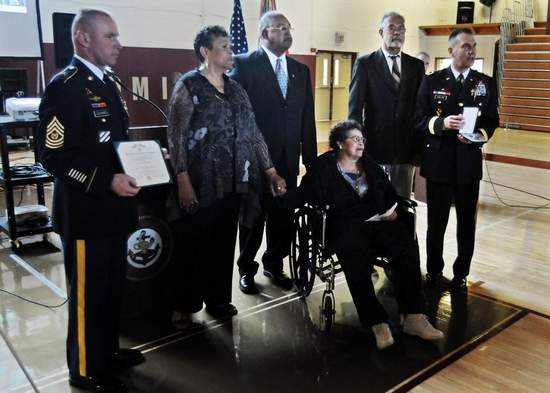
    Central to the ceremony was Brig. Gen. Jeffrey Phillips and Command Sgt. Maj. Jeffrey Ashmen, who presented the Silver Star to Charlie’s brothers and sisters.

    The General and Sergeant Major traveled from Fort Stewart, GA, the home of the 3rd Infantry Division (nicknamed the Marne Division for their actions in WWI). Charlie was a member of the famed 15th Infantry Regiment of the 3d ID, an honor that Audie Murphy and I share with perpetually young Charlie Johnson.

  • RIP Vernon J. Baker

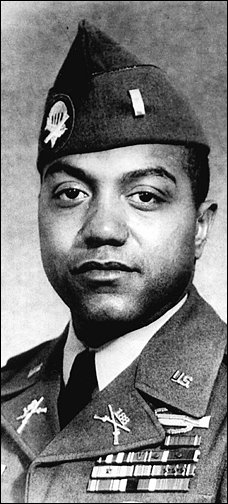
    The Washington Post reports that the sole liveing African American MOH recipient of WWII has left us.

    First Lt. Vernon J. Baker, 90, an Army infantryman who, more than 50 years after the end of World War II, became the only surviving African American to receive the Medal of Honor for his heroic actions during the war, died July 13 at his home near St. Maries, Idaho.

    The article goes on to describe Lt. baker’s actions agaionst the Germans in Italy.  It reads like something out of a movie:

    Two hours after starting their mission on April 5, Lt. Baker and his men came within 300 yards of the castle. While attempting to find a suitable place for a machine gun, Lt. Baker observed two rifle barrels hanging out of a concealed slit in some rocky earth.

    After stealthily crawling to the opening, he popped up and emptied the clip of his M-1 rifle into the observation post, killing two sentries.

    While searching for more camouflaged emplacements, Lt. Baker spotted a machine-gun nest occupied by two soldiers distracted by their breakfast. He shot and killed them both.

    A German soldier then hurled a grenade that landed at Lt. Baker’s feet. Undeterred, he fired two fatal rounds at the fleeing German, while the grenade by Lt. Baker’s boots failed to explode.

    He found the door to another bunker and blasted it open with a grenade. A wounded German soldier stumbled out in confusion, and Lt. Baker shot him. After tossing in a second grenade, he raided the bunker with a submachine gun blazing, killing two more Germans.

    Apparently, Baker spent 23 years in the Army and retired in 1968.  My favorite part of the article was the end:

    He spent much of his later life hunting big game in Idaho. During one expedition, he discovered a mountain lion lurking behind him. After receiving his Medal of Honor, Lt. Baker was asked by Clinton what happened to the cougar.

    “Why, it’s in my freezer,” Lt. Baker said. “I’m going to eat him.”

    BZ Lt.  Rest In Peace