
Category: Veterans’ Affairs Department

  • VA loses 30 cars and fires the guy who told them

    VA loses 30 cars and fires the guy who told them

    A number of folks have sent us links to the story of Anthony Salazar, a Veterans Affairs driver in Los Angeles who told his supervisor Robert Benkeser that there were 30 VA vehicles missing out of their stable of 88 vehicles. He also told Benkeser that there was significant abuse of Department credit cards. To reward Salazar, Benkeser fired Salazar;

    The department convened an “administrative investigation board” (AIB) that resulted in “a letter of counseling” to Benkeser for mismanaging the motor pool. Benkeser then fired Salazar several months later.

    The Office of Special Counsel (OSC), a government-wide agency that protects whistle-blowers, said earlier this month that VA blocked Salazar from showing that he was being retaliated against. The Merit Systems Protection Board (MSPB) imposed “an overly rigorous” standard of proof to show prohibited retaliation.

    […]

    Salazar was fired Feb. 4, 2015. The ease with which Salazar was fired — he was put on a “performance improvement plan,” told he didn’t meet the goals, then let go — stands in contrast to the many employees who unambiguously committed egregious misconduct and are still on the job.

    Funny how the VA can’t fire people who really need to be fired – folks who abuse the system – but they always find a way when they want to fire someone.

  • VA OIG investigation of Director of Denver VARO

    VA OIG investigation of Director of Denver VARO

    Director_Murphy_100x125

    Someone dropped this document in our inbox this morning. It’s a report by the Veterans’ Affairs Department Office of the Inspector General of the time the current Director of the Denver VA Regional Office, Melanie Renaye Murphy, didn’t bother to show up for her work.

    VA OIG investigation

    I’ll summarize some of the findings; During her time in the position, she habitually showed up late for work 508 days out of 1000 days between 2011 and 2014 (the year she was appointed to her current position). Of those days that she came to work, she showed up for work at least 30 minutes late 90 times. She also claims that she teleworked for 180 days but could not prove exactly what she was doing while not at the office.
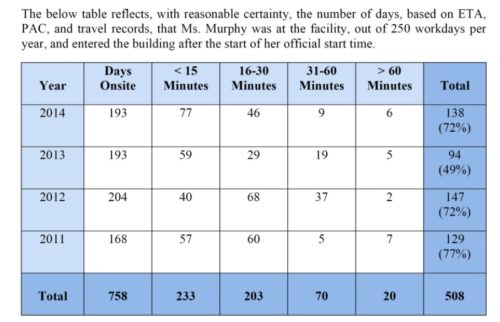
    Murphy work days

    The VAOIG concluded;

    Ms. Murphy misused her official time by frequently arriving late to her duty station between January 1, 2011, and December 31, 2014. Although she was permitted to flex her day by up to 15 minutes, we were unable to determine if she worked later to compensate for her late arrivals, whether 15 or more minutes. Further, this time was not entered into her ETA. As a senior leader, Ms. Murphy is held to a higher standard and should set the tone for her subordinates to follow, and arriving late to work over 70 percent of her workdays diminishes her position and authority as a senior leader.

    We also found no or insufficient records to support her arrival at the facility or that she worked the entire day for 14 identified workdays. Subsequent to our interview with her, Ms. Murphy amended her ETA to retroactively take leave for 2 full days and 7 partial days not related to these 14 days. We gave Ms. Murphy ample opportunity to provide evidence that she worked these unaccounted for days, and the most she provided us was one email or email chain for 5 of the days in question. Although she may have worked extended hours to compensate for these days, she failed to properly record her time through the use of VA Form 5631 or in the ETA as required by VA policy.

    Additionally, we found that Ms. Murphy improperly teleworked for about 6 months. She not only failed to take the required training, she split her workday to care for a family member and did not take the appropriate paid and/or unpaid leave to cover her personal travel time and the time she spent caring for the family member. Ms. Murphy, as the most senior leader within that facility, has a duty and responsibility to set the highest possible example for her workforce by adhering to Federal laws and regulations, as well as VA policy. Unfortunately, she failed to establish a culture of accountability for time and attendance, and time and attendance recordkeeping was too lax to provide an accurate accounting of the time she worked.

    Moreover, we found that Ms. Murphy and her staff improperly used a local credit hour policy, which was contrary to VA Policy. Employees maintained an off-the-books credit hour spreadsheet, did not notify supervisors in advance when credit hours were accrued, and did not record these hours as required in ETA. In addition, the former VARO Director, Ms. Murphy, and the Assistant Director failed to establish a culture of time and attendance accountability, which is a primary responsibility of senior management.

    So, that was just one employee in the Denver office, the director, but the OIG discovered that the problem was office-wide, probably because the director provided such a stellar example for her subordinates. The report was circulated to leadership in the VA two months ago, and all indications are that Ms. Murphy still occupies her position as director of the Denver VARO.


  • $20 Million for Art? Pfft. Merely Peanuts.

    I suppose everyone’s heard the recent news about the VA spending $20M on art.  Well, as far as VA “management excellence” goes, it turns out that’s peanuts.

    During the period 2010-2013, the VA began implementation of 15 solar energy projects.  They were projected to take on average of 7 to 12 months, and to all be completed by now.

    I suppose you can guess what’s coming.  And if you guessed “another sterling example of the VA’s excellence in managing the use of its resources” – you’d be right.  (I trust the sarcasm in the previous sentence is obvious.)

    Instead, the projects are taking an average of 42 months to completion.  Further, most aren’t yet fully operational.

    In aggregate, the projects were projected to cost $95M.  So far, the VA has spent approximately $408M – which is “only” 329+% over budget.  And some of the projects haven’t even begun to produce electricity, let alone reach full operating capacity.  In fact, of the 15 projects investigated by the VA OIG only two were operating at design capacity by March of this year.

    The Washington Free Beacon has a good article giving more details.  It’s worth a read.  So is the VA OIG report on the subject (PDF format).  Be forewarned:  both just might p!ss you off.

    “Saving the environment”? Yeah, right.  IMO “political payback using tax dollars” sounds more like it.

  • Robert Gingell VA employee defrauds taxpayers

    Robert Gingell VA employee defrauds taxpayers

    Robert Gingell

    According to Daily Caller, there was this guy, Robert Gingell, who was a GS-15 at the Veterans’ Affairs Department who didn’t bother to show up for work for six months while he started his dream-business. He pretended to be sick and unable to come to his office, and drew his paycheck, continuing to stockpile “sick days” that he eventually cashed in when he retired;

    He submitted a doctor’s note to VA saying he couldn’t work, but, “although the heading on the note reflected a legitimate medical practice, the signature on the note was unrecognizable as either of the named practitioners,” according to the IG. After bosses became skeptical about how long-running the illness was, he said he eventually became well enough to work, but unable to commute and thus needed to work from home.

    Well, until another VA employee started making inquiries which resulted in an Inspector General investigation.

    [W]hen the IG subpoenaed his store’s business records, Gingell immediately “appeared at an HR Specialist’s office with retirement forms completed and signed, asking that his retirement be effective” immediately instead, the IG said.

    At that point, the IG announced that “we are administratively closing this allegation, as Mr. Gingell retired from VA effective September 21, 2015,” with no further actions planned.

    Well, miraculously, he’s recovered from his ailment now that he has a business which is nice.

  • Four vets tie up suicide hotline with crank calls

    Four vets tie up suicide hotline with crank calls

    USAToday reports that four veterans have made 5,619 abusive and vulgar phone calls to the Veterans’ Affairs’ suicide hotline just in May for reasons that aren’t explained in the article.

    “It’s unacceptable that they would block that kind of access for other veterans and other active-duty service members that really need crisis help and so we’re working through this clinically now to address that, cause it’s just wrong,” Gibson said. “My bottom line was deal with it and deal with it quickly because we’re not going to continue to have that happen.”

    Five thousand phone calls from four people seem like a lot to me. I know of people who would do something like that – my inbox is full of emails from people like that – the VA ought to get to the root of the problem. I get the sense that, whatever their reason is, it’s probably not helping to force the VA to spend scarce resources on catering to these four guys’ opinions.

    Thanks to Dave for the link.

  • The VA wants to hack off your junk

    The VA wants to hack off your junk

    One of our ninjas send us the story from Stars & Stripes that the Veterans’ Affairs Department wants to get into the business of transgender surgeries, you know, because they’ve conquered all of the other dragons that veterans’ healthcare has presented them;

    The VA says the surgical procedures were not deemed to be “medically necessary” in the past and there were questions over their safety and effectiveness.

    “However, increased understanding of gender dysphoria and surgical techniques in this area have improved significantly, and surgical procedures are now widely accepted in the medical community as medically necessary treatment for gender dysphoria,” the VA wrote in the notice.

    The department called it a serious medical condition with severe consequences for patients if treatment is not provided.

    Until recently, gender dysphoria was considered a mental disorder – it was called gender identity disorder (GID) until 3 years ago – the Diagnostic and Statistical Manual of Mental Disorders, Fifth Edition (DSM-5), just edited in 2013, changes the name, because political correctness has permeated the medical community.

    Me, personally, I have no complaints about the medical treatment that I get at the VA, but there are enough horror stories out there that preclude me having the VA get anywhere near my genitals.

    This will end up being a huge recruiting tool for the military – everyone who wants to go through the expensive treatment and life-altering practice can just join the military, get a discharge for being unfit for duty because of their mental faculties, and then get in that line at the VA ahead of service connected disabled veterans. The waiting rooms at most VA medical facilities are already chocked full of confused people, this won’t lend any relief to that situation.

  • Wait times, the VA and Disneyland

    Wait times, the VA and Disneyland

    Robert-McDonald

    The Washington Post reports that Secretary of the Department of Veterans’ Affairs, Bob McDonald told reporters at the Christian Science Monitor that the amount of time that veteran waits to receive care from the VA shouldn’t be important to the VA, much like your wait in line at Disneyland isn’t important to the Disney staff;

    “When you go to Disney, do they measure the number of hours you wait in line? Or what’s important?” McDonald told reporters at a breakfast sponsored by the Christian Science Monitor.

    “What’s important is, what’s your satisfaction with the experience?”

    So, are the customers in line at Space Mountain going to die if they don’t get to the ride in time?

    While I have very few complaints with the VA, I also understand that my experience hasn’t been the same for every veteran. Trivializing the fact that veterans have actually died waiting for care from the VA isn’t helping McDonald. Besides, the Post claims that Disney does indeed keep track of wait times;

    Disney, it turns out, does collect and analyze extensive waiting time data, which it considers core to its overall customer experience. The company has a system that manages the information.

    […]

    [McDonald] said the date the appointment is made “is not the ultimate measure of satisfication.”

    “You would have a veteran who waits two days and one who waits eight days” for a medical appointment, McDonald said, but the one who waited longer might feel better about the care he or she received.

    I know what he’s saying, but he needs a more artful phrasing.

  • Senate caves to unions in Veterans Affairs omnibus bill dispute

    Senate caves to unions in Veterans Affairs omnibus bill dispute

    I think that we can all agree that the Veterans’ Affairs Department has a problem and that the culture at the agency needs to be changed. The only way to change the culture is to change the people who have created the anti-veteran culture there. So the Senate Veterans’ Affairs Committee set out to make it easier for the agency to rid itself of folks. Well the American Federation of Government Employees (AFGE) stuck their noses into the process and got everything that they wanted, and nothing that will help veterans (of course), according to the Daily Caller;

    All of a federal employee union’s objections were removed from a Senate bill designed to help the Department of Veterans Affairs (VA) discipline bad employees, making it politically easier for the bill to pass, but indicating it may not be doing the very thing it’s supposed to.

    Yeah, well, we can’t have Republicans doing something that will actually benefit anyone these days, can we?

    The original draft said no employee may complete their initial probationary period unless their manager affirmatively signs off on it. But this was changed so the employee will automatically become permanent unless other action is taken.

    The Government Accountability Office recently said one of the best ways to ensure bad employees are booted from government is by not renewing them after the probation period, but the period often ends without managers realizing it.

    The union’s other three complaints were that employees didn’t have enough time to appeal, reprimands wouldn’t be removed from their file quickly enough, and performance reviews could be revised after the fact.

    Isakson quickly allowed all of these to be changed. For example, the draft bill says letters of reprimand could be removed from an employee’s file after five years, but the final version reduces it to three years.

    I don’t even understand why the AFGE is such a threat to the Senate. I only knew a few people who were members of the union while I worked with the feds. The only people who belonged to the union intended to be F-ups when they began working. The rest of us didn’t see the point.

    Thanks to Bobo for the link.