Category: Valor

  • Valor Friday

    army moh

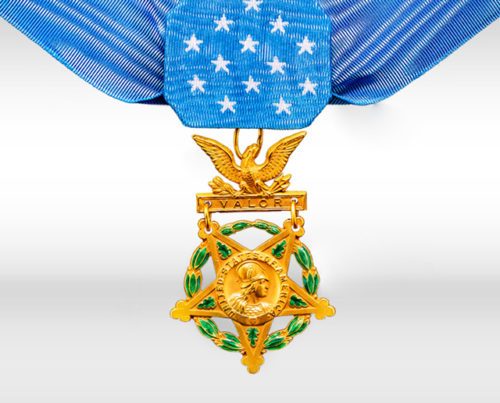
    Today’s Valor Friday honors Maurice “Footsie” Britt, USA, and chronicles his acts of heroism in WWII, from North Africa, to Sicily and finally Italy. Footsie survived the war, and like many quiet heroes, he continued to serve through elected office and Presidential appointment. Here’s his story, as sent to me by one who wishes to remain anonymous.

    Maurice is not a name one associates with fierceness, and the nickname “Footsie” conjures a soft, playful image, not a rugged one. But Maurice “Footsie” Britt was both fierce and rugged, a man the enemy repeatedly tried to kill but who denied them again and again.

    “Footsie” Britt was a handsome man who stood 6’4” and weighed more than 200 lbs. In high school, he was a gifted student and a gifted athlete who excelled at basketball and football. He was valedictorian of his class and attended the University of Arkansas on a dual scholarship. Despite the demands of studies and sports, he joined the ROTC. He was commissioned an officer upon graduation and was drafted by the Detroit Lions to play football. The Army granted him a temporary deferment to play ball and in 1941, at age 22, he started in nine of the Lions’ 11 games. Then came Pearl Harbor and the abrupt end to Britt’s deferment and football career.

    Britt was an infantry officer whose first combat experience came in North Africa in late 1942, followed by action in Italy at Sicily and Salerno in 1943. In a place called Acerno, he was wounded the first of four times during the war. He also prevailed against an enemy machine gun and, for that action, was awarded the Silver Star. At Sicily, his company was stopped by a well concealed enemy machine gun. The infantrymen knew it was there but could not see it. Britt devised a simple plan. He rose and began doing jumping jacks to draw enemy fire. It worked. The enemy fired, revealing itself, and was destroyed, but not before a round tore a chunk from Britt’s arm. For that, Britt received the Distinguished Service Cross but lost the possibility of returning to pro football after the war. The place where Britt did his famous cals was immediately renamed “Britt’s Junction” and one can easily imagine the account of Britt’s impromptu PT being told and retold among the grunts! Such is the stuff of legend.

    In Italy, Britt also received a Bronze Star w/ V Device and was promoted to captain in the field. Then came 10 November 1943, the account of which follows below in his Medal of Honor citation.

    After the war, “Footsie” returned to the University of Arkansas where he studied law but withdrew to pursue a business career. In 1966, he was elected lieutenant governor of Arkansas and was later appointed by President Nixon to the Small Business Administration. He died in 1995 at the age of 76.

    War Department, General Orders No. 23 (March 24, 1944)
    CITATION:
    The President of the United States of America, in the name of Congress, takes pleasure in presenting the Medal of Honor to Captain (Infantry) Maurice Lee “Footsie” Britt, United States Army, for conspicuous gallantry and intrepidity at the risk of his life above and beyond the call of duty while serving with Company L, 3d Battalion, 30th Infantry Regiment, 3d Infantry Division. Disdaining enemy hand grenades and close-range machine pistol, machinegun, and rifle fire, Lieutenant Britt inspired and led a handful of his men in repelling a bitter counterattack by approximately 100 Germans against his company positions north of Mignano, Italy, the morning of 10 November 1943. During the intense fire fight, Lieutenant Britt’s canteen and field glasses were shattered; a bullet pierced his side; his chest, face, and hands were covered with grenade wounds. Despite his wounds, for which he refused to accept medical attention until ordered to do so by his battalion commander following the battle, he personally killed five and wounded an unknown number of Germans, wiped out one enemy machinegun crew, fired five clips of carbine and an undetermined amount of Ml rifle ammunition, and threw 32 fragmentation grenades. His bold, aggressive actions, utterly disregarding superior enemy numbers, resulted in capture of four Germans, two of them wounded, and enabled several captured Americans to escape. Lieutenant Britt’s undaunted courage and prowess in arms were largely responsible for repulsing a German counterattack which, if successful, would have isolated his battalion and destroyed his company.

    Hand Salute. Ready, Two! Fair wind and following seas, Captain.
  • Valor Friday

    usn moh
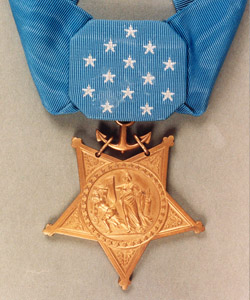
    Today’s Valor Friday honors Robert Charles Burke, USMC, who served with distinction in Viet Nam. Unfortunately, he did not survive the conflict. This is his story, as forwarded to me by one who wishes to remain anonymous.

    Some 18-year olds are seniors in high school. Others are college freshmen. Still others work a job or do nothing of value at all. When Robert Charles Burke was 17 and still in high school, he joined the USMC Reserve. A couple of months later, he enlisted in the Marines. He was trained as a mechanic but when he was sent to Vietnam in February 1968, he dropped his wrenches and picked up an M60 with I Company, 3rd Battalion, 27th Marines, 1st Marine Division (Reinforced). After three months in country, Burke’s company was leading a column of the 3/27 when it was ambushed by a strongly entrenched PAVN force near the hamlet of Le Nam on Go Noi Island. The furious and accurate enemy fire resulted in 88 casualties for I Company, including 20 KIA. Burke’s response to the ambush was to aggressively attack, using his M60 first and, when that jammed, a rifle and grenades taken from a casualty, and then back to his M60, now cleared. The bold, aggressive, and selfless action saved many of his fellow Marines and, in exchange, cost him his life.

    Robert C. Burke of Monticello, Illinois was the youngest recipient of the Medal of Honor during the Vietnam war. A six-acre park bears his name in his home town. Forever 18. Forever a Marine. Here is the official account of his valor, memorialized on the citation and immortalized in the valorous history of the US military and the United States Marine Corps:

    Citation:
    The President of the United States of America, in the name of Congress, takes pride in presenting the Medal of Honor (Posthumously) to Private First Class Robert Charles Burke (MCSN: 2359360), United States Marine Corps, for conspicuous gallantry and intrepidity at the risk of his life above and beyond the call of duty as a machine gunner with Company I, Third Battalion, Twenty-Seventh Marines, FIRST Marine Division (Reinforced), Fleet Marine Force, in action at Le Nam (1), Go Nai Island, southern Quang Nam Province, Republic of Vietnam on 17 May 1968. While on Operation ALLEN BROOK, Company I was approaching a dry river bed with a heavily wooded tree line that borders the hamlet of Le Nam (1), when they suddenly came under intense mortar, rocket propelled grenades, automatic weapons and small-arms fire from a large, well concealed enemy force which halted the company’s advance and wounded several Marines. Realizing that key points of resistance had to be eliminated to allow the units to advance and casualties to be evacuated, Private First Class Burke, without hesitation, seized his machinegun and launched a series of one man assaults against the fortified emplacements. As he aggressively maneuvered to the edge of the steep river bank, he delivered accurate suppressive fire upon several enemy bunkers, which enabled his comrades to advance and move the wounded Marines to positions of relative safety. As he continued his combative actions, he located an opposing automatic weapons emplacement and poured intense fire into the position, killing three North Vietnamese soldiers as they attempted to flee. Private First Class Burke then fearlessly moved from one position to another, quelling the hostile fire until his weapon malfunctioned. Obtaining a casualty’s rifle and hand grenades, he advanced further into the midst of the enemy fire in an assault against another pocket of resistance, killing two more of the enemy. Observing that a fellow Marine had cleared his malfunctioning machinegun he grasped his weapon and moved into a dangerously exposed area and saturated the hostile tree line until he fell mortally wounded. Private First Class Burke’s gallant actions upheld the highest traditions of the Marine Corps and the United States Naval Service. He gallantly gave his life for his country.

    Hand Salute. Ready, Two! Fair winds and following seas, Marine.

  • Valor Friday

    Hudner

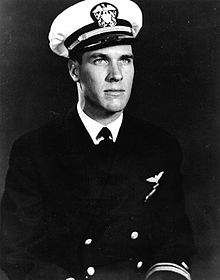
    Today’s Valor Friday highlights Thomas J. Hudner Jr. (August 31, 1924 – November 13, 2017). He was an officer in the United States Navy and a Naval Aviator. He rose to the rank of Captain, and received the Medal of Honor for his actions in trying to save the life of his wingman, Ensign Jesse L. Brown, during the Battle of Chosin Reservoir in the Korean War.

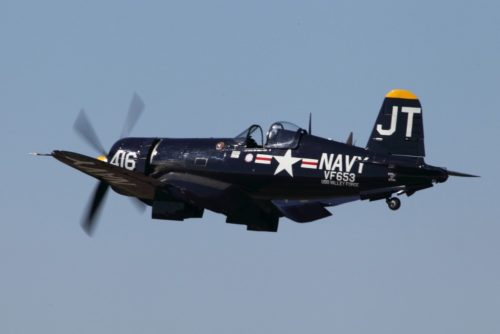
    Born in Fall River, Massachusetts, Hudner attended Phillips Academy and the United States Naval Academy. Initially uninterested in aviation, he eventually took up flying and joined Fighter Squadron 32, flying the F4U Corsair at the outbreak of the Korean War. Arriving near Korea in October 1950, he flew support missions from the aircraft carrier USS Leyte.

    corsair

    On 4 December 1950, Hudner and Brown were among a group of pilots on patrol near the Chosin Reservoir when Brown’s Corsair was struck by ground fire from Chinese troops and crashed. In an attempt to save Brown from his burning aircraft, Hudner intentionally crash-landed his own aircraft on a snowy mountain in freezing temperatures to help Brown. In spite of these efforts, Brown died of his injuries and Hudner was forced to evacuate, having also been injured in the landing.

    Citation.
    For conspicuous gallantry and intrepidity at the risk of his life above and beyond the call of duty as a pilot in Fighter Squadron 32, while attempting to rescue a squadron mate whose plane struck by antiaircraft fire and trailing smoke, was forced down behind enemy lines. Quickly maneuvering to circle the downed pilot and protect him from enemy troops infesting the area, Lt. (J.G.) Hudner risked his life to save the injured flier who was trapped alive in the burning wreckage. Fully aware of the extreme danger in landing on the rough mountainous terrain and the scant hope of escape or survival in subzero temperature, he put his plane down skillfully in a deliberate wheels-up landing in the presence of enemy troops. With his bare hands, he packed the fuselage with snow to keep the flames away from the pilot and struggled to pull him free. Unsuccessful in this, he returned to his crashed aircraft and radioed other airborne planes, requesting that a helicopter be dispatched with an ax and fire extinguisher. He then remained on the spot despite the continuing danger from enemy action and, with the assistance of the rescue pilot, renewed a desperate but unavailing battle against time, cold, and flames. Lt. (J.G.) Hudner’s exceptionally valiant action and selfless devotion to a shipmate sustain and enhance the highest traditions of the U.S. Naval Service.

    Fair winds and following seas, Captain Hudner.

    Refs.
    Wiki
    CMOH