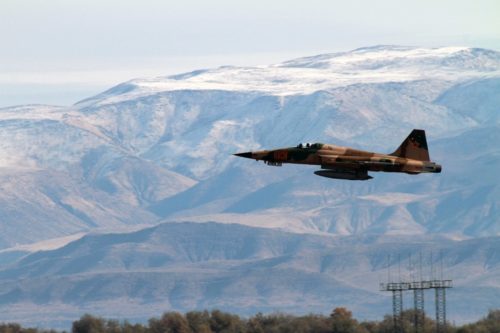
A year ago, an F-5N Tiger II tactical fighter aircraft the US Navy purchased from the Swiss Air Force crashed into the Atlantic Ocean forcing the pilot to eject.
The event took place on 09 August, about 20 nautical miles southeast of Naval Air Station Key West.
The unnamed pilot, assigned to Fighter Squadron Composite (VFC) 111, was quickly recovered by a Coast Guard helicopter at approximately 1:15 p.m.
He was reported to have no significant injuries.
The pilot — whose name is redacted in the report — was flying a standard training mission for the “Sun Downers” of Fighter Composite Squadron 111 that day, playing the role of an aerial adversary, according to the report.
This is the narrative from the mishap report.
The flight seemed routine until after he heard the call of “Fights On” and he “pulled the nose toward vertical … and noticed the nose tracking slow” at about the 70-degree mark, according to his official statement.
He tried to keep the nose from “getting parked close to vertical,” but the right rudder input seemed sluggish.
“I do not recall an altitude or airspeed as I was looking at my opponent at this time,” he said. “The aircraft departed controlled flight.”
That laconic statement belies the chaos that ensued over the coming seconds.
The jet inverted, slicing and rolling left before kicking into a fully inverted left spin, according to the report.
“Knock it off, Viper 2, watch the deck,” his colleague in the other jet warned.
But the jet continued to fall.
Upside down, the pilot recalled seeing “a number of items from the cockpit collect on the canopy above me.”
“I think the pens came out of my g-suit pocket.”
With the altimeter reading between 8,000 and 9,000 feet, he said that he tried to apply procedures to right the aircraft. He moved to roll the jet upright but failed, a sign he believed that the plane was gyrating after the stall.
“The situation was unbelievably disorienting as I was ‘hanging in the straps’ and waiting for control effectiveness to return,” the pilot said.
“Watch your altitude,” the other pilot warned again. “WATCH THE DECK!”
“I remember thinking I was rapidly losing the opportunity to eject as my altitude decreased,” the pilot said. “I grabbed the handles and commanded ejection.”
The next few seconds became a blur.
The “Knock it off” call is used whenever anyone involved in an evolution feels an unsafe condition exists, which clearly was the case here. To read the rest of the article, click Here.
Note: The article was too lengthy to post in its entirety. I highly recommend following the link for the remainder- it’s a real world water survival evolution, and should be required reading for all who fly in military aircraft.
AW1Ed