Category: Stolen Valor Act

  • 9th Circuit: You can lie about earning a medal, but don’t wear it

    We first wrote about David M. Perelman back in October 2009 when he was convicted of wearing a Purple Heart and convincing the Air Force that the wound in his leg that he inflicted on himself 20 years after his four-month stint in Vietnam was the result of VC shrapnel. The VA awarded him $180,000 in disability payments for his lie. But he’s been fighting the conviction with the appeals process ever since.

    The Ninth Circuit shot down his appeal last year, but took another look at it Tuesday in light of the Supreme Court decision several weeks back, according to the Wall Street Journal;

    A panel of judges in including Procter Hug Jr., Barry G. Silverman and Susan P. Graber said the provision of the law struck down by the Supreme Court criminalized pure speech, and thus was unconstitutional. But “the use of a physical object goes beyond mere speech and suggests that the wearer has proof of the lie, or government endorsement of it,” the panel ruled.

    Mr. Perelman and his lawyers argued the law could make criminals of actors who wear military medals in movies, or grieving spouses who wear their loved ones’ medals to military funerals. But the panel interpreted the law to criminalize the unauthorized wearing of medals only when the wearer intends to deceive.

    So, I guess the Stolen Valor Act wasn’t a total loss like we thought…and if the 9th Circuit says it, it must be true since they’re the ones who gave Alvarez a pass in the first place.

    I wonder if they’d uphold a Stolen Valor conviction against our tattooed phony, Matthew Beck.

  • 4th Circuit: Impersonating police is not free speech

    Even though the Supreme Court struck down the Stolen Valor Act as a violation of the constitutional guarantees of freedom of speech, the 4th Circuit Court of Appeals says those guarantees don’t apply to folks seeking to impersonate a police officer. From the Wall Street Journal;

    Douglas Chappell was stopped in October 2009 by a U.S. Park Police officer on the George Washington Memorial Parkway. In a bid for leniency, he fibbed, telling the officer he was a deputy sheriff in nearby Fairfax County, Va., according to court documents. In fact, he hadn’t been working at the office for about a year. The officer called the sheriff’s office, and Mr. Chappell was found out. He was arrested for speeding and impersonating an officer and was later convicted.

    Mr. Chappell maintained that the Virginia law against impersonating an officer violated his First Amendment rights. The argument failed in federal trial court, so he rolled it up to the U.S. Court of Appeals for the Fourth Circuit.

    The 4th Circuit wasn’t amused;

    “To strike down police impersonation statutes…would risk expanding the oppressiveness of the police function by adding to the legitimate number of officers an untold flock of faux policemen, all without any corresponding salutary benefit. This strikes us as a complete inversion of the traditional balance courts are charged with maintaining,” wrote Judge Wilkinson, who was joined by Chief Judge William Byrd Traxler Jr.

    While striking down Virginia’s law might induce more people to impersonate police, doesn’t the same hold true for striking down the Stolen Valor Act? While it could cause some public safety concerns, it’s much easier to check on the validity of a phony cop’s claims than it is to check on military records. And most jurisdictions already have measures in place to combat phony cops – like calling 911 to ask if there are police operating in your area during a traffic stop.

    At least some of the 4th Circuit judges think that US vs. Alvarez makes Virginia’s law unconstitutional;

    Nothing before us indicates that the challenged clause was intended to prohibit citizens from posing as off-duty officers to dodge speeding tickets. Officers, just like judges and all other citizens, are subject to traffic laws and should be ticketed just like anyone else when they fail to obey them. The government interest here is public safety—not the prevention of non-police officers from attempting to obtain benefits that police officers should not themselves receive.

    Personally, I think any pretenders should be punished, no matter what they’re pretending to be. I think we’ve had phonies who pretended to be in the military police, so if they did it in Virginia, they have a 50% chance of getting off the charges.

  • Danny Russell Crane update

    Mary at POW Network writes to tell us that Danny Crane has been arrested, apparently on an indictment from the Department of Veterans’ Affairs Office of the Inspector General. I couldn’t find anything about the arrest, but I did find this news report about him by a local TV station in Florida last week and it looks like he’s a wanted man down there;

    But Crane was apparently able to fool some veterans groups. He was able to join the Distinguished Flying Cross Society and he also convinced another veterans group to send him to Hawaii to visit Pearl Harbor.

    “I’m embarrassed for his family that he would even do something like that,” said Melissa Crane, who met Danny in high school. They married, had two kids, and are now divorced.

    She says her husband has conned a lot of people. She showed FOX 13 a picture of him in 1997 in uniform taken during boot camp.

    “I later found out that he was dishonorably discharged for theft,”she explained.

    FOX 13 contacted the National Personnel Records Center in St. Louis, Missouri. While much of the information is protected without written consent by Crane, we do know he entered the military in 1997 on December 30 and was discharged just 63 days later — still a private.

    I guess there are enough reasons to arrest him besides Stolen Valor, but if there was a Stolen Valor Act, perhaps he would have been prevented from all of these other crimes his wife seems to think he’s committed.

  • Valor Database Launched

    Doug Sterner writes to tell us that DoD has launched their Valor database of award recipients. It looks like so far, they’ve only recorded the Medal of Honor recipients by service. Which sounds about right for government employees. Doug sends us his remarks to NBC;

    This is indeed a step in the right direction, a small step but as they say, “A journey of a thousand miles begins with a single step.” There is much more that can and should be done, and my hope is that DoD will continue to expand on it so that no military hero is ever forgotten.

    I do appreciate that this is being offered as a database of REAL heroes, not as some have called it, a “Stolen Valor database.” This is evident both in the url (valor.defense.gov) and in the text and layout of the website itself. My calls for this database have always centered around the need to preserve the history of our true heroes. That such a database WILL make it harder for so-called “stolen valor” to be perpetuated is an ancilliary benefit. This is, as it should be, a website designed to remind our country that despite the many bogus heroes we see and hear about all to frequently, men and women of TRUE valor exist, and it is them we honor by efforts to preserve their service, deeds, and sacrifice.

    I am further encouraged that the template for this already lays a platform for including the Silver Star. These number fewer than 1,000 awards since 9/11, and respresent some of our finest men and women in service, thus it is appropriate that in the initial stage of this effort the Silver Stars are included. The Military Times Database (www.militarytimes.com/hallofvalor) already has the names of all but one of the 79 recipients of the Medal of Honor and service crosses since 9/11. We also have all or nearly all Marine and Air Force recipients of the Silver Star. But we’ve only been able to identify about 70% of the reported 655 Army Silver Star recipients. So forward momentum by DoD to identify the remainder is most welcomed.

    I do note that this, at present, seems to be simply a LIST of award recipients. It is my hope that DoD’s in-progress efforts include subsequently linking to the citation for each award. A list is important, but makes this less of a roster of recipients and more of a “stolen valor” cross-check reference. What these men and women have done, the details of their actions contained within their citations, if first and foremost American history. Further, such a database should be able to answer the question decades from now, “What did grandpa do to get the Silver Star in Iraq.” Any such effort is less about the men and women who did receive the awards, most are humble and self-effacing, and more about preserving history for future generations.

    That ARE some serious caveats in terms of the scope of the database, particularly as it applies to valor. For instance, the Army reports 309 Distinguished Flying Crosses awarded since 9/11. The other services combined probably double that number. The Air Force, when awarding the DFC, awards it with a “V” device denoting valor, but is the only service that does so. An Army or Navy DFC may be awarded for “heroism while participating in aerial flight” but is not awarded with a “V.” Obviously most DFCs are valor awards, even without the “V” denoted. Similarly, the Soldier’s Medal, Airman’s Medal, Navy and Marine Corps Medal, and Coast Guard Medal are awarded for “heroism at the risk of life not involving conflict with an armed enemy.” These are low in precedence (above the Bronze Star but below the DFC), and are among the services’ rarest awards, far more rare than even the Silver Star. (Army HR reports a total of 148 Soldier’s Medals since 9/11.) These distinctive awards are not a combat valor award, but are among the most respected of all awards for heroism, often called the “non-combat Medal of Honor.” I would, at the least, hope plans are in process to include these awards in the near future.

    DoD has thus far struggled to answer the question as to how far back and how low in precedence among the military awards to go. They have focused on awards since 9/11, which is good in that it first and foremost recognized the heroes of the current generation, upon whom the spotlight should rightly be focused. It is also good because the serious problems in record keeping is largely a post-1975 issue. The 1973 St. Louis fire often cited by DoD notwithstanding, it is far easier to compile and digitize data for pre-1975 awards than for those who served in Grenada, the Gulf War, Somalia, Pamama, Kosovo, Iraq, Afghanistan and elsewhere since the end of the Vietnam War.

    In fact, the Military Times Hall of Valor is currently at the least, 99% complete for ALL awards (including DFCs and the non-combat heroism awards) to ALL services from inception of our awards system until the beginning of World War II 1971. This part of the process has already been completed, save for the Citatation Stars what were later upgradable to the Silver Star. Of the estimated 15,000 to 20,000 of these awards, we have digitized and posted HALF, and I have in-hand the General Orders for an additional 30% or more of these awards. Having a complete database of EVERY U.S. Military Award from inception of our awards system to 1941 could be accomplished by four or five typists in a matter of weeks.

    Obviously, WWII through Vietnam are a larger project, but the data exists to do this easily in three years with a well-trained data entry team at a cost of less than $10 million. That is less than the amount of VA fraud reported by Congressman Chaffetz in his hearing on the need for this database last February.

    I applaud DoD for taking this first step. I only hope that they too, see this only as a first step in a long but important journey to preserving American history.

    While I appreciate Doug’s optimism, I personally think it’s a piss-poor start for the government. If they had actually used all of the resources that the President mentioned that that they were using the other day, it seems they could have a lot more than this completed by now. And let’s see how long it takes for their next update.

  • Obama: DoD to launch Stolen Valor website

    This probably could have gone with the next post down because it came from the same speech to the VFW, but it’s a different subject, so…

    According to the Stars & Stripes, the president announced that DoD will launch their database of awards on Wednesday. I’m sure it will be a humdinger;

    An administration official said that record keepers from each of the military services have been working to compile military awards records since the Supreme Court last month struck down the federal Stolen Valor Act, arguing that the punishments for individuals lying about military medals infringed on free speech.

    The website will initially list only the recipients of the military’s highest awards for valor – the Medal of Honor and service crosses – that were awarded after Sept. 11, 2001.

    Yeah, maybe the initial unveiling will be OK, cuz we’re only talking about twenty people more or less, and that sounds about right for three weeks work for the government. But, we’re talking about the same government that can’t get medical records from the Pentagon across the river to the Department of Veterans Affairs on Vermont Avenue in DC. And they say the services are all working together on this? I’m sure that they’re working on different operating systems and trying to get data passed back and forth. So I don’t have a lot of hope for this.

    But I guess at least they’re trying, and that’s a good sign. But, I’m sure our buddy, Doug Sterner, who sent us the S&S link, BTW, has a database that contains recent MOH and service crosses, so what is the government doing? Since 2001 happened during the computer and internet age, they should already have that database, shouldn’t they?

    Maybe I’m just too skeptical.

  • Stolen Valor Happens on Twitter Too

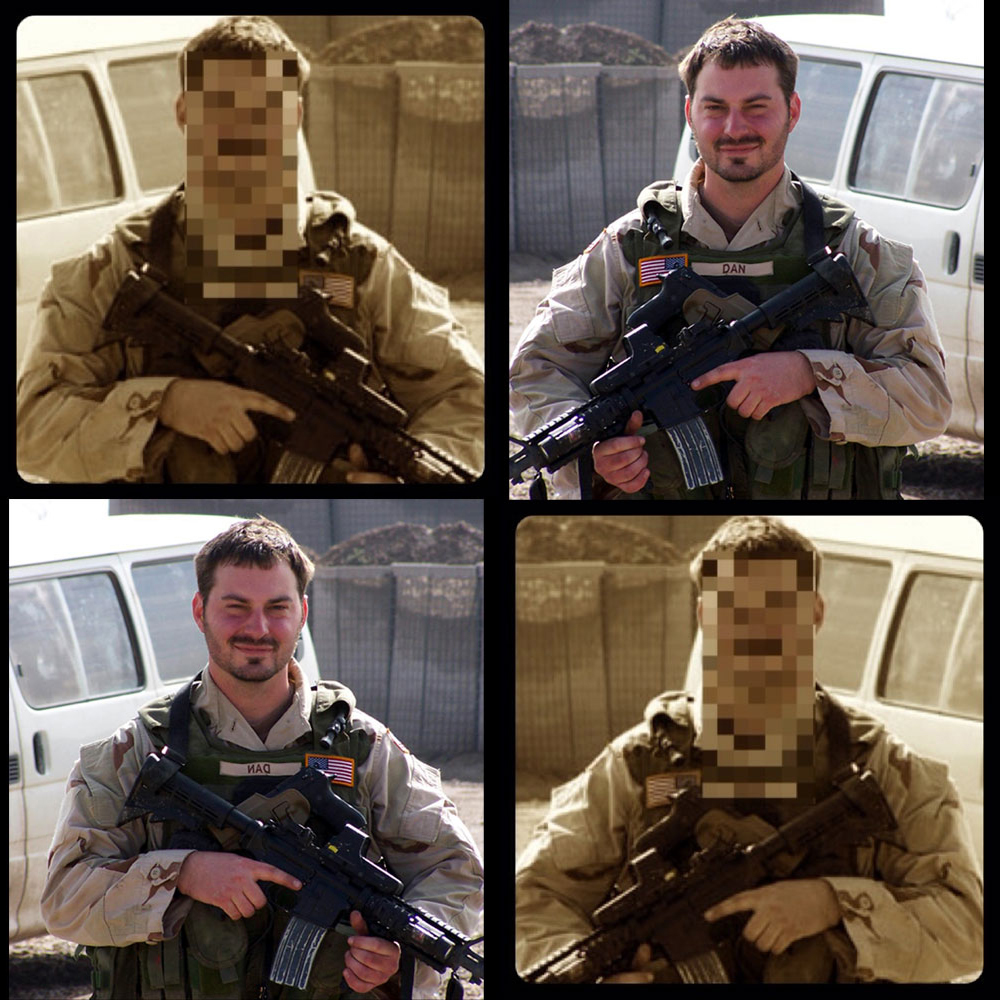
    I don’t really go on Twitter to find phonies at all. I just happened to see someone retweet (basically copy and republish what was said to the “twitter-uninitated”) something from a user with the name “FormerGrunt”. I thought, well.. let’s take a look at the Former Grunt.

    Something I noticed right off the bat is the profile photo. I’ve seen that photo before. Quick search and found it: SFC Daniel Crabtree. He’s a Special Forces soldier that was killed in Iraq in 2006. Quick lineup and flip in Photoshop and we have an exact match.

    So I decide to ask him about it… but since he’s a secret squirrel, he’s fuzzy on details. (more…)

  • John Giduck; Stolen Valor bully

    A week or so ago, I was honored with a request of some folks from SOCNET for our help in assisting them in a legal battle they’re having with a stolen valor thief turned bully who happens to be a lawyer. John Giduck was discharged from the Army after a lengthy career of 58 days and proceeded to build another career based on lies about his military experience – you know because all of that Drill & Ceremony gives him a distinct advantage in the world of private security. Well, the folks at SOCNET outed him as a phony and started damaging his business, so like some of the phonies we’ve had here, he struck back. I’ll let the folks from SOCNET explain the whole story;
    (more…)

  • Doug Sterner’s war against forgotten valor

    Our buddy, Doug Sterner, is featured in Stars & Stripes along with his database of hundreds of thousands of records, many of which the Defense Department considers lost in the pretenders’ favorite dodge which has become the Pentagon’s favorite argument against working on their own database;

    Thanks to the Army’s bureaucratic redundancy, most of what he needed to assemble this list was filed at National Archives in College Park, Md. Yet the fire was one of several reasons cited by the Department of Defense for not attempting to assemble a list of military valor medals.

    “Anyone who says this can’t be done simply doesn’t have the will to do it,” Sterner said.

    We all know how much much or an asset he’s been to this blog and the rest of us “valor vultures” as the phonies like to call us, Doug says that his battle isn’t with stolen valor criminals, but rather with “forgotten valor”;

    His most powerful inspiration through the years of work, he said, was a close friend, Jaime Pacheco, killed in Vietnam in 1972. Pacheco, a Ranger, sacrificed himself to cover his reconnaissance team’s withdrawal from a bunker complex.

    That sacrifice, and the Silver Star that resulted, should never be lost or forgotten, he said.

    “I think even worse than when someone pretends to be a hero — stolen valor — is when the nation forgets generations of real heroes,” he said. “That’s forgotten valor. I can’t allow that to happen.”