Category: Society

  • Church shooting averted in Alabama

    Church shooting averted in Alabama

    WHNT reports on the story of events in Limestone County, Alabama yesterday when Thomas Zebulun Lewter, 34, began to lecture his soon-to-be-ex-wife and her parents from the pulpit of the O’Neal Church of Christ;

    Stephen Young, Public Information Officer with the Limestone County Sheriff’s Office, said Lewter approached the pulpit during the service and began to speak about his pending divorce, calling out his wife and father-in-law who were present in the service.

    According to authorities, congregants approached the pulpit and tried to convince Lewter to stop talking and sit down, but he refused. That’s when deputies say Lewter attempted to grab his handgun. Deputies say congregants tackled and restrained him.

    A retired Limestone County Sheriff’s deputy who was present assisted, Young said, and handcuffed Lewter while they waited for deputies to arrive.

    I suppose shooting your soon-to-be-ex-wife won’t convince her to stop divorce proceedings, neither will failing to shoot her because of your neighbors piled on top of you. Try chocolates and flowers.

  • The Liberal Zombie Manifesto

    President Trump accurately identified the parties, on both sides, that were involved with violence. This was in the aftermath of the Charlottesville, VA, incident. The media, ignoring violent leftists, vilified the president for not carrying their narrative. In their eyes, only one side deserved this type of label and condemnation.

    Violent leftists were also guilty for the violence. Many in the media; however, deliberately disregarded them or deemphasized their involvement and impact.

    Shift to reporting on actual or assumed scandals and you’ll see a similar script. Liberal talking heads, and reporters, run fool’s errands regarding President Trump’s “scandals”. Yet, calls for pursuing actual scandals, by Democrats, are dismissed, swept under the rug, ignored, half baked, not seriously done, etc.

    Enter the Liberal Zombie manifesto. I also got this from the old Protest Warrior forums. As with the previous article, I did some major editing and adjustments. I also updated this as the years went by.

    The above photo is one of the protest signs that Protest Warrior used. One way they’d use this sign is to “blend in” with a group of people who were demanding gun control.

    Without further ado…

    I don’t pay for my mistakes or misfortunes.

    1. If I…

    a. Never went to college…

    b. Was born into a poor family…

    c. Am lazy…

    d. Am unmotivated…

    e. Wish to portray myself as a victim of any situation or series of events…

    It’s other people’s responsibility to extricate me from my own mess.

    2. Receiving more Social Security than I deserve is great because it rewards me for failing to put money away when I was younger.

    3. Abortion is great because I should never have to deal with the consequences of my failure to use the following:

    a. Birth control.
    b. Common sense.
    c. Keep the gates closed to irresponsible partners.

    4. Government subsidized paid abortion is a right that I have for not being responsible in the first place.

    NOTE: Please see Manifesto rules concerning my not having to pay for my mistakes. And society’s responsibility to get me out of the mess that I get myself into.

    Affirmative Action is great.

    1. If I’m a minority, I can get a job with substandard qualifications over someone that’s more qualified than me for the job. It’s not about who is qualified or not, it’s about giving me the job because I want it.

    2. If I’m white, I’ll support affirmative action to the hilt if it doesn’t affect me.

    The best thing about affirmative action is that it allows us to make protected groups think we’re helping them. Instead, we’re keeping them down by allowing them to take the path of least resistance. “Gain with no pain” is the rule. It’s easier to sway them with fake news this way.

    3. Racism against whites is OK. Racism against minorities is horrible.

    a. If whites kill a member of a protected group, that’s a hate crime. If a member of a protected group kills a white person, it’s simply a misunderstanding of the races.

    b. If you fail to hire a member of a protected group, you’re a racist. If you fail to hire a white person, you’re doing your job in “hiring the most qualified person” for the task.

    c. If you call a white person a thief, chances are he’s actually a thief. If you call an illegal immigrant a thief, you’re a racist, even if he’s a thief.

    d. If a black kid is kidnapped and drugs are involved, only report the kidnapping. If a white kid is kidnapped and drugs are involved, report everything.

    Gender discrimination only occurs when applied against a woman.

    1. If a man hits his woman, it’s domestic violence. If a man didn’t hit his woman, but she claimed that he did, it’s still domestic violence.

    2. If a woman hits her man, it’s domestic disturbance. Don’t worry, her hitting her man is her man’s fault. Scientific data proving that domestic violence is equally perpetrated by both genders is pure baloney. Numbers based on battered women’s shelters should be taken as gospel.

    Cherry picked “evidence” is better than data obtained via the scientific method.

    3. If a husband murders his wife in the heat of rage, prosecute him to the maximum extent of the law. If a wife murders her husband in the heat of rage, it’s due to self-defense. Even if he’d been long asleep when she had to “defend” herself…

    4. If the father kills the kids in the heat of rage, prosecute him to the full extent of the law, he should have controlled his anger in the first place.

    5. If the mother kills the kids because of post-partum depression, it’s because her husband subjected her to too much stress and she cracked. She wasn’t herself.

    NOTE: If this starts to get confusing, remember… If a man does something wrong, he failed to exercise responsibility over his behavior. If a woman does something wrong, it’s because of some external extenuating circumstance “out of her control”. If a man is involved, it’s the man’s fault.

    You can’t say I’m wrong here.

    1. If you think I’m wrong, you’re just exposing your own hatred, bigotry, and narrow-mindedness.

    2. There should be no restrictions on behavior or restriction against consumption of certain substances. There should be no restrictions on censorship in free media.

    3. Accepting a lifestyle only applies to lifestyles my friends and I accept. It’s okay to be intolerant of lifestyles that embrace conservatism, moderation, class, and modesty. I refuse to acknowledge the inherent hypocrisy in this.

    4. If our views of what’s “right” and what’s “wrong” came from different upbringing… Then what’s “right” and “wrong” for me is different from what’s “right” and “wrong” for you.

    5. There’s no universal rights or wrongs… There’s no absolute evil… My sense of what’s “right” and “wrong” always trumps yours.

    Drugs are good. Smoking is bad. I’ll defend that to the death!

    Censorship applies only when I want it to.

    1. Say you give me a forum and an outlet. I subsequently make a donkey out of myself.

    a. If you call attention to that fact, you’re infringing on my freedom of speech.

    2. If you refuse to buy my albums or watch my movies because of my political rants, you’re infringing my freedom of speech.

    3. If we deny you of a forum and an outlet, we’re not denying you your freedom of speech. We’re just silencing bigotry and hatred.

    Abortion is good. The death penalty is bad. I’ll defend that to the death to!

    I don’t like facts because they go against most of what I believe in.

    1. If you destroy my drivel and tripe with the facts, you’re just expressing your opinion.

    a. For the sake of not hurting anybody’s feelings, there’s no right or wrong when we debate. Facts are what my emotions say they are.

    b. The empirical evidence you present against my drivel is just your opinion.

    c. Facts are what my emotions say they are.

    d. Being right is in the eye of the beholder.

    e. If you refuse to see my emotions as fact, you’re narrow minded and stuck in a “black and white” mindset.

    Changes in society should fit my tastes.

    1. I’ve suffered a traumatic experience in my life and I have not gotten over it. Instead of changing myself and moving on, I’m going to change the world to fit my perception. It’s easier for me if the world did the hard work of changing to accommodate my habits and beliefs.

    2. Change is good if it fits my perceptions. Evidence that this change is harmful should be dismissed as…

    a. Conservatives’ refusal to be inclusive…

    b. Right wing religious extremism…

    c. Denying a group their rights…

    d. Discrimination…

    e. Refusing to share…

    Corruption by liberals, whether moral or political, will be ignored.

    1. If you call me out on my corruption, you’re a bigot consumed with hatred.

    2. If I’m minority and you call me out on my corruption, you’re a racist.

    3. If I’m a woman and you call me out on my corruption, I’ll accuse you of being misogynist.

    4. If I’m Muslim and you call me out on my corruption, I’ll accuse you of Islamophobia.

    5. If I’m gay, and you call me on me out on my corruption, I’ll accuse you of homophobia.

    I hate guns… There shouldn’t be guns.

    1. If nobody had guns, they’d be unable to stop me from stealing their property and rights. That’s my ultimate goal.

    2. We need to think of the safety of the person that’s going to rob your house or rape your loved one. Robbers and rapists are people too.

    Exception: Only the government, representatives of the government, and my security, shall have guns.

    I attended some liberal arts school in a left-wing university and got a degree in Postmodern Feminist Studies or some such horse poop.

    1. As a result of this useless degree, I consider myself a foreign policy, political, historical, economic, and crime expert. I know better than military veterans, policemen, and other residents of the real world.

    a. I also know how to raise and educate your kids better than you do.

    b. Let’s make this simple so that you’ll know what I am talking about.

    Say I have a degree in basket weaving. Say you’re a fire fighter and we’re arguing about disaster operations dealing with fire. Say, in this argument, you’re wiping my rear end all over the floor. Even under those conditions, I’m right and you’re wrong.

    My watching fire fighters (military, police, or other profession) in action on the news, or in the movies, has more weight over what those professionals experience firsthand. Even though I may never have access to the information they have access to.

    Diversity is great only when we’re talking about having both genders, almost all races, most religions, and almost all ethnic groups being represented.

    1. Diversity does not apply to those with conservative views, to Christians, and to white males.

    a. Don’t ask why, because my explanations of this concept always tend to be circular in nature. So we’ll just skip to the end and I’ll call you a bigot, racist, narrow minded, xenophobe, misogynist, NAZI, etc., right now, to save time.

    Or, I could be nice about it and just tell you that you’re wrong.

    b. The absence of Christians, Republicans, white males, conservatives, etc. does not constitute a lack of diversity. Don’t ask about this, either you narrow-minded racist.

    All religions-especially Christianity and Judaism-are bad.

    1. Crazy Muslim radicals are the only exception to this rule.

    2. “Separation of church and state” means “A churchless state.”

    3. “Freedom of religion” means “Freedom from having to acknowledge the right to practice religion. It also means the freedom from having religious morals and values.”

    4. Atheists that follow a moral code are lumped in with the religious people.

    5. We don’t care for atheists that support religious rights for others, who are conservative, who are white, etc.

    6. All mention of religion should be kept out of schools, even if it means revising the Declaration of Independence, fudging the facts about the first Thanksgiving, or suing the school if winter break is called Christmas Break.

    I will not accept any historical-primary source evidence-that the Founding Fathers were Christians and embraced Christianity.

    I’ll quote Thomas Jefferson, George Washington, John Adams, etc. completely out of context to make my case against religion and against war.

    Aggression is never good… It’s never okay to use force.

    1. Instead of using force to defend yourself, concede immediately. I’ve no concept of honor or national pride.

    2. I’d rather jeopardize my own family, economy, and security, in lieu of using force. It’s never okay to use force! Now, when my security is present, that’s a different story.

    The military should be eliminated.

    1. They’re all a bunch of brainwashed savages anyway who parrot what their bosses say.

    2. They just joined for education benefits and for the money (after we severely cut their budget).

    3. We totally support the troops, but not the military, its mission success, or its Commander in Chief-unless he is a Democrat.

    What’s that? Pointing out indefensible contradictions in my ideology? Why you fascist narrow minded racist, misogynist, xenophobe, Islamophob! Did you have to point that out to me with one or more big, long, multi paragraphed posts when you could’ve said it with less?

    I’ll never accept the fact that sometimes, people just get offended.

    That’s life in my world. In my perfect world, nobody-except conservatives-would ever be offended.

    I refuse to follow the rules of logic or rhetoric.

    Proper debate rules do not apply to me. I can argue however I want; please see my rules on what constitutes fact.

    I must win every argument even if I have to pull things out of my arse to do it!

    1. You must cooperate with me by not pointing out the errors of my argument.

    2. You must cooperate with me by using less words. Remember, less is more when you argue, more is more when it’s my turn.

    3. You must cooperate with me by conceding to me without requiring me to do the same.

    4. If I can’t win, I’ll resort to insults such as calling you a racist, anti-gay, right wing… By giving you a name that matches “Fantasy land” or any other false and derogatory descriptions.

    I refuse to acknowledge the validity of an analogy or metaphor.

    When you use them, I’ll make sarcastic remarks and/or give myself some omnipotent powers in dealing with the analogy.

    Say we’re arguing about gun control. Then you use an analogy. You point out the fact that gun free zones, and other gun laws didn’t stop mass shooting. Then you ask me if criminals, who didn’t follow the current laws in the books, would all of a sudden follow these new laws. I’ll tell you that we’re not talking about psychology. I might talk about some cartoon character. I’ll get emotional with you. Or I’ll simply conduct the verbal equivalent of evasive maneuvers.

    The best way to react when my statement has been disproved is for me to repeat myself.

    1. You’ll eventually get tired and give up, which is my actual goal. If you don’t, I’ll simply call you names.

    2. If you don’t fall for my ploy, I’ll accuse you of repeating yourself and ignore the fact that you’re doing so because I’m repeating myself.

    a. You see, only I can repeat myself. You can’t.

    Censoring conservative dialog is not censorship but preventing hate speech.

    1. If you’re minority, and you’re debating as a conservative, you’ll be labeled as a sell out to your race, ethnic group, etc… Even if you use proper debate etiquette and follow the rules.

    2. If you’re a woman that’s arguing as a conservative, you’ve sold out your gender.

    3. If you’re a democrat that’s arguing as a conservative, you’ve sold out the Democratic Party.

    4. If you’re a Republican arguing as a liberal, you’re arguing your conscience. You’re also a part of the center and the mainstream.

    It’s OK to criticize the the United States, but not OK to criticize the UN or any other country that hates the US.

    1. If you’re a foreigner and you bash your own country, you’re ashamed when you shouldn’t be.

    2. If you’re American and you bash your own country, you’re giving good and honest criticism.

    3. If you point other nation’s shortcomings out, you’re preaching hate.

    4. If these nations bash the United States, they’re giving “legitimate” criticism.

  • Native Americans and the flag

    Native Americans and the flag

    The Associated Press has a fairly good article today in regards to Native Americans and the debate over “taking a knee” that is raging in the country. They highlight the point that because of their strong warrior tradition, as well as their participation in our nations’ war, the American flag holds a revered place in Native Americans’ ceremonies.

    “I’ll stand. I’ll do whatever I think is appropriate to honor them first, and then over there, I can debate about whether the country is living up to its side of the deal when it comes to treaty rights, water rights, social issues that affect a lot of the tribes,” said Erny Zah, a singer, powwow emcee and dancer from the Navajo Nation in the Southwest. “Very rarely do I hear anything that negates the veterans’ services, or the country’s disparagement of whatever social issues might be happening at the time.”

    American Indians have served in the U.S. military at higher rates per capita than any other ethnic group despite a history of suffering at the hands of Europeans, and even in times when they were denied U.S. citizenship and the right to vote. Serving in the military and protecting one’s homeland is considered a continuation of warrior traditions.

    Even though most tribes replace the National Anthem with their own “flag songs” the reverence for the flag remains the same;

    The reverence on display is almost sacred, [Dennis Zotigh of the Smithsonian National Museum of the American Indian] said. Warriors are blessed through ceremonies before they encounter enemies, and welcomed back with parades, giveaways, eagle feathers, cleansing ceremonies and songs. Powwows often have a grand entry solely for veterans, who line up and can take hours to introduce themselves by name, military affiliation and years served.

    Singers sit around a drum, starting a melody and slow beat before the words of flag songs repeat.

    “The president’s flag will stand forever,” reads a portion of a Sioux song.

    “Our country, our land is the most powerful country in the world,” says a Hidatsa song.

    “Under the nation’s flag, generations will stand forever. So do I,” says another composed on the Pine Ridge reservation in South Dakota and first sung in a World War II victory celebration.

    Despite the fact that Indians were mistreated by European Americans, in general, they still honor and respect the flag and our patriotic traditions.

    William Runsabove, a singer and enrolled member of the Northern Cheyenne tribe of Montana, said the pride Native veterans have for serving the U.S. eclipses any feelings about the U.S. president, politics or social injustice.

    “You can’t take away from pride a Native American has for service,” he said. “And, of course, the tough times … a big percentage of people aren’t happy with the way things are going now, but you can’t take away that pride.”

  • Zachary McClimans; transgender deals with “offended” workmate

    Zachary McClimans

    Zachary McClimans, a Walmart employee in Pittsburgh, Pennsylvania, was contemplating becoming a woman. He told some of his fellow employees about his decision. At least one of them was “offended” so McClimans decided that he’d change the unnamed employee’s mind by shooting him according to the Associated Press;

    The suspect in a shooting at a Pennsylvania Wal-Mart store told police he opened fire on his co-worker because the employee was offended he was changing genders to female and had threatened him, police say.

    Zachary McClimans, 22, of Sharon, told police he raised his concerns to management at the Hermitage store last week but “no decision had been made” regarding the other employee, police said in a criminal complaint Friday.

    McClimans decided one “solution” to the problem was shooting his co-worker so McClimans took his grandfather’s .380-caliber pistol and drove to the store, the complaint said. Although McClimans originally planned to shoot the other employee outside the store, McClimans went in and shot him about 10:30 p.m. Thursday, the complaint said.

    I guess folks aren’t allowed to be offended by the choices of others. If they can’t be convinced, and their employers won’t fire them, they must die.

    The title of the article mentions a threat made by the victim of the shooting, but I can’t find any mention of a threat in the article.

    The Sharon, Pennsylvania Herald hints at one;

    According to the police criminal complaint, McClimans has worked at Walmart for seven months and told his co-workers that he is in the process of changing genders.

    After his arrest, McClimans told police Hall was offended by his decision to become a woman, and Hall allegedly began threatening him.

    The incident between the two was reported by McClimans to Walmart management, which began an investigation, court records state.

    No decision was made by Walmart management as of last week about the status of McClimans’ alleged complaint, according to the court reports.

    It seems to me that if there were credible threats involved, Walmart would have been motivated to make a move quickly.

    But, acceptance of the protected classes is more important than safety.

  • Tell Me Again How Vote Fraud is “Insignificant”

    As I noted in a previous article, we hear all the time from certain circles that vote fraud is “insignificant”.

    Well, maybe.  But IMO, that’s not exactly how the smart money would bet – or what Norm Coleman would say about the 2008 Minnesota Senate election.  Or what the late Coke Steverson would have said about the 1948 Senate primary in Texas, for that matter.

    Well, we have a bit of new news on the subject.  It seems that a group, Public Interest Legal Foundation, looked at voter registration in both Philadelphia and Virginia.  What it found was disturbing.

    Philly gave Public Interest Legal Foundation the “stiff arm” – the group had to file suit to get data.  Apparently that reluctance on the part of Philly was for good reason.  For years, the number of registered voters in Philadelphia has been nearly equal to the number of persons in the city eligible to vote.  That alone is absurd on its face.

    When they finally received data from Philly, the group found that in a 2 year period –  2013-2015 – at least 86 formerly-registered voters in Philadelphia had requested their voter registration be cancelled because they were not US citizens.  Of those 86, 40 of them were found to have voted in at least one election.

    Think about that for a moment.  This group of 86 was only those who voluntarily came forward.  That’s almost certainly only a tiny minority of the number of non-citizens still on the rolls unlawfully in Philly.

    Public Interest Legal Foundation also found literally thousands of felons still on the voter registrations rolls.  They were required by law to have been removed when convicted, but never were.

    In Virginia, only 8 counties in the state responded to Public Interest Legal Foundation’s request for information. Still, in those 8 counties over 1,000 aliens not entitled to vote were nonetheless found on those counties’ voter registration rolls.

    And unless things have changed, every one of those on the rolls had to have committed a crime to get there (or in the case of felons, had been convicted of a serious crime).  I don’t ever remember registering to vote without also having to certify, under pain of perjury, that I was indeed a US citizen.

    How did these illegal voters vote?  Dunno; ballots are secret.  But I think we can draw a reasonable inference about that from other information.

    One major political party wants to ensure voting is clean by such common-sense measures as requiring positive ID to vote, and by strengthening checking of voter registration rolls.  The other major party steadfastly opposes both of those common-sense measures.

    That opposition suggests a motive.   The nature of that motive should be obvious.

    The Washington Free Beacon has an article today with more details.  It’s worth a read.

  • Common Leftist Economic Claims, Part III: Exposing the “Shrinking Middle Class/Growing Poor” Fables

    The left is always droning on and on about alleged “income inequity”.  That – plus the claim that those “evil conservative economic policies” are changing the US to become a society with a tiny minority of very rich and a host of extremely poor, with a disappearing middle class – seems to be among their “five pillars of faith”.

    In fact, one of our frequent commenters with a decidedly Leftist bent has even posted slides from that “Great Center of Economic Wisdom and Analysis” Mother Jones purporting to “prove” that is the case.

    I’m not going to debunk those “wonderful” Mother Jones slides individually; they’re simply not worth the time.  Suffice it to say that they are misleading.  My guess is that they were constructed using means (averages) vice median values for data.  As I noted in the previous article in this series, using mean values allows the data to be skewed greatly by a small number of huge “outliers”.  That’s particularly true when you’re talking distribution of wealth or income, where a few people with a huge income or net worth (think Bill Gates) can grossly inflate the overall average (mean) and obscure the reality of the situation.

    Well, longtime readers probably can see what’s coming.  I got curious, so I decided to look for some definitive numbers.  And, “Lo and behold!” – I found them.

    It was easy, actually.  They were in the same place I found some of the numbers for the previous article in this series.

    You see, it seems the US Census Bureau also collects data on US household income each year.  They also publish that data, adjusted for inflation using CPI-U-RS, annually – going back to 1967.  Further, the published data is conveniently “binned” into nine different household income categories, ranging from poverty (<$15,000 annual household income in real terms) to quite well off (>$200,000 annual real household income).

    So, yeah – I decided to look at that data and see if it agreed with the Left’s claims.  I mean, really – the data’s all there.  All you have to do is download it and analyze it for yourself.

    The results were interesting.  But first, a small sidebar.

    Just What Is the US “Middle Class”?

    Perhaps not surprisingly, there are actually multiple definitions for the US “middle class”.  The one we’re concerned with here is a definition based on household income – and such a definition indeed exists.  Pew Research – who usually has their organic fertilizer well consolidated and neatly stowed when it comes to economic research and analysis – defines the middle class as having a household income ranging from “two-thirds to two times the national median income for your household size”.  For 2014, that equated to a household income between $46,960 and $140,900.

    Frankly, IMO there are some problems with that definition other than the fact that it appears kinda arbitrary.  First:  that definition excludes the bulk of a number of occupations that have traditionally been considered “upper middle class” – doctors, dentists, and nurse-anesthetists  being examples.  All three of those professional occupations (and possibly some others) have median incomes above the upper end of that range.  So I’m going to modify the definition for middle class I use here a bit.

    The second problem is more practical:  the income breakout by categories provided by the Census Bureau data doesn’t line up with those Pew Research income limits for the Middle Class.  So as a first cut, for income classes I’m going to use the following definitions:

    • Low Income: <$35,000 annual real household income
    • Middle Class: $35,000 to $150,000 annual real household income
    • “Wealthy”: >$150,000 annual real household income

    Yes, the quotes around the class “Wealthy” are intentional.  With a lower limit of $150,000, this “Wealthy” category IMO includes a large portion of some occupations traditionally considered “upper middle class”.

    My definition here – like Pew Research’s – is a bit arbitrary.  Here’s my rationale for the above categories.  First, I want to capture at more of those traditional “upper middle class” occupations that would be excluded using Pew Research’s upper limit.  Second, I have no way of knowing the distribution within the Census Bureau’s $35k-$50k or $100k-$150k income “bins” – so I’m not going to attempt to split them.  And, finally, $50k real household income hardly seems to qualify as “low income” anyway.

    I’ll revisit these definitions later in the article.  But they’re as good a starting point as is practical, given the data to which I have access.

    The Data.

    The data, as noted above, was obtained from the US Census Bureau.  The specific source is noted at the end of the article.

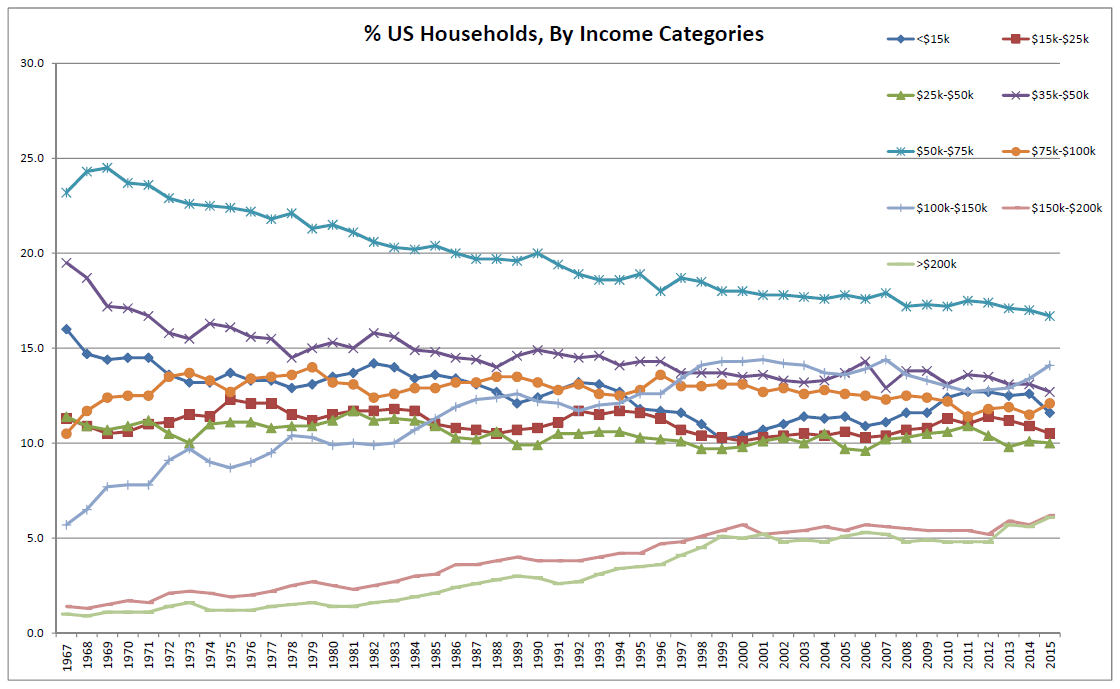
    The data shows the percentage of US households having real incomes in each of 9 categories for the period 1967-2015.  As was the case with the previous article in this series, the data has been adjusted for inflation, with 2015 as the base year, using the Bureau of Labor Statistics’ CPI-U-RS from 1977 on and the Census Bureau’s derived CPI-U-RS for the period 1967-1976.  For completeness, here’s a graph showing all 9 income categories.  Don’t worry if you can’t make heads or tails out of it – it’s far too busy to interpret easily.  I’m providing this chart for illustrative purposes and completeness only.

    A larger version of the same image may be viewed here.

    First-Cut Analysis

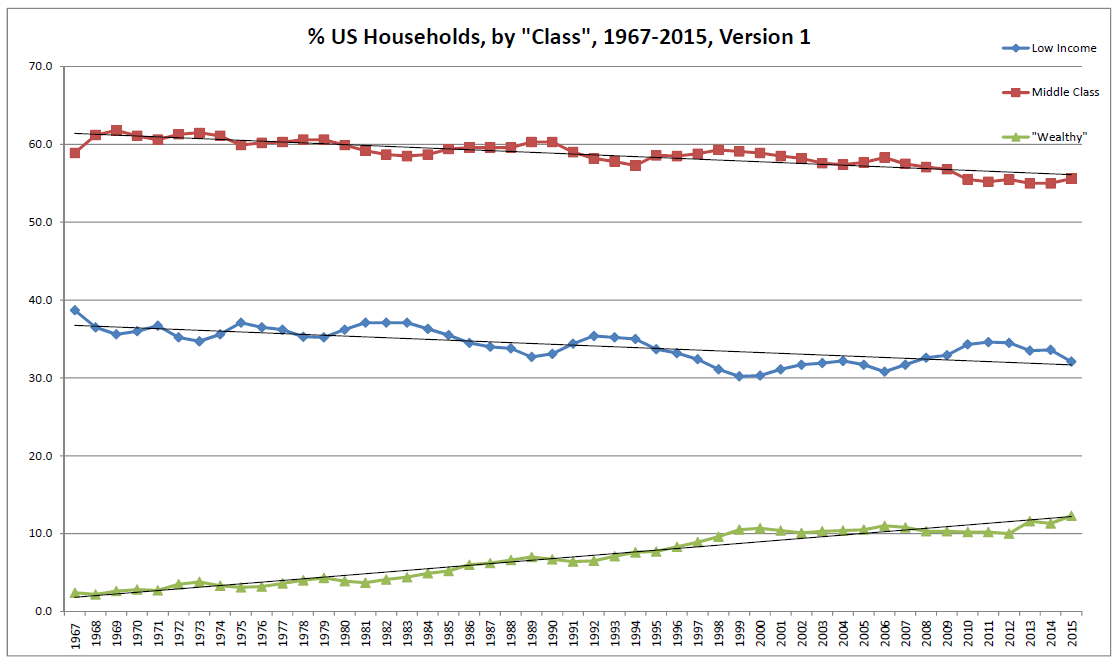
    OK, after “binning” the data into the three classes defined above, I prepared a second chart.  This chart is simpler – it shows the percentage of US households that, according to real annual household income, fit into each of those three class “bins” (Low Income, Middle Class, and “Wealthy”).  I’ve added trend lines to each of these data series to visually indicate the trend of change over time.

    A larger version of the same image may be viewed here.

    Hmm.  In 1967, 58.9% of US households were “middle class”.  And in 2015, the fraction of US households that were middle class was slightly smaller – but only slightly.  In 2015, the middle class comprised 55.6% of US households.  That is 3.3% less than in 1967.

    Looking at that, I’ll be damned if I can see a “disappearing” middle class.   Yeah, proportionally it’s slightly smaller.  But it’s not a helluva lot smaller.  And that’s over a period spanning nearly 50 freaking years.  At that rate, it will take something like another 800 years or so for the US middle class to vanish.  Doesn’t seem to be exactly the “major crisis” the Left keeps yapping about.

    So, where did those 3.3% of US households go?  If the Left is right, those “evil Reagan tax cuts” drove them to the Low Income category.  Is the Left correct?

    In a word:  no.  Or as we might have put it where I grew up:  “Oh HELL no!”

    In 1967, in terms of real household income 38.7% of US households were “Low Income” – e.g., real household incomes of $35,000 or less.  But in 2015, only 32.1% of US households were in that same Low Income category in real terms.  That’s 6.6% fewer US households than in 1967.

    Don’t forget, the middle class shrank half that much between 1967 and 2015 also.  That means almost 10% fewer US households today are Low Income and Middle Class today than in 1967.

    So, what the hell?  Where did nearly 10% of US households go?

    The answer is simple.  They became “Wealthy”.

    In 1967, the fraction of US households with a real income of >$150,000 (and which thus were “Wealthy”) was indeed tiny.  In 1967, only 2.4% of US households – or roughly 1 household out of 42 – had a real household income of $150,000 or more.

    Today?  Well, the percentage of US households that “Wealthy” by that criteria is 12.3% – or roughly 1 US household in 8.  THAT is where the “missing” poor and middle class went.  They freaking got wealthy.

    Second Pass:  Reworking the Categories.

    OK, maybe those categories were “bad”.  So let’s try a more detailed look.  Let’s “re-bin” everyone, using the following categories.  Maybe that will help us see what’s happening.

    • Poverty: <$15,000 annual real household income
    • Working Poor: $15,000 to $35,000 annual real household income
    • Lower Middle Class: $35,000 to $50,000 annual real household income
    • Middle Class: $50,000 to $100,000 annual real household income
    • Upper Middle Class: $100,000 to $150,000 annual real household income  (I’d argue $200,000 would be a better upper limit here, in order to include most medical professionals and other occupations traditionally held to be members of the upper middle class having real household annual incomes above $150,000.  But here, to stay reasonably close to Pew Research’s definition I’ll continue to use an upper cutoff of $150,000 annual real household income.)
    • “Wealthy”: >$150,000 annual real household income

    As before, the quotes around “Wealthy” are intentional – for the same reason previously stated.

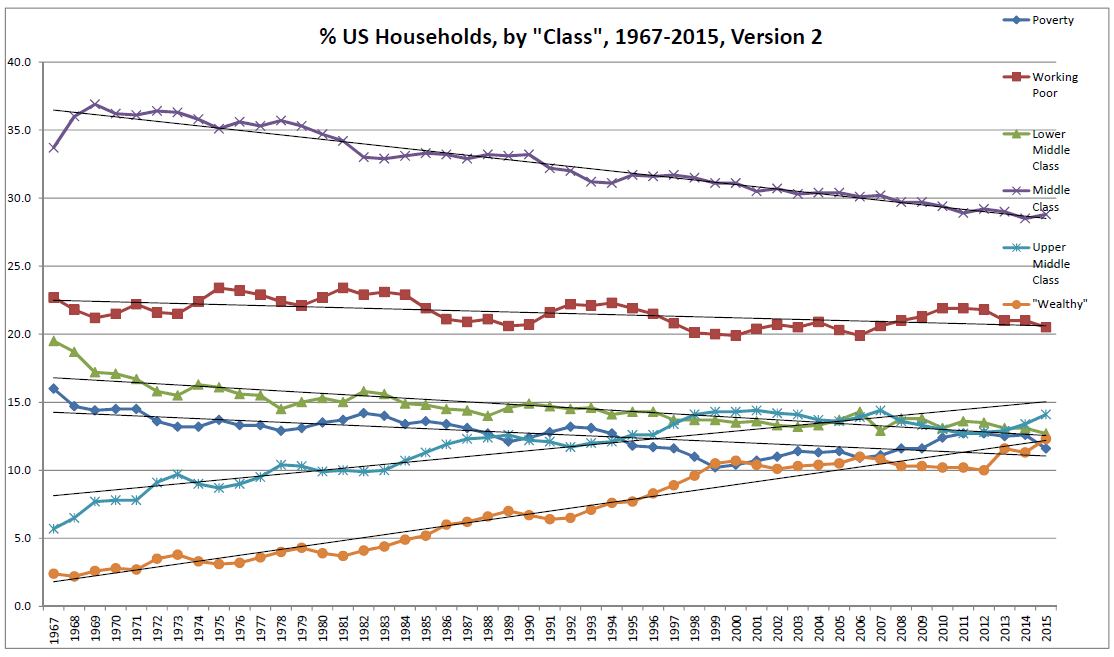
    So, what does that look like in graphical form?  Here you go – again, with trend lines.

    A larger version of the same image may be viewed here.

    Yep – pretty much the same as before.  Here, we see that every income category below the upper middle class has gotten proportionally smaller.  In contrast, the Upper Middle Class and the “Wealthy” have each grown – hugely.

    Conclusions.

    The Left’s contention that the US “middle class is shrinking” has a tiny grain of truth – but that grain of truth is wrapped with so much Leftist propaganda and bullsh!t that it obscures reality.  The “middle class” is indeed shrinking – EXTREMELY slowly.  Statistically speaking, 3.3% of the US population has moved out of the middle class in the last 50 years.  At that rate, as noted above it would take the US middle class over 800 years to disappear entirely.

    What the left WON’T tell you is the reason why those households have moved out of the middle class.  No, those leaving the middle class haven’t become impoverished by those “evil” conservative policies, statistically speaking.  Rather, they’ve become enriched instead.  Statistically speaking, they left the middle class because they became wealthy.

    Why do I say that?  I say that because the Low Income category is also shrinking.

    In fact, the fraction of Low Income US households is shrinking twice as fast annually, percentage-wise, as the middle class.  Where did they go?  Again:  since the Middle Class is also shrinking, there’s only one place they could have gone.  Statistically speaking, they also got wealthy – or at least, wealthier.  Today, 6.6% fewer US households are “Low Income” in real terms than was the case in 1967.

    The bottom line:  in 1967, in real terms 2.4% of US households were “wealthy” in terms of real household income.  In 2015, that fraction was 12.3%.  Over that roughly 50 year period, nearly 10% of American households left the ranks of the “poor” and “middle class” – and became “wealthy”.

    The same is generally true if one looks at the more detailed classes defined in the second “binning” above.  There, collectively a net 18.4% – or nearly 1 out every 5.4 American households – moved out of the classes of Poverty, Working Poor, Lower Middle Class, and Middle Class.  They moved from there to either the “Upper Middle Class” (real household income between $100,000 and $150,000 annually) or the “Wealthy” (>$200,000) – with the net influx split almost evenly between the latter two categories.

    Last time I checked, having a larger household income in real terms was indeed a “good thing”.  And becoming “Wealthy” was called “The American Dream”.

    In summary:  yeah, the US “middle class” is shrinking – at the rate of around 0.067% per year.  But the US Low Income “class” is also shrinking – and it’s shrinking at twice the rate.  And those two groups are shrinking because members of each are becoming wealthy.

    Yes, it’s true that a handful of Americans are filthy rich.  There are probably more of those today than in the past.

    And that’s also absolutely, positively freaking irrelevant.

    Those getting filthy rich are not getting filthy rich because the poor and middle class are “getting screwed”.  Rather, while some are becoming filthy rich, many of the poor and middle class are also becoming wealthy right alongside them.  In 50 years, nearly 10% of American households have moved from the “low income” and “middle class” categories to the “wealthy” category in real terms.

    In short, the Left is misleading or outright lying to us yet again. Is anyone surprised?

    Here, for the Left the actual, hard, documented economic data that’s freely available truly is an “inconvenient truth”.

    . . .

    Data used in this article was obtained from

    http://www2.census.gov/programs-surveys/demo/tables/p60/256/table3.xls (Data used is for all races with one of the two entries for 1988 omitted.  The dual entries for that year are apparently due to two different methods of calculation used, and using both is impractical.  Regardless, they’re pretty damn close to each other, so omitting either makes effectively little or not difference.)

    And yes, Poodle – unlike your previous false claim, the data used above IS inflation-adjusted data – AKA “real” income.  That’s exactly what the annotation “Income in 2015 CPI-U-RS adjusted dollars” in the description of the data in the original source means.  Have someone ‘splain that to you if you don’t “get it”.


    Author’s note:  I also “ran the numbers” for the 3 income category case  – Low Income, Middle Class, and “Wealthy”- with the Middle Class defined as having an upper limit of $200,000 in real household income.  This would be necessary to capture many traditional members of the “upper middle class”, such as doctors and dentists who as groups generally have household incomes in excess of $150,000 in real terms. 

    In that case, the US middle class didn’t shrink appreciably at all between 1967 and today – it actually increased slightly instead.  However, the Low Income fraction (real household income of less than $35,000 annually) still shrank by 6.6% – and the fraction of US households classified as “Wealthy” (real household income greater than $200,000 annually)  grew by nearly that much (5.1%). 

  • Social Security’s Finances: Follow Up on a Question

    A few days ago, I wrote an article discussing Social Security and its finances.  In the comments, one of TAH’s regular readers (ex-OS2) asked two questions – one of which stumped me royally.

    So I got curious, and decided to poke around a bit and see if I could find an answer.

    While I didn’t find the precise answer, I did find the answer to a couple of similar and related questions.  And the questions seemed to be ones that might be of general interest, so I decided to post the answers here.

    The question I couldn’t answer was, “What fraction of Disability payments are made to those who never contributed?”  That in turn raises a bigger question:  “What fraction of Social Security recipients overall (Disability, Old Age, Survivors) fall into the ‘never contributed’ category?”

    Yes, that’s indeed possible.  Social Security pays benefits to spouses, survivors, and dependents under many circumstances.  Sometimes those beneficiaries in fact never have paid FICA taxes themselves.  But they still qualify based on the worker’s earnings history.

    As I surmised might be the case, Social Security doesn’t make it particularly easy to find this information, and I can’t say with that I found the precise answer to either the question concerning disability or the larger question for Social Security overall.  But I do think I found enough information to answer a closely-related question:  “How many people are receiving benefits based on someone else’s earnings history, and how much do those benefits total?”

    It turns out that Social Security does publish one report monthly that gives useable data here:  their monthly “snapshot” report.  The latest one I could find was for July 2016.  Apparently it takes a bit of time to get the necessary data, because August’s report doesn’t yet seem ready.

    Here are the pertinent numbers in table form.  The snapshot for July 2016 can be downloaded, in PDF format, here.

    July 2016 – Social Security Benefits Paid, Summary  Number of Beneficiaries (x 1,000) Percent of Beneficiaries  Benefits Paid (x $1M) Percent of Benefits Paid Average Monthly Benefit
    Grand Total 60,505 100.0% $74,854 100.0% $1,237
    Old Age/Survivors – Total 49,841 82.4% $63,890 85.4% $1,282
    Retirement Benefits – Total 43,831 72.4% $57,167 76.4% $1,304
    Paid to
         Retired Workers 40,817 67.5% $55,086 73.6% $1,350
         Spouses of Retired Workers 2,369 3.9% $1,660 2.2% $701
         Children of Retired Workers 645 1.1% $421 0.6% $652
    Survivor Benefits – Total 6,010 9.9% $6,722 9.0% $1,119
    Paid to
         Children of deceased workers 1,852 3.1% $1,542 2.1% $833
         Widowed mothers/fathers 134 0.2% $126 0.2% $943
         Nondisabled widow(er)s 3,763 6.2% $4,866 6.5% $1,293
         Disabled widow(er)s 260 0.4% $186 0.2% $717
         Parents of deceased workers 1 <0.002% $1 0.0% $1,142
    Disability Benefits – Total 10,664 17.6% $10,965 14.6% $1,028
    Paid to
         Disabled workers 8,861 14.6% $10,335 13.8% $1,166
         Spouses of deceased workers 138 0.2% $44 0.1% $323
         Children of deceased workers 1,666 2.8% $585 0.8% $351


    In looking at the table above, it’s pretty apparent that some of those individuals receiving benefits are receiving those benefits based on another individual’s Social Security record.  For disability, that is benefits paid to spouses and children.  For Old age And Survivors, that would be those benefits paid to spouses and children of retired workers.  By definition, it also includes all forms of survivor’s benefits that Social Security pays regarding deceased retirees.  All of these categories of persons are eligible to receive benefits from Social Security based on the worker’s earnings history under the proper circumstances.

    Doing the math, I came up with an approximate answer to the question for disability.  Social Security paid disability benefits to roughly 10,664,000 persons in July 2016.  Of those, 1,804,000 – or a bit more than 1 in 6 – were NOT disabled workers; the vast majority of that number (1,666,000) were children.  It’s a virtual certainly that they never paid a dime in FICA taxes.  The remaining 138,000 were disability benefits paid by Social Security to selected spouses of disabled workers; these are paid based on the worker’s qualification to receive disability benefits, and thus were due to the disabled worker’s earnings record.  However, it’s possible that some of these spouses indeed worked and paid FICA taxes at some point in their lives – so I can’t say with certainty that they “never paid into” Social Security.

    In dollar terms, these disability payments to spouses and children appear quite modest.  They represent only about 5.7% of Social Security’s total disability outlays.

    The situation is somewhat different for Social Security retirement and survivor benefits.  These payments are both more numerous and proportionally more costly than payments made to children and spouses of disabled workers.

    Spouses and children of retired workers receiving benefits from Social Security on the basis of the retired workers earnings histories totaled 3,041,000; benefits were also paid to 6,010,000 survivors of deceased workers.  The total of these categories – 9,024,000 – represents 20.6% of those receiving Old Age and Survivor’s benefits from Social Security – or just over 1 in 5.  These payments constitute approximately 15.4% of all Social Security Old Age and Survivors benefits paid.

    Summing both categories (Disability and Old Age/Survivors), it turns out that a bit less than 18% (17.9%) of those receiving benefits from Social Security are receiving benefits on the basis of another individual’s work history.  Those benefits represent 12.6% of all Social Security benefits paid.

    A caveat:  many of these spouses receiving benefits on the basis of a spousal work history indeed may have paid FICA taxes themselves.  A person can qualify for Social Security based on both their own work history and that of their spouse.  They’re allowed to choose to receive whichever benefit that is more advantageous financially.  So in many cases, the individuals would be entitled to a benefit – but a smaller one – based on their own work history.

    I hope someone besides me finds this information interesting or of use.

  • Social Security’s Finances: Can You Say, “House of Cards?”

    There are a plethora of misconceptions out there regarding Social Security.  Some of the more common ones:

    1. I have a retirement account with Social Security.
    2. Social Security has plenty of money.
    3. I paid into the system, so I own something and am guaranteed payments.

    Plus many, many more other mistaken ideas.

    The truth is far different.  Regardless of how many people have claimed otherwise, Social Security is in effect the biggest Ponzi scheme ever run.  It has the false appearance of a retirement plan by design – indeed, that was only one of the lies told to get the US public to accept it.  But it’s not a retirement plan in any way.  If it were done by private industry, it would almost certainly be illegal.

    However, until recently I didn’t know that much about the details of Social Security financing.  Yes, I knew it had something called  “Trust Funds” (more on why the quotes are there later in this article).  But I realized I didn’t know much at all about how they worked.  So I decided to see what I could find.

    What follows is the result of that research.  This one’s rather long – so if you’re going to read it, keep that in mind.

    Overview.

    Here’s a brief overview of how Social Security operates.  It’s not complete, and is lacking some details.  But it hits the main points. It was also compiled from various documents on the Social Security Administration web site.

    1.  Social Security is funded from multiple sources; those will be further identified below, but are generally identified in footnotes and/or explanatory text here and here. Those funding inputs are mingled and “laundered” through two so-called Social Security “trust funds” – which in reality are general purpose “slush funds” that receive every dollar that Social Security takes in, and from which all Social Security expenses get paid.  Thus, everything Social Security receives goes into one of two such “pots”:  one called “Old Age and Survivors,” and a second called “Disability”.  Everything Social Security must pay out is paid from one of those two common “pots”.   Anything left over at the end of the year “rolls over” and remains in the applicable “trust fund”.

    2.  Those Social Security   slush funds    “trust fundsbuy “special” Treasury securities not available to the public. These “special securities” are always redeemable at face value.  They also accrue interest annually.  (Being government debts, the interest of course comes out of other Federal tax revenues or from borrowing by Uncle Sam.)

    The Social Security      slush funds     “Trust Funds” buy these special securities on a daily basis. All Social Security expenses are paid by redeeming some of those “special” securities.

    Since the same fund is used to receive current income and pay current expenses, this means that the “trust funds” are not investment funds.  Rather, they’re merely temporary buffers – just like an interest-bearing checking account (if you can still find one of those these days).   Benefits are still primarily paid from incoming tax receipts, but because these “trust funds” have a nonzero balance there’s a time lag between receipt of taxes and outlay of those same dollars due to the “trust fund’s” providing a buffer.  The length of this time lag has varied over time and depends both on the fund’s balance and the average benefits dispersed monthly.  Currently the Old Age and Survivors     slush fund      Trust Fund has a “buffer length” of somewhat over 3 years.  The Disability      slush fund      “Trust Fund” has much less of a reserve on hand; it’s in serious trouble.

    3.  The Federal Government – not retirees – owns these “trust funds”. Technically, they are financial accounts belonging to the US Treasury.  All benefits are paid to qualifying individuals from these “trust funds”, as are other program expenses.  As noted above, it does this by redeeming those “special” Treasury securities you or I can’t buy.

    4.  Individuals receiving benefits actually own nothing. Since Social Security is a government benefit and not something you own, Congress can change qualification requirements, benefit amounts, or even cancel the program outright if it so desires.  Don’t believe me?  Well, then you might want to read the SCOTUS case Fleming v. Nestor (1960).  There’s a link to that case later in the article.

    5.  Social Security is primarily (at present, around 88% – and dropping) funded by payroll taxes on income below a certain level. These payments are not “retirement contributions”; they are taxes that are legally mandatory.  You do not have a “Social Security Account” with a calculable balance; all you have is an earning history.  That earning history is used – in a rather convoluted manner, which by design grossly favors career low-income wage earners at the expense of those earning a large income – to calculate the amount of the benefit the law deems you deserve.

    6.  Benefits are paid, as defined by law, to those who qualify to receive them. Federal law defines who qualifies and what must be done to qualify.  Qualification requires two things:  meeting an age or disability threshold, and having enough “qualifying quarters” of work under Social Security for which you’ve paid your Social Security taxes.  Currently, one calendar quarter of coverage credit is given for each $1,260 earned in a calendar year; earn $5,040 in a year, and you’ve got a year’s coverage.   That number was lower in the past.

    7.  Under current Federal law, 40 quarters of coverage over your entire working lifetime – in other words, 10 years – are all that is required to be “fully covered” and receive a benefit when you retire. Benefits based solely on age can be received as early as age 62 if not for disability, and earlier for disability.  Nonworking spouses receive benefits based on their spouse’s earning history.  These benefits continue should their spouse predecease them.

    8.  Those retiring for disability generally do not require as many quarters of “credit” under Social Security, but must have varying amount of Social Security employment “credit” based on their age.

    9.  Not all income is subject to Social Security taxes. Only the first $118,500 of earned income (the amount changes periodically) is subject to Social Security taxes; this is called the Social Security Wage Base.  This is because, regardless of income, there is a maximum possible benefit that can be paid to anyone receiving Social Security Benefits.  That maximum monthly benefit is currently $2,639 for someone retiring at their full retirement age of 66 (this will rise to 67 over the next few years).  Receiving this benefit requires earning at least the Social Security Wage Base for 35 or more years. In contrast, a person working full-time at a minimum wage job for 40 years at age 66 gets a monthly benefit of $924.

    10.  Under some conditions, Social Security benefits are taxable income. When this happens, these income taxes are returned to the applicable Social Security “trust fund” which paid them the benefit, not kept by the Treasury to pay Uncle Sam’s bills.  Don’t ask me why.

    OK, that’s a rather long overview.  Though it hits the major points, it’s missing a fair number of details.  So I think you can see already why there are so many varied misconceptions regarding Social Security.  It’s complex as hell – and we’ve been lied to about it for years.

    What Social Security Is Not.

    1.  Social Security is not a retirement plan. This is the biggest and oldest lie about Social Security – right up there with “3% of your income” being “the most you will ever pay” (see the paragraph here titled “Your Part of the Tax”).  While it was sold as a retirement plan by FDR and his cronies, it is not.  You do not own anything.  Your payments are not “retirement contributions”; they are legally mandatory taxes you must pay to avoid going to jail.  You do not have any kind of “retirement account”, nor are your payroll taxes invested on your behalf.  Rather, they’re used to pay benefits to others – currently, with about a 3 year delay between the time you pay them and the time they’re paid out. (In late 1983, that lag was around 2 months.)

    What Social Security is is an income transfer program, funded by payroll taxes, that transfers income from those who are working to others eligible by law to receive benefits.  Period.

    2.  Social Security is not property; you own nothing. I mentioned this before, but it merits repeating.  Unlike an earned pension, you have no legal property right to receive Social Security benefits because you paid into the system.  The SCOTUS ruled that Social Security was a government benefit, not a pension in which you have ownership rights, in Flemming v. Nestor (1960). (You can read the full SCOTUS opinion here.)  If Congress wants to change the rules, lower benefits, or terminate the whole Social Security program tomorrow, it can – and you’re SOL.  All you did when you paid those FICA taxes was do what was necessary to stay out of jail:  obey current tax laws.

    3.  Your benefits are not guaranteed. Congress can change the rules at any time – and indeed has several times over the life of the program.  Just ask anyone affected by the 1970s “notch” – if you can find anyone still alive who was affected, that is.  Or you can anyone who’s had to delay retirement due to the rise in Social Security retirement age.

    4.  You didn’t “pay into the plan” or “earn it”. What you did was pay your taxes as required by law.  That’s it.  You earned nothing, and there was no “plan” to “pay into”.  You pay taxes because the law says you must.

    5.  Social Security is not “insurance. Insurance involves paying premiums in exchange for a defined payment in the event a certain event occurs.  Social security involves paying taxes required by law, along with – if you’re lucky – getting whatever benefit Congress deems you deserve when you retire or become disabled.  Big difference.

    6.  The “Trust Funds” contain investments that have real value.  Not really.  As explained above, they’re more like interest bearing checking accounts.  They earn little value – not nearly enough to pay annual benefits.

    Plus, those “trust funds” are “guaranteed” by Uncle Sam, not by real assets.  Uncle Sam is so broke these days that if it cost a quarter to take a dump he’d probably have to upchuck instead if he couldn’t find someone to loan him a nickle.

    7.  Finally, I’ll say it again: Social Security is not a retirement plan.  Bluntly, it’s an intergenerational income transfer program – or in plain language, a means of redistributing income from workers who earn it to others who in general no longer work.  In plain language, it’s a welfare program that by design provides an unearned income to elderly and disabled persons as recipients, and is funded by taxes levied on those currently employed.

    The Social Security “Trust Funds” – What They Are, and How They Work.

    OK, above there’s an overview, followed by a list of some things Social Security is not.  So, how does it work?  How does the money get from taxpayer to beneficiary?  Where does it all come from, and where does it all go?

    In what follows, I won’t be addressing Medicare; that also has a trust fund, but though there are some similarities it’s a different beast and appears to be run somewhat differently.  I also haven’t researched that one in enough detail to be able to write anything about it that would be reasonably accurate.

    The “Trust Funds”.  Social Security has two so-called “trust funds”.  The quotes are there because in reality, these are merely two temporary holding accounts – or, if you prefer, “laundry bins” or “slush funds” – that allow income to be held temporarily (and earn a bit of interest) before it is spent within a relatively short period of time.  These funds are called the “Social Security Old Age and Survivors Trust Fund” and the “Social Security Disability Trust Fund”.  (Though it’s technically in the name, I refuse to include the term “Insurance” in the name of either trust fund – because Social Security IS NOT FREAKING INSURANCE, no matter how many times people have lied through their teeth claiming that it is.  It’s a damned tax-funded government income transfer program mandated by law; neither payments nor participation are voluntary, and taxes are not insurance premiums.)

    While the two funds (Old Age and Survivors, Disability) are distinct, they both operate virtually identically.  So a single discussion of how they operate suffices for both.

    Income.  All income for Social Security is glommed together in the applicable    slush funds    “trust funds”.  It’s held there until it’s needed to pay expenses, at which point it’s spent.

    On receipt, this income is used to buy interest bearing “special” Treasury securities.  These are different Treasury securities than those available to the public.  They generally earn some interest between purchase and redemption.

    These sources of income for Social Security’s “trust funds” come in 3 basic “flavors”.  The first, and largest, income “flavor” is payroll taxes.  This is the 12.4% of all earned income below the Social Security Wage Base (for 2016, that’s $118,500; a history of the Social Security wage base can be found here) that is required to be paid as the OASD portion of the total 15.3% FICA or SECA taxes.  Since 2000, of that 12.4% of payroll income roughly 1.8% has gone to the Social Security Disability fund; the rest  has gone to the Old Age and Survivors fund.

    Yes, I did say 12.4% and 15.3%.  That’s not a mistake.  If you’re working as a payroll employee, you don’t see that much deducted from each paycheck.  However, that’s because payroll employees only pay half of that tax; their employers pay the other half.  Self-employed individuals pay SECA taxes vice FICA taxes; these “lucky” folks get boned royally, because they’re responsible for paying that full 15.3% total out of their earned income.  (The “extra” 2.90% is Medicare taxes – which are not limited to the first $118,500 of annual earned income.  Payroll employees generally only pay half of those as well, with the other half paid by their employer.  Self-employed individuals pay the full amount.)  In 2015, those OASD payroll taxes totaled nearly $795 billion in income for Social Security, divided between the two “trust funds”.

    The Social Security “trust funds” also receive interest from the US Treasury; that’s the second “flavor” of income received by these slush funds.  This is the interest earned by those “special” Treasury securities the “trust funds” buy between the time they’re bought with payroll taxes/other income and the time they’re redeemed to pay benefits or expenses.  In 2015 that amount was also significant, totaling over $93 billion – again, divided between the two “trust funds”.

    The third “flavor” of income for Social Security “trust funds” is payments Social Security receives from the US Treasury’s general fund.  Most years, this consists mainly of the return of income taxes paid on the taxable portion of Social Security benefits; those are transferred by the Treasury to the appropriate Social Security “trust fund” vice retained by the Treasury.  (As I said previously:  do not ask me why this occurs.)  There are a few other reasons why the Treasury would transfer money to Social Security (or, even more rarely, where money would flow in the opposite direction).  However, with the exception of special reimbursements that occurred in 2011 and 2012, these other reimbursements are generally dwarfed by the other types of Social Security “trust fund” income.  (In 2011 and 2012, the Treasury “made up” the 2% temporary reduction in Social Security OASD withholdings by paying the Social Security “trust funds” the difference – which was a huge amount both years.)  For 2015, these Treasury payments were around $32 billion – with returned taxes accounting for nearly 99% of that total.

    OK, that’s where the money comes from.  These “trust funds” thus have their hands in the American taxpayer’s pockets 3 different ways:  direct seizure of income (payroll taxes); interest from the Treasury (which taxpayers pay for as well, through other taxes); and diversion of income taxes paid on taxable Social Security benefits that are returned to the fund vice being kept by the Treasury (which taxpayers again must make up through paying other offsetting taxes).

    So, that’s where the Social Security “trust funds” get their coin.  Where does that money go?  Glad you asked.

    Expenses.  Like income, Social Security has three “flavors” of expenses.  The first is Social Security’s own administrative expenses.  These currently total somewhere around $6 billion annually, and come out of the “trust funds” vice the Treasury’s general fund.  When you’re talking an enterprise that takes in and spends close to $900 billion annually, that’s not really too much in the way of overhead.  It’s around 0.67% or so of income.

    The second “flavor” is reimbursements to the Federal Railroad Retirement program.  By law, Social Security and Part I Railroad Retirement are coordinated, with railroad retirees guaranteed the equivalent of Social Security as their Part I Railroad Retirement benefit. (Part II railroad retirement is funded differently, is optional – and to my understanding is actually backed with some real assets besides Treasury IOUs – just like Social Security should have been funded from day 1.)  What that means is that whenever the Railroad Retirement Old Age and Survivor and/or Disability “trust funds” have insufficient income to pay Part I railroad retirement benefits . . . the Social Security “trust funds” transfers them funds to bail them out.  That has happened every year but two since 1960 for both railroad retirement Old Age and Survivors and Disability benefits (for railroad retirment Old Age and Survivors benefits, it’s happened every year since 1958).  However, this is also a relatively small item; in 2015, that total was less than for admin expenses, coming in at a bit less than $4.7 billion – maybe a bit over 0.5% of income.

    The last “flavor” of expense for the Social Security “trust funds” is the “biggie”:  benefits payments.  In 2015, the combined benefits paid by Social Security for Old Age and Survivors benefits and Disability benefits totaled over $886 billion – exceeding payroll tax receipts by over $91 billion.  Only the other two sources of “trust fund” income (interest payments, returned taxes/other Treasury payments) kept the “trust funds” from collectively losing money for the year.  Indeed, the Disability fund DID lose money last year – bigtime.  In contrast, last year the Old Age and Survivors fund showed a net surplus.

    After all is said and done, anything not spent at the end of the year is retained in the “trust funds”.  The balance rolls over to the next year.  Last year there was a net increase in the OAS fund of around $51 billion.  In contrast, the Social Security Disability fund decreased by nearly $28 billion.

    Unfortunately, the gap I referenced above between payroll tax receipts and benefits paid is getting larger every year.  In the relatively near future, both funds will have more outgo in terms of benefits paid/other expenses than income received from all sources – hell, the Disability fund is already in that state, and has been for several years.  When that happens, the “trust fund” concerned spends down its assets to pay those legally-mandated benefits.  When the fund balance drops to zero, payments then get dramatically reduced – when that happens, then by law payments will be limited to available income  (though it’s unclear if that applies by fund or overall).

    Observations Based on the Data – and the “So What”.

    1.  Many readers may remember the late 1970s/early 1980s “Social Security Crisis”. Yeah, that crisis was real. The Old Age and Survivor’s portion of Social Security damn near went broke.

    In the late 1970s and early 1980s, the Social Security Old Age and Survivor’s “Trust Fund” went into a downward spiral.  At the end of 1983, the Social Security Old Age and Survivor’s “trust fund” was low enough that it was in real terms less than  2% of today’s balance; it had lost almost half its nominal value (and far more in real terms) from a decade before.  It had just over 1 1/2 months of average monthly benefits on hand as a reserve.  Since monthly benefits are paid by redeeming securities (and replacing them by immediately repurchasing new Treasury securities with payroll taxes received), this means that the fund was at risk of being unable to pay full benefits if the economy experienced anything but a trivial slowdown.  Absent those early 1980s reforms, Social Security would have almost certainly gone Tango Uniform (in terms of paying full benefits due) within a few years.  In contrast, at the end of 2015 the Old Age and Survivors “trust fund” had somewhere around 3 years of benefits on balance.  (And no – that does NOT mean everything is “Hunky Dory”.  Read on.)

    2.  The Social Security Old Age and Survivors “trust fund” turns over every 3 years or so. It is, in effect, nothing more than a Ponzi scheme that presently has a largish (3 years or so worth of benefits) “slush fund” acting as a 3-year buffer through which to “launder” incoming payments.  The fund has nowhere near enough interest and other income annually to pay annual benefits; those incoming payments are thus used, after being held for about a 3 year or so period, to pay benefits.  Only what ever is left over after current benefits are paid – today, only a tiny fraction of overall fund income – is retained annually to increase the “trust fund” balance.  That ended years ago for the Disability fund.  For the Old Age and Survivors fund, that necessary condition (fund increasing annually) for continued operations will be coming to an end pronto.

    3.  Today’s Social Security “trust funds” are not in any way, shape, form, or fashion funded by tax payments made decades ago. (Remember:  the Old Age and Survivors fund was nearly gone at the end of 1983 – and the Disability fund is damn near gone today.) Those payroll taxes from long ago were spent decades ago to provide bennies.  Rather, today’s “trust funds” were funded by payroll taxes paid during the past 5 years, give or take – as has historically been the case.  Take away income from payroll taxes and the whole thing comes to a screeching halt in about 3 to 4 years, maybe less.  And benefits payments keep increasing each year.

    4.  The Social Security Disability Fund is a “dead man walking”. It will run out of money (e.g., hit zero balance) within 2 years.  I’m not sure precisely what happens then; my guess is that either the Old Age and Survivors fund gets tapped to make up the difference, or perhaps disability benefits get temporarily limited to funds received – with the shortage “to be made up later” (yeah, right).  Or maybe the Treasury makes up the difference – if it can find anyone to lend it the additional money.  Dunno.

    However, any of those options is seriously “bad juju”.  The Treasury “making up the difference” increases the Federal deficit substantially.  The second option cuts bennies substantially for those receiving SSDI benefits.  The first accelerates dramatically the coming crash of the OAS fund, which is already projected to occur within 20 years (2035) as it is.

    5.  Finally: the “so what”.  Why do we care about these “trust funds” and how they’re run?  How does it affect us?

    Here’s why we should care.  When Social Security’s “trust funds” are depleted Social Security then reverts to “pay as you go” status, or PAYGO.  That means Social Security benefits payments will be limited to that which can be supported by payroll taxes alone.  Barring a change, it’s estimated that when that happens in around 20 years, income will at the time support maybe 75% of the benefits that otherwise would be paid.  That means everyone receiving Social Security benefits gets a very sudden and (for most) extremely painful 25% financial “haircut”.

    “Bad juju,” indeed.  We should have listened to folks trying to privatize the system back in the early 1980s.

    Unfortunately, we did not. And as a result, to paraphrase the words of Apu Nahasapeemapetilon:  “Oh – now (we) are truly screwed!”