Category: Search and Rescue

  • Indonesia’s tsunami death toll now over 400 as officials warn that more deadly waves possible

    Christmas tsunamiThe death toll from Indonesia’s Christmas-time tsunami continues to rise, as officials warn that additional volcanic landslides could trigger more deadly waves.

    Posted by Leslie Eastman

    On the other side of the world, Sicily’s Mt. Etna puts on a Christmas show.

    At least 429 people died, more than 1,400 were injured and another 158 are missing as of Tuesday morning, more than two days after the wave came crashing ashore on the northwest coast of Java, one of the large islands comprising the country, officials said.

    The threat did not disappear with the waves themselves, as officials were warning residents and tourists to stay as far away from coastal areas as possible on Monday because continued volcanic eruptions from Mount Anak Krakatau could potentially trigger a second devastating tsunami.

    More than 600 housing units and at least nine hotels were destroyed or badly damaged in the tsunami, according to Sutopo Purwo Nugroho, head of public relations for the Indonesian National Disaster Mitigation Agency. He said more than 16,000 people have been displaced.

    “In our initial report on the disaster, I noted that members of a popular “boy band” were filmed being hit by the wave. Only the lead singer appears to have survived, and the wave claimed his 26-year old wife’s life as well.”

    The lead singer of the local group “Seventeen,” Riefian Fajarsyah, included a video of himself stroking his bride’s white coffin in a heartbreaking Instagram post from the back of a hearse.

    “How can I live without you, Dylan Sahara?” Fajarsyah, 35, wrote of his wife, to his 1.9 million followers.

    Eerie video footage had shown fans clapping and cheering at the band’s beachside performance in Java on Saturday night — seconds before a huge wave smashed onto the stage.

    The frontman’s wife, an Indonesian actress and TV-personality, was one of the dozens of people swept away by the wave.

    Her body was identified at a hospital late Monday, according to local reports.

    The group’s drummer, Wisnu Andi Darmawan was also found dead Monday — as the group’s bassist Muhammad Awal Purbani, guitarist Herman Sikumbang, manager Oki Wijaya and crew member Rukmana Rustam were laid to rest.

    The 2004 Indian Ocean earthquake occurred on 26 December, with an epicentre off the west coast of northern Sumatra. Named the Boxing Day tsunamis, communities along the surrounding coasts of the Indian Ocean were seriously affected, and the tsunamis killed an estimated 227,898 people in 14 countries.

    One would think an early warning system of wave buoys and other observation systems would have been installed after this disaster to predict potential tsunami activity. Or perhaps they were and the indications were just missed. A tragic occurrence either way.

    The rest of the article, including Etna’s eruption, can be viewed here: Legal Insurrection

  • 1 killed, 1 rescued, 5 still missing off Japanese coast after C-130 and F/A-18 fighter jet crash

    aar
    Article by By: Geoff Ziezulewicz , Shawn Snow , and Tara Copp

    ChipNASA brought us the sad news yesterday evening. Two Marines have been recovered, and sadly one perished. The five remaining Marines are still missing, and the search continues.

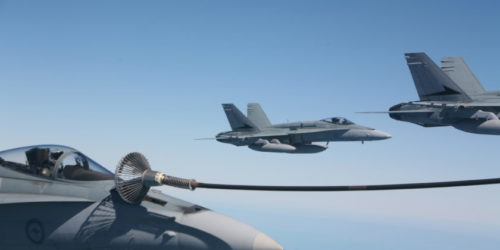
    Search and rescue operations were underway off the Japanese coast early Thursday local time after a Marine Corps KC-130 with five crew members and an F/A-18 fighter jet with two crew members collided midair at about 1:42 a.m., roughly 55 nautical miles south-southeast of Cape Muroto, Kochi Prefecture.

    Earlier today, military officials announced that one Marine had been rescued and was being evaluated by medical personnel at Marine Corps Air Station Iwakuni, Japan, where the service members are based. Japanese officials later said the Marine was one of the F/A-18 crew members.

    Later, Lt. Gen. Jerry Martinez, commander of U.S. Forces Japan, told Military Times that a second person had been recovered from the crash and was transported by helicopter back to Japan and was under evaluation.

    In a statement late Thursday local time, Okinawa-based III MEF said the second recovered Marine had ” been declared deceased by competent medical personnel.”

    Neither Martinez nor III MEF would say which aircraft the deceased Marine was supporting at the time of the crash.

    The entire article may be found at The Marine Times.

  • Coast Guard rescues ailing man far off the North Carolina coast

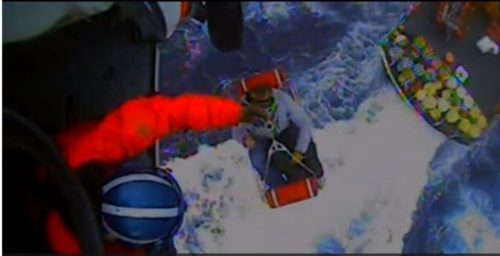
    rescue basketA Coast Guard MH-60 Jayhawk rescue helicopter crew from Air Station Elizabeth City, North Carolina, hoists an ailing man from the cutter Spencer about 200 miles southeast of Cape Hatteras on Saturday. The man was experiencing chest pains aboard a sailboat 275 miles offshore when the vessel’s crew requested a medevac. (Coast Guard video screenshot)
    By: Carl Prine

    The Coasties shine once again, flawlessly executing a boat-to-cutter, and cutter-to-helo, rescue way off the coast of North Carolina. Say what you may about the Coast Guard, but give credit where credit is due- these guys and gals are World Class when it comes to Search and Rescue.

    A ham radio operator in Florida helped the Coast Guard rescue a man far off the North Carolina coast on Saturday.

    Coast Guard officials said a rescue helicopter pulled the unnamed 57-year-old man suffering chest pains off the cutter Spencer after its crew rendezvoused with his sailboat and retrieved him Saturday morning about 200 miles southeast of Cape Hatteras.

    Public Affairs Specialist 2nd Class Corinne Zilnicki told Navy Times on Sunday that watchstanders at the Fifth District Command Center in Portsmouth, Virginia, received the first alerts from the Personal Locator Beacon and Emergency Position Indicating Radio Beacon registered to the 48-foot sailboat Marie Elena around noon on Friday.

    But communication with the sailboat crew wasn’t established until about 30 minutes later, when a high frequency radio operator with the Maritime Mobile Service Network in Inverness, Florida, established a connection between the watchstanders in Virginia and the Marie Elena’s crew, Zilnicki said.

    The sailboat crew requested a medical evacuation. But because it was so far offshore, Coast Guard command center personnel urged them to turn toward Cape Hatteras.

    The cutter Spencer, which was underway near the Virginia-North Carolina border, was redirected to the Marie Elena.

    Because the Netherlands-flagged heavy load cargo ship Rolldock Sky was about 40 miles from the sailboat, Coast Guard watchstanders urged the vessel’s captain to try to close the gap and aid the ailing mariner, officials said.

    But when the Rolldock Sky reached the sailboat, very rough seas prevented the crew from safely medevacing the man. So the Marie Elena kept sailing toward the barrier islands.

    The Spencer reached the sailboat about 7:30 a.m. on Saturday and launched a small boat crew to retrieve the patient.

    An hour later at Air Station Elizabeth City in North Carolina, an MH-60 Jayhawk rescue helicopter and an HC-130 Hercules extended-range search and rescue plane took off to rendezvous with the cutter.

    Reads like a Clive Cussler novel. What I’d like to highlight:

    “The fact that the EPIRB and PLB were registered and utilized properly allowed us to home in on the sailboat’s location,” said Petty Officer 1st Class Travis Unser.

    Don’t leave home without them. The article may be read in its entirity at The Navy Times

    Semper Paratus
    you don't have to come back

  • Valor Friday

    Airman First Class William Airman First Class William “Pits” Pitsenbarger was awarded the Medal of Honor posthumously after he sacrificed himself to save numerous wounded soldiers. (Air Force)

    Yes, I know late again. Seems this thing called “work” interfered with my schedule. But better late than never, especially for “Pits.”

    Pararescue airman received Medal of Honor for saving soldiers, refusing to leave firefight

    A call for a medevac went out on April 11, 1966, after soldiers from the Army’s 1st Infantry Division positioned near Cam My, Republic of Vietnam, began taking extreme casualties during a lengthy firefight.

    Airman First Class William H. Pitsenbarger, a Pararescue crew member assigned to the 38th Aerospace Rescue and Recovery Squadron, was dispatched with a team to evacuate the wounded soldiers.

    As the helo approached the combat zone, Pitsenbarger, sensing the urgency of the situation, volunteered to ride the rescue hoist from over 100 feet in the air to the jungle floor, where he immediately began rendering aid to the wounded and preparing casualties for evacuation.

    Despite recovering nine casualties, ”Pits,” as his friends called him, repeatedly refused to leave the ground, insisting on trying to get even more wounded to safety.

    Another helo eventually arrived on scene to take more wounded, but as it approached, the assault by the Viet Cong intensified, forcing the helicopter to evacuate. Instead of leaving with the helicopter, Pits waved the pilots off to tend to the beat-up Americans on the ground who were being battered by sniper and mortar fire.

    On the ground with the other men, Pitsenbarger took up arms and fought back the Viet Cong for an hour and a half while repeatedly exposing himself to heavy enemy fire to make improvised splints and stretchers out of surrounding vegetation.

    With ammunition running low, Pits ran to the positions of mortally wounded soldiers to collect ammunition and distribute it to those still in the fight. He was wounded three times in the process.

    Ignoring his wounds, he continued to repel the attack and treat wounded soldiers up until the point the American perimeter was finally breached.

    He was mortally wounded by a sniper when the line was overrun. In the end, the Americans on the ground suffered 80 percent casualties.

    Pits was clutching a med kit in one hand and a rifle in the other when his body was recovered.

    For ignoring his own safety and remaining behind to treat and evacuate as many wounded as possible, Pitsenbarger was posthumously awarded the Air Force Cross, which was later upgraded to the Medal of Honor.

    The Piqua, Ohio, native was 21 years old when he was killed.

    Medal of Honor
    AWARDED FOR ACTIONS
    DURING Vietnam War
    Service: Air Force
    Battalion: 38th Aerospace Rescue and Recovery Squadron
    Division: DaNang Air Base, Vietnam
    GENERAL ORDERS:

    CITATION:

    The President of the United States of America, in the name of Congress, takes pride in presenting the Medal of Honor (Posthumously) to Airman First Class William H. Pitsenbarger (AFSN: 15680744), United States Air Force, for conspicuous gallantry and intrepidity at the risk of his life above and beyond the call of duty. Airman First Class Pitsenbarger distinguished himself by extreme valor on 11 April 1966 near Cam My, Republic of Vietnam, while assigned as a Pararescue Crew Member, Detachment 6, 38th Aerospace Rescue and Recovery Squadron. On that date, Airman Pitsenbarger was aboard a rescue helicopter responding to a call for evacuation of casualties incurred in an on-going firefight between elements of the United States Army’s 1st Infantry Division and a sizable enemy force approximately 35 miles east of Saigon. With complete disregard for personal safety, Airman Pitsenbarger volunteered to ride a hoist more than one hundred feet through the jungle, to the ground. On the ground, he organized and coordinated rescue efforts, cared for the wounded, prepared casualties for evacuation, and insured that the recovery operation continued in a smooth and orderly fashion. Through his personal efforts, the evacuation of the wounded was greatly expedited. As each of the nine casualties evacuated that day were recovered, Pitsenbarger refused evacuation in order to get one more wounded soldier to safety. After several pick-ups, one of the two rescue helicopters involved in the evacuation was struck by heavy enemy ground fire and was forced to leave the scene for an emergency landing. Airman Pitsenbarger stayed behind, on the ground, to perform medical duties. Shortly thereafter, the area came under sniper and mortar fire. During a subsequent attempt to evacuate the site, American forces came under heavy assault by a large Viet Cong force. When the enemy launched the assault, the evacuation was called off and Airman Pitsenbarger took up arms with the besieged infantrymen. He courageously resisted the enemy, braving intense gunfire to gather and distribute vital ammunition to American defenders. As the battle raged on, he repeatedly exposed himself to enemy fire to care for the wounded, pull them out of the line of fire, and return fire whenever he could, during which time, he was wounded three times. Despite his wounds, he valiantly fought on, simultaneously treating as many wounded as possible. In the vicious fighting which followed, the American forces suffered 80 percent casualties as their perimeter was breached, and airman Pitsenbarger was finally fatally wounded. Airman Pitsenbarger exposed himself to almost certain death by staying on the ground, and perished while saving the lives of wounded infantrymen. His bravery and determination exemplify the highest professional standards and traditions of military service and reflect great credit upon himself, his unit, and the United States Air Force.

    No greater love…

    Perhaps a bit late as well, but still deeply felt- Fair winds and following seas, Airman First Class Pitsenbarger.

    Military Times Link

  • Coast Guard Mostly Saves Very Stupid People, Study Finds

    Coast Guard

    When it comes to Search and Rescue (SAR) our Coast Guard is world class. But after a while, it must get pretty repetitive saving people suffering from self-inflicted wounds. So a study was conducted, with some surprising results.

    WASHINGTON, DC — Nearly 83 percent of mariner rescues since 1960 involved unrelentingly stupid behaviors and/or people, according to a recent study by the U.S. Coast Guard.

    Though the service treats all search and rescue situations equally, most on-scene commanders will privately admit that a majority of the time “it was just some dumb bastard with no concern for personal safety,” according to the study’s authors.

    “These statistics are unthinkable,” said Coast Guard spokesperson Lt. Carla Willmington. “Our service prides itself on response time, SAR organization, and comprehensive rescue pattern analysis. But it’s tough to stay on task when the bulk of these cases involve people paralyzed from the neck up. ”

    To view the article in its entirety, click Here

  • US Navy Rescues 3 Fishermen Adrift for 8 Days

    P-8A

    Navy Times reports the U.S. Navy rescued three fishermen Tuesday who were adrift on a boat in the Pacific Ocean for eight days.

    The men were reported missing Feb. 12 after failing to return from a fishing trip in Micronesia. The men had food and water aboard their 19-foot skiff, but no safety equipment or radios.

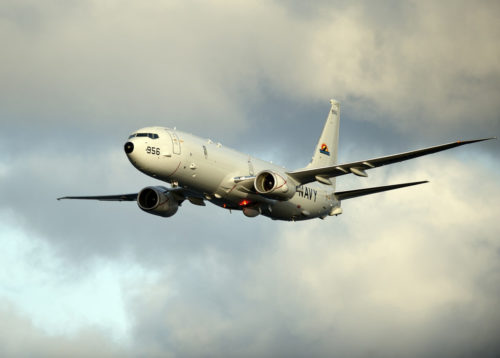
    The U.S. Coast Guard based in Guam searched for the men for several days before calling in a Navy team from Japan, who used a P-8A Poseidon plane equipped with advanced radar to find the boat within three hours.

    The Navy said they dropped a kit to the boat containing food, water, medicine and communications equipment before a nearby police boat picked up the fishermen a few hours later.

    “It was incredibly rewarding to be a part of saving lives — it’s what everyone joins the Navy to do,” said Lt. Miles Schumacher, the tactical coordinator of the Patrol Squadron Eight aircrew.

    Schumacher said in a statement that the P-8A Poseidon aircraft had enabled a “massive step forward” in the ability of search and rescue teams to search large areas quickly and effectively, even in the farthest corners of the globe.

    Micronesia is about three-quarters of the way from Hawaii to Indonesia, and is home to about 100,000 people.

    Successful rescues make my day, especially when “my” aircraft performs the save. The SAR kit is stored in the weapons bay, and is a vast improvement over the P-3 kit, which was deployed from the main cabin door.