Category: Real Soldiers

  • Soldiers saving the world

    Soldiers saving the world

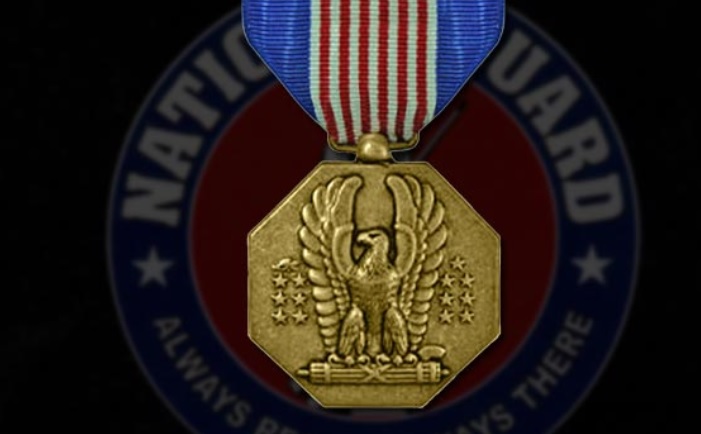
    Chief Tango sends us three stories about folks in the Army and in the National Guard who earned Soldiers Medals for saving folks in their respective communities, you know stories that aren’t about crazed gun men suffering from specters of their pasts – the stories you don’t usually read about soldiers these days. The first is about 24-year-old Wisconsin Guardsman Sergeant Michael C. Black who was at his pre-deployment training in New Mexico when he came upon an automobile accident;

    But the Wisconsin soldiers soon discovered the passenger, Linda Hartman, a mother of two who had just finished her overnight security shift at the missile base, was dying.

    Both of Hartman’s legs were broken and her femoral artery was severed from a compound fracture. Black ran to get his medical kit and quickly placed a tourniquet around her leg to stem the flow of blood, treating her for shock until paramedics arrived. Hartman also suffered four cracked ribs and a cracked sternum.

    In Utah, Guardsman Staff Sergeant Robert Kelley happened to witness an airplane crash;

    “I jumped out of my truck and headed over to the plane to get the occupants out,” Kelley said.

    Three people were inside — two women and one man. Kelley introduced himself, unbuckled the seatbelt of one of the woman, pulled her out of the airplane and dragged her to safety. He returned to the assist the other woman, also dragging her to safety. He then helped the other man get the pilot out. The passengers suffered a range of serious injuries. A fire caused by the crash by then was spreading toward the cabin.

    “As soon as we got him out, the plane went up in flames,” Kelley said.

    Kelley told DVIDS reporters “Anyone would have done what I did if they had been there. My military training just kicked in.”

    Last but not least, Spc. Christopher L. Grant, a paralegal specialist assigned to Headquarters and Headquarters Company, 10th Combat Aviation Brigade; Pfc. Matthew M. Phillips, a cavalry Scout formerly assigned to 3rd Squadron, 71st Cavalry Regiment, 3rd Brigade Combat Team; and Pvt. Trenton M. Brown, a hydraulic repair specialist assigned to B Company, 277th Aviation Support Battalion, 10th Combat Aviation Brigade were all fishing the treacherous Black River near Fort Drum, New York when they witnessed a canoe capsize in the rushing current. They sprang into action to save the struggling sportsmen;

    Realizing the distressed boaters needed immediate assistance, Grant ran to his truck to retrieve a 100-foot rope and immediately sprang into action.

    The two Soldiers unraveled the rope, tied a heavy stick to the end for weight and made several attempts to throw it out to the couple, but came up short each time, the last attempt coming about 15 feet from them. By this time, Grant estimated the couple had been in the river nearly 15 minutes.

    “As I attempted to throw the rope again, the back current caught them and started dragging them back towards the (boat) launch,” Grant said. “It was at this point that the male began trying to hold the female up, causing him to go under and take on water. We ran back from the dock to the launch, and I noticed the male go under.”

    It was around this time when Phillips, a former lifeguard from St. Paul, Virginia, arrived at the Black River and immediately realized something wasn’t right.

    Read the rest of the exciting story of the rescue at this link.

    Americans sleep safely at night because these rough men are always on guard.
  • William Albracht; Abandoned in Hell

    William Albracht; Abandoned in Hell

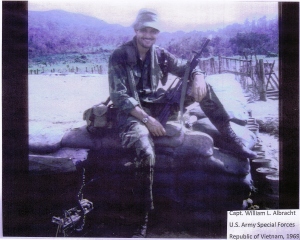
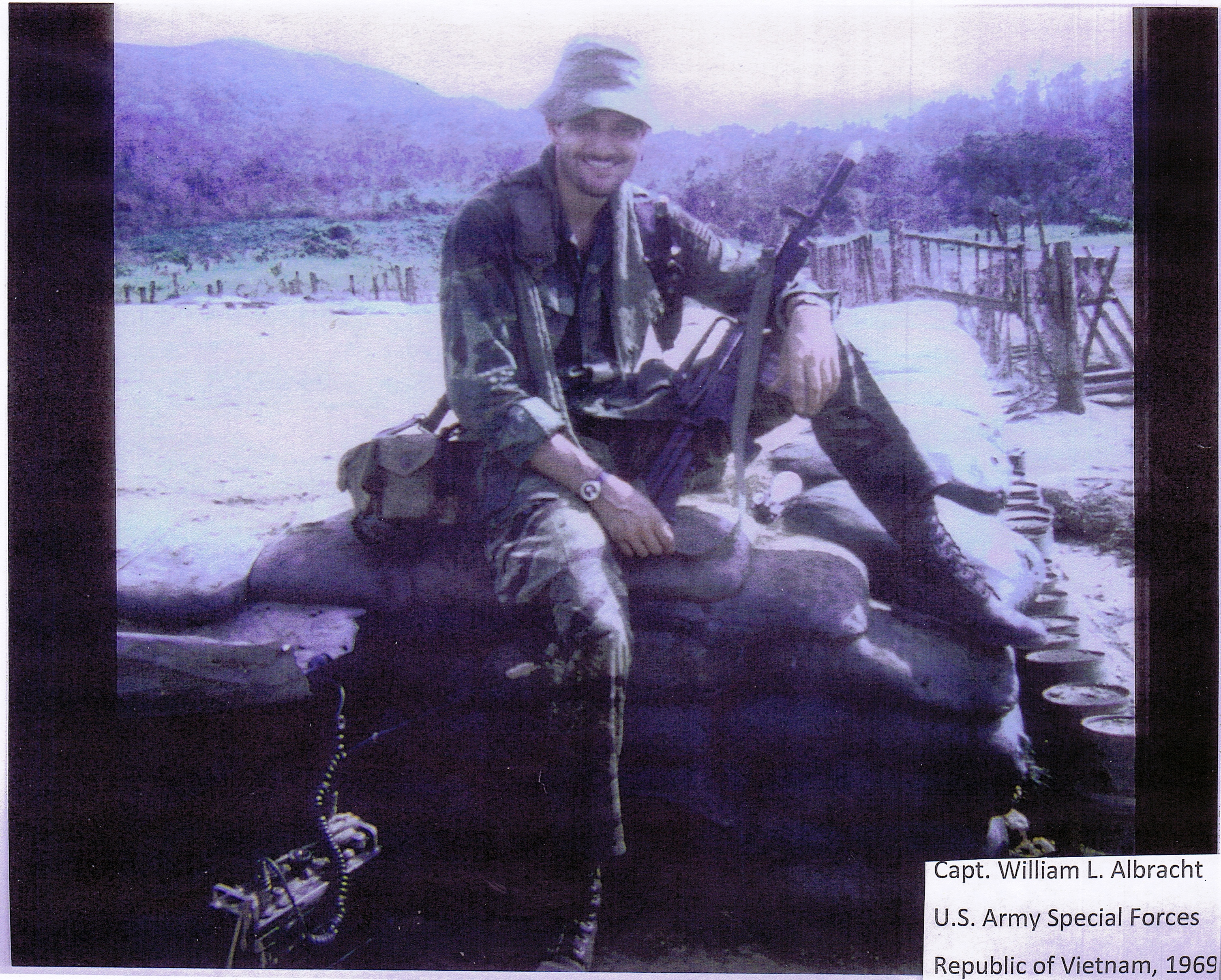
    Bill Albracht

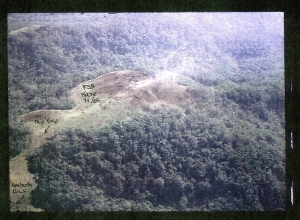
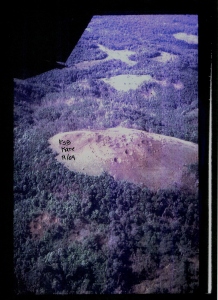
    I know I’ve been AWOL a little this weekend, but some friends of Bill Albracht sent me a mountain of documentation for his book “Abandoned in Hell: The Fight For Vietnam’s Firebase Kate” that is due out next month. I had the privilege of listening to the radio traffic between Captain Albracht, the new commander of Firebase Kate, as he guided Spooky gunships over the firebase on October 31st, 1969 and as the 27 American soldiers and 150 Montagnards made their way to safety from the overrun base on November 2d after the 5-day seige. I wish that there was someway that I could share it with you. I’ll work on that.

    Albracht Fire Base Kate

    Albracht Fire Base Kate after

    I also read the supporting statements from eye witnesses for Albracht’s Medal of Honor nomination, and it’s clear to me that the people who had served only briefly under Captain Albracht’s command were in awe of his battlefield skills as he juggled combat aircraft over his battle space, the ground combat as well as the resupply and, finally, the successful 7 mile evacuation from the firebase to relative safety. As the Montagnards threatened to abandon the Americans and as the generals prepared to throw the base and it’s occupants away, Captain Albracht held it all together with nothing but the force of his will and war-fighting skills.

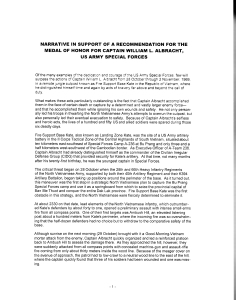
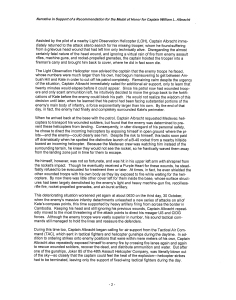
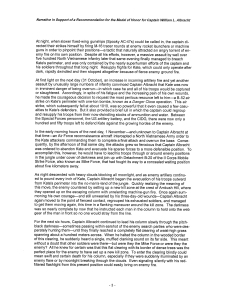
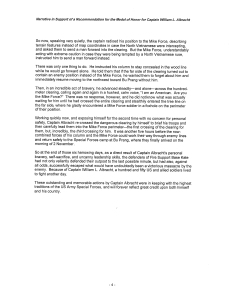
    Albracht earned three Silver Star Medals in the space of a few months, the last one caught up with him in 2012. His Congresswoman has asked the Army to consider him for the Medal of Honor and here is the four-page narrative;

    Albracht MoH narrativeAlbracht MoH narrative2Albracht MoH narrative3Albracht MoH narrative4

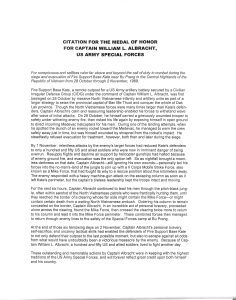
    And the suggested citation;

    Albracht MoH citation

    Like I said, the book is due on February 3rd, you might want to consider pre-ordering it.

  • Guardmen rescue flag from Ferguson protesters

    Guardmen rescue flag from Ferguson protesters

    burnredblue

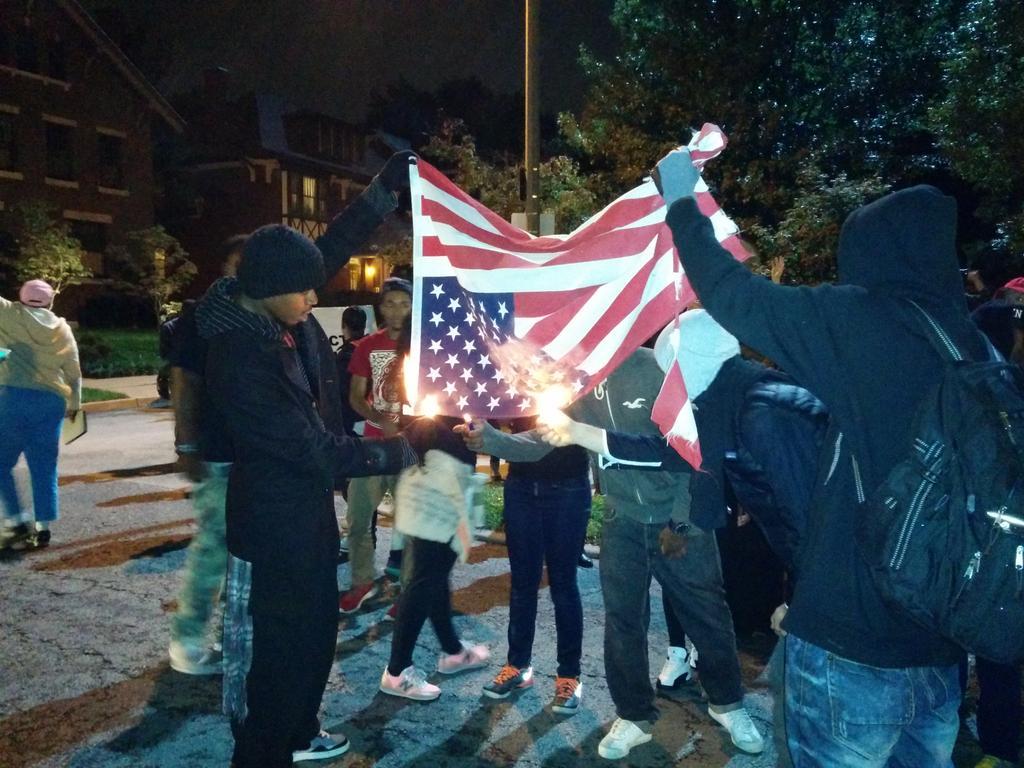
    Stars & Stripes recounts the story from two weeks ago when Missouri National Guardsmen Major Lance Dell and Sergeant First Class Eric Allison rescued a burning American flag from protesters in Ferguson;

    “They treated the flag like it was trash,” Allison said. “It’s not trash to us.”

    […]

    Dell, 46, and Allison, 43, are full-time National Guard members, assigned to the 205th Military Police Battalion in Poplar Bluff.

    Both men spent 13 months in Afghanistan around 2010, and Allison also spent 18 months in Iraq in 2004-05. They’ve served together long enough that they knew their thoughts were aligned when the flag was burned. They looked at each other and acted.

    Said Allison, “My dad used to tell me that you can’t even count the people who gave their lives so we can fly that flag. We love the flag, or at least what it stands for.”

    Dell noted that he and his men are well aware of the court rulings concerning flag burning.

    “We know that it’s a constitutional right to burn the flag,” Dell said.

    “But I knew we couldn’t leave it just lying in the road.”

    The article continues that two weeks later the flag is still in the possession of the two Guardsmen and they promise that it will be treated in accordance with the Code.

  • Unrewarded Valor

    Unrewarded Valor

    At a time of so much racial strife and discord, we should never lose sight of the fact that our military forces were the first, and remain the best, example of a fully integrated America. Yes there are problems from time to time, but there are few other places in our society where blacks, whites and Hispanics have learned to live and work together with a common mission as in our military. And that is an example that we seldom hear about from our media.

    Instead we are treated by our sensationalist media to endless examples of lawlessness in black communities and the vitriol of the race-baiters like Farrakhan, vowing “We’ll tear this go**amn country up!” and unending charges of racism leveled against whites who question the values of black culture. However, we all, black, white, brown and whatever, should keep in mind the reality that we have family members out there serving shoulder to shoulder around this world, with some of them dying in the process.

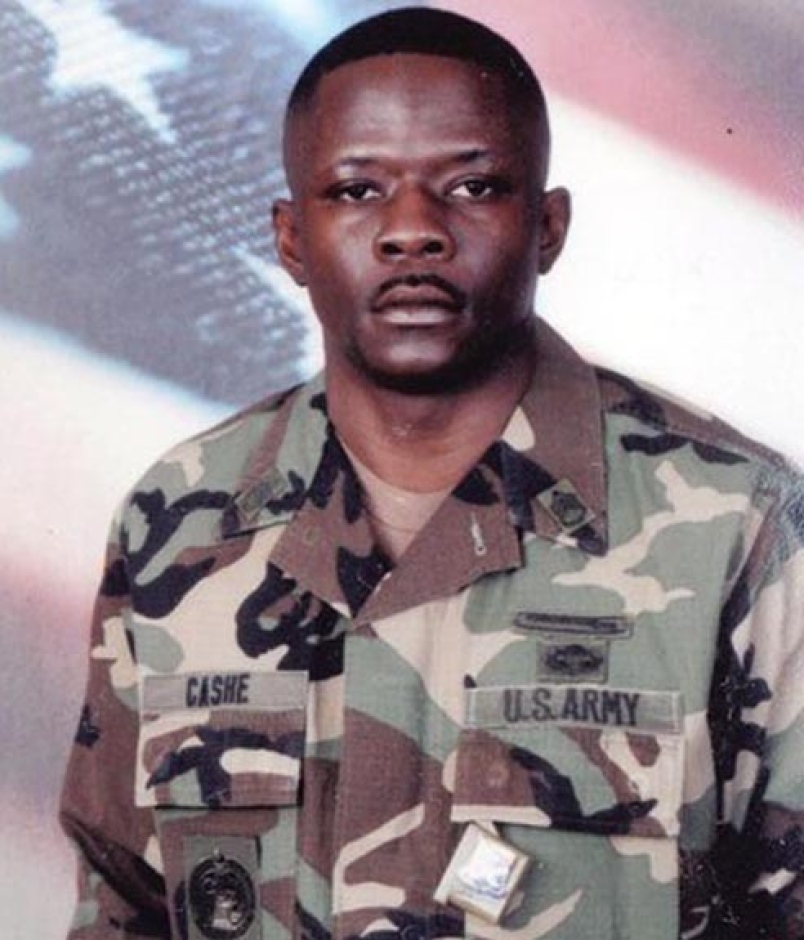
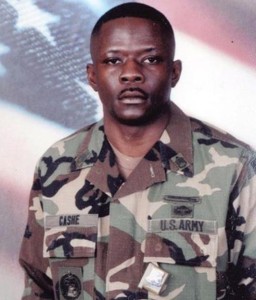
    Such is the case of Sergeant First Class Alwyn C. Cashe, who, on October 17, 2005, sacrificed his life to save those of the troops in his care. With his unit under enemy fire, SFC Cashe, his uniform soaked with fuel from a roadside explosion which ruptured the fuel tank of his Bradley Fighting Vehicle and set it afire, repeatedly entered the fiery interior to rescue his men who were trapped inside. Even with his uniform burned away and his flesh ablaze, SFC Cashe managed to pull six soldiers from the flaming interior. Four of them later succumbed to their burn wounds as did, some three weeks later, SFC Cashe.

    For his incredibly selfless valor, SFC Cashe was awarded the Silver Star, an award that seems to many of us in the military and veteran communities, insufficient to the events of that terrible day. Colonels have been known to be awarded the Silver Star for monitoring and directing ground combat from the relative comfort of an overhead helicopter. I would wager that among all warriors, soldiers, sailors, aviators, etc., fear of death by burning or being horribly injured and disfigured by fire is greater than any other dread associated with combat. Yet SFC Cashe overcame that fundamental fear and charged directly into the flames repeatedly to save his young soldiers. A Silver Star seems a bit inadequate to reward that level of courage and self-sacrifice.

    Among those who feel that Cashe’s bravery deserves more is the officer who was his battalion commander at the time, now Brigadier General, Gary Brito. According to this account in the LA Times, then Lieutenant Colonel Brito, was unaware of the full extent of Cashe’s actions because those soldiers immediately involved were too seriously wounded to provide many details and soon most would die from their injuries. And more so than for any other combat valor award, detailed documentation and corroboration are required for the Medal of Honor.

    However, one of the two survivors and an eyewitness, now retired Army Sergeant Gary Mills, who was himself pulled from the burning vehicle by SFC Cashe, says there is no doubt in his mind that Cashe’s gallant actions warrant the highest award for valor and sacrifice. BG Brito, SGT Mills and Cashe’s sister, Kasinal Cashe White have been conducting a campaign for several years but the Obama Department of Defense seems unable or unwilling to do the right thing despite support for the award from multiple general officers.

    One of the phrases frequently found in citations that accompany awards for valor, particularly those awarded posthumously, is “with selfless concern for his fellow soldiers and complete disregard for his own safety,” and a wonderful example of how deeply imbued that trait was in SFC Cashe is revealed in the Times article:

    Cashe’s sister, Kasinal Cashe White, spent three weeks at her brother’s bedside at a military hospital in Texas as doctors treated his extensive burns.

    She knew nothing of his actions during the bomb attack until a nurse asked her, “You know your brother’s a hero, don’t you?”

    When Cashe was able to speak, White said, his first words were: “How are my boys?” — his soldiers, she said. Then he began weeping, she said. He told her: “I couldn’t get to them fast enough.”

    Cashe died Nov. 8, 2005.

    “My little brother lived by the code that you never leave your soldiers behind,” White said. “That wasn’t just something from a movie. He lived it.” White says her family hopes Cashe is awarded the medal while his mother, who is 89, is still alive.

    “How are my boys?” I have to tell you that this old former combat infantryman choked up on reading that account for the first time. Enduring unbelievable pain and suffering from a horribly burned body for three weeks, SFC Cashe’s first conscious words were of concern for his troops. I don’t know if that quote can be included in a Medal of Honor citation but it damned well should be. It should also be inscribed above the command entrance of every NCO academy in the United States Army.

    An interesting aspect of this issue is the absence of support from the Congressional Black Caucus. Why are they missing in action? Are they too busy pontificating and demonstrating on behalf of dubious heroes to convene their members in the office of the Secretary of Defense and demand action on behalf of a genuine hero, of whom all of America, black and white, can be unified in their pride and admiration? They should pause the racial grandstanding long enough to secure a richly deserved Medal of Honor for SFC Cashe. Perhaps then his elderly mother can be brought to the White House for the presentation of the medal so that she can then go to her grave knowing her son’s valor and sacrifice have finally been recognized and rewarded by a genuinely grateful nation.

    Readers might want to contact their own senators and congressmen just in case the Black Caucus is too busy supporting misguided demonstrations to fight for this gallant warrior. Arkansas Senator-elect Tom Cotton’s office has communicated to me that they will pursue the matter after he is sworn in, but the more representatives and senators pursuing the matter, the better.

    Crossposted at American Thinker

  • Army Specialist Five Karen Irene Offutt

    Army Specialist Five Karen Irene Offutt

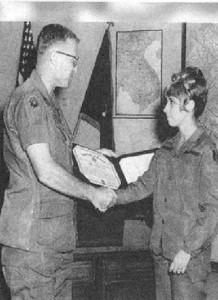
    Karen Irene Offutt

    I learn an awful lot from blogging. When I was a young NCO, I learned that the best way to learn how accomplish a task is to teach it, because of the stuff you learn from preparing your classes. So, it is with blogging, I suppose. Doug Sterner emailed us another phony yesterday who happened to be a female and she claimed that she had earned a Soldiers Medal. I mentioned to Doug that I had never heard of a female who had earned a Soldiers Medal (for the uninitiated, a Soldiers Medal is awarded for heroism while not engaged with an armed enemy). Doug straightened me right out and sent me this list of women who had been awarded the Soldiers Medal;

    Stephenson, Orah D. World War II
    Donaldson, John J. World War II
    Atwood, Pauline A. Vietnam War
    Roberts, Laurel V. Vietnam War
    Sperry, Deborah R. Vietnam War
    Picard, Carol Y. Vietnam War
    Bolling, Wilma F. Vietnam War
    Wills, Marilyn War on Terrorism
    Cruz-Cortes, Roxane War on Terrorism

    But, there was one missing, SP5 Karen Irene Offutt. Her story;

    “We were on the second floor of an old hotel. Across the alleyway were a series of Vietnamese shanties, made of beer cans and thatch roofs. A bamboo-type awning extended across all the houses. That awning was on fire, and [Vietnamese] were running around trying to salvage their things. I ran down and pulled some women and children out. I was barefoot and burned my feet. I don’t remember much. Eventually, the fire department showed up.”

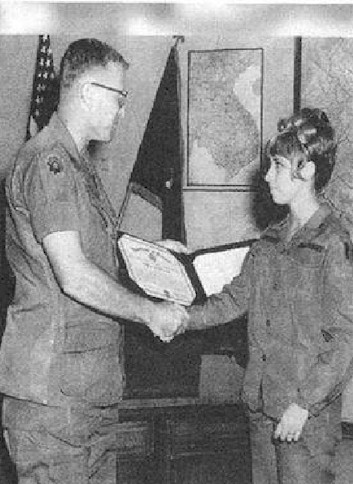
    Offutt doesn’t feel she did anything especially heroic, and remembers with more clarity that she wrote home about the incident, and her mother organized churches and neighbors to collect clothes and send them to Vietnam for the children. Offutt was surprised when she was called to MACV (Military Assistance Command Vietnam) and informed that the Hamlet Chief had written a letter commending her for saving numerous lives, and that she was to be awarded the Soldier’s Medal. Then, on 24 January, officials told Offutt that women were not awarded Soldier’s Medals; instead, Offutt was presented with a Certificate of Achievement for Heroic Action. “I wasn’t really upset at not getting it [the Soldier’s Medal] because I did what anybody should have done anyway.”

    […]

    On April 7, 2001, at Medard Park, east of Tampa, Florida, Karen Offutt was finally presented the Soldier’s Medal she had earned thirty-one years earlier in Vietnam. A guest speaker at The Moving Wall, she was presented the medal in a surprise ceremony by a representative of Congressman Mike Bilirakis (R-Fla)

    The official citation reads:

    (Then) Specialist Five, United States Army for heroism not involving actual conflict with an armed enemy: Specialist Karen I. Offutt, Women’s Army Corps, United States Army, assigned to Headquarters Military Assistance Command Vietnam, J47, distinguished herself by heroic action on 24 January 1970 while in an off-duty status.

    Observing a fire in Vietnamese dwellings near her quarters, she hurried to the scene to provide assistance. Without regard for her personal safety and in great danger of serious injury or death from smoke, flames, and falling debris, she assisted in rescuing several adults and children from the burning structures. Without protective clothing or shoes she repeatedly entered the buildings to lead children that had reentered their homes to safety. She continued to assist the Vietnamese residents in removing personal property and livestock, although danger increased until fire-fighting equipment and personnel arrived. Specialist Five Offutt’s heroic action reflects great credit on herself, the United States Army, and the United States mission in Vietnam.

  • SFC Alwyne Cashe and the MoH – Maybe We Can Help

    SFC Alwyne Cashe and the MoH – Maybe We Can Help

    I trust everyone reading this saw Jonn’s article about SFC Alwyne Cashe the other day. If not, you need follow the link and read it – now – along with the LA Times article to which Jonn links.

    While I trust that the Army will eventually do the right thing, that’s not a lock. Even then, doing the right thing may take a long time unless there’s significant external interest in the matter.

    With that latter, maybe there is something we can do to help.

    One thing that the Five Sided Asylum seems to notice is inquiries from Congress. And one thing that Congress seems to notice is stuff that makes the mainstream press. Hell, most Members of Congress appear to pray daily at the Altar of the Media Gods.

    Well, SFC Cashe’s story has now hit one of the larger media outlets.  So, tell me: what do you suppose would happen if a large number of Congressional Representatives and Senators started receiving mail from their constituents consisting of a polite letter asking them to look into SFC Cashe’s case – with a copy of that article attached?  (I’ve archived a copy in the event it ages off the LA Times’ website.)

    I can’t say for sure whether that would make a difference.  But I’d guess that if the Pentagon gets forty or fifty inquiries from different Representatives and Senators, they just might decide to move out smartly – if for no other reason than to “stop the pain”.

    This link seems to be a good source of contact information for Members of Congress.   (E-mail contact is found by clicking the state; you have to click individual names next to get “snail mail” addresses.) I’ve also taken the liberty of drafting a sample letter to Congress as a starting point. You can download the draft text for a letter here.  You’ll need to format/alter it to suit your own ‘druthers and situation.

    The above link for Congressional contact info has both electronic and USPS contact information. However, if you decide to send your Senators and/or Representative correspondence and can afford to do so, I’d suggest going the hardcopy route – or maybe doing both.  I understand hardcopy still gets more “weight” in Congressional offices these days.

    Again, this might or might not do any good.  But IMO, it’s certainly worth a shot.

  • Alwyn Cashe’s Medal of Honor moves slowly forward

    Alwyn Cashe’s Medal of Honor moves slowly forward

    Alwyn Cashe

    The LA Times, in their own way reports that Sergeant First Class Alwyn Cashe is still in the running for an award of the Medal of Honor, nearly a decade after he gave his life to save his troops from his burning Bradley. This has been my personal crusade – you know because Cashe and I are just alike – we were Bradley platoon sergeants. We look a lot alike, too – in the eyes. They issue those to us at ANCOC. His hair is a little short than I liked, though. I’d like to think that I would have done the same thing that SFC Cashe did in his circumstances;

    Cashe rescued six badly burned soldiers while under enemy small-arms fire. His own uniform caught fire, engulfing him in flames. Even with second- and-third degree burns over three-fourths of his body, Cashe continue to pull soldiers out of a vehicle set ablaze when a roadside bomb ruptured a fuel tank.

    […]

    Sgt. Gary Mills…was inside the stricken Bradley fighting vehicle that day. He was on fire, his hands so badly burned that he couldn’t open the rear troop door to free himself and other soldiers trapped inside the flaming vehicle.

    Someone opened the door from outside, Mills recalls. A powerful hand grabbed him and yanked him to safety. He later learned that the man who had rescued him was Cashe, who seconds later crawled into the vehicle to haul out the platoon’s critically burned medic while on fire himself.

    “Sgt. Cashe saved my life,” Mills said. “With all the ammo inside that vehicle, and all those flames, we’d have all been dead in another minute or two.”

    Four of the six soldiers rescued later died of their wounds at a hospital. An Afghan interpreter riding in the Bradley died during the bomb attack. Cashe refused to be loaded onto a medical evacuation helicopter until all the other wounded men had been flown.

    SFC Cashe succumbed to his injuries a few weeks later, at Fort Sam Houston’s Brooke Army Medical Center surrounded by his family. The Army awarded him a Silver Star, but that doesn’t go far enough, in my opinion and now, that’s the opinion of his leadership apparently. They claim that for nearly ten years some nebulous cloud of war hung over SFC Cashe’s actions that day that is only now lifting.

    In the article, the LA Times quotes now-Brigadier General Gary Brito, then SFC Cashe’s battlion commander, as saying that if the events of that day had been clearer, he would have nominated Cashe for the Medal of Honor then.

    Brito, who is still on active duty, says he has spent the last seven years locating soldiers and obtaining sworn statements, which he has included in the latest packet he is submitting to the Army.

    One statement is from Lt. Gen. William G. Webster, Cashe’s division commander, who wrote: “The pain he suffered must have been unimaginable, and yet he continued to suffer in the name of saving others. I cannot remember a story that is its equal.”

    Taluto, who also commanded Cashe, wrote: “In all my years of service I have yet to witness or hear of such an act of bravery.”

    The article quotes Cashe’s sister, Kasinal Cashe White;

    When Cashe was able to speak, White said, his first words were: “How are my boys?” — his soldiers, she said.

    Then he began weeping, she said. He told her: “I couldn’t get to them fast enough.”

    So, let’s get to Cashe a little faster, there, Pentagon.

  • The Little Drummer Boy . . . General

    We often say that truth is stranger than fiction. We say that because, well, it’s true.

    If someone told you that a lad had (1) run away from home to join the Army at age 9; (2) was a Sergeant at age 12; (3) by age 13 was a twice-wounded, exchanged POW, and had been discharged; (4) made the Army his career; and (5) retired as a General . . . well, you’d probably accuse the person telling you that of telling tall tales, or talking about some third-world country. Or maybe engaging in an episode of “better living through recreational chemistry.” (smile)

    Problem is, they’d be talking about US history. They’d be talking about John Lincoln Clem.

    They’d also be telling the truth.

    . . .


    John Joseph Klem was born in Ohio in August 1851. (He later adopted the spelling “Clem” for his last name; as a youth, he adopted the middle name “Lincoln” in place of his given middle name Joseph). When he was 9, his mother died.

    Clem’s earliest military history is not well documented. However, generally accepted history is it that he ran away from home at age 9 after his mother’s death and attempted to join multiple Union regiments forming after the outbreak of the Civil War. Some research casts doubts on this, and indicates he actually left home a year or two later.

    Clem’s earliest documented service was with the 22nd Michigan. He was initially rejected by the 22nd Michigan as well, due to his young age and small size. However, accepted history is that Clem followed the regiment anyway; after a time, the regiment’s officers adopted him as mascot and drummer boy, chipping in to give him a “regular soldier’s” pay. After a time (in May, 1863), Clem was allowed to formally enlist – at age 12.

    Though often rumored to have served at the Battle of Shiloh and been the “Johnny Shiloh” of Ray Bradbury short-story and Disney movie fame, the former claim appears almost certainly apocryphal. The 22nd Michigan, with whom Clem did serve, was not at Shiloh. However, it appears that Clem’s service at Chickamauga was indeed the inspiration for the Civil War song “The Drummer Boy of Shiloh”, which was first published after Chickamauga and which doubtless inspired Bradbury’s story and the Disney movie.

    Clem is documented to have served at the Battle of Chickamauga in 1863. At Chickamauga, Clem did more than merely beat a drum. During the Union retreat, Clem is reported to have served with an artillery caisson withdrawing from the battlefield. That caisson was reportedly intercepted by a Confederate Colonel, who demanded Clem surrender. Accounts state that Clem – using a musket with a stock shortened so that he could carry it properly – shot the Confederate Colonel vice surrendering, and escaped with the caisson.

    Though later research has cast some doubt on the “shot a Confederate Colonel” portion of this account – Confederate records do not show a Colonel to have been wounded at Chickamauga – the Union Army accepted the story at the time. Clem was promoted to Sergeant not long afterwards, becoming the youngest NCO in Army history (age 12). He was also later decorated for his actions at Chickamauga.

    Clem was taken prisoner in October 1963 while serving as a train guard. (Other accounts indicate he was taken prisoner during the latter stages of Chickamauga.) He was returned to Union control as part of a prisoner exchange not long afterwards; he resumed service with Union forces of the Army of the Cumberland, serving in multiple battles as a mounted orderly. While serving, Clem was wounded twice. In September, 1864, he was discharged.

    After the Civil War, Clem completed high school. He applied for admission to West Point, but failed the entrance exam and was refused admission. Almost certainly because of his well-known wartime record, President Grant appointed Clem a Second Lieutenant in 1871. While the appointment may have been political, it turned out to be an excellent move on Grant’s part.

    As a Lieutenant, Clem served initially with the 24th US Infantry. He later attended artillery school, then was transferred to the Army’s Quartermaster Department in 1875. He was to remain a Quartermaster officer the remainder of his career.

    Clem retired from active duty on 13 August 1915 – on reaching the Army’s mandatory retirement age of 64. He’d attained the rank of Colonel. As was customary for retiring Civil War veterans who had achieved that rank, he was promoted to Brigadier General on retirement – indeed, Clem was the last Civil War veteran to serve on active duty. A bit over a year later, he received a promotion on the retired list to Major General.

    Clem lived more than two decades after his retirement from the Army. Just before World War II, a ship was named after him – the USAT (later USAHS) John L. Clem.

    Clem died on May 13, 1937 – roughly seventy-six years after he’d reportedly run away from home to join the Army. He is buried at Arlington National Cemetery.

    Drummer boy at Chickamauga. WIA twice, without permanent disability. POW. Youngest NCO in Army history. Direct commissioned by the President. Last Civil War veteran to serve on active duty. Retired a General.  Ship named in his honor.

    Yes, I’d certainly call that the proverbial “life well-lived”. We all should be so lucky.

    Rest in peace, General Clem. Rest in peace.


    Sources:

    http://www.civilwar.org/education/history/biographies/john-clem.html
    http://en.wikipedia.org/wiki/John_Clem
    http://www.arlingtoncemetery.net/jlclem.htm
    http://www.ohiohistorycentral.org/w/Johnny_Klem
    http://www.patheos.com/blogs/mcnamarasblog/2011/09/johnny-clem-%E2%80%9Cthe-drummer-boy-of-chickamauga%E2%80%9D.html
    http://histclo.com/bio/c/bio-clem.html
    http://www.old-picture.com/defining-moments/Boy-Soldier.htm
    http://www.gacivilwar.org/story/john-lincoln-clem-an-american-legend
    http://en.wikipedia.org/wiki/USAT_John_L._Clem