Category: Military issues

  • What my military pension means to me

    The news this week is that the Military Compensation and Retirement Modernization Commission will release their report and recommend changes to the military 20-year retirement system, abolishing the old system for a 401k-type of program and will delay any pension benefits until the age of 60, or longer. Of course, it’s because the Commission doesn’t have any representatives on their little club who understand what a 20-year pension represents to enlisted retirees who aren’t flush with disposable cash.

    I retired at the age of 38 along with my family. I went to college the month after I left the service. It was a fairly tough transition – I worked a full time job with a security company as a rent-a-cop on a construction site, I also worked as a work/study student in the campus VA office, all while carrying a full load of classes. The pension helped us meet our transition expanses until I graduated.

    After college, I went into sales with an investment company, a totally foreign environment. While I struggled to learn the business and how to teach other people what they needed, the Army pension paid the bills. Eventually, I failed at that business because some people are too stupid to help, and I’m no salesman,

    When I went to work for the National Archives, most of the people my age had been at the job longer, so I was behind my peers in pay, but living in the District of Columbia, my employer didn’t take that into consideration and I still had to pay rent and bills. My pension gave me parity with my peers in an expensive environment.

    My pension was $999/month when I retired in 1994 – it wasn’t a lot, but it made up for those years that I wasn’t competing in the workforce. It has kept pace with inflation, and it’s half-again as much now. It’s still not a lot but now that I’m retired and I’ve made as much as I’m ever going to make, it still makes a difference.

    This Commission is only looking at how they can save the Pentagon some money, they aren’t looking at how their decision will impact future soldiers and how they’re going to make their transition to civilian life more difficult with their cost-cutting.

    They’re recommending a 401k-type retirement as if it is a new idea. It is not – military members have the Fed’s Thrift Savings Plan available with tax-deferred benefits. But service members don’t get the employer match benefit that civilian employees have, and the tax-deferred money isn’t available to retiring members until they’re 59 1/2 years old, unless they are disabled.

    So, it doesn’t make military retirement as attractive to careerists as the current program does. And therein lies the problem – a professional force needs to retain it’s experienced warriors. Those experienced warriors aren’t going to stick around if the Pentagon’s bean counters are only looking for ways to save money regardless of how it affects the folks kicking doors and making widows.

  • Mac Thornberry opposes personnel and equipment cuts

    Mac Thornberry opposes personnel and equipment cuts

    Mac Thornberry 1

    According to the Stars & Stripes, Congressman Mac Thornberry (Republican from Texas) the new chairman of the House Armed Services Committee claims that he opposes further cuts to defense.

    Rep. Mac Thornberry, R-Texas, staked out a hawkish position for his military oversight committee in his first major policy speech of the new Congress. He signaled he will follow his predecessor and push back against Pentagon plans to reduce servicemember compensation and retire weapons systems such as the A-10 Thunderbolt to balance budgets.

    The speech was an early indication of how a new Republican majority in both chambers of Congress may deal with a $523 billion budget cap on defense spending this year, which will likely prompt the White House and Defense Department to again call for a range of cuts. Both are expected to release proposed budgets early next month.

    I appreciate his attitude today, but I’ll just wait and see. Republicans have seemed more eager to slash defense spending to the bone than their Democrat colleagues in the past few years all in an effort to appear as if they don’t oppose the president every time he makes a proposal. But, here we are with thousands of troops deployed to various trouble spots around the world while the White House and the service chiefs sacrifice everything. Well, everything except trouble spots.

  • Soldier found dead in Killeen, TX

    Folks have been sending me the link to this story about an unnamed soldier who was “self-monitoring” his health after he returned from the operations against Ebola in West Africa. Apparently, he was found dead in his yard yesterday and out of an abundance of caution, first responders removed his body while wearing protective equipment.

    The unidentified soldier, who recently returned to Fort Hood in central Texas on emergency leave, was monitoring himself twice daily and reporting his status to medical officials, they said.

    He was found dead at his off-post residence in the town of Killeen.

    “We are not saying Ebola at all,” Killeen police spokeswoman Carol Smith said. “It’s just that because of the circumstances from West Africa, we are erring on the side of caution.”

    This is the United States of America – we don’t die of Ebola in our homes – we go to the hospital when we get that sick, so I doubt very much that the soldier died of Ebola. I know everyone wants to believe that Ebola was involved, but I just can’t convince myself that someone with that deadly, painful condition wouldn’t seek medical help. I’m calling this one a media distraction.

  • Advice from an old sergeant

    At midnight, I will have been retired 21 years from the Army, but as many of your can attest, I never really left. I still love the service and I appreciate everything that service did for me. I get upset when I see things go sideways for the troops like they have recently. A lot of the problems are with the leadership. Like the 1SG who made a public spectacle of herself earlier this year and elevated some misbehavior by some troops on social media to the Pentagon. In the comments, some folks have asked what she should have done differently, so I’m going to give some unsolicited advice.

    Many of my peers thought that “Courtesy Patrol” in Germany was their opportunity to act like MPs and arrest people for drunkenness down on the strasse. I saw it as a teaching opportunity. If I saw people in drunken brawls, me and my minions would unceremoniously toss them in our van and drive them to their units and turn them over to their Charge of Quarters and their First Sergeants instead of turning them over to the MPs and get them put in the community blotter report.

    When one of my squad leaders was picked up by the MPs for fighting one night, my battalion commander blamed me. So, instead of crying about being picked on for something that wasn’t my fault, I started my own platoon courtesy patrol – I went around to the local bars and policed up my troops at 2AM very night and took them back to the barracks before they could get in trouble. Because my peers didn’t do the same for me that I did on courtesy patrol for them.

    I never got any recognition for making the hard choices, I didn’t go around telling my leadership how I kept their troops’ names out of the blotter – I just did it because it was the right thing to do. It gave me a sense of satisfaction about me and my job. The troops knew that I cared about them and they’d walk through fire for me.

    Those things I did back then are things I still do today.

    A few months ago, someone sent me some stuff on a fellow he knew at Fort Drum who was wearing things he hadn’t earned – a Purple Heart and a CIB. I looked him up on AKO, which also lists their supervisors’ names and I emailed the evidence against the guy to his squad leader. A few weeks later, the squad leader emailed me back that he had corrected problem and he thanked me for coming to him.

    Last week, someone emailed us a disturbing picture of a buck sergeant making some wild ass statements about something that has been in the news lately. Instead of making a big deal of it, like some of the Facebook busts of troops (the young lady who skipped out on retreat and the folks misbehaving on burial detail come to mind) I sent the Facebook picture to him personally and warned him about his behavior. The other day, I got an email back from him thanking me for coming to him and promising that he would refrain from that behavior in the future.

    I’m not looking for accolades by telling these stories, I’m telling you because it’s a minefield out there. If the professional NCO Corps is going to survive the current political climate, they need to think about doing the right thing that doesn’t get them medals and spots on the news and in DoD press releases. It’s not covering up problems, it’s fixing problems – the thing that needs to be done.

    Real heroes are embarrassed by the recognition, and the professional NCO Corps are the real heroes of the military. They get the job done because that’s their job – not because they want some more shinies on their clothes.

  • That “bring back the draft” thing again

    Joseph Epstein writes in The Atlantic that he really wishes that the federal government would restart the draft again. A draftee himself, Joseph, writes that his experience justifies the return to conscription that disappeared in 1973;

    Under the draft, the American social fabric would change—and, judging from my experience, for the better. I write as a former draftee who served in the Army from 1958 to 1960. I was, in other words, a Cold War soldier, and never for a moment in danger. Much of my time in the military—I worked on the post newspaper at Fort Hood, in Texas, and later as a clerk, typing up physicals, in a recruiting station in Little Rock, Arkansas—was excruciatingly boring.

    Yet I am grateful for having served. Doing so took me out of my own social class and ethnic milieu—big-city, middle-class, Jewish—and gave me a vivid sense of the social breadth of my country. I slept in barracks and shared all my meals with American Indians, African Americans from Detroit, white Appalachians, Christian Scientists from Kansas, and discovered myself befriending and being befriended by young men I would not otherwise have met. I have never felt more American than when I was in the Army.

    I guess that Mr. Epstein hasn’t been watching the news lately – the military is trying to downsize. There is no shortage of volunteers and there’s no need to force people into uniform at this point. The only reason to reconstitute the draft, with no real national emergency on the horizon, would be if the government intended to make military service unattractive, as the Washington Post suggests in the previous post.

    As a private in the Army, I’m sure Mr. Epstein didn’t experience the downside of trying to lead soldiers who didn’t want to participate in the daily drudgery of training – and since he served in non-war years, he certainly didn’t get to witness conscripts involved in combat operations.

    Since the Pentagon is wringing it’s hands over the fact that 75% of military-age men and women are ineligible for service for various reasons. How would a draft fix that? It actually means that it would probably be too costly to screen the number of candidates to get to the numbers that would justify conscription.

    It was probably the Joseph Epsteins in the country that ended the draft in the early 70s and now they think it’s a good way to spread the misery of defending the country from the vast array of enemies facing the country. It was Richard Nixon who ended the draft and it was Jimmy Carter who brought back draft registration when the Soviets invaded Afghanistan out of fear that he had destroyed the sense of military service so badly that he’d have to force Americans to serve if the Soviets didn’t stop there. You know, after he gave amnesty to draft dodgers on his first day in office insuring that no one would take the draft seriously again.

    Of the 2.7 million Americans who served in Vietnam, less than 700k were draftees (out of the 1.7 million total draftees during that war), but judging by the news of the day, one would think that all of the troops in Vietnam were draftees. Less than 18,000 of those draftees were killed in combat there out of the 58,000 total casualties. One might argue that we didn’t need the draft during Vietnam. So why would we need it now, unless, like I said, the Left wants to make military service so miserable that no one wants to join voluntarily.

    Thanks to Chock Block for the link.

  • Yeah, we get it, Washington Post; you hate the military

    Yeah, we get it, Washington Post; you hate the military

    Washington Post hates the military

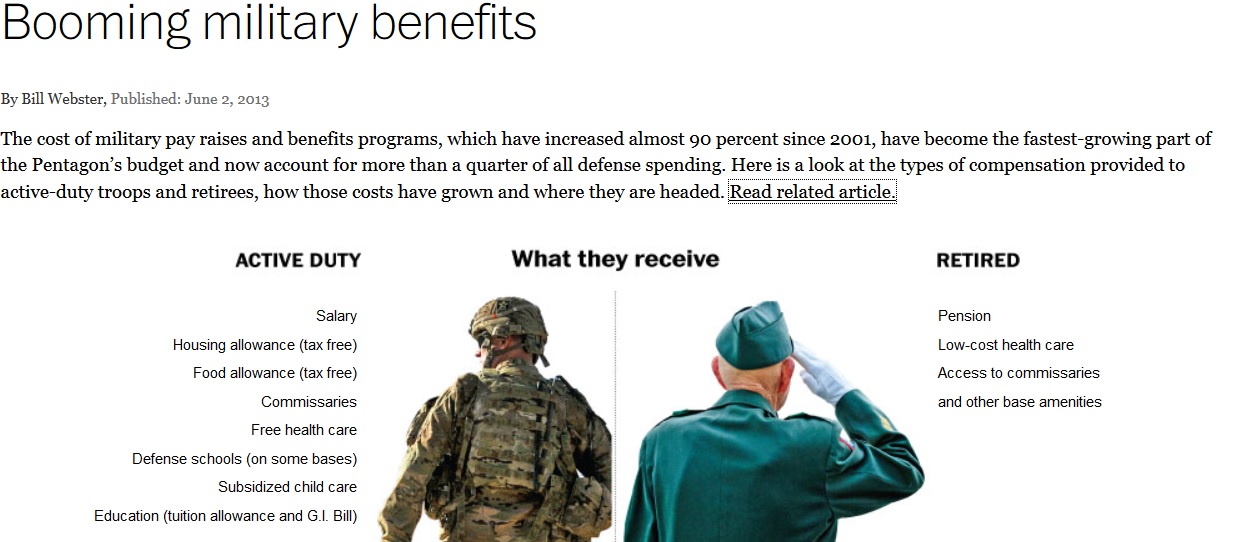
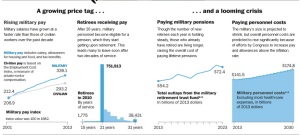
    Chock Block sends us a link to the latest hit piece in the Washington Post by some fellow named Bill Webster about the personnel costs of maintaining an effective fighting force. Of course, he compares the job to the civilian sector;

    Washington Post hates the military2

    A job in the military, the military in which I served, doesn’t compare to the civilian sector. What Mr. Webster doesn’t understand is that the Department of Defense needs to attract the best and brightest to a job that is more arduous and more time consuming than any job in the private sector. I suspect that Mr. Webster is a little bit jealous that he didn’t plan for his future like people in the military have done. We paid with our youth, our lives and our health for our comfortable retirement, while Mr. Webster was drinking himself through college – put a price tag on that.

    Training for war is as hazardous as the war itself, military operations begin long before they appear in a journalist’s camera lens. If this country needs well-trained educated people to operate the tools of victory, they need to pay for it and there has to be a light at the end of the tunnel for folks who make a career of the military – the backbone of a professional fighting force is careerism. The troops don’t have the option of taking their skills elsewhere for higher pay when they’re combat arms – there’s no compensation package to compete for their skills. There is little they can do with those skills when they leave the military.

    I’ll bet Mr. Webster can count on one hand the number of times that he was headed to work at 4 AM and his workday lasted for days at a time after that, often without sleep. I wonder how many times he got a call at 1 AM to come to work prepared to fight off the Soviet hordes. And there was no overtime pay involved – it was a call to arms. That training was what kicked Saddam Hussein out of Kuwait in 100 hours, it was what kicked Hussein out of Baghdad in 2003. That kind of performance, expertise and dedication costs money.

    I absolutely dare Mr. Webster and the Washington Post to do the same comparison and tax payer cost analysis on welfare and Medicaid.

  • Bergdahl non-news

    Bergdahl non-news

    Bergdahl and pal

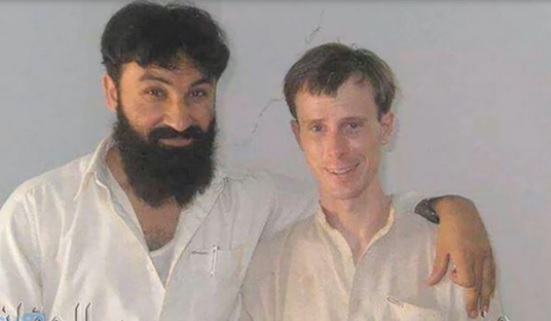
    So the news and my inbox is full of non-news about the Bergdahl case – you remember, the fellow who left his post and as a result was a guest of the Haqqani Network for the next five years. The Associated Press doesn’t want you to get your hopes up for a desertion prosecution;

    In trial cases over the last 13 years, about half the soldiers pleaded guilty to deserting their post. Another 78 were tried and convicted of desertion.

    Desertion is relatively easy to prove, former Army lawyer Greg Rinckey said, but circumstances such as post-traumatic stress or family problems are also taken into account.

    “A lot of deserters suffered from PTSD or other mental health issues, or they were on their second or third deployment,” said Rinckey. Numbers spiked as soldiers began returning to the battlefront, sometimes for up to 15 month deployments.

    […]

    Rinckey and other military officials say the Bergdahl case will be difficult. It’s now in the hands of Gen. Mark Milley, head of U.S. Army Forces Command at Fort Bragg, N.C.

    Even if Milley concludes Bergdahl deserted his post, he may consider mitigating circumstances while weighing whether to charge the soldier with desertion or being absent without leave (AWOL). He may also handle the matter administratively.

    Now I’m no expert on the Uniform Code of Military Justice, but I know that if the military wants to burn you, they’ll find a way – there are enough catch-all provisions in that manual that, undoubtedly, you’ll be guilty of something. So, if and when they ever come to a conclusion in this case, you’ll know whether its a political decision or not.

    Meanwhile, in Bergdahl’s hometown, Hailey, Idaho, they’re being a little more forgiving than those of us wore the uniform and followed the laws;

    “We have a soldier who’s been returned to America, who’s been in captivity for 5 years under extremely adverse circumstances. I would hope that at this point, everybody would just support Bowe going on with his life,” said Sue Martin, owner of Zaney’s Coffee.

    “I think the community in general is glad to read about Sgt. Bergdahl and glad to know that there is progress being made. I think those who care about him want there to be resolution for his sake and the sake of his family,” said Schoen.

    Oh, I’m all about Bergdahl getting on with his life, but I’m not going to roll over if the government decides to act like nothing happened, that no one was spending their time Afghanistan looking for someone who was a flaky sparkle pony and wandered the country side for some stank-ass hippie reason. Yeah, I’m glad he’s not going to be beheaded on a propaganda video, but that doesn’t mean that he shouldn’t be punished like the rest of would have punished during our tours if we’d flaked out like Bowe.

    Thanks to one of our ninjas for the Idaho link.

  • Yeah, We’re Really Succeeding in Reining In NORKLand

    By now, everyone’s heard the response of the      feckless fool ‘s festival in DC    current Administration to North Korea’s alleged cyber attack on Sony Pictures.  They’ve got to stand up for their most reliable political supporters, I guess.

    But just how well has the current     clueless DC clown krewe     handled North Korea’s nuclear program? Based on recent reporting by Bloomberg.com, not so well.

    North Korea has pretty much told the world to go pound sand regarding the Nuclear Non-Proliferation Treaty for years. It has continued its nuclear weapons development programs with hardly a break in stride for the last several years.

    Just how bad has this administration fumbled this? Well, the low-end estimate is that North Korea will possess enough enriched uranium and/or weapons-grade plutonium in about 5 years to fabricate 33 nuclear weapons. The high-end estimate? They’ll have enough material for nearly 80 – 79, to be precise.

    Yeah, the NORKS produce some pretty lousy nukes.  But while 5 to 10 kT isn’t exactly the second coming of the Big Bang, it’s not exactly a firecracker either.

    This article has more details. It’s worth reading.

    I guess we should be glad that the current Administration is such a big fan of missile defense, and has devoted so much time/effort/money into developing same.   And yes – for anyone who didn’t catch it, that last sentence was indeed pure sarcasm.