Category: Iran

  • Trump restores sanctions, Iranians rally to mark anniversary

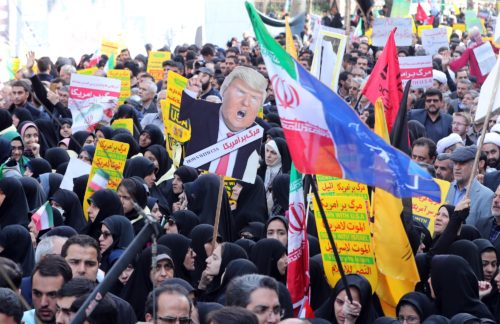
    anniversary Iranian students occupied the embassy on 04 November 1979 after the U.S. granted permission to the late Iranian Shah to be hospitalized in the States. Over 50 U.S. diplomats and guards were held hostage by students for 444 days.ABEDIN TAHERKENAREH / EPA

    Anger and distrust of the United States is surging again following President Donald Trump’s decision to withdraw from Iran’s nuclear deal with world powers.

    Thousands of Iranians rallied in Tehran on Sunday to mark the 39th anniversary of the U.S. Embassy takeover, as Washington restored all sanctions lifted under the nuclear deal.

    The crowd chanted “Down with U.S.” and “Death to Israel” during the rally in the capital, and state TV said similar demonstrations were held in other cities and towns.

    Iranian students stormed the embassy shortly after the 1979 Islamic Revolution, taking 52 Americans hostage for 444 days. The U.S. cut off diplomatic relations in response.

    The Trump administration has stated the sanctions aren’t aimed at toppling the government, but at coercing it to radically change its policies as the world’s leading exporter of terror, and halt its development of long-range ballistic missiles and nuclear capability.

    Hard to see how this plays out. Iran is already in the grip of an economic crisis, and has seen large protests in recent months as Iranian officials have tried to downplay the existing sanctions and their effects. Iran knows it can’t prevail militarily, and Trump is already shuffling the flow of oil and will sanction any county that buys oil from the Mad Mullahs without a waiver.

    Interesting times.

    The entire article may be viewed at NBC News
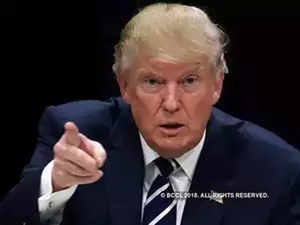
  • All US sanctions against Iran will be back in full force on Nov 5

    trump

    President Trump said on Thursday, all American sanctions against Iran will be in full force on 5 November, as he signed into law another legislation imposing hard-hitting sanctions on Lebanese militant group Hezbollah.

    On November 5th, all US sanctions against Iran lifted by the nuclear deal will be back in full force, every sanction that we had on their originally, which would have if they would have just left it a little bit longer, would have been so much easier than what we’ve been through over the last number of years,” Trump said at a White House event

    After withdrawing from the Iranian nuclear deal, Trump has asked all countries to reduce their purchase of oil from Iran to zero or face secondary sanctions. India, being one of the largest importers of Iranian oil, also comes under the purview of American sanctions. To avoid this, India either needs a waiver from the US or has to bring down the purchase of Iranian oil to zero.

    Trump said these sanctions will be followed up with even more sanctions to address the full range of Iran’s “malign conduct”.

    “We will not allow the world’s leading sponsor of terror to develop the world’s deadliest weapons. Will not happen” he said.

    Pretty obvious Trump’s intentions aren’t to bring the Mad Mullahs to heel, but regime change. This time, however, the change will be from the inside. Ask the shade of Nicolae Ceausescu how that turns out.

    The entire article may be read here at The Economic Times

  • Iran hit by computer virus more violent than Stuxnet

    iran computer hack

    Times of Israel reports Iranian infrastructure and strategic networks have come under attack in the last few days by a computer virus similar to Stuxnet, but more violent, more advanced and more sophisticated.

    Israeli officials are refusing to discuss what role, if any, they may have had in the operation.

    The report came hours after Israel said its Mossad intelligence agency had thwarted an Iranian murder plot in Denmark, and two days after Iran acknowledged that President Hassan Rouhani’s mobile phone had been bugged. It also follows a string of Israeli intelligence coups against Iran, including the extraction from Tehran in January by the Mossad of the contents of a vast archive documenting Iran’s nuclear weapons program, and the detailing by Prime Minister Benjamin Netanyahu at the UN in September of other alleged Iranian nuclear and missile assets inside Iran, in Syria and in Lebanon.

    Iran is not doing well, economy wise, either. And since Phase 2 of Trumps sanctions take effect next week, things there aren’t likely to get any better, anytime soon.

  • Confronting Iran: The Trump Administration’s Strategy

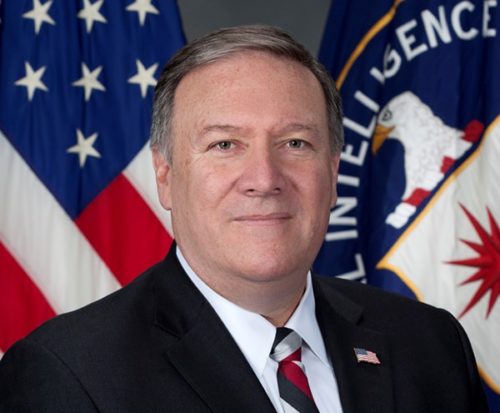
    sec state pompeo

    A very open and telling article by SecState Pompeo on the Trump doctrine, it’s objectives and differences from the previous administration’s policy of “leading from behind.”

    The end of the Cold War forced new thinking among policymakers and analysts about the greatest challenges to U.S. national security. The emergence of al Qaeda, cybercriminals, and other dangerous entities affirmed the threat of nonstate actors. But equally daunting has been the resurgence of outlaw regimes—rogue states that defy international norms, fail to respect human rights and fundamental freedoms, and act against the security of the American people, U.S. allies and partners, and the rest of the world.
    Chief among these outlaw regimes are North Korea and Iran. Their transgressions against international peace are many, but both nations are most notorious for having spent decades pursuing nuclear weapons programs in violation of international prohibitions. Despite Washington’s best efforts at diplomacy, Pyongyang hoodwinked U.S. policymakers with a string of broken arms control agreements going back to the George H. W. Bush administration. North Korea’s nuclear weapons and ballistic missile programs continued apace, to the point where after Donald Trump was elected, President Barack Obama told him that this would be his greatest national security challenge. With Iran, likewise, the deal that the Obama administration struck in 2015—the Joint Comprehensive Plan of Action, or JCPOA—failed to end the country’s nuclear ambitions. In fact, because Iran knew that the Obama administration would prioritize preserving the deal over everything else, the JCPOA created a sense of impunity on the part of the regime, allowing it to increase its support for malign activity. The deal has also given Tehran piles of money, which the supreme leader has used to sponsor all types of terrorism throughout the Middle East (with few consequences in response) and which have boosted the economic fortunes of a regime that remains bent on exporting its revolution abroad and imposing it at home.
    That the threats from North Korea and Iran grew in the post–Iraq war era has further complicated the question of how best to counteract them; Americans are rightly skeptical of the costs of a protracted military commitment in the name of protection from weapons of mass destruction. With the difficulties of Iraq fresh in mind, and with previous agreements to restrain the threats from North Korea and Iran having proved impotent, stopping these recalcitrant regimes from doing harm demands new diplomatic paradigms.
    Enter President Trump. For all of the Washington establishment’s fretting over his style of international engagement, his diplomacy is anchored in a deliberate approach that gives the United States an advantage in confronting outlaw regimes.

    There is considerably more to the article- highly recommended reading at Foreign Affairs

  • US Navy says assault rifles were seized from Persian Gulf boats

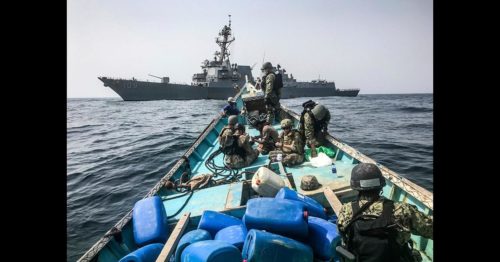
    ddg jason dunhamA team from the guided-missile destroyer USS Jason Dunham inspects a dhow while conducting maritime security operations. A U.S. military video released Aug. 31, 2018, purported to show small ships in the Gulf of Aden smuggling weapons amid the ongoing war in Yemen, with officials saying they seized over 2,500 arms from the vessels. (U.S. Navy via AP)
    A boarding team from the guided-missile destroyer Jason Dunham captured more than 1,000 AK-47 rifles from a vessel sailing in the Gulf of Aden.

    Navy officials said the warship intercepted the stateless skiff while it was drifting without engine power on Tuesday.

    The boarding team determined that the vessel was not flagged to any nation and then discovered the cache of weapons.

    The Navy’s Bahrain-based 5th Fleet gave the updated total in a statement Wednesday.

    It boarded a skiff and a dhow, a traditional ship in the Persian Gulf, during routine checks in the Gulf of Aden on Aug. 28.

    The Navy added: “The origin and intended destination of the skiff have not yet been determined.

    I’ll take, “Who Are Iran and Yemen?” for thousand, Alex.

    The entire article may be viewed Here.

  • Exclusive: Iran moves missiles to Iraq in warning to enemies

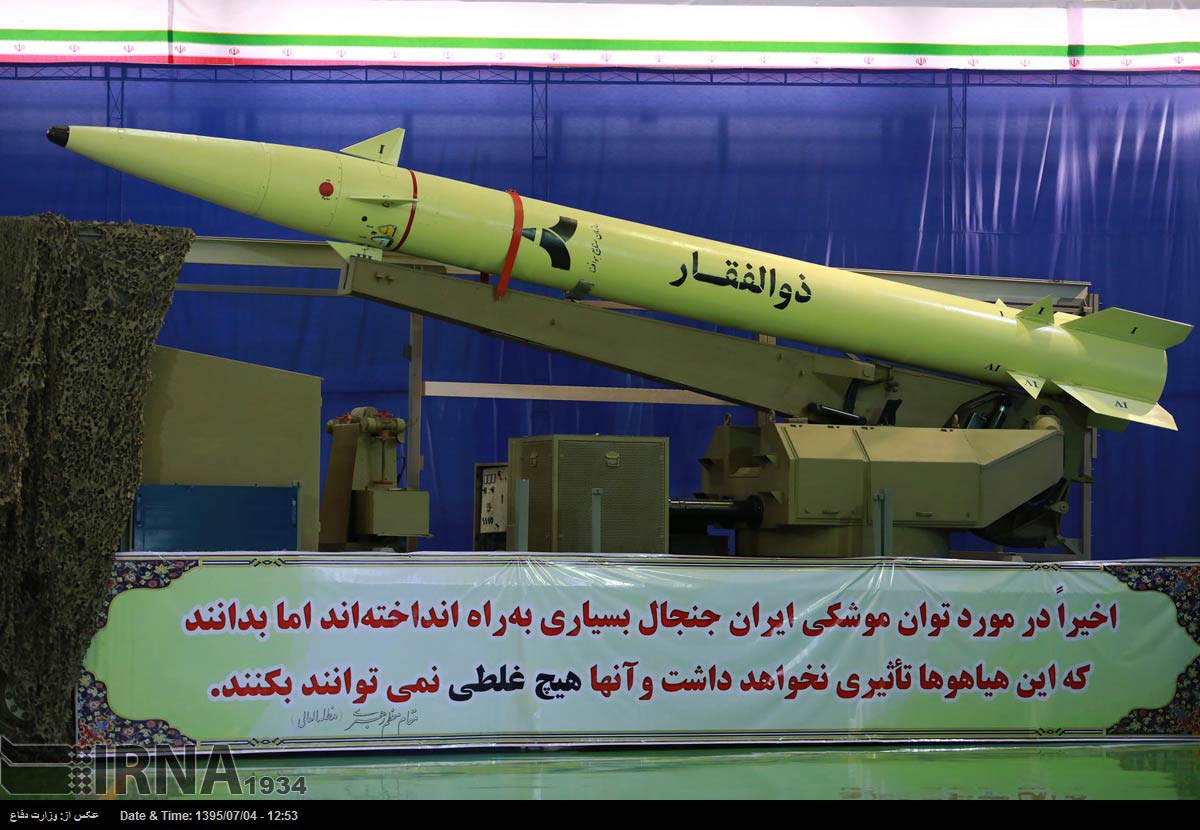
    Zolfaqar-missiles

    Iran has given ballistic missiles to Shi’ite proxies in Iraq, and is developing the capacity to build more there. Iran sees this as a deterrent against attacks on its interests in the Middle East, and to give it the means to hit regional foes, Iranian, Iraqi and Western sources said.

    Reuters reports any sign that Iran is preparing an aggressive missile presence in Iraq will exacerbate tensions between Tehran and Washington. Tensions are already heightened by President Trump’s decision to pull out of a 2015 nuclear deal with world powers, and to re-establish economic sanctions.

    It would also embarrass France, Germany and the United Kingdom, the three European signatories to the nuclear deal, as they have been trying to salvage the agreement despite new U.S. sanctions against Tehran.

    According to three Iranian officials, two Iraqi intelligence sources and two Western intelligence sources, Iran has transferred short-range ballistic missiles to allies in Iraq over the last few months. Five of the officials said it was helping those groups to start making their own.

    “The logic was to have a backup plan if Iran was attacked,” one senior Iranian official told Reuters. “The number of missiles is not high, just a couple of dozen, but it can be increased if necessary.”

    The Iraqi government and military both declined to comment, of course.

    The Zelzal, Fateh-110 and Zolfaqar (pictured) missiles have ranges of about 200 km to 700 km, putting Saudi Arabia’s capital Riyadh or the Israeli city of Tel Aviv within striking distance if the weapons were deployed in southern or western Iraq.

    How many here think Israel is going to ignore this escalation, and hope for the best?

    Yeah, me neither.

  • Khamenei says war unlikely but urges boosting Iran’s defenses

    khamenei

    Iranian Supreme Leader Ayatollah Ali Khamenei said on Sunday war was unlikely, but called on Iran’s armed forces to boost their defense capacities, as the country faces increased tension with the United States.

    Saturday, Iran announced plans to boost its ballistic and cruise missile capacity, and acquire modern fighter planes and submarines following both the U.S. pullout from Tehran’s nuclear agreement with, and the resumption of economic sanctions.

    Reuters Link

    “Ayatollah Khamenei emphasized that based on political calculations there is no likelihood of a military war but added that the armed forces must be vigilant … and raise their personnel and equipment capacities,” the website quoted Khamenei as telling commanders of Iran’s air defense forces.

    “The Supreme Leader said …the air defense units were a very sensitive part of the armed forces and on the front line of confronting the enemy, and emphasized the need to increase their readiness and capabilities,” the website said in its report on the gathering, which was held to mark Iran’s Air Defence Day.

    Saturday’s news of the military development plans came a day after Iran refused a French call to return to negotiations on Tehran’s nuclear plans, its cruise and ballistic missile arsenal, and its role in wars in Syria and Yemen.

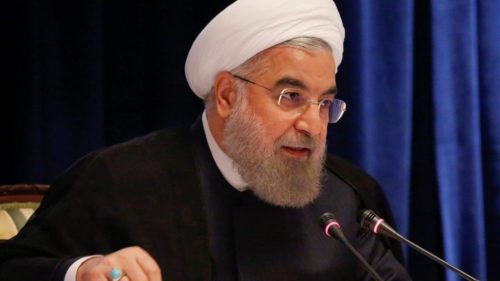
    Iranian President Hassan Rouhani said last month the Islamic Republic’s military prowess was what deterred Washington from attacking it.

    Separately, a senior Iranian diplomat met visiting UK Foreign Minister Alistair Burt, and urged swift European action on economic measures to offset the U.S. pullout from the accord, and the reimpositions of sanctions by Washington.

    “The imposition of (U.S.) sanctions and pressures and the lack of rapid action by Europe to fulfill their commitments will have serious consequences,” Kamal Kharrazi, a former foreign minister who heads a top foreign policy council, told Burt.

    Iranian officials have said they would decide whether to quit the 2015 nuclear deal with world powers after studying the European package of economic measures that could help offset U.S. sanctions.

    “European countries have not been able yet to take necessary measures to secure Iran’s interests under the nuclear agreement,” Kharrazi said.

    Of course the Europeans are stalling. They know as soon as the sanctions are re-enacted in November, anyone conducting trade with Iran will be barred from U.S. banks and markets. The sanctions already in place prohibit Iran’s purchase of U.S. currency, trade in gold and precious metals, ability to purchase auto parts, commercial aircraft and related services.

    Novembers sanction’s will prevent sale of Iranian oil and petroleum products on the world market, transactions with Iranian banks, and operations of Iranian ports and shipping companies.

    Trump is looking for a regime change from within. For the sake of the Iranians and the security of the Middle East, I hope it works.

  • Iran says it has control of Gulf, Strait of Hormuz

    SoH

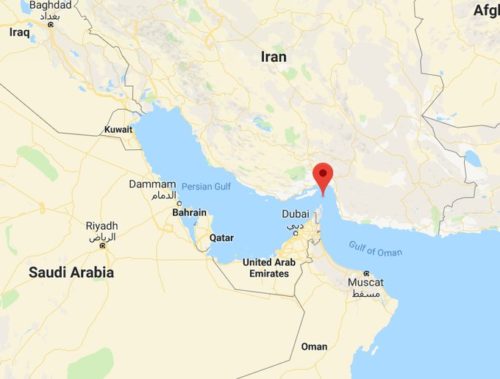
    The Mad Mullahs and their lackeys in the Revolutionary Guard’s Navy are rattling their sabers again, followong a large scale naval exercise in the Straights of Hormuz (SoH). The strategic waterway provides the only access to the Indian Ocean, and nearly 1/3 of the world’s sea-borne oil passes through.

    Fox News reports the head of the navy of Iran’s Revolutionary Guards, General Alireza Tangsiri, said on Monday that Iran had full control of the Gulf and the U.S. Navy did not belong there, according to the Tasnim news agency.

    “It’s a very contentious area,” retired Lt. Col. Bob Maginnis told Fox News’ “Your World with Neil Cavuto” earlier this month.

    “The blockage of the Strait of Hormuz, even temporarily, could lead to substantial increases in total energy costs,” the agency said in a 2012 report.

    At the beginning of August, Iran began a large-scale exercise in the Strait of Hormuz involving more than 50 small boats, practicing “swarming” operations that could potentially shut down the vital waterway if ever deployed for real. The drill came after President Trump pulled the U.S. out of a landmark nuclear accord with Iran and leaders of both countries exchanged fiery rhetoric.

    “They’re causing problems once again, as predicted, in the Strait of Hormuz,” Maginnis said. “This is something we’ve grown accustomed too.”

    But if Iran were to follow through with any bluster to close down the vital shipping channel, a potential U.S. response would be swift.

    Gen. Joseph Votel, head of U.S. Central Command, said earlier this month that Iran was showcasing its military capabilities and has the ability to plant mines and explosive boats in the waterway, as well as use missiles and radar along the coast. He stressed the U.S. and allies routinely train for that possibility and are prepared to insure that freedom of navigation and commerce continues in those waters.

    President Obama’s former National Security Adviser Jim Jones, a four-star general, said in an interview earlier this month the Iranian Navy should be “wiped out” if any action is taken to block maritime traffic.

    “I personally would like to see, if they ever did something in the Strait of Hormuz, I would like to see their navy disappear,” Jones told The National.

    Color me impressed- an Obama advisor with some stones. As for the Iranian regime, this bluster is a result of Trump’s disengaging from the ludicrous nuclear deal. and slapping the sanctions back on. They need a refresher in Operation Praying Mantis.

    Operation Praying Mantis