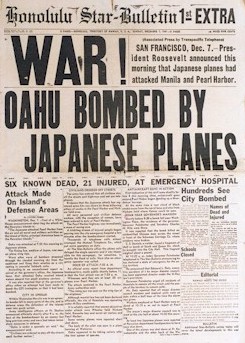
67 years ago today, on another Sunday morning, our forces were attacked at Pearl Harbor, HI. The first Army unit to engage the enemy on that day were units of the 24th Infantry Division stationed there;
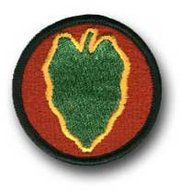
Despite the fact that the units were unprepared for the massive air attack, members of the “Victory Division” were still able to shoot down 5 Japanese planes on that fateful day. That moment marked our opening return fire that culminated in the atomic bomb dropped on Hiroshima nearly four years later.
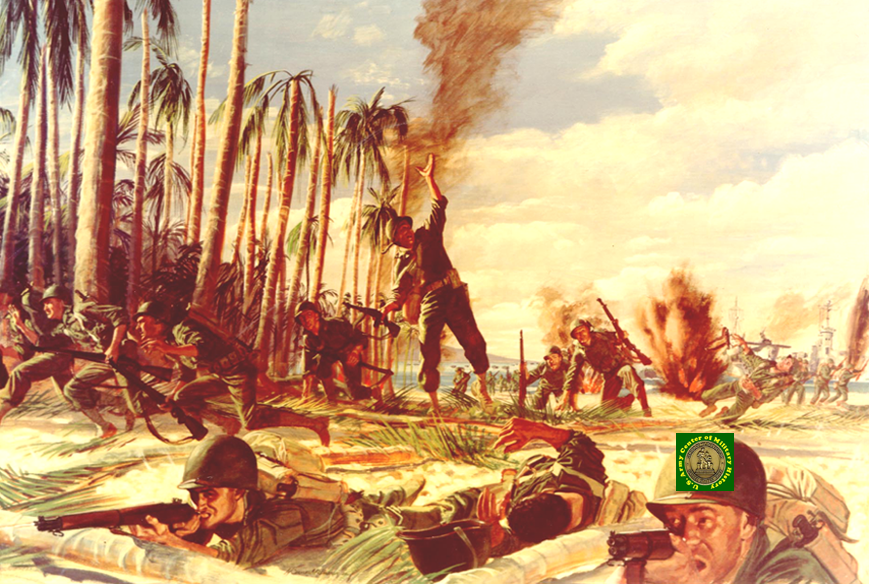
The 24th Division was one of the few Army units to fight across the Pacific – their campaigns included Dutch New Guinea, Leyte and Luzon. On Leyte, one commander, Colonel Aubry S. Newman, gave the Infantry branch their famous “Follow Me” motto when he stood up under withering fire on the naked beach and shouted to his men “get the hell off the beach. Get up and get moving. Follow Me.”The moment was captured in this official Army painting;
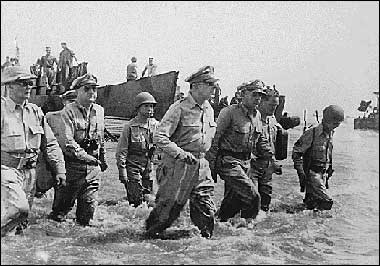
The famous picture of General Douglas MacAurther’s “I have returned” moment showed him wading ashore in Colonel Newman’s sector of Leyte beach.
The 24th Division had three Medal of Honor awardees across the Pacific;
Private HAROLD H. MOON, JR.
Albuquerque, New Mexico
G. Company, 34th Infantry Regiment
21 October 1944, near LeyteIn a forward position, armed with a sub machine gun, Private Moon met the brunt of a strong, well-supported night attack on his platoons flanks. Although wounded, he maintained his stand pouring deadly fire into the enemy, daringly exposing himself to hostile fire. Private Moon killed a Japanese Officer who was attempting to knock out his position with grenades. When the enemy advanced a machine gun within 20 yards of the shattered perimeter, Moon stood up exposing himself to locate the gun. He remained exposed correcting mortar fire which knocked out the enemy weapon. Later he killed two Japanese soldiers as they charged an aid man. His position became the focal point of the attack for over four hours and was virtually surrounded. An entire Japanese platoon attacked the position with fixed bayonets. From a sitting position, Private Moon emptied his magazine on the advancing enemy, killing 18 and repulsing the attack. In a final display of bravery, he stood up to throw a grenade at a machine gun when he was hit and instantly killed. In the aftermath, nearly 200 dead Japanese were found within 100 yards from his foxhole. His heroism broke up a powerful threat and contributed to our initial successes in the battle for Leyte.
Sergeant CHARLES E. MOWER
Chippewa Falls, Wisconsin
A Company, 34th Infantry Regiment
3 November 1944, near Capoocan, LeyteSergeant Mower, an assistant squad leader, was participating in an attack against a strongly defended Japanese position which was situated along both sides of a stream that ran through a wooded gulch. As the squad moved forward through intense enemy fire, the squad leader was killed and Sergeant Mower took charge. He led his men across the stream, but was severely wounded before making it all the way. After halting his unit, he realized that his exposed position was the best place from which to direct the attack and he stood fast. Gravely wounded and lying half submerged in the stream, he refused to seek cover or to accept aid of any kind. Shouting and signaling instructions to his squad, he directed them in the destruction of two enemy machineguns and the killing of of numerous enemy rifleman. The remaining Japanese concentrated their fire at Sergeant Mower, who was killed while still directing his men forward.
Private First Class JAMES H. DIAMOND
New Orleans, Louisiana
D Company, 21st Infantry Regiment
8-14 May 1945, Mintal, MindanaoJust two weeks before the surrender by Japan, a Japanese sniper arose from his foxhole to throw a grenade at Pfc. Diamonds section. Pfc. Diamond charged the enemy soldier, killing him with a burst from his submachine gun. While delivering sustained fire upon the enemy with his submachine gun, he directed artillery and heavy machinegun fire on a group of enemy pillboxes that were pinning down his and other sections. This allowed two U.S. machinegun sections to set up and bring their weapons to bear on the enemy. He later volunteered to assist in evacuating wounded soldiers from a bridgehead, transporting them to safety through a hail of enemy mortar and artillery fire. Days later, while leading a patrol through enemy fire to evacuate wounded, he was mortally wounded as he secured an abandoned machinegun. Though near death, he was able to draw the enemys fire, allowing the remaining patrol members to reach safety.
After the war, the 24th was assigned to occupation duty in Japan which set them up for their inclusion in the Task Force Smith mission to fire our opening shots in the Korean War.
Michelle Malkin has pictures of the attack on Pearl Harbor, The Jawa Report has video.