Category: Historical

  • British heroine dies alone

    Eileen Nearne was headed for a pauper’s grave when she died alone at the age of 89 taking the secrets of her young life with her, until her medals and citations were discovered in her apartment, reports the Associated Press;

    Historian M.R.D. Foot, who had access to Nearne’s secret account of her activities, said Nearne had entered France in 1944 and was the only British agent with an operating wireless transmitter in the Paris area during the crucial period from March 1944 until she was caught by the Germans in July 1944.

    “She was there during D-Day,” he said. “What she did was extremely important. She was arranging for weapons and explosive drops, and those were used to help cut the Germans’ rail lines.”

    He said Nearne displayed rare bravery and discretion when she refused to talk about clandestine operations even when Gestapo agents stripped her and forced her into a tub filled with frigid water, holding her head under until she nearly drowned. They then interrogated her with the threat that she would be submerged again if she didn’t provide information — but she didn’t crack.

    “Thank goodness I was spared that,” said Foot, who was also a clandestine operator inside France in 1944. “She maintained she was just a little French shop girl who went into the Resistance for fun.”

    Nearne managed to escape from a forest camp set up near the main Ravensbruck concentration camp, he said.

    You should really read the whole article…especially any phonies or their supporters who happen to be reading. This is how courage is done.

    Thanks to Tman for the link.
  • 20 years ago today

    COB6 wrote to remind me that Hussein’s Iraq invaded Kuwait twenty years ago today beginning the wars we in which we are still engaged.

    COB6 says he was going to the wash rack that day on Garlstedt’s Clay Kaserne when he found his troops engaged in a water fight. This caused him some thoughts on taking these guys to a war.

    I was driving up the east coast on I95 from another seven weeks of playing TAC NCO at Cadet Command’s Region One Advanced Camp on Fort Bragg thinking I was stabilized for two more years at the University of Vermont. Within a month I was packing my bags to take over a platoon in Co. C 1/41st with COB6 in a sister platoon and less than a month later we were alerted for (then) Desert Shield.

  • Patrolling the East German Border

    9 Watch Tower

    I found some of my old pictures from patrolling the East German border back in the mid-80s when I had to dig out an old citation to help a politician verify his own medal from the Gulf War. Luckily for him, we both had been in the same division and had been awarded the same medal back then.

    Anyway, when I did a photo essay last year and told one of my stories, it got some measure of interest, so I thought I’d do it again;
    (more…)

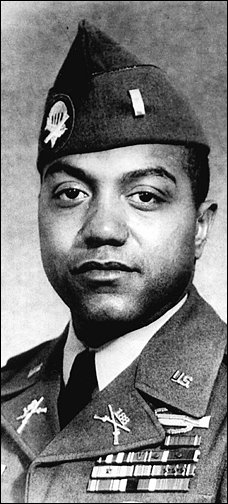
  • RIP Vernon J. Baker

    The Washington Post reports that the sole liveing African American MOH recipient of WWII has left us.

    First Lt. Vernon J. Baker, 90, an Army infantryman who, more than 50 years after the end of World War II, became the only surviving African American to receive the Medal of Honor for his heroic actions during the war, died July 13 at his home near St. Maries, Idaho.

    The article goes on to describe Lt. baker’s actions agaionst the Germans in Italy.  It reads like something out of a movie:

    Two hours after starting their mission on April 5, Lt. Baker and his men came within 300 yards of the castle. While attempting to find a suitable place for a machine gun, Lt. Baker observed two rifle barrels hanging out of a concealed slit in some rocky earth.

    After stealthily crawling to the opening, he popped up and emptied the clip of his M-1 rifle into the observation post, killing two sentries.

    While searching for more camouflaged emplacements, Lt. Baker spotted a machine-gun nest occupied by two soldiers distracted by their breakfast. He shot and killed them both.

    A German soldier then hurled a grenade that landed at Lt. Baker’s feet. Undeterred, he fired two fatal rounds at the fleeing German, while the grenade by Lt. Baker’s boots failed to explode.

    He found the door to another bunker and blasted it open with a grenade. A wounded German soldier stumbled out in confusion, and Lt. Baker shot him. After tossing in a second grenade, he raided the bunker with a submachine gun blazing, killing two more Germans.

    Apparently, Baker spent 23 years in the Army and retired in 1968.  My favorite part of the article was the end:

    He spent much of his later life hunting big game in Idaho. During one expedition, he discovered a mountain lion lurking behind him. After receiving his Medal of Honor, Lt. Baker was asked by Clinton what happened to the cougar.

    “Why, it’s in my freezer,” Lt. Baker said. “I’m going to eat him.”

    BZ Lt.  Rest In Peace

  • Stalin at D-Day

    Curiously, the National D-Day Museum in Bedford, VA has added a bust of Joseph Stalin this last week to pay tribute to Stalin’s contribution to winning the war against Nazi Germany according to John Fund in the Wall Street Journal;

    The memorial’s board chose the 66th anniversary of the Normandy invasion to add a bust of Soviet dictator Joseph Stalin to accompany the busts already in place of FDR, Harry Truman and Winston Churchill.

    William McIntosh, president of the D-Day Memorial Foundation, hasn’t been returning calls from reporters, but previously said his group merely wanted to note Stalin’s role in winning the war.

    Yeah, how about highlighting Stalin’s role in starting the war. The world recognizes September 2, 1939 as the date the global war began. The Molotov-Ribbentopp Pact was signed in Moscow on August 23, 1939 enabling Hitler to invade Poland on Sept. 2 without a thought as to the disposition of Soviet armies. Of course, June 22, 1942, Hitler broke the pact and marched across Soviet territory unopposed for weeks causing over 4 million casualties for the Soviets and 3 million prisoners.

    Yeah, Stalin’s’ contributions to the war against Nazis was immeasurable and certainly worthy of a bust at the museum in Virginia since without his contributions, there might have been no war.

  • At Point du Hoc, June 6th

    a0139_small.gif

    Rangers Mission for D-Day, 6 June 1944

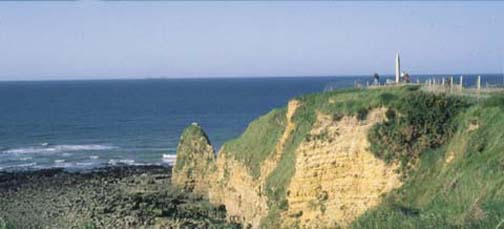
    The Ranger Group, attached to the 116th Infantry and commanded by Lt. Col. James E. Rudder, was given the mission to capture Pointe du Hoc and destroy the guns. The Ranger Group was made up of two battalions: the 2d Rangers, under direct command of Col. Rudder, and the 5th Rangers, under Lt. Col. Max F. Schneider. Three companies (D, E, and F) of the 2d Battalion (Task Force A) were to land from the sea at H-Hour and assault the cliff position at Pointe du Hoc. The main Ranger force (5th Battalion and Companies A and B of the 2d, comprising Task Force B) would wait off shore for a signal of success, then land at the Point. The Ranger Group would then move inland, cut the coastal highway connecting Grandcamp and Vierville, and await the arrival of the 116th Infantry from Vierville before pushing west toward Grandcamp and Maisy.

    dday_pointeduhoc_375.jpg

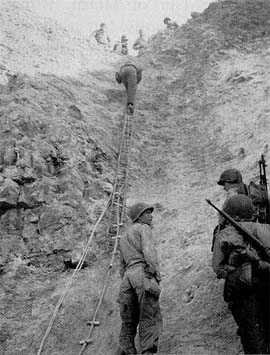
    One DUKW was hit and sunk by 20-mm fire from a cliff position near the Point. The nine surviving LCAs came in and managed to land in parallel on a 400-yard front on the east side of Point du Hoc, landing about 0705. Allied naval fire had been lifted since H-Hour, giving the Germans above the cliff time to recover. Scattered small-arms fire and automatic fire from a flanking machine-gun position hammered the LCAs, causing about fifteen casualties as the Rangers debarked on the heavily cratered strip of beach. The grapnel rockets were fired immediately on touchdown. Some of the water-soaked ropes failed to carry over the cliff, but only one craft failed to get at least one grapnel to the edge. In one or two cases, the demountable extension ladders were used. The DUKWs came in but could not get across the cratered beach, and from the water’s edge their extension ladders would not reach the top of the cliff.

    Despite all difficulties, the Rangers used the ropes and ladders to scramble up the cliff. The German defenders were shocked by the bombardment and improbable assault, but quickly responded by cutting as many ropes as they could. They rushed to the cliff edge and poured direct rifle and machine gun fire on the Rangers, augmented by grenades tossed down the slope. The Rangers never broke, continuing to climb amidst the fire as Ranger BAR men picked off any exposed Germans. The destroyer USS Satterlee (DD-626) observed the Rangers’ precarious position, closed to 1500 yards and took the cliff top under direct fire from all guns, a considerable assist at a crucial time.

    Within ten minutes of the landing the first Americans reached the top of the cliffs.

    rangers_pointe_du_hoc_700_01.jpg

    Four decades later Ronald Reagan described the battle and honored those who fought;

  • FBI: Shots fired at NG in Kent State 1970 incident

    5414
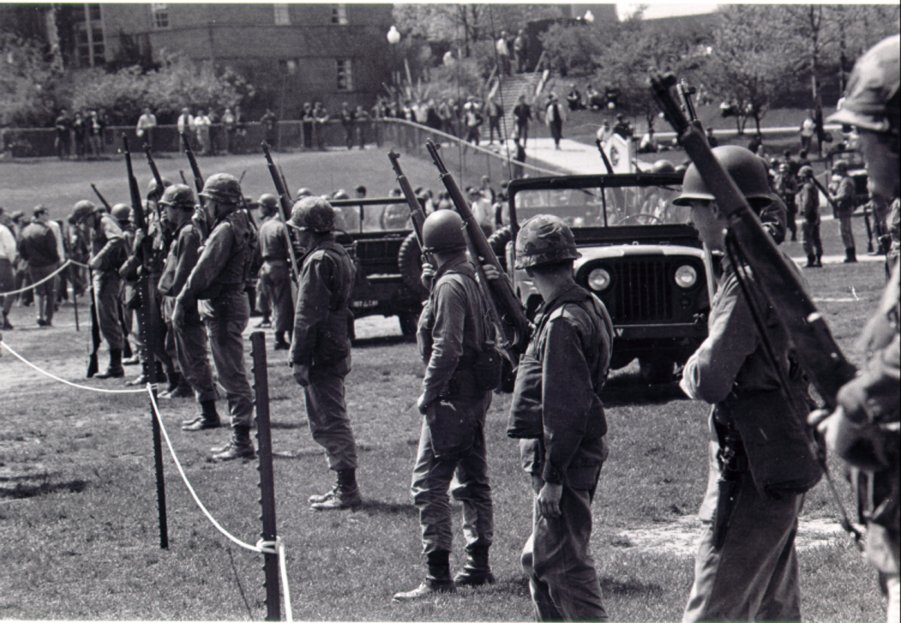
    The Washington Times reports that newly released documents in the May 1970 Kent State shooting of several students by National Guard troops state the the troops may have been provoked by a sniper;

    “We did it,” one man exulted, according to the inquiry. “We got the riot started.”

    The second man expressed disappointment at being excluded from the riot’s planning. “Wait until tomorrow night,” the leader replied excitedly. “We just got the word. We’re going to burn the ROTC building.”

    This was 20 hours before the ROTC headquarters on the Kent State campus, an old wooden frame building, was, in fact, burned to the ground.

    Despite the classic media account that the National Guard fired for no real reason, the FBI had evidence to the contrary;

    Yet the declassified FBI files show the FBI already had developed credible evidence suggesting that there was indeed a sniper and that one or more shots may have been fired at the guardsmen first.

    Rumors of a sniper had circulated for at least a day before the fatal confrontation, the documents show. And a memorandum sent to FBI Director J. Edgar Hoover on May 19, 1970, referred to bullet holes found in a tree and a statue — evidence, the report stated, that “indicated that at least two shots had been fired at the National Guard.”

    It’s too bad that the FBI didn’t pursue the investigation and nab the shooters or at least narrow it down to a particular group (I have my suspicions).

    At a minimum, the FBI documents strongly challenge the received narrative that the rioting in downtown Kent was spontaneous and unplanned, that the burning of the ROTC headquarters was similarly impulsive and that the guardsmen’s fatal shootings were explicable only as unprovoked acts.

    Of course, the shootings had the opposite result that any conspirators had imagined since Kent State was the beginning of the end of the anti-war protests. it seems that gunfire had a quenching effect on the gutless hippies who were really only protesting for their own own comfort rather than any grandiose ideal.

  • Maggie’s ironic post

    My buddy Boston Maggie reprints Patrick Henry’s speech in the Virginia House of Burgesses at Williamsburg on this day in 1775. It’s Ironic because of today’s events 235 years later.