Category: Foreign Policy

  • Kirchner’s slight-of-hand

    14argentina190.jpg

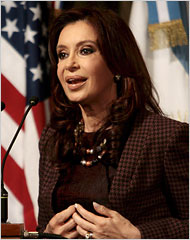
    New Argentinian president Christina Kirchner tries her hand at distracting Argentinians and the world from her domestic problems by raising the specter of another war in the Fauklands (AFP link);

    Argentina’s claim to the Falkland Islands, which remain in British hands after the 1982 war between the two countries, is “inalienable,” President Cristina Kirchner said Wednesday.

    “The sovereign claim to the Malvinas Islands is inalienable,” she said in a speech marking the 26th anniversary of Argentina’s ill-fated invasion of the islands, located 480 kilometers (300 miles) off shore.

    The April 2, 1982 invasion prompted then British prime minister Margaret Thatcher to deploy naval forces to retake the Falklands, known as the Malvinas in Spanish.

    The short, bloody conflict led to Argentina’s surrender on June 14, 1982 after the death of 649 Argentines and 255 Britons.

    Kirchner’s problems actually began before her election when it was discovered that she was using hundreds of thousands of dollars from Venezuela’s socialist president Hugo Chavez in her campaign. A courier from Chavez was stopped at the airport in Buenas Aires with a suitcase stuffed with $800, 000 in what is now known throughout the region as “maleta-gate“.

    Yesterday, her latest challenge conditionally ended when farmers ended their three-week strike (Miami Herald);

    Thousands of farmers on Wednesday lifted a three-week strike that produced food shortages at markets throughout this 40 million-person country and represented the biggest challenge so far to President Cristina Fernández de Kirchner.

    The farmers didn’t achieve their main goal, killing an increase in export taxes on soybeans and sunflowers, but they said they would wait, for at most 30 days, for negotiations with the government to move forward. Speaking at a rally in the central Argentine city of Gualeguaychú, a spokesman for the country’s four main farm associations said farmers would go back to blocking roads and withholding their production if negotiations failed.

    Such measures have stopped tons of meat, fruit and other food from reaching markets, especially in Buenos Aires. Farmers began lifting roadblocks throughout the country Wednesday morning.

    Farmers have criticized what they said are crippling price freezes, export bans and tax hikes that the government implemented. The moves have targeted the country’s powerful farm sector, which produces about 60 percent of Argentina’s exports.

    Mary Anatasia O’Grady of the Wall Street Journal wrote that the farmers rose up against Kirchner’s “facism”;

    Argentina has been growing fast — better than 8% a year — since 2003. But this has largely been the result of the combination of a natural bounce after a collapse and a global boom in commodities. Meanwhile, simmering just beneath the surface of the recovery remains the fundamental contradiction that provoked the 2001 economic crisis. To wit, while a strong peso made Argentines prosperous in the 1990s, it was incompatible with the rigid, closed economy. The situation is the same today: Either the economy is opened, labor markets are made flexible and the business climate improves or the government clings to a weak peso policy as a way to compensate for an uncompetitive economic model and inflation comes back. Take your pick.

    By choosing the latter, the Kirchners have won the support of that segment of the Argentine economy loyal to the principles of 20th-century fascist Juan Peron. These include labor militants, government bureaucrats, the Peronist political machine and the likes of Mr. D’elía, whose thugs act as Mrs. Kirchner’s informal enforcers. But by generating inflation and provoking shortages Kirchneromics is also fueling widespread discontent.

    So taking a page from Hugo Chavez’ book, who has alternately told Venezuelans that he was targeted by the United States and Colombia for assasination, Kirchner decided to fan the flames of patriotism by flexing her military muscles, just as the military junta did twenty-six years ago. But, I’d remind Ms. Kirchner that the war against Britain ended up costing the junta their jobs eventually.

    Another Chavez acolyte, Daniel Ortega, is trying the same tactic in poverty-stricken Nicaragua by making noise about some islands in the Caribbean with Colombia (Reuters link);

    The two nations, separated by Panama and Costa Rica, lay claim to the isolated Caribbean Islands San Andres and Providencia off Nicaragua’s Atlantic Coast, as well as several keys and some 50,000 sq km of fishing waters.

    Colombia told the court in June border disputes were inevitable after the fall of the Spanish Empire in the Americas and the one in question was “definitively settled” in 1928, when Nicaragua and Colombia signed a treaty granting Colombia sovereignty over the islands.

    But Nicaragua’s Sandinista government in the 1980s annulled the accord and argued it was signed while Nicaragua was under U.S. military occupation.

    Many Nicaraguans consider the treaty a U.S. payoff to Colombia for arranging the independence of Panama from Colombia in order to build the Panama Canal.

    If the US unilaterally abrogated a treaty, you’d hear the screaming from one corner of the globe to the other, but communists and socialist are stroked by the world’s Left and the media as a whole.
  • Iranians mining uranium in Venezuela?

    veniran27.jpg

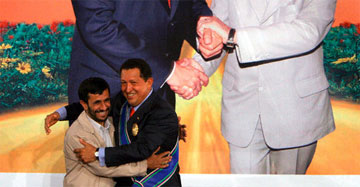
    This morning, I read in Weasel Zippers about the Chinese ratting out the Islamic Republic to the International Atomic Energy Agency (link to AP article)

    Diplomats say that China has given the U.N. nuclear watchdog intelligence linked to Tehran’s alleged attempts to make nuclear arms.

    The development is surprising because Beijing, along with Russia, has opposed U.S.-led attempts to impose harsh penalties on Tehran over its nuclear defiance of the U.N. Security Council.

    I thought it was pretty strange given the fact that it’s pretty likely the Chinese gave Iran the technology (at least indirectly) for the nuclear program in the first place. But then I read over on The Jungle Hut that there’s some evidence that Iran is mining uranium in Venezuela. Jungle Mom links to this World Check article;

    * An interesting postscript; Nasar’s whereabouts were known to the United States, but no attempts were ever made to capture or neutralise the man who was most likely the most dangerous terrorist to ever set foot in the Western Hemisphere. Claims have been made that he was subsequently captured by local authorities in Pakistan, and subsequently turned over to American agents, but no public confirmation has ever been issued. Exactly where is the man understood to be one of Al-Qaida’s leading theoreticians?

    * Did Al-Qaida take possession of some of the Venezuelan Uranium? most of it is presently being refined in Iranian laboratories, but was some diverted by Nasar?

    * For those who still doubt that Venezuela is now, with the able assistance of Iranian engineers on-site, processing Uranium for eventual use in weapons of mass destruction, please note that a number of Venezuelan publications have detailed the locations of the mines, and a senior Venezuelan governmental officials has, coincidentally, advised that any unauthorised aircraft overflights in the region where the mines are situated, are strictly prohibited, and that such aircraft will be subject to deadly force, and shot down.

    Gateway Pundit wrote about it last September and linked to another article a year older at VCrisis which raised the specter of Venezuela’s plans to help Iran with their program;

    Camilo Ospina, on the day he was sworn in as Colombia’s new ambassador to the Organization of American States, stated in a speech…stated further that “if you were to go straight in the direction of Arauca, arrive at the border and penetrate about 400 kilometers beyond, you will find two factories, one is a bicycle factory and the other a motorcycle factory. These two factories are a façade for a uranium excavation.”

    And he concluded: “Venezuela has no means of enriching uranium, but Iran does. If that came about, we would have a real problem.”

    This article in Spanish from Noticias24 mentions the important fact that Raul Reyes’ laptop mentioned 50 kilos of uranium, but Colombian police only found 30 kilos the other day. UK’s Spectator asks similar questions;

    …Hugo Chavez, president of Venezuela, is known to be in cahoots with Iran and has given free passage to people associated with al Qaeda, Hamas or Hezbollah. Which makes him a pretty dangerous kind of guy. But a few days ago Reuters reported something which raises the stakes and should ring the loudest possible alarm bells: that the authorities in Columbia have seized at least 30 kg of uranium from the FARC terrorists — who have received financial support from Chavez.

    Since the FARC revolutionaries don’t themselves appear to want to make a nuclear bomb to incinerate Bogota, it is most likely that the uranium stash was destined to be sold to a bidder who did want to make such a bomb. So to where was it destined — and where might other uranium from the same source have ended up?

    It may just be that Iran’s program is advancing faster than China expected due to this new source of uranium.

  • Hey! Neo-New Left! Socialism fails everytime!

    capt61267a6da8514b71b465644f5baee1d7cuba_consumer_goods_hav110.jpg

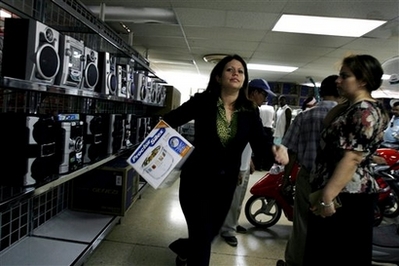
    A woman leaves after buying a pressure cooker in a store in Havana, Tuesday, April 1, 2008.

    Here’s some new life lessons provided by real world examples.

    The socialist paradise of Cuba has succumbed to consumerism. After decades of having the evils of capitalism shoved down their throats during every waking moment, the Cubans have chosen the decadent life. Nevermind that a pressure cooker probably costs several months wages and is still out of the reach of the average, practical Cuban. (Yahoo/AP link)

    Shoppers snapped up DVD players, motorbikes and pressure cookers Tuesday as a slew of consumer products went on sale to all Cuban citizens for the first time. Possibly more significant, Cuba announced it will lend unproductive state land to private farmers to boost agricultural production.

    Combined with other reforms announced in recent days, the measures suggested that substantial changes are being driven by new President Raul Castro, who vowed when he took over from his brother Fidel to remove some of the more irksome limitations on the daily lives of Cubans.

    Monica at Babalu Blog is a bit skeptical about the neo-Castro regime’s intentions;

    [W]e all know that Cubans’ low wages render them unable to purchase a cell phone, computer or hotel stay without foreign assistance. Therefore, any time a documented purchase of these items occurs, the government has a better grasp of who’s getting money from exiled relatives. Also, the Cuban desire for these items will prompt a cash infusion from said exiled relatives as Val just wrote about.

    To me, the story isn’t about what the Castros have allowed Cubans to do – because it’s all window dressing. The real story is what Cubans have chosen.

    Just like in Zimbabwe where Zimbabweans have chosen to dump their big socialist land reformer Robert Mugabe. Something about 100,000% inflation turns the voters against a politician for some reason. (AP/Yahoo link)

    Morgan Tsvangirai told his first news conference since Saturday’s elections that he was waiting for an official announcement of election results before he would enter any discussions.

    “Our country is on a precipice, on a cliff edge,” he said.

    A businessman close to the Zimbabwe Electoral Commission, or ZEC, and a lawyer close to the opposition said earlier that aides of Mugabe and Tsvangirai were discussing how Mugabe could relinquish power.

    The rivals’ advisers were discussing a “transitional arrangement,” the lawyer said. Both sources spoke on condition of anonymity because of the sensitivity of the issue.

    I know, I know, the only reason that Cuba’s communist economy has failed is because one nation out of all of the other nations in the world won’t trade with them. That’s what you have to believe to be a socialist these days. And Mugabe failed because the EU shunned him after decades of his abuse of Zimbabweans and destroying an agricultural system that at one time fed most of Africa.

    So while the rest of the world moves towards more capitalism, while even third world people who’ve never tasted freedom get the whole concept, we’re discussing more government regulation here in the United States.

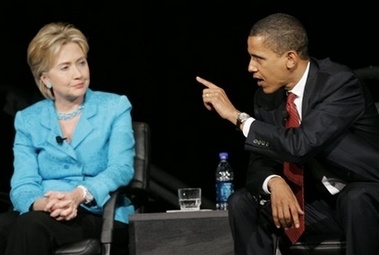
    clinton_obama_tension.jpg

  • Specters from the Carter dark days

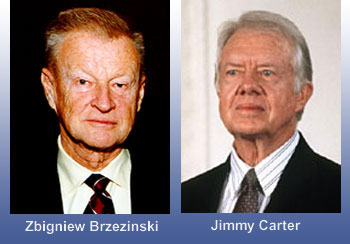
    zbigniewbrzezinskijimmycar.jpg

    We all remember all of the amazingly successful foreign policies that came out of the Carter Administration, don’t we? Um, don’t we? Well, we’re treated to a stream of opinions from these unmitigated failures – the latest being Zbigniew Brzezinski in the Washington Post yesterday morning entitled “The Smart Way Out of a Foolish War“.

    Claiming that the best way to end the conflict in Iraq is to withdraw all of the US forces, “Biggy”, as he was known in those heady years of the Carter fiasco, makes predictions without the knowledge of yesterday’s events;

    Contrary to Republican claims that our departure will mean calamity, a sensibly conducted disengagement will actually make Iraq more stable over the long term. The impasse in Shiite-Sunni relations is in large part the sour byproduct of the destructive U.S. occupation, which breeds Iraqi dependency even as it shatters Iraqi society. In this context, so highly reminiscent of the British colonial era, the longer we stay in Iraq, the less incentive various contending groups will have to compromise and the more reason simply to sit back. A serious dialogue with the Iraqi leaders about the forthcoming U.S. disengagement would shake them out of their stupor.

    You can tell he’s just been holding on to that piece waiting for a flare up like what happened in Basra last week to rush it to an editor at the Post.

    But the flare up in Basra proves just the opposite – the vacuum created by the British withdrawal in the city was the impetus of the fighting last week. Brzezinski completely ignores that.

    And the proof that the US forces are holding Iraq together is what happened yesterday while the Post’s readers were just opening their copy – after US air power was applied to the situation, Mookey al-Sadr scrambled to save the remnants of his fighters. Save them for what? Well, for when the US pulls out and he can use them to seize the reins of government. Or to wait and see if there’ll be a Democrat President so Mookie can run the Americans out of Iraq and be the Great Savior of the New Islamic Republic Part II.

    See, Carter and Brzezinski brought us to this point in our history. Their indifference to early events in Iran brought about the Islamic Revolution and installed the mullahs. Their weak responses (like boycotting the Olympics when the Soviets invaded Afghanistan), encouraged the mullah, in fact, encouraged terrorists worldwide. Protecting the Shah openly enraged the mullahs.

    Pronouncing as the Carter Doctrine (the free flow of Persian Gulf oil at market prices) without having any intention of enforcing it made us a paper tiger. Allowing our military to deteriorate to the point that a few broken helicopters caused an operation to be canceled and cost the lives of eight military members deep inside Iran – giving us an even greater appearance of a paper tiger.

    I don’t know which is more disgusting; Brzezinski thinking he has something valuable to lend to the discussion, or the Washington Post for allowing into print this gomer’s opinion.

  • What I’m reading today

    20070404_highres_color.jpg

    Stolen from The Jungle Hut

    I must be getting old – I’m only reading other people’s brilliant thoughts today from the blogs that link here.

    People like Van at Kesher Talk who is convinced that McCain will tap Lieberman for VP.

    People like my friend Kamangir the Archer – the most visible moderate Iranian I know – who rationally opposes Wilder’s Fitna. As opposed to the irrational Dutch moonbats who apologize for Fitna as reported by Gateway Pundit and Weasel Zippers. If you’re like the two or three people on the planet who haven’t see it yet, Moonbattery and Say Anything have it up on their servers. The Jawa Report writes that the Islamic Republic has summoned the Dutch ambassador – I wonder what they want now?

    Folks like my buddy Skye from Midnight Blue who climbed back up on the horse yesterday after being attacked last weekend by an irrational moonbat in Chester County.

    I got an email tip from the Milblogs this morning about the upcoming Bad Voodoo’s War from PBS and Andi’s got the teaser video.

    If you’re wondering what I think about the recent uptick in violence in Iraq, it’s best described at Neptunus Lex. The Iranians are trying to upend our elections with total disregard for Iraqi lives. al Sadr finally realized it this morning. Rick Moran at the Right Wing Nut House questions Maliki’s judgement. McQ at Q&O dissects the events leading up to the Basra battle and provides links. Haystack at Redstate catches the LA Times painting al Sadr as a poor victim in the latest flare up. The Lonely Sandpiper blames the Brits. I think it’s just Maliki’s version of the Whiskey Rebellion.
    The only woman with whom I agree all of the time (except my wife and my Mom), Beth at My Vast Right Wing Conspiracy posts John McCain’s first national campaign ad.

    Marooned in Marin (who is actually marooned in Northern Virginia these days) examines the rumor that while super-delegates decide between two candidates, the Democrats are plotting to throw all of the primary voters under the bus and just pick their favorite loser of all time. So much for the democratic part of their party. Mike Tippet at Wake Up America is thankful for the democrats’ biggest loser.

    Bob Parks at Outside the Wire examines a survey that declares there’s no indoctrination at our schools.

    In case anyone is wondering, Snapped Shot is still behaving himself.

    Solomon reviews and dissects the play “My Name is Rachel Corrie” at Solomonia.

    Spanish Pundit writes that Palestinian Christians are being harrassed by a fundamentalist Islamic mafia in the Holy Land.

    Wordsmith at Sparks From the Anvil writes about an Iraqi translator who was denied resident alien status.

    The Avid Editor claims (and rightly so) that we’re already at war with Iran.

    Wolf Howling has more links to other blogs for something different.

    Chicagoan Marathon Pundit, who seems to have something against an Obama Presidency, writes about Obama’s latest embellishment.

    And just go visit The Jungle Hut and Don Surber because they both exhibited exceptionally clear judgment by adding me to their blogrolls last night.

  • El Gran Circo de Chavez

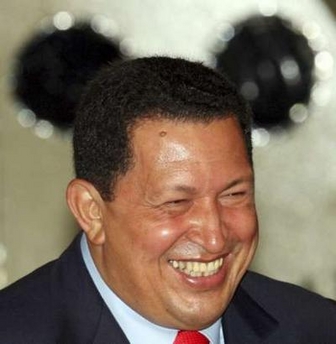
    r2237890389.jpg

    Photo from Reuters

    (It’s not my fault he looks like Mickey Mouse in this picture – blame Reuters)

    So much Chavez buffoonery today, I just couldn’t let it pass without comment. The Miami Herald writes about Chavez’ supposed fascination with the death of Simon Bolivar;

    Bolívar, a leader of the revolution that freed Colombia and its neighbors from Spanish rule, died in Santa Marta 16 days later. ”It was easy to recognize,” reported the attending physician after an autopsy, that he died from tuberculosis.

    But Venezuelan President Hugo Chávez — whose devotion to Bolívar knows no bounds — is questioning that verdict and suggesting he was poisoned by oligarchs in neighboring Colombia — his main current foe after the United States.

    Chávez has created a high-level commission, led by his vice president, to open Bolívar’s coffin and ”clear up the important doubts woven around the death of the Liberator,” according to the Official Gazette.

    Chávez has even questioned whether Bolívar’s remains actually lay at the National Pantheon in downtown Caracas, about 10 blocks from where he was born in 1783.

    ”I swear I will not rest in the search for the real truth,” Chávez said in December, promising “an investigation with all the resources Venezuela can offer.”

    Historians dispute Chavez’ fixation;

    Referring to Chávez’s suggestion of assassination by poison, [Germán Carrera-Damas, Venezuela’s most prominent historian on Bolívar’s era] said, “There’s just as much evidence to say that Bolívar died from a fall in the bathroom. This is just a decoy by Chávez. When things get difficult at home for him, he invents something to distract people.”

    […]

    David Bushnell, a retired University of Florida expert on Bolívar, tied Chávez’s comments about Bolívar’s death to the president’s verbal attacks on Colombian President Alvaro Uribe, whom he has called a ”puppet” of the Colombian oligarchy and a ”lapdog” of the United States. The two countries engaged in a weeklong diplomatic crisis that ended earlier this month.

    ”Chávez says that the enemies facing him are the same ones who faced Bolívar,” Bushnell said by telephone from Gainesville. “If they killed Bolívar, according to Chávez’s thinking, then it would follow that they’re trying to kill him.

    ”It’s nonsense,” Bushnell added. “In Latin America in the 19th century, they used gunfire, not poison. What Chávez is claiming sounds like a Renaissance Italy tactic. I can’t think of any leading figure from 19th century Latin America who was killed by poison. A lot were shot, though.”

    Bloomberg reports that Chavez has plans to begin seizing “idle” farm land. Apparently, milk producers and farmers are causing the wide spread food shortages by failing to plant and produce, according to Chavez;

    “We have to intervene in all idle land,” Chavez said today during a ceremony to commemorate the government’s nationalization of a milk plant, in comments broadcast by state television. “We have to make them produce.”

    Chavez is using rising revenue from oil exports to try to resolve politically sensitive shortages of basic foods like milk, beans and beef before state and municipal elections scheduled this year.

    But, The Devil’s Excrement writes that the Chavez family in the state of Barinas, Venezuela has already started buying up parcels of land, making them one of the largest landowner families in the area;

    [Wilmer] Azuaje all of a sudden got ambitious and sensing the weakness of the Chavez name in Barinas, decided he could be Governor. Thus, despite the express prohibition by Chavez for people to announce candidacies, Azuaje announced he was running in November. However, he also decided to go for the jugular and denounced the Chavez family for corruption, saying they have accumulated large pieces of land, most of which they keep in somebody else’s name.

    He brought the evidence to the Comptroller’s Commission of the National Assembly and the stuff is apparently quite thorough, so much that they had to admit it as evidence and open an investigation.

    Even Leftist Venezuelanalysis (generally written and maintained by US Leftists in support of Chavez and his revolution) reports on this tidbit;

    “This cannot be socialism,” Azuaje asserted, and asked that the Comptroller`s Commission travel to Barinas and speak with those involved in the contracts to verify how Izarra and Báez were able to pay for the farms. He also denounced that the roadways in and around the farms owned by Chávez family members are better kept than statewide roads.

    Chavez is still haunted by Raul Reyes’ computer hard drive, so he pretends that it couldn’t have survived the attack according to Daniel at Venezuela News and Views;

    Chavez, scared shitless of the Reyes computer, is trying to promote the thesis that if Reyes was killed he certainly could not be survived by his computer. People like me, scientists by trade, know very well that if the bulk of Reyes body survived then there is a very good chance that the hard drive of his lap top could also make it.

    Of course, the best way for Chavez to redeem his image is shut down opposition media (BBC link);

    Meanwhile, the Venezuelan government is holding a series of events in Caracas to counter “media terrorism”.
    […]
    “Chavez’s government denies media outlets that are not subordinate to his hegemony access to public information”, David Natera, publisher of Venezuela’s Correo del Caroni newspaper, was quoted as saying by the Associated Press news agency.

    So, let’s recap; the oligarchs in Colombia are trying to kill Chavez because they killed Bolivar; while Chavez’ family is buying up land, and he’s trying to nationalize land (I remind readers that all politics in agrarian Latin America revolve around land reform), and to keep everyone quiet about his failures and FARC buffoonery, he tries to shut down the opposition media.

    I’m sorry but I don’t see the resemblance between Bolivar and Chavez.

  • 5 ex-State secretaries blather on

    Five former secretaries of State gathered in Georgia yesterday to do what secretaries of State do best – use a lot of words, point fingers and offer no real solutions (Washington Times link);

    Five former U.S. secretaries of state today urged the next presidential administration to close the Guantanamo Bay prison camp and open a dialogue with Iran.

    […]

    Each of them said shuttering the prison camp in Cuba would bolster America’s image abroad.

    “It says to the world: ‘We are now going back to our traditional respective forms of dealing with people who potentially committed crimes,’” said Colin Powell, who served as President Bush’s first secretary of state.

    Powell was joined by Henry Kissinger, James Baker III, Warren Christopher and Madeleine Albright, who sat in a round-table discussion sponsored by the University of Georgia at a sold-out conference center in downtown Athens.

    OK, that’s all well and good – close Guantanamo. So what do we do these cretins we have locked up there? (insert chirping sounds here) Diplomats are always so good at telling us what “looks bad” but they can’t offer solutions. And where were they all when Bill Clinton stashed thousands of Haitian refugees in Guantanamo under worse conditions than the terrorist thugs living there now?

    Henry Kissinger got a little testy when the topic changed to China;

    “We should not look at China as a military adversary,” said Kissinger, adding that a military confrontation is unlikely. “We should see where we could cooperate.”

    Has Henry paid any attention to what’s happening in the world and seen the evidence that China is behind nearly every bad thing? China has it’s fingers in Hugo Chavez’ pie, Ahmadinejad’s business, they hold sway over North Korea and the Myanmar government. There’s evidence that China and North Korea were helping Syria build nuclear weapons. they knocked our plane out of the sky over international waters, for pete’s sake. China sold both India and Pakistan their nuclear technology. How would you describe a military adversary, Henry?

  • Mugabe; socialism at it’s best

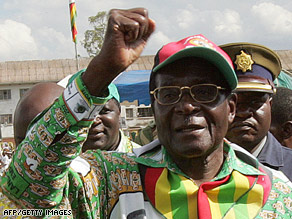
    artmugabe2afpgi.jpg

    Photo from CNN/AFP/Getty

    Saturday Robert Mugabe, socialist President of Zimbabwe (formerly Rhodesia) stands for reelection again. The Associated Press illustrates the economic situation there;

    The word is out: The Spar supermarket has bread at only $7 million a loaf. People rush to the shelf duly marked $7 million, but by the time they reach the till with their hyper-inflated Zimbabwean dollars, the price is up to $25 million.

    That equals just 62 American cents, more than a teacher makes in a week. “How can we afford to eat that?” a woman exclaims. Customers leave their loaves at the counter and walk out with their brick-sized bundles of bank notes, angry and disconsolate.

    Yet they continue to vote for Mugabe. A rational person might admit failure, but no one has ever accused Mugabe of being a rational person. A Reuters story in the New York Times demonstrates his vote-buying;

    President Robert Mugabe gave out 450 cars to senior and midlevel doctors at government hospitals in what opponents say is a vote-buying campaign ahead of Saturday’s presidential election. […] He also promised the doctors houses within two years.

    Funny how that happens a few days before the election. A CNN article briefly describes the economic conditions Zimbabweans face;

     Zimbabweans are the poorest they have ever been since the nation became a democracy. Unemployment is estimated at around 80 percent, inflation is more than 100,000 percent, and hundreds of thousands are fleeing the country to earn more elsewhere than they would back home.

    Mugabe has been in office since the country, then called Rhodesia, gained independence from Britain in 1980.

    He was once respected as a liberation hero, but observers now criticize him for repressive tactics and corruption, and blame him for the country’s dire economic state.

    Yesterday, the Zimbabwe courts sentenced a white farmer to five years in prison (suspended under the condition he comply with the law) for refusing to vacate his property for more of Mugabe’s land reform – seizing white-owned farms and turning them into failing collectives. (Wall Street Journal link)

     A Harare magistrate gave Deon Theron, a vice president of the white-dominated Commercial Farmers Union, one month to leave his farm and a six-month prison sentence, suspended for five years on condition he does not violate the Land Act. Mr. Theron’s lawyer said he would appeal the conviction and sentence.

    The 53-year-old dairy farmer was convicted Tuesday of unlawfully remaining on his farm after it was declared state land. The prosecutor had called for his imprisonment. The prosecutor, who refused to give his name to reporters but was addressed by the magistrate as Mr. Zvakare, urged a quick sentencing and said it was “a serious criminal case.”

    But his target hasn’t always been the white residents of Zimbabwe writes the Wall Street Journal editorial board;

    His first target, and greatest victims, were his fellow blacks. In the mid-1980s, he unleashed a campaign of torture and murder against political opponents in Matabeleland that claimed 20,000 lives. Later, he razed shantytowns in the big cities inhabited by poor supporters of the opposition Movement for Democratic Change. Trade unions, journalists, independent courts and other institutions, and political opponents received the African “big man” treatment. Only in 2000 did Mr. Mugabe, out of desperation, target the country’s few remaining whites. The subsequent dispossession of white-owned farms destroyed Zimbabwe’s agricultural economy and brought the country’s troubles fully to the world’s attention.

    So why starvation? Well, all great communist revolutions used famine as a weapon to control people. Lenin, as far back as 1891, thought of famine as a tool for communists to gain control when he refused to help in own home town. “Famine,” he explained, “in destroying the outdated peasant system, would usher in socialism.” He later presided over a two year famine (1921-1922) after the revolution that cost an estimated 5 million Russian souls – Stalin also forced a famine on the country and it’s satellites that killed another 5 million people. The toll from Mao’s “Great Leap Forward” will probably never be counted reliably.

    So Mugabe is only following in the steps of great communists and keeping the dream alive.