Category: Economy

  • Mugabe; socialism at it’s best

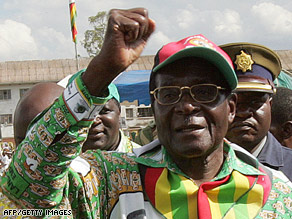
    artmugabe2afpgi.jpg

    Photo from CNN/AFP/Getty

    Saturday Robert Mugabe, socialist President of Zimbabwe (formerly Rhodesia) stands for reelection again. The Associated Press illustrates the economic situation there;

    The word is out: The Spar supermarket has bread at only $7 million a loaf. People rush to the shelf duly marked $7 million, but by the time they reach the till with their hyper-inflated Zimbabwean dollars, the price is up to $25 million.

    That equals just 62 American cents, more than a teacher makes in a week. “How can we afford to eat that?” a woman exclaims. Customers leave their loaves at the counter and walk out with their brick-sized bundles of bank notes, angry and disconsolate.

    Yet they continue to vote for Mugabe. A rational person might admit failure, but no one has ever accused Mugabe of being a rational person. A Reuters story in the New York Times demonstrates his vote-buying;

    President Robert Mugabe gave out 450 cars to senior and midlevel doctors at government hospitals in what opponents say is a vote-buying campaign ahead of Saturday’s presidential election. […] He also promised the doctors houses within two years.

    Funny how that happens a few days before the election. A CNN article briefly describes the economic conditions Zimbabweans face;

     Zimbabweans are the poorest they have ever been since the nation became a democracy. Unemployment is estimated at around 80 percent, inflation is more than 100,000 percent, and hundreds of thousands are fleeing the country to earn more elsewhere than they would back home.

    Mugabe has been in office since the country, then called Rhodesia, gained independence from Britain in 1980.

    He was once respected as a liberation hero, but observers now criticize him for repressive tactics and corruption, and blame him for the country’s dire economic state.

    Yesterday, the Zimbabwe courts sentenced a white farmer to five years in prison (suspended under the condition he comply with the law) for refusing to vacate his property for more of Mugabe’s land reform – seizing white-owned farms and turning them into failing collectives. (Wall Street Journal link)

     A Harare magistrate gave Deon Theron, a vice president of the white-dominated Commercial Farmers Union, one month to leave his farm and a six-month prison sentence, suspended for five years on condition he does not violate the Land Act. Mr. Theron’s lawyer said he would appeal the conviction and sentence.

    The 53-year-old dairy farmer was convicted Tuesday of unlawfully remaining on his farm after it was declared state land. The prosecutor had called for his imprisonment. The prosecutor, who refused to give his name to reporters but was addressed by the magistrate as Mr. Zvakare, urged a quick sentencing and said it was “a serious criminal case.”

    But his target hasn’t always been the white residents of Zimbabwe writes the Wall Street Journal editorial board;

    His first target, and greatest victims, were his fellow blacks. In the mid-1980s, he unleashed a campaign of torture and murder against political opponents in Matabeleland that claimed 20,000 lives. Later, he razed shantytowns in the big cities inhabited by poor supporters of the opposition Movement for Democratic Change. Trade unions, journalists, independent courts and other institutions, and political opponents received the African “big man” treatment. Only in 2000 did Mr. Mugabe, out of desperation, target the country’s few remaining whites. The subsequent dispossession of white-owned farms destroyed Zimbabwe’s agricultural economy and brought the country’s troubles fully to the world’s attention.

    So why starvation? Well, all great communist revolutions used famine as a weapon to control people. Lenin, as far back as 1891, thought of famine as a tool for communists to gain control when he refused to help in own home town. “Famine,” he explained, “in destroying the outdated peasant system, would usher in socialism.” He later presided over a two year famine (1921-1922) after the revolution that cost an estimated 5 million Russian souls – Stalin also forced a famine on the country and it’s satellites that killed another 5 million people. The toll from Mao’s “Great Leap Forward” will probably never be counted reliably.

    So Mugabe is only following in the steps of great communists and keeping the dream alive.

  • Obama’s stalinist economic plan

    The Democrats’ hope, Barak Obama laid out his economic policy this morning and proved he’s either an inept buffoon or a naive babe in the woods. Christina Bellantoni from the Washington Times writes;

     The Democratic presidential hopeful said he would rein in special interests as president, complaining the government has allowed the markets to “bend the rules” for the most profit at the expense of the nation’s workers.

    “Under Republican and Democratic administrations, we failed to guard against practices that all too often rewarded financial manipulation instead of productivity and sound business practices,” Mr. Obama, of Illinois, said at the Cooper Union in Manhattan.

    President Bush has tightened restrictions on accounting and business practices more than any president since Franklin Roosevelt. So what’s he talking about?

    “We let the special interests put their thumbs on the economic scales,” he said. “The result has been a distorted market that creates bubbles instead of steady, sustainable growth; a market that favors Wall Street over Main Street, but ends up hurting both.”

    He said the government must adapt.

    “The American economy does not stand still, and neither should the rules that govern it,” he said.

    Those “bubbles” are from over-speculation, Barry, not from a lack of government intervention. A distorted market happened when Bill Clinton declared that his administration had put an end to business cycles.

    I saw the current market problems coming three years ago when more people in California applied for real estate licenses than drivers licenses one month. I adjusted my portfolio accordingly – like every other savvy investor.

    Greed brings on bubbles, Barry, buddy. Now if you want to regulate greed among investors who chase returns, you might find it a bit impossible.

    There’s no such thing as “steady, sustainable growth” in the short term. The market jumps up and down based on best guesses. There’s no solution to spikes in the economy unless you want to regulate every aspect of production, supply and purchase.

    Of course, you can promise that to those pea-witted bozos that faint at the sound of your voice, but it’ll never happen in this country.

  • More empty words from the empty suit

    Still trying to recover from the blow to his campaign over the weekend over the Reverend Wright fiasco, Obama decided to shift fire onto the only politician that’s not running for anything this November – President Bush (WSJ Washington Wire link);

    Sen. Barack Obama slammed the Bush administration for failing to respond aggressively to the economic crisis on Wall Street and for his administration’s cluelessness about the economic concerns of Americans.

    That strikes a contrast with the statement that Sen. Hillary Clinton issued earlier today, when she didn’t mention the Bush administration, and instead underscored the steps she had taken to speak with top economic officials.

    At least Clinton has the good sense to not blame on the President things he can’t control. So what would President Obama done?

    Obama underscored the difficulty of addressing those nuances when he slammed the White House today for its prolonged inaction. “The President traveled to New York last week to say that there is a danger in doing too much and implied that doing nothing would be preferable,” he said in his statement today.

    “Prolonged inaction”? What should the White House have done? He’s not clear on that. I cringe to think what an Obama Administration would have inflicted upon us. Probably something along the lines of his 5 year freeze on mortgage payments.

    But in an interview with the Chicago Tribune last week, the Illinois senator acknowledged the difficulty in drawing a line between intervention and allowing the market to correct itself. “My philosophy on this is that intervening in bubbles that burst is not always helpful and can just delay the pain,” he said. “On the other hand, I do think what you don’t want is a cascading decline.”

    I think the only bubble we should be wary of bursting is the one between Mister Obama’s oversized ears.

  • Colombia vs. Chavez/US Democrats (UPDATED)

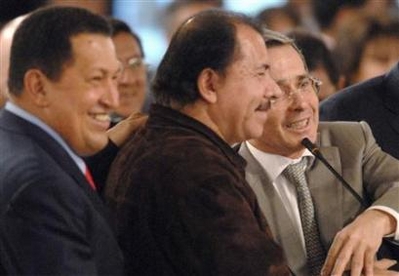
    2008_03_07t230149_450x311_us_venezuela_colombia.jpg

    Photo from Reuters/Yahoo

    Colombia’s President Alvaro Uribe (R), Nicaraguan President Daniel Ortega talk as Venezuelan President Hugo Chavez looks on after they agreed to resolve a territorial dispute.

    We were all surprised, somewhat, Friday when Ecuador, Venezuela and Colombia stepped back from the heated rhetoric, suddenly all broke into grins and shook hands. It appeared that one side was scared and the other side was glad they were scared. The Devil’s Excrement posits the theory that Colombian President Uribe had much more information on the underhanded dealings of Venezuela’s Chavez and Ecuador’s Correa than he was showing;

    My theory? Easy, Uribe a master politician, had only leaked earlier some of the information gathered at the guerrilla camp and there was much more than they had released to the press two days ago. Either the additional material was being passed on to the various Governments as Uribe spoke, or it was handed over at that point to Correa and Chavez. Chavez was simply too timid, talking about peace, religion, God, even calling for a mass (how cynical can he be?). My further guess is that the Colombian Government uncovered financial information compromising both Ecuador and Venezuela. In fact, Uribe read at one point a letter from a FARC leader mentioning a specific amount of aid to the FARC from the Ecuadorian Government.

    It turns out that Miguel’s theory panned out, according to a Miami Herald article this morning;

    Colombia’s FARC guerrillas discussed contributing up to $100,000 to the campaign of Rafael Correa six weeks before he was elected president of Ecuador in 2006, Colombia’s Semana magazine reported on Sunday, citing a document found on the laptop of slain rebel leader Raúl Reyes.

    Another document reportedly found by Colombia’s National Police is a letter from 2000 that asks Libyan leader Moammar Gadhafi for a $100 million loan so the guerrillas could buy weapons, including surface-to-air missiles. There’s no evidence that the deal went forward.

    Mary Anatasia O’Grady, in the Wall Street Journal this morning, uncovers more evidence of FARC’s connections to the Chavez and Correa governments;

    The FARC puts a lot of effort toward discrediting Mr. Uribe in the court of world opinion. A September letter from a rebel commander to “secretariat comrades” reads: “As to the manifesto, I suggest adding the border policy and making it public by all means possible to see if we can stop all the world from supporting uribismo [the agenda of Mr. Uribe] in the October elections.” He then proposes a “clandestine” meeting between one rebel and Mr. Chávez in Caracas to discuss “our political-military project.” Mr. Chávez, the rebels say in a later document, suggested that the FARC videotape any Colombian military strikes in the jungle for propaganda purposes.

    In January, FARC leader Manuel Marulanda (aka “Sureshot”) wrote to Mr. Chávez: “You can imagine the happiness that you have awoken in all the leaders, guerrillas, the Bolivarian Movement of New Colombia [and] the Clandestine Communist Party with the plan you put forth . . . to ask for the analysis and approval of recognizing the FARC as a belligerent [therefore legitimate] force.”

    The documents also show why it was a good idea for Colombia not to ask Ecuador for permission before moving against the FARC camp — even though in the past it had done so when tangling with the rebels at the border. A January memo reports on a FARC meeting with the Ecuadorean minister of security, who said that Mr. Correa is “interested in official relations with the FARC” and has decided not to aid Colombia against the rebels. “For [Ecuador] the FARC is an insurgent organization of the people, with social and political proposals that it understands,” the memo reads.

    Even the Venezuelan people couldn’t find it to support Chavez’ “war”. The Miami Herald, in another article, describes the terror that frontier-dwelling Venezuelans suffer because of Colombian guerillas conducting cross-border operations with at least tacit approval of the Chavez government;

    Dozens of people in this hilly, forested border region also have gone missing, and many here believe Colombian guerrillas are to blame. Despite the government’s pledge to crack down on groups terrorizing the border, few here think that will happen. ”The national government lies,” Davila said. Colombian police have even told him they suspected the National Liberation Army, one of three guerrilla groups believed to be operating here, was holding his father.

    ”Here, Colombian guerrilla groups are operating, sometimes with the complicity of police,” he said. “We live in a climate of terror fueled by the indifference of the state and the injustice of impunity.”

    The Devils’ Excrement writes that the majority of Venezuelans were opposed to a war with Colombia;

    Despites Chavez’ intention to raise nationalistic spirits with the crisis, polls indicate that this was not the case. At least two polls, one public, indicate 90% rejection levels for an armed conflict with Colombia, 70% rejection levels for the FARC, 70% rejection levels for closing the border with Colombia and one poll shows a 66% majority do not believe Chavez when he says the FARC holds no Venezuelan hostages.

    The Wall Street Journal accuses US Democrats in Congress of supporting Chavez at the cost of losing Colombia as an ally;

    Yet Democrats on Capitol Hill are doing their best to help Mr. Chávez prevail against Mr. Uribe. Even as Mr. Chávez was doing his war dance, Senate Finance Chairman Max Baucus was warning the White House not to send the Colombia deal to the Hill for a vote without the permission of Democratic leaders. He was seconded by Ways and Means Chairman Charlie Rangel, who told Congress Daily that “they don’t have the votes for it, it’s not going to come on the floor,” adding that “what they [the White House] don’t understand it’s not the facts on the ground, it’s the politics that’s in the air.”

    The editorial staff goes on to name names – including both Democrat Presidential candidates;

    Connecticut Senator Chris Dodd’s early support helped the strongman consolidate his power. Former President Jimmy Carter blessed Mr. Chávez’s August 2004 recall victory, despite evidence of fraud. And then there are the many House Democrats, current and former, who have accepted discount oil from Venezuela and then distributed it in the U.S. to boost their own political fortunes. Joseph P. Kennedy II and Massachusetts Congressman Bill Delahunt have been especially cozy with Venezuela’s oil company. If Democrats spurn free trade with Colombia, these Democratic ties with Mr. Chávez will deserve more political scrutiny.

    Senators Hillary Clinton and Barack Obama are both competing for union support. But if they wanted to demonstrate their own Presidential qualities, they’d be privately telling Ms. Pelosi to pass the Colombia pact while Mr. Bush is still in office. That would spare either one of them from having to spend political capital to pass it next year.

    Instead, both say they oppose the deal on grounds that Mr. Uribe has not done more to protect “trade unionists.” In fact, Mr. Uribe has done more to reduce violence in Colombia than any modern leader in Bogotá. The real question for Democrats is whether they’re going to choose Colombia — or Hugo Chávez.

    Chavez and Correa have made it increasingly apparent that their loyalties lie with the less desirable elements in Latin America. Letters on Reye’s computers bring to light ties that FARC had connections with Libya and North Korea and that Correa was interested in exploiting those ties for his own enrichment. Are the Democrats willing to ally themselves with the interests of FARC and, by extension, the whole rest of the evil that terrorizes in the world?

    UPDATE: Noticias 24 confirms that there are indeed Colombian guerillas operating in Venezuela (my Calle J bar room Spanish translation);

    La guerrilla colombiana está bien instalada en Venezuela. Un periodista del diario brasileño Folha de Sao Paulo corroboró la actuación de las FARC, el ELN y la guerrilla chavista en la zona fronteriza con Colombia. Infobae lo reseña hoy. También “El Mundo” publicó ayer un reportaje sobre Guasdalito.

    Colombian guerillas are very well entreched inside Venezuela. A Brazilian daily newspaper, Folha de Sao Paulo, corroborates the accusations that FARC, ELN and chavista guerillas operate in the frontier zone with Colombia. Infobae reviewed the article today. Also “El Mundo” (Spain) published a news article on Guasdalito yesterday.

    So let’s see Chavez wiggle free from this and blame it on the United States propaganda machine. If ever the US had enemies, it was in the Latin American prensa.
  • Saturday night must-reads

    I’ve got two cats sleeping on my lap and so all you get is links tonight;

    First, stop by and take at look at the Gathering of Eagles who were rewarded for braving the weather to support the military recruiters in Times Square by a visit from Pamela Gellar from Atlas Shrugs.

    If Baldilocks says he’s dead, then he’s dead as far as I’m concerned.

    Big Dog defends John McCain in the Boeing contract kerfuffle.

    The American Pundit catches the media lying about McCain’s position on waterboarding.

    Bloodthirsty Liberal examines Arab techniques of border control.

    Gaius at Blue Crab Boulevard writes on the absurdity of Hillary’s statement that she ended the hundreds of years of Britain’s war with the Irish.

    Jammie Wearing Fool writes about an idiot judge who disagrees with the war against terror, so she keeps a foster kid from enlisting. I’d always thought judges were supposed to lay aside their own bias when they rule – I must be wrong.

    The Liberty Pundit ties in yesterday’s job report to the only legislation the Democrats passed last year – the minimum wage.

    Gateway Pundit rounds up news on the death of the latest FARC leader found in pieces several miles apart.

    Bob Parks at Outside the Wire dissects the Obama sucker factor and reports that Obama doesn’t have a plan to withdraw from Iraq. Bob Owens at Confederate Yankee explains what that means. Meanwhile, Flopping Aces writes that Hillary’s military advisor says she won’t pull troops out of Iraq. I’m beginning to see a pattern here.

    Wild Thing explains in detail the history of the Weather Underground buddies of Barak Obama.

    Crotchety Old Bastard compares Michele Obama’s speeches to Che Guevara’s “New Man” speech.

    Pam at Right Voices reports on a stunning archaeological find.

    The Hatemonger’s Quarterly has the exclusive report on several fictional TV characters and who they support in the Presidential campaign.

    Moonbattery‘s Van Helsing warns that environmentalists are coming for your X-Box.

    Jay at Stop the ACLU explains why he’s voting for John McCain.

    GI Jane at The Foxhole tears up the Washington Post for their self-flagellating over their treatment of Muslims.

    Weasel Zippers writes on the Hamas admission that they’re supported by Iran – and I feign surprise.

    Dean Barnett at The Weekly Standard Blog writes that the New York Times will take a swipe at Barak’s Iraq policy tomorrow.

  • AP’s reporting on the unemployment rate (UPDATED)

    I’ve been seeing the AP story on the unemployment rate for February released this morning under the headline “Employer Slash Jobs By Most In 5 Years“. It was pretty scary headline, so I finally read the article after avoiding it all morning;

    Employers slashed 63,000 jobs in February, the most in five years and the starkest sign yet that the country is heading dangerously toward recession or is in one already.

    The Labor Department’s report, released Friday, also indicated that the nation’s unemployment rate dipped to 4.8 percent as hundreds of thousands of people perhaps discouraged by their prospects left the civilian labor force. The jobless rate was 4.9 percent in January.

    Job losses were widespread, with hefty cuts coming from construction, manufacturing, retailing, financial services and a variety of professional and business services. Those losses swamped gains elsewhere, including education and health care, leisure and hospitality and the government.

    So I decided to slip over to the report at the Bureau of Labor Statistics and this is what it said;

    Nonfarm payroll employment edged down in February (-63,000), and the unemployment rate was essentially unchanged at 4.8 percent, the Bureau of Labor Statistics of the U.S. Department of Labor reported today. Employment fell in manufacturing, construction, and retail trade. Job growth continued in health care and in food services. Average hourly earnings rose by 5 cents, or 0.3 percent, over the month.

    The number of unemployed persons (7.4 million) and the unemployment rate(4.8 percent) were essentially unchanged in February. Over the month, the unemployment rates for adult men (4.3 percent), adult women (4.2 percent), teenagers (16.6 percent), whites (4.3 percent), and Hispanics (6.2 percent) showed little or no change. The jobless rate for blacks fell to 8.3 percent,in line with the average rate for 2007. The unemployment rate for Asians was3.0 percent, not seasonally adjusted.

    So employers certainly didn’t SLASH jobs really, and the writer’s bias, which by the way shows up nearly every week when reporting unemployment in the same lame phrase that “hundreds of thousands of people perhaps discouraged by their prospects left the civilian labor force”. Since when does “perhaps” become an acceptable part of an analytical phrase? “Perhaps” they all won the lottery. “Perhaps” they all started their own businesses. “Perhaps” it was a combination of thousands of possible answers.

    Only at the Associated Press does the unemployment rate falling a tenth of one percent portend doom and gloom. Seein’s how the unemployment rate has floating around 4.5% for over a year now (a half of one percent below what economists consider full employment) it stands to reason that jobs would start falling away.

    But let’s look what was the report a year ago?

    Nonfarm payroll employment continued to trend up (+97,000), and the unemployment rate (4.5 percent) was essentially unchanged in February, the Bureau of Labor Statistics of the U.S. Department of Labor reported today. Employment grew in some service-providing industries but declined sharply in construction. Manufacturing employment continued to trend downward.

    So unemployment rose .3% in the last year. And in February 2006?

    Nonfarm payroll employment grew by 243,000 in February, and the unemployment rate was little changed at 4.8 percent, the Bureau of Labor Statistics of the U.S. Department of Labor reported today. Job gains occurred in contruction, financial activities, health care, and several other industries.

    Both the number of unemployed persons, 7.2 million, and the unemployment rate, 4.8 percent, were little changed in February.

    Hmm, the same as this February. How about February 2005;

    Nonfarm payroll employment increased by 262,000 in February and the unemloyment rate edged up to 5.4 percent, the Bureau of Labor Statistics of the U.S. Department of Labor reported today. Job growth occurred in both goods-producing and service-providing industries.

    Over half-a-percent higher unemployment. Imagine that – I’ll bet the AP predicted economic failure for the entire period from February 2005 until February 2006, too.

    UPDATE: Thanks to Lamplighter for pointing out that AP changed their title to “Dangerous cracks appearing in job market” from the fear-mongering title that was up nearly all day while the market was open.

  • House jacks up fuel prices

    Hoping to scoop out some of those profits that oil companies have been reaping lately, the House passed what they named the “Renewable Energy and Energy Conservation Tax Act of 2008”. The stated purpose was not to give consumers and US taxpayers some relief from high fuel prices. Let Steny Hoyer explain (Reuters/Yahoo link);

    “We simply must begin to break our addiction to fossil fuels, particularly our addiction to foreign sources of oil,” said Rep. Steny Hoyer of Maryland, the House Democratic majority leader.

    “We”? Got a mouse in your pocket, Steny? Better yet; got an alternative fuel in your pocket, Steny?

    House Democrats said oil companies that have earned record profits off $100-a-barrel oil did not need the tax breaks, and the money could be better used to promote alternative energy supplies for the future.

    First of all, how is drawing more taxes off from oil profits going to “promote alternative energies for the future”? That always gets me – the solution is always give money to the government, not give money to people who’ll actually do something worthwhile.

    All that happens when government jacks up taxes on oil companies, oil companies pass the burden on to consumers. Oil profits won’t suffer, just the poor working folks who have to fill their fuel tanks up everyday to schlep off to work will suffer. But try and explain that to Congress.

    But guess who doesn’t get hit with the higher taxes – Hugo Chavez. From CQ Politics (h/t Michele Malkin) ;

    The tax package (HR 5351), which passed 236-182, repeals subsidies for five major oil and gas companies to offset $13.7 billion of the $18.1 billion in renewable-energy tax breaks contained in the bill.

    Meanwhile, Citgo Petroleum Corp. would continue to receive a 6 percent deduction for domestic manufacturing that the largest firms would lose.

    Citgo, which refines oil and markets and transports gasoline in the United States, is owned by a subsidiary of the government-owned Petróleos de Venezuela, S.A., or PDVSA. Because Citgo does not drill for oil and gas domestically or abroad, it does not fall under the bill’s definition of companies that will lose a major tax break.

    The five big companies targeted by the bill — Chevron, BP, ExxonMobil, Shell and ConocoPhillips — all produce and refine oil and sell gasoline in the United States, and therefore under the bill would lose the domestic manufacturing deduction they received as part of a corporate tax law in 2004 (PL 108-357).

    Now how do we get independence from foreign oil producers by giving them a tax break and more heavily taxing our domestic producers? Huh? Can one of you rocket scientists on the Left explain that to me?

    Back to the Reuters story;

    Under the bill, energy companies would no longer be able to exclude a certain portion of their oil and gas production income from U.S. taxes and would also have to pay U.S. taxes on some foreign income that also was taxed in the country where it was earned.

    Makes tons of sense doesn’t it? Don’t allow domestic exploration for fuels, and tax domestic producers – sometimes double taxation.

    Right now, the Bush Administration has threatened to veto this garbage, but just wait until Democrats have both ends of Pennsylvania Avenue again. We’ll all be riding bicycles in no time – well, we’ll have no jobs to get to, so we might as well ride bikes around.

  • Jesse Jackson; the pointless point

    I just knew that reading a Jesse Jackson opinion piece in the Washington Times would be good for a chuckle as soon as I saw the heading. The fathead never fails to disappoint.

    At issue is the competitive bid for the Air Force’s new refueling tanker between US company Boeing and British BAE. Jackson is rightly outraged that the Department of Defense may end up awarding the bid to BAE based on the bidding process – effectively sending jobs to Europe that we need right here in this country. Although BAE has said they’ll subcontract work to American Northrup Gruman, it’s also pretty clear most of the jobs will go to Europeans. But Jackson takes aim and shoots himself in the foot in the last sentences (emphasis mine);

    No one disputes that DoD should always promote vigorous competition for military contracts. In fact, Congress did the right thing several years ago by stripping Boeing of a no-bid contract award for replacement tanker aircraft. But at a time when the U.S. economy is facing a recession, when cities are crumbling and workers are hurting, the idea of not rewarding foreign companies who cheat international trade laws to undermine our labor market should be a no-brainer.

    Congress should step in immediately to revitalize our economy with domestic investment and good-paying jobs for U.S. workers and require this foreign manufacturer to abide by the rules.

    So it was fine that Congress stopped all of those jobs and money were to go to Americans during the Bush economy, but since that money might provide jobs under a Democrat economy, Congress had better act to keep those jobs here now. If Jackson were any more transparent, he’d have to get a real job. I guess we know how he spotted that “no-brainer”.