Category: Disposable Warriors

  • As Long as We’re On the Subject of Veterans

    This is kind of long, but it has to do with how veterans have been treated in the past in some place other than the USA.

    Does this sound familiar? An unpopular war in a foreign location that nobody knows much about, nor does anyone really care, but which costs lives and leaves veterans disliked and often stranded when trying to get help of any kind… war-related medical needs, including counseling going sadly lacking, no real support, disdainful remarks about serving, the media not telling the truth about it, etc.

    Welcome to the aftermath of the Soviet Union’s war in Afghanistan. It started in the late 1970s and lasted until 1989, just before the Politburo was dissolved and Gorbachev announced that the Soviet Union was out of money and bankrupt.  And now, the Russians are embroiled in another war in the Middle East, in Syria. Another generation of Russian veterans is on deck.  http://www.cnn.com/WORLD/europe/9902/09/afghan.veterans/

    From the article:

    Once a year, Zhdanov — among the last soldiers to leave Afghanistan in February 1989 — visits the grave of his friend Nikolai who died two months before the Soviet pullout.

    “At least his gravestone says where he died,” Zhdanov said, sprinkling another glass of vodka over the grave in a traditional Russian gesture. “Relatives of soldiers who had been killed earlier were not allowed to mention that for fear of ‘demoralizing the population’.”

    In December 1979, the Soviet Union sent 80,000 troops into Afghanistan to support the leaders it had installed there.

    The operation was planned as a “little victorious war” meant to thwart Western-backed Islamist rebels and subdue growing discontent over economic and social problems at home.

    But the full-scale war proved too expensive for the creaking Soviet economy and the flow of zinc coffins with the bodies of dead soldiers, most of which were delivered in secrecy, only compounded the unpopularity of the aging Soviet leadership.

    The glasnost policy of more public openness encouraged by Kremlin leader Mikhail Gorbachev after he came to power in 1985 exposed the truth about the Soviet role in Afghanistan and the atrocities of the war, fueling public rage and making withdrawal inevitable.

    On February 15, 1989, the last Soviet commander in Afghanistan, General Boris Gromov, crossed a border bridge to complete the pullout. Behind him lay one million dead Afghans and the memory of 15,000 comrades in arms who perished.

    “Perhaps glasnost was good, but when we came back home people treated us as criminals, as if we started the war,” Zhdanov said. “‘We did not send you there’ was the mildest answer one could get turning for official assistance.”

    The appalling conditions under which the Soviet troops in Afghanistan were far worse than you can imagine, but they are described in that 1999 article.

    We all know what followed: the collapse of communism, wars in Eastern Europe and Central Asia, the rise of fundamentalist Islam, the appalling use of passenger airplanes to attack Americans at home, the invasion of Kuwait, the Great Recession, so-called “lines in the sand”, and now the seemingly endless conflict in the Middle East.

    By 2000, not only were Russian military wages low and benefits nearly nonexistent, but also when someone left the military there was no real support system in place. Families had to pay to bury their veteran members, and in some cases could not afford the cost of a coffin. There were local veterans’ organizations that were set up to try to get medical and other help and were given tax exempt status to do so, so that they could provide some support such as food and housing for these Russian Army vets, but it was not a government organization like our Veterans Administration. Crime was rampant in some of them, also.

    http://factsanddetails.com/russia/Government_Military_Crime/sub9_5b/entry-5209.html#chapter-7

    In regard to active duty pay, in early 1996, a Russian pilot holding the rank of major was paid approximately 1.5 million rubles per month, or about US$300. By comparison, a 1996 NATO pilot of equivalent rank earned US$6,000 per month. [Source: Library of Congress, 1996]

    1996 is now 22 years in the past. In the 1999 collapse of the USSR, the frail base of support for veterans collapsed with it. The Russian economy literally imploded.

    In 2001, Russian soldiers were paid USD $2/month and officers were paid $12/month. This was after the collapse of the ruble fo a value of $0.01733, which has since recovered with a 2018 value of about $0.15 on the dollar. My cousin and his wife went to Moscow back then, and told me that they found Russian vets on the streets trying make a little money for food by selling their uniforms and medals.

    Currently, in 2018, wages are better, as are housing, food and medical care for troops but there are still issues with caring for veterans, because that is where the real expense lies: the aftermath. In January this year, Deputy Defense Minister Tatyana Shevtsova told journalists on Friday that military pay and pensions will increase four percent per annum in 2018, 2019, and 2020. It remains to be seen if this will happen consistently, as the Russian economy is still quite creaky.

    June 2017, Russian Federation President Vladimir Putin addressed military pay publicly for the first time since 2012. It had not been indexed for inflation once during the interval according to NVO.  But Putin said he wants to improve the “material stimulus” for the MOD, MVD, FSB, and SVR.

    With another presidential election looming, he wanted to show he’s still concerned about men in uniform. This is not easy when the federal budgets scarcely have money for it and economic recovery is weak. While four percent raises will be welcome, they won’t make up for the eroded purchasing power of military pay. The CPI in Russia has increased more than 50 percent since May 2012. An increase like that sounds wonderful on paper, but it does not address the real sluggishness of the Russian economy at the time. Theirs was considerably worse than ours, and the impact on ex-military with no base of support was heavy.

    Whether or not this 4% raise does become an annual reality, remains to be seen. It may be less or may be inconsistent. It is an election year in Russia, just as it is here.  Politicians are prone to make many promises, but, as some say, campaign promises are made to be broken.
    The fact that military wages in Russia’s military are low to begin with means that the money Putin makes from gas and oil sales is stretched quite thin already.

    From what I have found, it appears that the military may be more of a show with “advanced” equipment production being more important than real-world improvements for the troops, as in Big Missiles instead of better equipment and logistics. The pounding they are taking in the Middle East, in Syria, may be taking its toll, too.

    As for how Russia’s veterans are treated now, things seem to have improved somewhat since 1999, when the returning Afghan veterans were not just looked down upon but despised. This comes from Quora, from someone in Russia:

    Andrey Yanovski, Senior Business Development Specialist Answered Jun 19, 2017 Russian Federation.

    First of all, I want to say that here under “military veterans” I will understand “combat veterans” – people who have participated in active combat operations as they receive a set of social support measures in extension to the social support of a retired military person who has never participated in combat operations. Also some people may be legal combat veterans and not be actually former or active military personnel.

    That includes:

    1. WWII vetrans include anyone, who has received a medal or a decoration both on the front and in the rear. That may include. for example, military factory workers, security officers, engineers etc, who contributed to the war effort.
    2. Persons, who were engaged in minesweeping duties both on land and at sea after WWII
    3. Some police/security services officers who were engaged in military combat operations
    4. Persons who served in “automotive battalions”, delivering cargo to Soviet troops in Afghanistan.
    5. Wounded, concussed or otherwise disabled persons, who were at any time engaged in supporting (servicing) military units of USSR or RF in foreign countries, if at that time there was a military conflict at that county.
    6. People, who received medals or other decorations for actions in support of combat operations (doctors, drivers etc.)
    7. Pilots, who were performing flights (including civilian) from the territory of USSR to Afghanistan at the time of active combat in Afghanistan.
    8. Citizens commandeered to work in Afghanistan in the period between 1979 and 1989.

    So, for all veterans both civilian and military the following social support is available:

    1. Veterans are exempt from property tax
    2. Veterans have also tax reductions of personal income tax and land ownership tax, but the reduction amounts are negligible.
    3. Veterans have a right for additional annual leave of 35 days per year, however this leave is unpaid.
    4. Veterans receive a pension increase (in addition to their military pension) of ~2500 rub/month (roughly $50).
    5. Veterans don’t need to pay fees for court applications.
    6. Veterans have the right to receive free housing, however there is a queue for the housing being constructed, so it is unfortunately not guaranteed.
    7. Veterans have a 50% discount on housing services fees. Note: not utilities payments, only housing fees.
    8. Veterans are entitled to free medical care in military hospitals and clinics, Note: military hospitals and clinics are able to provide treatment for a fairly limited number of conditions, of course.
    9. Veterans are entitled to free medical examination every 3 months.
    10. Veterans are entitled to receive free limb prosthetics (only manufacturing cost included, including replacement of worn ones, any treatment/surgery costs still need to be paid by the vet.  In some regions of Russia, tooth implants are also included.
    11. Some medication can be received for free (specific list is updated annually, but generally it’s the most basic stuff).
    12. Veterans have a right of free pass on suburban electric trains.
    13. Veterans receive increased scholarship payments in colleges and universities.
    14. Veterans receive priority admittance to colleges and universities.

    Our own politicians use veterans as a mounting block to get votes for themselves. Some of them do mean well and do support the veteran community, but in the end it still comes down to votes. And as I said, talk is great; politicians are prone to make many promises, but, as some say, campaign promises are made to be broken.

  • When they start pimping out the corpse of a dead veteran for votes…everyone should lose.

    When they start pimping out the corpse of a dead veteran for votes…everyone should lose.

    The corpse of Jason Simcakoski seems to be popular fodder for political grazing these days.  Jason died in 2014 while in the care of the VA.  Now,  Leah Vukmir and Tammy Baldwin are using his death in their respective campaign adds.

    The parents and widow of a Marine veteran who died at the Tomah Veterans Affairs Medical Center appear in a pair of television ads that debuted Thursday praising Democratic Sen. Tammy Baldwin and calling attacks against her “shameful.”

    The spots are an attempt by Baldwin to counter one of the main criticisms of her lodged by Republican opponent Leah Vukmir and conservative groups. Vukmir has charged that Baldwin failed to respond quickly enough to the crisis at Tomah, where veterans were being over-prescribed opioids leading up to the death of Jason Simcakoski in 2014.

    Simcakoski’s parents are in one new Baldwin ad and his widow is in another. In both, they praise Baldwin for working with them to enact a law that toughened opioid prescription guidelines. They also call for attacks against Baldwin on Tomah to stop.

    “When I see these attack ads against Tammy Baldwin, using Jason’s death, I think it’s shameful,” his widow Heather says in one ad. “Tammy has literally been there with us every step of the way for three years. She’s the one helping us do right by our veterans.”

    It’s not bad enough that two politicians are using his death for political gain…now his widow and parents have jumped into the ring.

    In an ad released Wednesday, Vukmir attacked Baldwin over her response to the Tomah crisis. It was the latest in a series of spots by her and conservative groups that have spent millions attacking Baldwin on the issue.

    “You knew about the opioid crisis at the Tomah VA and you did nothing,” Vukmir said in the ad.

    Baldwin’s office heard from a whistleblower about concerns at Tomah in March 2014. It received a report in August 2014 about its 2½-year investigation into Tomah that cited concerns over the prescription of opioids at the facility, which is about 100 miles northwest of Madison.

    Simcakoski died the day after Baldwin’s office received the report.

    The family of Jason Simcakoski became effective activists and were instrumental in passing the  Jason Simcakoski Memorial Opioid Safety Act.  They were also awarded $2.3 million.  The practice of treating veterans at “Pill Factories” needed to be addressed.

    Everyone is diminished when they are drawn into petty political fights.  Vukmir and Baldwin are political parasites feeding on the dead corpse of a veteran.  Shame on his family for jumping into this fight.  Vukmir needs to STFU and Baldwin lacks the dignity to ask this family to stay out of this petty fight.  The lawyers were all paid, the family was paid, even the doctor that was in charge of Simcakoski managed to get his back pay.  Now, these two political hacks seek to profit from his death.

    I hope my family has the dignity not to pimp out my corpse.    Maybe one day they will all find the dignity to let my brother rest in peace.

  • A Room With a View

    The author of this article, Duke Barrett, is a friend of Pdoggbiker, the owner of the Cherries Writer blog. Very much worth your time to read it.  Pdoggbiker was kind enough to consent to my reposting it here.

    From the article at Cherries Writer….

    Room With a View

    “At approximately 3 PM on yet another hot and humid September day, we, the 2nd squad of Delta Co.’s recon platoon of the 1st airborne brigade/8th Cavalry/1st Air Cavalry Division, left the relative security of our firebase and headed down a steep, heavily forested hillside to set up an ambush. The mission…… I mean there had to be a purpose, right? To kill bad guys I guess. As an army Specialist Fourth Class I wasn’t privy to much inside information. The one thing I did know, it was dead on monsoon season and we’d be sleeping out in the rain again.”

    You can read the rest of the article here:

    https://cherrieswriter.com/2018/09/04/room-with-a-view-guest-post/

    If you go to Pdoggbiker’s blog, he’ll appreciate it a lot.


  • “Faggot” gets Lt. Col. Marcus J. Mainz fired.

    “Faggot” gets Lt. Col. Marcus J. Mainz fired.

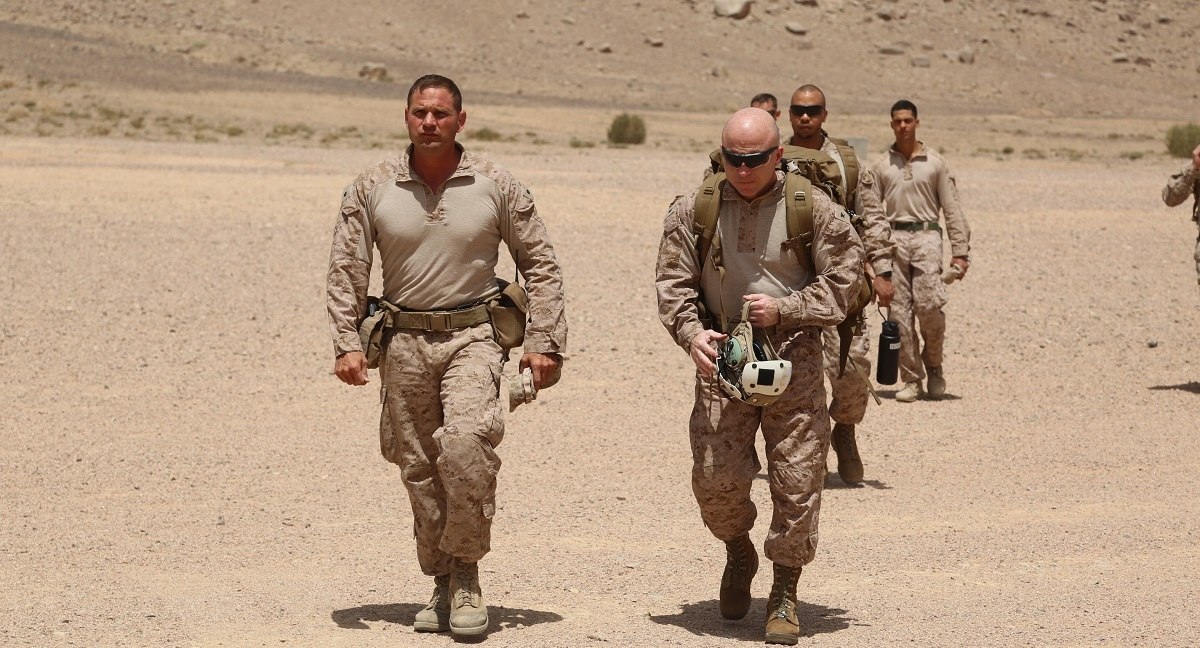
    U.S. Marine Corps Lt. Col. Marcus Mainz (left), commanding officer, Battalion Landing Team, 2nd Battalion, 6th Marine Regiment (BLT 2/6), 26th Marine Expeditionary Unit (MEU), walks with Col. Farrell J. Sullivan (right), commanding officer, 26th MEU, after landing in Jordan to observe training during exercise Eager Lion, April 19. (Gunnery Sgt. Eric L. Alabiso II/Marine Corps)

    Come on Jimbo, show us some of that Warrior Monk stuff and fix this nonsense.  Military Times reports

    An infantry battalion commander sacked in the middle of a deployment with the 26th Marine Expeditionary Unit, or MEU, was at least partially fired for allegedly using a term that could be disparaging to members of the LGBTQ community, Marine Corps Times has learned.

    Following a vandalism incident during a port call visit by the San Antonio-class amphibious transport dock New York in Gaeta, Italy, Lt. Col. Marcus J. Mainz, the commander of 2nd Battalion, 6th Marine Regiment, allegedly used the term “faggot” or “faggoty” during a meeting with the 2/6 Battalion Landing Team leaders, multiple sources have told Marine Corps Times.

    Corps officials have said Lt. Col. Marcus J. Mainz was fired May 19 over a loss of trust and confidence in his ability to lead.

    Several Marines were charged with and punished for underage drinking while on liberty during a port visit in Italy. One of those Marines was also charged with vandalizing a construction site.

    People, we all need to keep our heads until this peace craze passes.  If so-called “Leaders” turned in a BLT Commander for such nonsense the Corps needs to man the Phuck Up.  What the hell is going on in My Marine Corps?  Real Marines have been using disparaging terms for everyone forever.  Why should the LGBTQ people get special treatment?  I was always under the impression we were all equally worthless.  Is Dickweed still kosher…or is the Jew-ish thing a no go too?  I don’t understand, can somebody please help me?

  • Asking for pardon

    1LT Clint Lorance has people asking for a pardon for his for murdering two Afghan men.  According to this story, Lorance ordered his unit to shoot the two Afghans, but did not shoot them himself, and there is evidence connecting the two Afghan men to a roadside bomb that exploded.

    http://www.stripes.com/news/trump-is-asked-to-pardon-army-officer-convicted-of-afghan-murders-1.452228

    This brings up the questions about Wm. Calley’s conviction for personally shooting 22 villagers at My Lai. A total of 109 Vietnamese civilians were killed, but there was never any indication that he gave an order to his men to do that. They acted independently.

    http://www.history.com/this-day-in-history/calley-charged-for-my-lai-massacre

    The question that needs to be answered is direct. In a war zone, under direct attack or an unexpected ambush, why is it not understood that the reaction to being attacked, and subsequently trying to find the enemy to take him out, but failing and taking the anger out on the next perceived enemies is exactly what happens in warfare?

    I’m not saying it’s right when it happens. I’m questioning the lack of understanding of the reaction itself. When these accusations and charges by people who were not in the war zone are inflicted on people reacting normally under extreme duress, why is this reaction to being attacked, or not finding the enemy but finding a viable substitute, not understood?


  • Ending the 20-Year Military Retirement: Buyer’s Remorse?

    Jonn’s written previously here at TAH about that new military retirement plan the current       gang of fools and tools running the show in DC       Administration      conned Congress into passing        convinced Congress to approve.  The bottom line:  the former 20 year military retirement plan goes away, effective for people entering in 2018, in favor of a “blended” plan much like Federal civilian employees have today. (Ask most Federal civilians how much of a “good deal” the current Federal retirement system is compared to its predecessor, CSRS – which was somewhat similar to the military’s 20 year retirement. But you might want to be prepared to get an earful at high volume when you do so.)

    A major criticism of the “new plan” before it was approved was that it made early service too lucrative, and that this would lead more troops to bolt early  – resulting in a loss of experience/expertise. Well, guess what:  the Pentagon apparently is now having second thoughts for precisely that reason.

    In this year’s Defense Budget Request, DoD has proposed modifications to the changes implemented just last year.  Bottom line is that the newest proposed changes are designed to keep people in the service by making later service more attractive than earlier.

    Gee.   Seems to me that’s kinda exactly what the 20 year retirement did.  Except IMO it did it much better than either this new “blended system” or the latest changes DoD proposes to same will.

    But heaven forbid DoD admit it goofed and backtrack, even when it makes perfect sense to do so.  Just look at the F-35!

    The Army Times IMO has an article giving an overview of the Pentagon’s latest proposed changes.  It’s a bit longish, and the overall situation is somewhat complex.  But if you have interest it’s certainly worth a read.

  • Fifty Years Ago Yesterday

    On 10 August 1964, Public Law 88-408 was signed by the POTUS, and became effective.

    It’s better known today as the Gulf of Tonkin Resolution. That resolution was described by then-Undersecretary of State Nicholas Katzenbach as “the functional equivalent of a declaration of war.”

    The resolution was passed by Congress at the request of the LBJ administration in Joint Assembly of Congress on 7 August 1964.  A “pair” of “hostile fire incidents” in the Gulf of Tonkin involving US Navy ships – the destroyers USS Maddox and USS Turner Joy – on the nights of 1- 2 and 3-4 August 1964 were the stated reason for the LBJ administration’s request.

    The first incident involving the USS Maddox was legitimate. Best evidence indicates that the second “incident” involving both ships actually was not a hostile fire incident at all, but was due to sonar/radar reflections being misinterpreted as possible hostile vessels and torpedo tracks.

    In reality, there was no second “hostile fire incident”.  In 1999, Robert McNamara – SECDEF at the time of the incidents – publicly acknowledged that fact.

    The evidence also indicates that LBJ likely knew full well that the second incident was questionable, and probably had not actually happened. He chose to ask Congress for the resolution nonetheless.

    Why? LBJ was wary of appearing “soft on Communism”. His opponent in the upcoming 1964 Presidential Election – Senator Barry Goldwarter of Arizona – was widely viewed as the more strongly conservative, anticommunist candidate. Getting Congressional backing for stronger action in Vietnam would neutralize Vietnam as a political issue – particularly if LBJ reacted strongly to a “provocation”.

    Further, LBJ had been urged over 2 months earlier by his Foreign Affairs Advisor, McGeorge Bundy, to declare the defense of Vietnam “essential” to the US – and that a declaration of authority and intent to use force was desirable. And of course, there’s this statement by LBJ to the Joint Chiefs of Staff in December 1963 (some of whom were also pushing for more US involvement in Vietnam): “Just get me elected, and then you can have your war.”

    At the time of his statement to the Joint Chiefs, LBJ may well have been playing one faction against another – classic “backroom politics”, at which LBJ was a master. But by mid-1964, that no longer appears to have been the case.

    The resolution gave LBJ carte blanch authority to maneuver the US into Vietnam in strength – without further consultation with Congress. He did exactly that, by stealth, beginning in early 1965.

    After he’d been reelected.

    The Army Times has an excellent article today on the Tonkin Gulf Resolution. It’s worth a read.

    And afterwards, maybe also take a moment to remember those who didn’t come back from that questionable conflict.

  • Hate to Say I Told You So . . . .

    The Army has announced that more than 20 central boards meeting next year will also consider soldiers for involuntary separation, according to the Army Times.

    All senior NCO promotion boards meeting next year will also serve as QSP/QMP screening boards.  For those unfamiliar with the difference:  the Army’s QSP (Qualitative Service Program) is intended to reduce senior NCO populations in over-strength MOS, while the QMP (Quality Management Program) is a program that targets senior NCOs with derogatory information in their personnel files for termination of service.  This means that every E6, E7, and E8 being screened for promotion next year will also be screened for involuntary termination or forced early retirement.

    The article doesn’t specifically address officer selection boards.  However, traditionally officer promotion boards are also used to screen records on a “show cause for retention” basis.  I’m guessing that the O3, O4, O5, and O6 boards are the others not named in the article that bring the total to “more than 20”.  However, I could easily be wrong.

    This is nothing new, and this should be no surprise.  The same thing happened during the Bush(41) and Clinton administrations.  (I’m guessing it happened after Vietnam and during the Carter administration as well, but I can’t say for sure from personal knowledge.)  Hell, some QMP boards occurred during the last couple of years of the Reagan administration.

    I’m guessing the other three services are all doing something similar.

    Welcome back to the Peacetime Army.  Bless Our House It’s Christmas Almost”.