Category: Defense cuts

  • Old enough to know better.

    Old enough to know better.

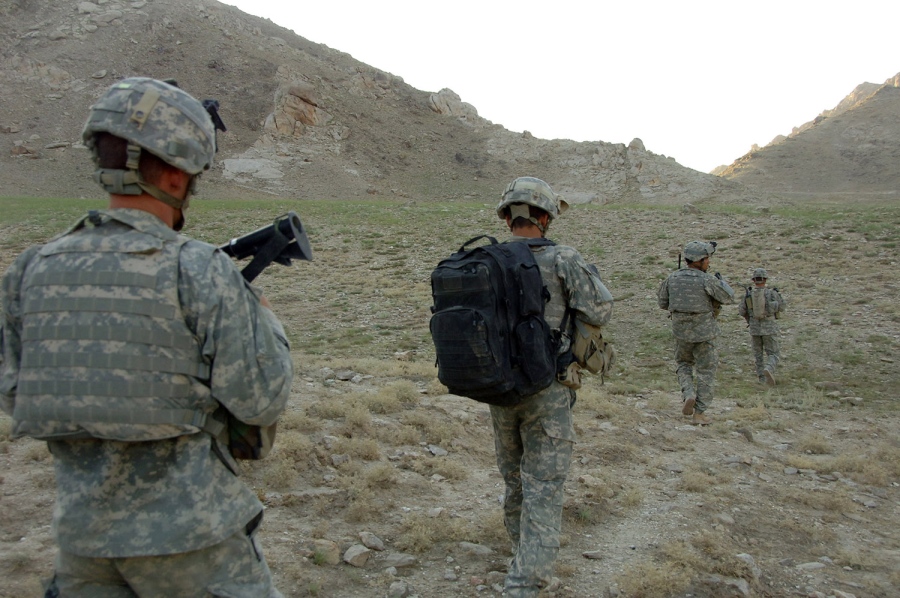
    The Army is moving forward with the deactivation of its Small-Team Reconnaissance Units.  The drawn down of military capabilities that has been going on for the last 8 years is still in motion.

    Computer models were used to conclude long-range surveillance companies were not in demand by ground commanders.

    Defense analysts have said Army commanders have an aversion to risk and a growing preference to use technology such as satellites and drones for reconnaissance rather than insert small teams of soldiers.
    Most of us have been around long enough to know that we have not always had the ability to play reconnaissance with a keyboard and a joystick.  Victory on the battlefield often requires that we have  redundant capabilities.   Using computer models as the primary justification to restructure military assets seems juvenile.

    Long-range surveillance soldiers in the model would attack large units and were killed immediately based on their coding, Scales said, delivering war planners the conclusion the units were a risky, low-reward asset.

    I am sure their computers do show that kind of result.  I can not help but wonder what their computers show happens if the damn things get unplugged.   Drawing down a capability to the point where it no longer exists will cause a loss of expertise that can not be duplicated by killers in cubicles.

    All LRS soldiers are airborne qualified, and many have graduated from Ranger and Pathfinder schools. Most LRS soldiers end up attending at the Reconnaissance and Surveillance Leaders Course at Fort Benning in Georgia — a schoolhouse that also trains units such as Navy SEALs and Marine Force Recon.

    Maybe their coding for battlefield simulations did not include having Secretary Mattis in control of the on/off button.  I certainly hope his presence makes a difference in the outcome.

  • “Today, the vast majority of Marine Corps aircraft can’t fly.”

    Fox News today has an article discussing USMC aviation readiness.  Bottom line:  not so good.  The article’s “money quote”:

    Out of 276 F/A-18 Hornet strike fighters in the Marine Corps inventory, only about 30% are ready to fly, according to statistics provided by the Corps. Similarly, only 42 of 147 heavy-lift CH-53E Super Stallion helicopters are airworthy.

    No, that’s not 100% of USMC aviation assets.  But it’s a big portion of them.  And if the article is accurate, well, . . . .

    Why?  Well, for pretty much the same reason as during the Carter Administration.  Then, we were just a few years post-Vietnam – and Carter cut the defense budget radically.  (To be fair, that began under Nixon and Ford – but continued bigtime under Carter).  Regarding similarities to the last 5 years or so . . . well, you do the math.

    I wasn’t USAF, nor was I in Army aviation.  However, I seem to remember folks in the late 1970s and 1980/81 making similar statements about USAF and Army aircraft readiness then.  And “hanger queens” weren’t exactly unknown among other types of military vehicles and/or weapons systems during that time frame, either.

    Looks like it’s, “Welcome back, my friends” – to the Carter Administration. But anyone with 3 or more working brain cells who isn’t a libidiot political apologist (and who hasn’t been living in a cave or on the moon) already knew that.

    A second quote from the linked Fox News article provided the title above.  That linked article is IMO definitely worth a read.

    Just maybe wait to read it if your blood pressure is high today.


  • Previewing our post draw down world?

    NPR is reporting that with the increasing levels of escalation by Russia that countries in Europe are finding their military forces wanting.

    Last month a Russian military aircraft flying in stealth nearly crashed into a commercial passenger plane taking off from Copenhagen. In April, Russian fighter jets carried out a simulated bombing raid on Stockholm. And nobody seems able to do anything about it.

    Why you ask?

    “The army has been reduced by 90 percent, from approximately half a million men to, today, 50,000 [troops] including the home guard, 25,000 if you just count the regulars,” he says.The story is similarly dramatic with the navy — which has been scaled back by some 80 percent — and the air force, which has slimmed down by 70 percent, according to Neretnieks.

    The line that caught my eye and should be read over and over.

    “Europe as a whole, of course, downsized their forces,” he says. “We tend to forget that things can change quicker than we thought.” “I’ve been in the armed forces since the early ’70s, and I’ve only experienced reductions,” he says.

  • Regarding USAF Personnel Cuts

    One of our readers of the USAF-persuasion recently provided a link regarding USAF personnel issues.  So thought I’d write about that too.

    As has been the case with the Army and Navy, members of the USAF are also being scrutinized for involuntary separation. The USAF recently completed a records review of 7,121 individuals in the ranks of Senior Airman through Senior Master Sergeant in “over-manned specialties”.   Of that group, 5,700 were retained – a retention rate of just over 80%. The remaining 1,421 individuals will be discharged, will be offered the opportunity to retire under temporary early retirement authority (TERA), or will be allowed to retire normally (but involuntarily) NLT 1 February 2015.  And individual’s time-in-service will determine which option(s) they can use.

    Little information was provided regarding current USAF officer force-shaping measures. The article did mention that due to voluntary losses there would be no reduction-in-force of USAF medical officers by the reduction-in-force board to be held in October.

    To put things in perspective: the number enlisted personnel selected for involuntary discharge by the USAF this year is approximately the same as the number of CPTs and MAJs that the Army has selected this year for involuntary separation.  And while I have no idea how many enlisted personnel have/will be been identified by the Army to get their walking papers this year, I’d guess that number will be somewhat larger than the number of O3s and O4s combined.  But I could be wrong.

    Still – for those selected, I’m sure they’re thinking “Bless Our Hearts, It’s Christmas Almost. Or at least thinking the acronym.

    And, yeah – being told to “hit the bricks” is one helluva Christmas present from Uncle Sam.

  • Continuation Boards – Coming Again to a Navy Near You!

    It appears as if the US Navy – like the Army – is about to engage in some “force shaping” efforts.  The Navy has announced that almost 8000 Chiefs (E7/8/9) will have their records screened for continuation in service, starting on 27 October 2014.

    The board will consider both active duty and reserve personnel.  Acitve duty personnel who had 19 years of service as of 28 February 2014, and who had 3 years time in grade as of 30 June, will be considered.  On the reserve side, only those with 20 “good” (qualifying) years for reserve retirement will be considered.

    The Navy held similar boards in FY2010-FY2013.  There was no board this year (FY2014).  But unlike previous years, no career fields will be exempted from consideration.

    No quota for eliminations was set.  Rather, based on the recommendations of Navy senior enlisted advisers the board will operate on a “pure quality cut” basis instead – whatever that means.

    Hey, at least they’re not forcing folks to retire earlier than 20.  Still – for some, it looks like it will soon be, “Bless Our Home It’s Christmas Almost”.


  • Along With the A-10, Wanna Guess What Else The Air Force Wanted to Ax?

    If you guessed the U-2 – formerly the TR-1 – give yourself a pat on the back.

    Yes, you read that correctly.  Although I don’t remember hearing much about it at the time, buried in the USAF’s fleet retirement proposals back in February was a proposal to retire the U-2 along with the A-10.  The stated reason was that RPV’s could now perform the mission at an acceptable cost.

    Color me a bit skeptical.  In prior years, the USAF had stated outright that even our latest RPVs couldn’t perform that mission an affordable cost.  And despite recent improvements in the efficiency of RPV operations (and thus lower operating costs), not long ago the USAF also said that RPVs still don’t provide equivalent SIGINT and IMINT capabilities to those provided by the U-2.  I’m guessing that’s still the case today.

    As I understand it, RPVs today still can’t carry some of the U-2’s sensor packages – so either the platforms or their sensors will have to be substantially “improved” to do so.  And we all know that improvement will be a “snap”, and will be really cheap and quick too.

    Oh, and the USAF is also scaling back it’s proposed RPV fleet, too.

    Congress appears to have put the kibosh on this proposal for now.  For once, maybe we owe Congress a bit of thanks.

    Hey, I realize the USAF needs to modernize.  But throwing the baby out with the bath water has always seemed to me to be, well, kinda stupid.  And regarding the U2, IMO it looks like exactly that was what the USAF was proposing.

    Must be something in the water that the Air Staff drinks these days.  Maybe the old Cold War TAC insult is becoming apropos again:  “Hell, those boys done been SACumcized – and forgot how to fight a war!”

  • YRGBSM!! (the “R” Stands for “Really”)

    I wish I were, and that this article of mine was fiction.  Sadly, I’m not – and it isn’t.

    DoD is buying “green fuels”.  We all knew that.  Hell, it’s one of this administration’s   obsessions    apparent means of political payback    wealth redistribution mechanisms    truly stupid ideas   pet projects.

    But this time, what DoD’s done IMO really takes the cake.  Let me assure you – you don’t want to know what DoD has been paying for “green” jet fuel.

    You probably need to know.  But you don’t want to know.

    The article documenting just how badly Uncle Sam is taking it in the . . . ear regarding some of this type of “green fuel” can be found here.  It’s so damn bad I’m intentionally omitting some of the details in this article.

    If you really want to get p!ssed, follow the link and read it.  If you have even two or more working brain cells and pay taxes I’m pretty sure you will be seriously angry after reading it.

    And yeah – one of the guys heavily invested in the firm getting top dollar is a big donor to the current Administration’s political party.

    Given what else is going on with the DoD budget these days, this is particularly galling to me.  But maybe that’s just me.

    Sheesh.  GMAFB.


    (Edited to add:  hat tip to the Drudge Report for the link.)

  • More About the Current Army Cutbacks

    Many have probably heard that the Army is cutting 10 Brigade Combat Teams (BCTs) this year and next .  It’s doing this in order to reduce end-strength to 490,000 (active component) by the end of FY 2015.

    For those interested, here’s the list of which units have/are scheduled to inactivate.

    Already inactivated:

    • 4th BCT, 1st Cavalry Division (Fort Hood) – inactivated last October
    • 4th Stryker BCT, 2nd Infantry Division (JB Lewis-McChord) – inactivated in March
    • 4th BCT, 101st Airborne Division (Fort Cambell) – inactivated in April

    Scheduled to be inactivated:

    • 4th BCT, 82nd Airborne Division (Fort Bragg) – to be inactivated in June
    • 3rd BCT, 1st Infantry Division (Fort Knox) – to be inactivated in July
    • 3rd BCT, 10th Mountain Division (Fort Drum) – to be inactivated this fall
    • 2nd BCT, 3rd Infantry Division (Fort Stewart) – to be inactivated during winter 2015
    • 2nd BCT, 4th Infantry Division (Fort Carson) – to be inactivated during winter 2015
    • 3rd BCT, 1st Armored Division (Fort Bliss) – to be inactivated during spring 2015
    • 4th BCT, 1st Infantry Division (Fort Riley) – to be inactivated during summer 2015

    The unit inactivations at Forts Knox, Carson, Bliss, and Riley will require a substantial number of soldiers to PCS.  The unit inactivations at Forts Drum and Stewart will not require very many PCS moves, as soldiers assigned to the inactivating BCTs at those locations will be reassigned to other units on their current installation.

    The current reductions are in conjunction with scheduled Army end-strength reductions.  They will reduce the Army’s overall end strength to 980,000 (450,000 Active/195,000 USAR/335,000 ARNG) by FY 2017.

    Additional unit inactivations may be forthcoming.  The Army is looking at potential options reducing the Army’s overall strength further after 2017, to a possible end-strength of 920,000 (420,000 Active/185,000 USAR/315,000 ARNG).

    The Army Times has a decent article giving more details.  It’s worth reading if you have the time and inclination.

    Yeah, we can give out free phones and pay for people’s groceries while they sit on their azz, eat Cheetos, and play X-Box.  And we can keep funding Social Security “disability” and unemployment, and giveaway “free” medical care subsidies.

    But we can’t figure out how to pay for an adequate defense.  And we don’t seem to be able to figure out that Social Security and Medicare  are about to go belly up – in about 20 years.

    Ain’t life wonderful?