Category: Air Force

  • Air Force Portraits in Courage

    The Secretary of the Air Force’s Public Affairs Office sent us a link to their new website “Portraits in Courage” which features the stories of 20 Airmen;

    “Portraits in Courage highlights the honor, valor and devotion of our Airmen who have risked life and limb so that others may live. They are the best of the best and exemplify our core values of integrity, serivce and excellence,” said Mr. Donley upon announcing the names at today’s opening ceremony of Air Force Week New York City at the Intrepid Sea, Air, Space Museum.

    This series highlights Airmen who display exceptional bravery and determination in the face of especially challenging or dangerous circumstances. To date, the Air Force has recognized 153 Airmen through this project.

    There are some pretty studly stories in the mix. Here’s a taste;

    Tech. Sgt. David Perez, 377th Logistics Readiness Squadron, Kirtland Air Force Base, N.M.

    While serving as a convoy commander in Iraq, a high-speed collision between two Iraqi passenger vehicles occurred near the convoy. Both vehicles burst into flames. Perez halted the convoy and directed his fellow service members to render aid. They saved four lives, including two children.

    Tech. Sgt. Scott Saenz, 375th Civil Engineer Squadron, Scott AFB, Ill.

    While serving on an explosive ordnance team in Afghanistan, Saenz’s team leader was seriously injured by an improvised explosive device. Without concern for his personal safety, Saenz rushed through dangerous terrain to render life-saving medical assistance to his team leader.

    Staff Sgt. Jeffery Salazar, 22nd Special Tactics Squadron, Joint Base Lewis-McChord, Wash.

    While serving as a joint terminal attack controller in Afghanistan, Salazar and Soldiers from a special forces unit were attacked by Taliban. While engaging the enemy with his rifle, a grenade explosion knocked him off his feet. Though he received fragmentation injuries, Salazar fought through the pain, continuing with the four-hour engagement until the mission was complete.

    Staff Sgt. Vanessa Salzl Bibb, 59th Medical Wing, Joint Base San Antonio, Texas

    While serving on a provincial reconstruction team that was attacked in Afghanistan, the aeromedical technician facilitated the treatment of 14 critically-wounded personnel, all of whom lived. She later helped evacuate coalition casualties from a burning building and helped fight the fire.

    Staff Sgt. Travis Sanford, 10th Combat Weather Squadron, Hurlburt Field, Fla.

    During an attack by insurgents in Afghanistan, Sanford rendered life-saving medical attention to a Marine while exposing himself to enemy fire. He then helped load the Marine on stretcher and moved him to an evacuation point, while further exposing his position to the enemy. Throughout the ordeal, Sanford continued to perform his duties as a special operations weatherman. Once the patient was loaded onto a helicopter, Sanford ran back to join his teammates in the firefight.

    Staff Sgt. Ben Seekell, 4th Security Forces Squadron, Seymour Johnson AFB, N.C.

    While serving on a security mission in Afghanistan, Seekell and his working dog Charlie were injured by an explosion. Despite losing his leg, Seekell was determined to return to duty with Charlie at his side. He had to endure multiple surgeries and countless hours of physical therapy. Only eight months after sustaining his injuries, Seekell managed to score a 93.5 percent on his Air Force physical fitness test, and eventually returned to duty with his partner.

    Master Sgt. Christopher Uriarte, 212th Rescue Squadron, Joint Base Elmendorf-Richardson, Alaska

    Uriarte and his pararescue team were assigned a mission to rescue to rescue the crew and passengers of a civilian aircraft that crashed in Alaska’s Chugach Mountains. Due to heavy winds, the team had to land on a glacier that was 3,000 feet beneath and five miles from the crash. After nearly 24 hours of non-stop climbing, they finally reached the crash site and were able to treat those who were injured.

    Staff Sgt. Trevor Brewer, 48th Security Forces Squadron, Royal Air Force Lakenheath, U.K.

    As Brewer waited on a bus with 14 other security forces Airmen in Frankfurt, Germany, when a gunman boarded the bus and began shooting. Brewer managed to distract the gunman, chased him off the bus through the crowded airport terminal to a place that prevented the gunman’s escape until German police arrived.

    Senior Airman Veronica Cox, 33rd Rescue Squadron, Kadena Air Base, Japan

    After a massive earthquake rocked northeastern Japan, Cox, an intelligence analyst fluent in Japanese, volunteered to help. While serving with an air crew on a search and rescue mission, Cox spotted an emergency message crafted out of rocks on the roof of a building in an isolated town. Further investigation by her team led to the rescue of 200 Japanese civilians. As the only Japanese speaking member of the crew, she was able to relay precise medical and survival requirements to Japanese disaster response teams.

    Capt. Jennifer Curtis, 75th Medical Operations Squadron, Hill AFB, Utah

    As her camp in Afghanistan was attacked, Curtis, a family nurse practitioner, Curtis identified six injured service members, dragged them into the medical facility and provided treatment until medics arrived. Later during her deployment, she treated a local woman who was having a heart attack in the midst of being attacked by rocket-propelled grenades and small arms fire.

    Capt. Darrel Deleon, 1st Space Operations Squadron, Schriever AF, Colo.

    While serving in Afghanistan, DeLeon’s camp was attacked by a team of insurgents. As he joined the fight, he noticed a downed Soldier still vulnerable to enemy fire. Without concern for his personal safety, DeLeon, a former Army medic, pulled two injured Soldiers from harm’s way, rendered first aid and transported them to a medical facility.

    Tech. Sgt. Matthew Schwartz, 90th Civil Engineer Squadron, F.E. Warren AFB, Wyo.

    While serving in support of a joint combat operation in Afghanistan, Schwartz methodically cleared a path through hostile territory, effectively locating and neutralizing two explosive devices. During the operation, a device targeting his vehicle detonated, leaving Schwartz mortally wounded.

    Master Sgt. Kevin Wallace, 100th Air Refueling Wing, Royal Air Force Mildenhall, U.K.

    While serving with Army scouts in Afghanistan, Wallace and the team were attacked with rocket-propelled grenades and small arms fire. Throughout the initial stages of the fight, he alternated between engaging the enemy with his rifle and documenting the fight with his camera. He was eventually wounded and knocked unconscious, but recovered quickly and joined the fight, helping to pinpoint enemy locations and investigating an evacuation route for the wounded. Due to his contributions, none of the injured Soldiers were killed.

    Master Sgt. Angela Blue, 355th Medical Operations Squadron, Davis-Monthan AFB, Ariz.

    While deployed to Afghanistan, Blue’s base came under attack. She triaged the wounded, directed medical care and arranged for medical evacuation while still under attack. While traveling in a resupply mission later in her deployment, she provided immediate medical care that saved the lives of four Afghan soldiers who were injured by roadside bomb. Just hours later, Blue sustained combat-related injuries and required medical evacuation after her vehicle was struck by another roadside bomb.

    Capt. Barry Crawford Jr., 104th Fighter Squadron, Md.

    Throughout a ten-hour fire fight with insurgents, Crawford exposed himself to grave risk on four separate occasions while helping to evacuate wounded Soldiers and Afghan commandos and pinpointing enemy locations to better coordinate airstrikes. More than 80 insurgents were killed during the fight.

    Tech. Sgt. Tavis Delaney, 116th Air Support Operations Squadron, Camp Murray, Wash.

    After his team was pinned down by a Taliban ambush in Afghanistan, Delaney coordinated airstrikes that allowed the team to reposition. As the 15-hour fight went on Delaney helped guide 26 strikes on heavily fortified enemy positions. The 250 enemy fighters were completely decimated while not a single American or allied service member was significantly injured or killed.

    Lt. Col. Karl Ingeman, 555th Fighter Squadron, Aviano Air Base, Italy

    While flying an F-16 as part of Operation Odyssey Dawn in Libya, Ingeman responded to two aircrew members who ejected from their F-15E. As ground forces closed in on the downed aircrew, Ingeman and his wingman flew into hostile air space within range of enemy surface-to-air weapons. He helped identify the aircrew’s location and performed two low-altitude, high-speed passes over enemy vehicles as a show of force, effectively dispersing them away from the downed aircrew.

    Staff Sgt. Christopher Jarrell, 81st Security Forces Squadron, Keesler AFB, Miss.

    After coming under attack while serving with Soldiers in Afghanistan, Jarrell, a military working dog handler, provided suppressive fire that enabled the recovery of injured or wounded service members. After the team’s mine-detecting equipment was abandoned during the fight, Jarrell, with the help of his dog Toki, stepped up to search for mines along a path leading to a safe position for ammunition resupply and medical evacuation.

    Staff Sgt. Kyle Klapperich, 23rd Special Tactics Squadron, Hurlburt Field, Fla.

    Klapperich served as the sole medic on a team of Navy Seals and Afghan commandos in support of Operation Enduring Freedom. While performing an operation near an insurgent stronghold, the team found themselves in an area full of improvised explosive devices. After a first explosion, Klapperich rendered aid to several members of the team, including an Afghan commando who was critically injured and fell onto a pressure plate IED. Klapperich continued to render medical care even as an explosive ordnance specialist disabled the explosive.

    Capt. Blake Luttrell, 21st Special Tactics Squadron, Pope Field, N.C.

    While battling insurgents in Afghanistan, Luttrell aggressively engaged the enemy in order to recover a wounded Soldier, rendered life-saving medical care, then coordinated a show of force with attack helicopters and established a safe landing zone to medically evacuate the wounded Soldier. He then proceeded to coordinate the release of a 2,000 pound bomb that effectively ended the enemy resistance.
  • Lackland Commander relieved in wake of sex scandal

    The Associated Press reports that the commander of the Air Force’s basic training installation has lost his job over the widening sex scandal at the base;

    Col. Glenn Palmer was commander of basic training for the 737th training group at the Texas base, where more than a dozen military instructors in the past year have been investigated or charged with sexually assaulting recruits. Officials familiar with the decision said Palmer has been relieved from those duties, speaking on condition of anonymity because the announcement was not yet public.

    The officials said there was no indication Palmer was facing any criminal charges. In all, six instructors have been charged with offenses ranging from rape to adultery.

    Investigators say more than three dozen female trainees have been victimized by male instructors at Lackland, where approximately 35,000 airmen graduate each year.

    I’m not going to deny that sexual assault doesn’t occur in the military. In fact, I tried to punish one of my NCOs when I worked at HHC 10th Mountain Division who thought it would be a good idea for him to walk through the female barracks, drunk, in an open robe wearing Daisy Dukes, calling a certain young soldier who he thought was particularly attractive. She called me at home late on a Sunday night, which didn’t bode well for anyone.

    I wasn’t successful getting him punished, but I did get him fired. I think it affected my other NCOs in that they behaved themselves in public, anyway. Of course, while I was trying to get him some NJP, it was a major battle between me, the commander and 1SG, because they didn’t think his behavior rose to the level of punishment, but I was just trying to protect them by urging them to take action. But, I guess some people don’t see sexual misbehavior as all that serious. So, I got them to move him to the Division TOC and away from my females.

    I’ve seen it the other way, too. One of my female soldiers thought that I should give her a sexual end-of-tour award on her last day in the unit and she became quite adamant about it. Yeah, it didn’t happen, but I probably could have had her busted for sexual assault, but actually, I just wanted her gone. I guess pretty 20-year-olds aren’t all that accustomed to people telling them ‘no’.

    But, yeah, I’ll admit that it happens, and commanders who aren’t willing to do something about it deserve what they get.

  • This Had to Be Kinda Embarrassing . . . .

    Dunno if everyone caught this, but apparently late last week the crew of an ANG C17 made a minor error.

    Well, maybe “minor error” is a slight understatement. The error consisted of landing on a 3,500’ runway at an airport on an island near Tampa vice the 11,000’ runway at MacDill AFB a few miles away.

    I’m guessing that landing certainly made for a high APF day for those onboard.

    There was no crash, and the aircraft was apparently not seriously damaged. It was later able – after removing cargo and pax – to fly out and return to operational use.

    Kudos to the pilot for managing to land safely on a very short runway. But I’m guessing he or she has a bit of explaining to do. And I’m also guessing his/her career prospects may well have taken a rather sharp downturn, at least in the short-term.

    Predictably, the incident has generated a bit of discussion.  I’m no aviator, so I’ll pose my questions here:

    • Just how bad of a screw-up was this?
    • Do the pilot/co-pilot need to start working on their resumes and/or making plans on how to use their GI-bill to get education/training in a different career field?
    • Has this incident killed their chances of getting post-service employment in the commercial aviation industry?
  • Six Airmen come home after 47 years

    SGT K sends us this link to an article in Fox News/Associated Press about 6 airman shot down over Laos in 1965 who are finally coming home;

    The burial comes after the recovery of remains in 2010 and 2011 by joint U.S.-Laotian search teams. Examiners relied on dental records, personal items recovered from the site and circumstantial evidence to conclude that the recovered remains are representative of all six Air Force servicemen: Col. Joseph Christiano of Rochester, N.Y.; Col. Derrell B. Jeffords of Florence, S.C.; Lt. Col. Dennis L. Eilers of Cedar Rapids, Iowa; Chief Master Sgt. William K. Colwell of Glen Cove, N.Y.; Chief Master Sgt. Arden K. Hassenger of Lebanon, Ore.; and Chief Master Sgt. Larry C. Thornton of Idaho Falls, Idaho.

    The Air Force gave all six posthumous promotions, a military spokeswoman said.

    Welcome home.

  • Cadets pay homage to their favorite President

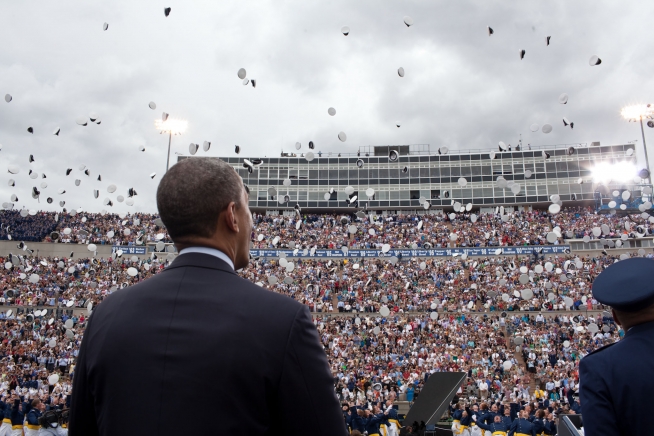
    So on my usual trip through the blogs and Facebook, I came across Uncle Jimbo’s post about the Me-Me-Me-Memorial Day about the memorial Day Photo of the Day at the White House website. Since I have an interview this afternoon with Politico on the subject of the presidential candidates using the troops for political props, I went through some more of the White House photos of the day and got to this one on May 23rd;

    It looks like the Air Force academy cadets are cheering their favorite president rather than just engaging in a centuries old tradition of tossing their caps in the air after they graduate, doesn’t it?

  • Warriors over Wasatch

    Photobucket

    Dead Man sends us some pictures from his trip to Warriors Over Wasatch airshow yesterday at Hill Air Force Base, UT.

    Photobucket

    The Salt Lake Tribune estimated the crowd at 100,000;

    The day culminated with the F-16 Thunderbirds — in a precisely choreographed series of moves that included the neat diamond formation, knife-edge passes, maximum-performance turns, crossovers, inverted rolls and more — thrilling the crowd.

    Stewart and Ruth Hunsaker drove in from Smithfield Saturday afternoon.

    “It just shows the thousands of hours that these guys put in for training,” said Stewart Hunsaker, a retired national guardsman. “I never get tired of seeing them fly. They put on a fantastic show — heck yeah, that’s why I came.”

    Photobucket

    Photobucket

    There are more pictures at Dead Man’s Photobucket. Enjoy

  • “I wanted to see how you could sit in that little seat with balls as big as you’ve got.”

    Generally, the USAF has the reputation of being the least “hardcore” of all of the armed services. No offense to any of our USAF brethren, but IMO that reputation is at least partly deserved. That shouldn’t really surprise anyone; a much smaller portion of the USAF directly and personally engages the enemy than the Army or USMC – or even the Navy. Proportionally more of the USAF is engaged in support. It takes a helluva lot of effort to keep those birds flying.

    Still, some in the USAF do indeed personally go into harm’s way and engage. And some members of that service exhibit truly astonishing valor in combat. I’m about to relate a brief version of one such case, and link to a more detailed – and riveting – account. And in all of US military history, it is unique in two respects.

    The story is that of Lt Col Joe Jackson, USAF. I won’t attempt to relate the whole story here; our friend Doug Sterner has covered that in great detail – and far better – than I ever could on his Home of Heroes website.
    For full details, follow the link below to Doug’s website; the story is truly well-written, and transfixing. His story would be difficult to believe were it presented as fiction – but it’s the God’s honest truth.

    Here are the bare bones of the story:

    In Vietnam in 1968, MACV made the decision to abandon a particular base, Ap Bac Kham Duc. During the evacuation, three Airmen were inadvertently left behind. As the base area was literally being overrun by hostile forces, multiple attempts were made to rescue these three individuals. All but the last of these efforts were unsuccessful, resulting in numerous US casualties.

    During the last failed rescue attempt, Lt Col Jackson was literally flying a routine mail delivery mission in a C-123. Hearing the last failed attempt on the radio, and realizing that he was likely his three brothers-in-arms last hope, Lt Col Jackson went to Ap Bac Kham Duc, combat landed his C-123 under fire, and rescued the three who’d been left behind.

    The unique aspects? Here’s the first: it’s the only MOH action for which photographic evidence of the actual heroic act exists. An aerial photo was taken of Lt Col Jackson’s aircraft while on the ground at Ap Bac Kham Duc during the rescue.

    The second? This MOH action yielded what is perhaps the ultimate compliment ever given from one warrior to another. That compliment is the title to this article. It was delivered to Lt Col Jackson by one of the men he’d rescued – Sgt Jim Lundie, USAF. It was delivered after Sgt Lundie had just spent 3 days on the ground, surrounded by enemy, hiding and/or running for his life, expecting at any moment to die or be captured. Sgt Lundie visited the cockpit of Lt Col Jackson’s plane while en route back to base after being rescued. He delivered that compliment then and there, spontaneously, in person.

    After reading the detailed account of the rescue, I kinda wonder the same.

    Doing this in any aircraft would be an amazing feat of both flying ability and courage. However, I’ve flown in a C-123. Doing this in a freaking C-123. . . . well, let’s just say that IMO Sergeant Lundie was absolutely on target with his compliment.

    Again, Doug tells the story on his website better than I can. It’s definitely worthwhile to take the time and read his article.

    This happened on May 12, 1968 – Mother’s Day. I guess you could call it a Mother’s Day present from Lt Col Jackson to the mothers of those he rescued. And tomorrow this Sunday is Mother’s Day 2012 – 44 years later.

    As of this writing, this American hero is still alive. Kudos, Colonel Jackson. Kudos.

  • Air Force walks back on 2008 DADT discharge

    Apparently, the Servicemembers Legal Defense Network (SLDN) and the law firm, Morrison & Foerster thought this was important enough to send us a press release. I wonder why. But it looks like the Air Force is reinstating Staff Sergeant Anthony Loverde who was discharged under the Don’t Ask, Don’t Tell policy;

    “I am honored and humbled to return to the service of my country and the job I love. I am grateful to my legal team and all of those in the armed forces who helped to facilitate this reinstatement. I am eager to take the oath and get to work,” said Loverde.

    Loverde’s reinstatement is the result of a resolution on his behalf in the historic case, Almy v. U.S., filed in 2010, which challenges the constitutionality of the three plaintiffs’ discharges under DADT and seeks their reinstatement to active duty. A resolution was reached in December 2011 on behalf of Petty Officer 2nd Class Jase Daniels, who was reinstated in the U.S. Navy as a linguist. A resolution on behalf of the third plaintiff in the case, former Air Force Major Mike Almy, is expected soon.

    Yeah, that’s pretty much stupid. The problem is that they were removed from the service while it was the policy of the military that they adhere to easily definable constraints, and they refused to fulfill their end of the bargain. They couldn’t keep their mouths shut about their sexual proclivities, and all they had to do was not admit that they were deviants. How hard is that? Too hard, apparently. When you break the law, you break the law.

    Of course, the press release calls the policy “discriminatory”, which it most certainly was NOT. What’s discriminatory is the way straights are forced to tolerate this deviant behavior while we’re not allowed to complain about it. That’s oppressive.

    “This historic reinstatement again reminds us that today’s military is a welcoming place for qualified patriots whose careers were cut short by the unjust ‘Don’t Ask, Don’t Tell’ law. This victory is unique because it is a reinstatement – not just a reentry – meaning that Sergeant Loverde will return to his previous rank and be able to continue his career as if it had never been interrupted.

    Even though he couldn’t follow a simple policy, he’s returned as if nothing ever happened. Why would the Air Force want him back? What if he decides that haircut policies are “discriminatory”? Or uniform standards? Maybe we can see Soup Sandwich returned to the Air Force because he thinks their policy against huffing shoe polish discriminates against idiots?