Category: Air Force

  • Seventy Years Ago Today: Black Sunday

    We of the other services sometimes chide our Air Force brethren for not being “hardcore” enough. And in some respects, that’s certainly true.  The Air Force lifestyle is in general  considered the least stressful of any of the military services.  Ground combat it ain’t – by design.

    Still, some in the Air Force are certifiably hardcore at times.  And seventy years ago today, “hardcore” doesn’t even begin to describe the actions of a group of roughly 1650 Army Air Forces personnel.

    Today marks the seventieth anniversary of one of the most costly US operations in World War II:  Operation Tidal Wave.  This operation was a large-scale bombing raid on oil facilities near Ploesti, Romania.  It was executed by elements of the 8th and 9th Army Air Forces.

    As in many wartime operations, politics played a part.  The operation had been agreed to by the POTUS and British Prime Minister at their conference in Casablanca in January 1943.

    It wasn’t solely a political target, though.  The Ploesti oil facilities were chosen as the operation’s target as they were believed to be a critical part of the “Achillies heel” for the Axis war effort:  POL production.  Postwar analysis was to show that this assessment regarding Axis POL production was correct – even if for many reasons Ploesti turned out not to be a single point of failure.

    (more…)

  • Airman earns second Silver Star

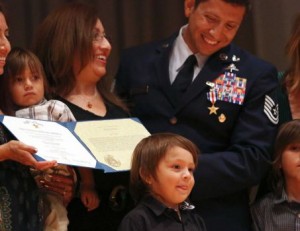
    Ismael Villegas

    In the Air Force Times, is a story about Tech Sergeant Ismael Villegas who has been awarded a second Silver Star for his actions in Afghanistan in 2011;

    During a battle early in the mission, a friendly element was pinned down by hostile fire. Villegas ran toward the troops to get a sight on the insurgent’s position. While completely exposed to the small arms fire, Villegas coordinated with an overhead remotely piloted aircraft and fixed-wing air support to drop 14,000 pounds of bombs.

    In another instance, Villegas volunteered for a patrol to explore the area, and his team came under enemy fire. The group was inside a structure, stacked up on a door, when an RPG hit. Shrapnel shredded the wall in front of them and hit a Green Beret soldier next to him.

    “I heard the screams, so I grabbed him, pulled him back and began directing air support in the area,” he said.

    Villegas moved between his team and the enemy, providing additional cover fire and controlled close air support within 60 meters of him to stop the onslaught and help the patrol fight their way over the kill zone.

    From Stars & Stripes;

    A Silver Star citation credited Villegas, a native of Mexico City, with controlling 40 aircraft that dropped 32,500 pounds of bombs over his 18-day mission. It also said he constantly risked his life during a series of engagements.

    Thanks to David for the links.

  • AF sergeant gets accomplice to stab her to get out of PT test

    I saw this yesterday on Facebook but GunzRunner sent us the link from the Air Force Times today to the story of an Air Force Staff Sergeant who enlisted the help of an accomplice to stab her so she wouldn’t have to take her PT test;

    Mona told San Diego police Feb. 27 she was grabbing a smoke outside her house before work when she saw someone standing by her car and decided to check it out, according to the charge sheet. “The person pulled my hair, stabbed me in the stomach and ran off,” she reportedly told a detective.

    A few days later, on March 6, she offered another account of the stabbing, the charge sheet said. “A man jumped out from the side of the bushes, yanked my hair, pulling my head downward, and shoved what I think was a knife through my side.” She gave a description of the alleged assailant: dark hooded sweater, jeans and dark tennis shoes.

    Neither version was true, however.

    I guess there could be a market out there for folks to stab Airmen on the day of their PT test.

    Following a two-day sentencing hearing, the military judge sentenced Mona to confinement at Vandenberg Air Force Base, Calif., reduction in rank to E-2, forfeiture of $1,805, and an official reprimand.

    How much do you not want to run that one-mile course? Of course, it reminded me about the post we wrote nearly four years ago. I wish I could find our posts about the Air Force LTC who was whining about how hard the PT test is for old guys. I think his ex-wife chimed in on that one.

  • Forest Service & DoD fighting fires in Colorado

    It hasn’t been in the news very much, but apparently, there are wildfires roaring in Colorado. Thousands of people have been evacuated from their homes. The Forest Service emails us that they’re on the job along with Department of Defense air assets;

    WASHINGTON, June 12, 2013 — The U.S. Forest Service is mobilizing two Department of Defense C-130s equipped with Modular Airborne Firefighting Systems, known as MAFFS, to assist with wildfire suppression efforts in Colorado and elsewhere in the West as needed.

    The systems will be provided by the 302nd Airlift Wing, Air Force Reserve, Peterson Air Force Base, Colo. They will be based in Colorado Springs, Colo., and will begin flying wildfire suppression missions as soon as safe and effective operations can be established.

    “We are experiencing an uptick in wildfire activity and we are mobilizing MAFFS to ensure that we have adequate air tanker capability as we confront explosive wildfire conditions in Colorado, New Mexico, and elsewhere in the West,” said U.S. Forest Service Chief Tom Tidwell. “Maintaining adequate aerial firefighting capability is critical to provide support to, and enhance the safety of, the firefighters on the ground who are working so hard to suppress wildfires that are threatening lives, homes, infrastructure, and valuable natural and cultural resources.”

    Modular Airborne Firefighting Systems are portable fire retardant delivery systems that can be inserted into military C-130 aircraft to convert them into large airtankers when needed. Military C-130s equipped with the systems can drop up to 3,000 gallons of fire retardant on wildfires. They can discharge their entire load in under five seconds or make variable drops.

    Airtankers are used in wildfire suppression to deliver fire retardant to reduce the intensity and slow the growth of wildfires so that firefighters on the ground can construct containment lines safely, which is how wildfires are suppressed. Fire retardant is not typically used to suppress wildfires directly. Professional fire managers decide whether to use airtankers to deliver fire retardant , and where to use them, based on the objectives they have established to manage wildfires and the strategies they are using to achieve them. Airtankers are not requested for all wildfires.

    The Modular Airborne Firefighting Systems program is a joint effort between the U.S. Forest Service and Department of Defense that has been in place for 40 years. The U.S. Forest Service owns the Modular Airborne Firefighting Systems equipment and supplies the retardant, while the Department of Defense provides the C-130 aircraft, flight crews and maintenance and support personnel to fly the missions.

    The U.S. Forest Service has a total of eight Modular Airborne Firefighting Systems ready for operational use. Military installations in Wyoming, North Carolina, California, and Colorado provide C-130s to fly the missions. Specifically, the 153rd Airlift Wing, Wyoming Air National Guard, Cheyenne; the 145th Airlift Wing, North Carolina Air National Guard, Charlotte; the 146th Airlift Wing, California Air National Guard, Port Hueneme; and the 302nd Airlift Wing, Air Force Reserve, Peterson Air Force Base, Colo.

    In 2012, Modular Airborne Firefighting Systems delivered 2.4 million gallons of fire retardant while flying wildfire suppression missions in Colorado, Wyoming, South Dakota, Montana, Utah, Idaho, Oregon, California, and Nevada. That was the second busiest year for the systems in at least the last 20 years. 1994 was the busiest year, when they delivered more than 5 million gallons of fire retardant while flying wildfire suppression missions.

    Over the last 10 years, military C-130s equipped with Modular Airborne Firefighting Systems have delivered a total of approximately 8.5 million gallons of retardant on wildfires, an average of about 850,000 gallons per year.

    Each year, an average of nearly 75,000 wildfires burn an average of more than 7 million acres of private, state, and federal land in the United States.
  • Brandon Bryant: Drones gave me PTSD

    Y’all have been sending us this link all day from NBC about Brandon Bryant, the former drone operator from 2006 until 2011 when he left the service to be a media darling, apparently. He says that he killed 1,626 people from his desk chair in Nevada. I wonder if anyone, besides me, has bothered to do the math – that’s 325 people a year. Almost one a day for the entire time he was in the service, from day one at Basic Training. If it were true, and I doubt it, I’d say the drone program is doing a great job.

    But we discussed Bryant in December and some of the folks who worked with him said that he was full of shit. His favorite story, he repeats in the NBC article – that he saw a child going into a goat shed just as he was blowing it up (because the US war machine hates goat sheds, for some reason) and he was wracked by the guilt of not aborting the Hellfire before impact. His mates said that there’s a delay in the video image, ya know, after going halfway around the world and all, so the missile had actually impacted on the goat shed by the time he saw the child on the video screen, if the story is even true.

    His mates said that Bryant was actually a drone operator, but that none of the things he is telling the media is true. Besides, in the same character as Breanna Manning, Bryant isn’t supposed to be talking about anything he does, so it stands to reason that he’d tell the media stuff like this because none of it is true and he can’t get in trouble with his chain of command (he’s still in the IRR).

    In the original post he told the Daily Mail that he “accidentally” joined the Air Force after the Army recruiter said he should join the Air Force. Yeah, I’m sure. I’m going to trust his mates on this one and file him under shitbag.

    When he told a woman he was seeing that he’d been a drone operator, and contributed to the deaths of a large number of people, she cut him off. “She looked at me like I was a monster,” he said. “And she never wanted to touch me again.”

    So why did he feel that he needed to tell this unknown woman that story? She probably knew he was lying, and a fan of TAH.

  • 10 camouflaged patterns is nine too many

    When I left the military in 1994, there was one camouflaged pattern for all of the services – the “woodland” pattern, and we also had a desert uniform for people who were living in the desert. But as the Washington Post reports, the Pentagon has ten different patterns that it’s paying for with tax payer dollars;

    Today, there is one camouflage pattern just for Marines in the desert. There is another just for Navy personnel in the desert. The Army has its own “universal” camouflage pattern, which is designed to work anywhere. It also has another one just for Afghanistan, where the first one doesn’t work.

    Even the Air Force has its own unique camouflage, used in a new Airman Battle Uniform. But it has flaws. So in Afghanistan, airmen are told not to wear it in battle.

    In just 11 years, two kinds of camouflage have turned into 10. And a simple aspect of the U.S. government has emerged as a complicated and expensive case study in federal duplication.

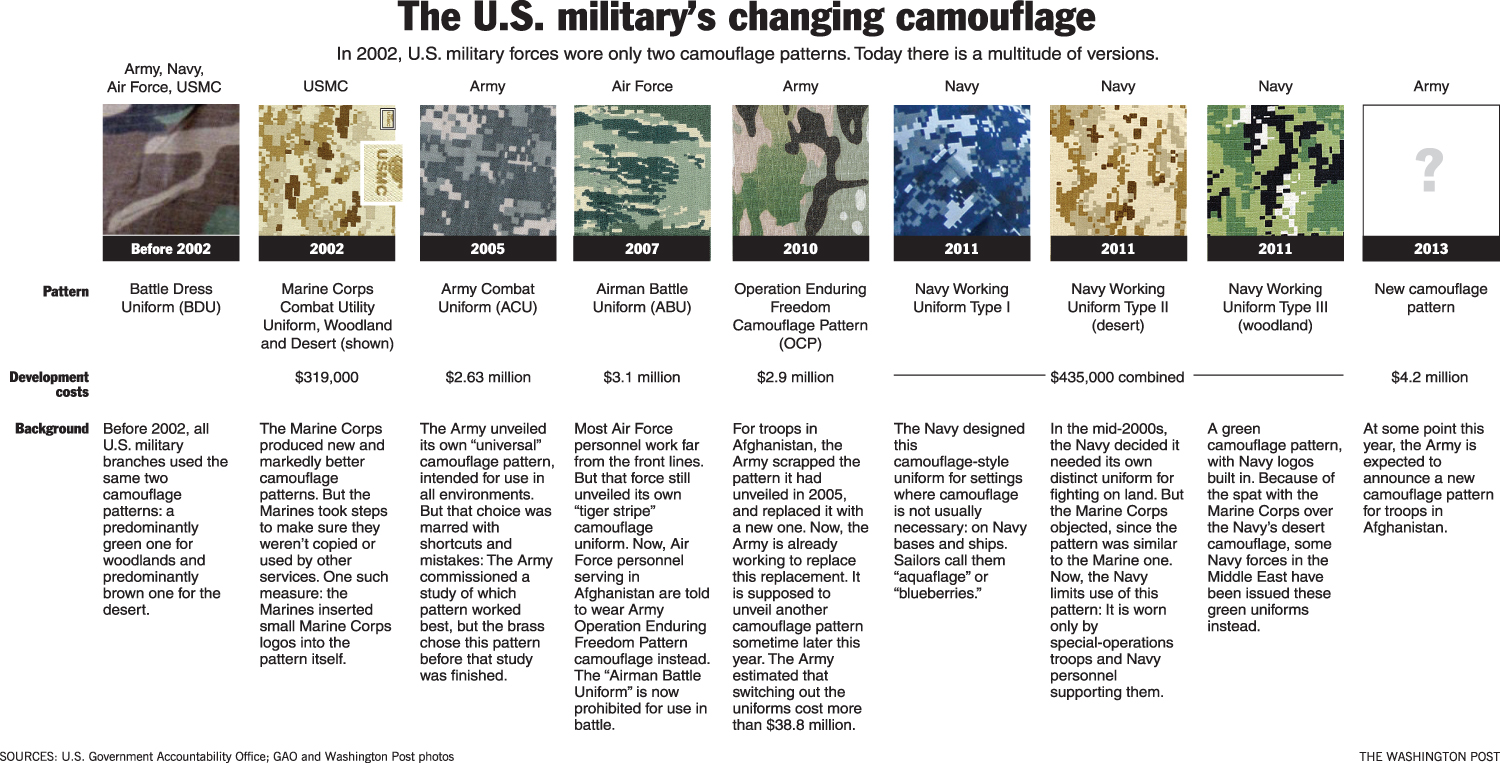
    Somehow, people think that their uniform is an essential part of fighting wars. It really isn’t. Especially if you look at the Navy’s and Air Force’s uniforms which don’t hide anyone from anything. The Stars & Stripes has a chart which tracks the uniform changes over the last few years;

    The U.S. military's changing camouflage

    The Pentagon has spent billions of dollars going through the motions of picking “the best” pattern for their purposes and then changing their minds. But it’s all so much mental masturbation, since most of the wars we fought, the troops didn’t wear any camouflaged pattern and they still won the actual battles. The services are like a bunch of teenagers fretting over what cool new clothes they want to wear for the first day of school. But in the end, troops’ uniforms in combat all end up the same color – whatever color the dirt is in their particular area of operations. So all of that exercise that the pogues at Natick Labs go through has no real impact on the battlefield, but their jobs are secure for the next billion-dollar “back-to-school” shopping spree.

  • Marine Commander relieved over mortar accident

    The Marine Corps Times reports that LTC Andrew McNulty, commanding officer of 1st Battalion, 9th Marines, at Camp Lejeune, NC was relieved along with two other officers by BG James Lukeman, commanding general of 2nd Marine Division for the explosion during a mortar live fire exercise in Utah several weeks back which claimed the lives of CPL Aaron J. Ripperda, 26, 19; LCPL David P. Fenn II, 20; LCPL Roger W. Muchnick Jr., 23; LCPL Joshua C. Taylor, 21; LCPL Mason J. Vanderwork, 21; LCPL William T. Wild IV, 21; and PFC Joshua M. Martino.

    McNulty, who assumed command of the battalion less than a year ago, was relieved due to a “loss of confidence in his ability to continue to lead the battalion,” Koerner said. The battalion’s executive officer, Maj. Thomas Siverts, will oversee the unit until a new commander is selected, Koerner said. That is expected to take several weeks, he added.

    The battalion is scheduled to deploy to Afghanistan at the end of this year. The leadership shakeup is not expected to affect those plans, Koerner said.

    Unless they found a systemic maintenance issue in the battalion, I don’t know what the commander could have done to prevent the accident.

    But there have been a lot of firings of officers in recent weeks. For example, 17 Air Force officers were relieved at Minot Air Force Base for “rot” in the nuclear force says WDAZ, and there’s no explanation of those firings either.

    The tip-off to trouble was a March inspection of the 91st Missile Wing at Minot Air Force Base, N.D., which earned the equivalent of a “D’ grade when tested on its mastery of Minuteman III missile launch operations. In other areas, the officers tested much better, but the group’s overall fitness was deemed so tenuous that senior officers at Minot decided, after probing further, that an immediate crackdown was called for.

    The Air Force publicly called the inspection a “success.”

    But in April it quietly removed 17 officers at Minot from the highly sensitive duty of standing 24-hour watch over the Air Force’s most powerful nuclear missiles, the intercontinental ballistic missiles that can strike targets across the globe. Inside each underground launch control capsule, two officers stand “alert” at all times, ready to launch an ICBM upon presidential order.

    How hard is it to pass a readiness test? Do fingers fit red button. Check. Can officer push the red button? Check. Pass.

    Thanks to SJ for the link to the USMC story.

  • Down In the Silos – a Follow-Up

    A follow-up to yesterday’s article.  It seems the SECDEF now has gotten wind of that recent not-so-stellar inspection within the USAF missile community.

    He’s not pleased.  And he’s now reportedly asking for details.

    That doesn’t bode well for anyone involved.  IMO that’s particularly true for those launch officers who got “benched” and for the unit’s chain-of-command.

    I’m thinking the wing CO – as well as the affected squadron and flight COs, if a significant number of the “benched” launch officers were clustered in the same squadron or flight – might want to start working on their resumes.  And I’d guess the officers who got “benched” might want to start thinking about alternate long-term career plans, too.

    When the SECDEF personally starts asking for details about problems in your unit, if you’re the CO that is not a good thing.   Ditto if you’ve done something personally to cause or contribute to the incident.

    Frankly, I just don’t see senior USAF leadership as having the stones to tell the SECDEF, “Sir, we got this; back off and let us fix the problem.”  That’s especially true after the nuke-related incidents in 2008 that led to several very senior USAF officials getting fired.

    That would mean that “Big Air Force” is willing to own up to being partly responsible for the situation – years after they should have fixed things.  I just don’t see that happening.  Instead, I’m guessing they’ll look for someone to take the fall – whether it’s deserved or not.