Category: Air Force

  • 34…count ’em 34

    Ex-PH2 sends us a link to an MSM link which reports that 34 Air Force officers have been removed from their “launch duties” at Malmstrom Air Force Base in Montana for cheating, or tolerating cheating by others in regards to their proficiency tests. I said 34 like it’s a lot, because yeah, it is a lot.

    The cheating scandal is the latest in a series of Air Force nuclear stumbles documented in recent months by The Associated Press, including deliberate violations of safety rules, failures of inspections, breakdowns in training, and evidence that the men and women who operate the missiles from underground command posts are suffering burnout. In October the commander of the nuclear missile force was fired for engaging in embarrassing behavior, including drunkenness, while leading a U.S. delegation to a nuclear exercise in Russia.

    That’s going to leave a mark. By the way there were 11 others involved in a drug investigation in the same unit. Of course, you have to remember that the media calls everyone officers in the military, so they might not be all real officers.

  • Colonel living in his van

    A couple of dozen readers have sent us this link to the story of former-Colonel Robert Freniere who retired a few years back and has been unable to find much work lately and he’s living out of his mini-van;

    So Freniere, a man who braved multiple combat zones and was hailed as “a leading light” by an admiral, is now fighting a new battle: homelessness.

    “You stay calm. That’s what we were trained for when I went through survival training,” he said recently in King of Prussia, where he had parked his blue minivan, the one crammed with all his possessions and held together with duct tape.

    As of January 2012, more than 60,000 veterans were homeless, according to the Department of Veterans Affairs. Reducing that number has been a priority for the Obama administration – and the number of homeless veterans dropped 24 percent nationwide from 2009 to 2013. In Pennsylvania, however, it jumped 46 percent, to more than 1,400.

    Joblessness among returning service members is even more common. Freniere describes a monthly lunch he has attended in Washington, a hushed tradition that he says attracts about 200 veterans. After they eat, the men and women who are unemployed stand up one by one to recite their service records, hoping someone else in the room will hire them.

    I’m guessing that you want me to do a FOIA on him, but there are official photos floating around and former colleagues are commenting on what great guy he is, so I don’t know how productive it would be to check on him. I didn’t see his name in AKO, but he’s Air Force, so that says nothing. I tend to believe him – yeah, he’s a retired LTC and he should be pulling in a couple tens of thousands of dollars, but he also got divorced right before he retired, which probably took a chunk of his retirement pay, and he has kids in college and private schools, so there it all goes.

    I’m thinking he’s a victim of geography – he probably wants to stay near his kids. And Philadelphia doesn’t have a lot of opportunities for his particular set of skills. He should try to find a job in the DC area – my kids go through jobs there like I change my socks, but to each his own. Then again, I could be wrong. I spent sometime unemployed in Upstate New York and when I got tired of that, I moved to DC. But then, I don’t have any ex-wives and my kids are spread out around the world.

  • Air Force IDs victims of helicopter crash

    The other day an HH-60G Pave Hawk crashed off the coast of England. Robert sends us a link to the identification of the Air Force crewmembers lost;

    Capt. Christopher S. Stover, Capt. Sean M. Ruane, Tech. Sgt. Dale E. Mathews, and Staff Sgt. Afton M. Ponce were the HH-60G Pave Hawk aircrew members killed in a crash on the Norfolk coast in England Jan. 7.

    An HH-60G helicopter carries a four-person aircrew: a pilot, co-pilot, and two special mission aviators who are qualified as both gunners and flight engineers. On this particular mission, Stover and Ruane were the pilots, and Mathews and Ponce were the special mission aviators.

    A reminder that training for war is almost as deadly as the actual war.

  • Remembering the Past:

    More specifically family history. In this case this is about my relatives, who I know as Uncle Tommy. At the time he was Lieutenant Thomas H. Temple. With family items you heard bits and fragments of stories so you never get the whole image. Well here I was able to find out more due to a long thought lost article about my Great uncle helping out a fellow pilot in 1952 Iceland.
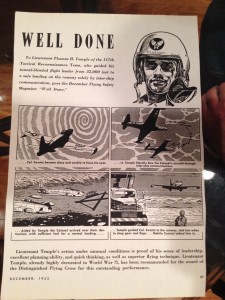
    Korea 1952 Dec

    He was with the 117th Tactical Reconnaissance Team that were flying RF-80s. I have only found one other reference to this event that is described briefly.

    On approach to Keflavik, Col.Maynard T. Swartz suffered the bends at 32,000 feet, when a nitrogen bubble lodged in his brain. Fortunately, he was led down by his wingman and was talked down by colleagues on the ground.

    The only thing I was able to find out about the 117th was it is now part of the Alabama National Air Guard with some photos of their RF-4 Phantoms during Desert Storm. The person that he saved was on a C-53 on D-Day according to this link.

    I do not know if my Great Uncle was awarded the DFC or not though. I wonder if anyone has heard of anything about this event?

    Update : October 2nd 2015

    I got a reply from Col Swartz’s son and I wanted to added it here.

    Sporkmaster,

    Warren, I just ran across your RFI on this site while searching Google for this very same incident! I might be able to fill in a couple of gaps in your story, as Lt Col Maynard T. Swartz was my dad. As most veterans of his era, he didn’t discuss his military record much, but he did talk about this incident with me and had an original copy of your Dec ’52 Fight Safety Magazine. He spoke highly of your Great Uncle and, believe it or not, almost named me “Tom” after him!

    My dad’s bends were caused by a slow pressurization leak in his RF-80 cockpit, and he essentially went blind. Bailout was not an option as the sea survival rate was only a few minutes off Keflavik, so Lt Temple stayed glued to him and skillfully talked him all the way down to short final, where mobile control took over to touchdown. Your Great Uncle was written up for a DFC, but for some reason or another, the USAF powers didn’t award it to him, which my dad was upset about. Cleary, his actions were heroic. My dad left the Reserves in ’53 and returned to Omaha, NE, where he was in the commercial printing business until he passed in ’95, while I was stationed in London. Incidentally, per your comment, he was actually one of the first C-47s over Normandy, in the early morning hours of D-Day, as he dropped Pathfinders for the invasion… where he also realized that he had eaten and swallowed an entire cigar he had in his mouth during the sortie!

    So, thanks to your Great Uncle saving my dad’s life, I just happened to have been born in ’54, graduated from Annapolis in ’78, produced a couple of daughters and retired from the Navy as a CDR/P-3C pilot in 2003. Since then, I’ve been employed as a defense contractor down in Tampa at HQ, USCENTCOM.

    From my family to yours, a special thanks will always be given for the skill and professionalism of Lt Thomas H. Temple!

    Best regards,
    Jerry

    Jerry C. Swartz, CDR, USN (Ret)
    Tampa, FL

    And I found a photo of my Great Uncle Tommy when he was flying this type of aircraft.
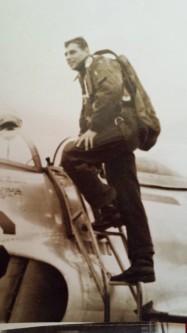
    Uncle Tommy 4

  • More on the Former 20th AF Commander

    New information has been publicly released concerning the incident leading to the relief of Maj. Gen. Michael Carey, former Commander of the 20th Air Force.  It turns out the rumor he was relieved due to misconduct on a “business trip” involving alcohol were 100% true.

    Seems he was rather drunk and disorderly in public.  But the circumstances are, shall we say, a bit different than one might expect.  And that’s only part of the story.

    The misconduct occurred while Carey was traveling on official business in Russia.  And it also looks like he came pretty close to causing a diplomatic incident, and may have engaged in practices dangerous to security.

    While attending a nuclear security training exercise in Russia as head of a U.S. government delegation, Maj. Gen. Carey apparently was rather drunk and loud in the lobby of a hotel.  And he also reputedly offered a toast at an official function that included remarks about the traitor Snowden – after Snowden had arrived in Russia, but before he had been offered asylum.  The toast was reportedly “not well received” by his Russian hosts.  Imagine that.

    Indeed, Carey was reportedly “frequently rude to both his fellow delegates and to his Russian hosts” during the trip.  He also reportedly spent some time during the trip socializing  “with Russian or non-American women” who he later acknowledged were “suspect”.

    When questioned about the trip afterwards by IG investigators, Carey also apparently had very poor memory. It appears he was rude to the IG investigators, too.

    Drunk, disorderly, rude to host nation officials, and chasing tail publicly while overseas.  Yeah, that’s exactly what one expects from a Major General TDY to a foreign nation conducting official business of a sensitive nature.

    IMO, looks like the USAF made the right call to relieve the guy.

  • NG/AF Rivalry in Ohio

    Since we’re hating on Big Air Force this week for rationalizing dumping the A-10, let’s hate on them a little longer for more stupid shit from the Washington Post;

    After spending almost $600 million to buy a tiny fleet of the planes over the past six years, stationing them in Mansfield and at two other National Guard bases, the Air Force flew all of them to a junkyard earlier this year. Five more planes, which the Pentagon already has paid for, will be mothballed as soon as they are built.

    To Air Force leaders, it was all about economics. They deemed the small planes less efficient than larger, more commonly used transport aircraft.

    To National Guard leaders in Ohio, how­ever, it was all about politics. The decision to get rid of perfectly good planes, they argue, was driven by a desire among active-duty Air Force leaders to shift the burden of budget cuts onto the National Guard.

    With no planes at the Mansfield base, the Pentagon would no longer pay for it — or the jobs there. Local leaders howled, and the state’s congressional delegation confronted the Air Force. The ensuing battle, which escalated into an intense political dogfight in Washington, was an opening skirmish in what many federal and state officials predict will be the next big clash over defense spending.

    Haven’t we been hearing about how the National Guard and the Reserves are going to play a bigger role in the near future as the Pentagon draws down the active force? And, in the meantime, they’re spending money on aircraft that will be mothballed as it rolls off the assembly line. Yeah, I understand that contracts must be filled, but still, someone should have seen this coming six years ago and maybe not ordered the planes that they don’t really want.

    As shrinking budgets force the military to thin its ranks, many active-duty leaders, seeking to protect their ilk, want the pain to fall disproportionately on National Guard and reserve forces.

    I’m starting to get the feeling that someone in Washington doesn’t know what they’re doing. It looks like by the time the active force gets drawn down, there will be no National Guard or Reserve units left to fill their gaps.

  • A-10 on chopping block again

    I remember prior to the first Gulf War, the first thing the Air Force wanted to cut was the A-10 close air support aircraft for the “Peace Dividend”, not because it didn’t work, but rather because it wasn’t sexy enough for the Air Force. But then in the middle of shutting the program down, Saddam Hussein intervened and the A-10 proved to be the star of that brief conflict. Then there was talk of cutting the aircraft from the roles before 9-11 and reality intervened again. Now, according to the Washington Times, the A-10 is facing extinction once again;

    “Is the A-10 the best at close air support? Absolutely,” Gen. Welsh, a former A-10 pilot, said Friday at a Pentagon news conference. “[But] we can do it with other aircraft. Those other aircraft do other things for us.”

    Supporters of the Warthog say other aircraft can perform close air support only in a “second-rate manner” and service members fighting on the ground would end up suffering the most from its elimination.

    “The A-10 has proven successful in every single war we’ve fought since Desert Storm in 1991,” said Winslow T. Wheeler, director of the Straus Military Reform Project of the Project on Government Oversight.

    “In 2000, name one person who said the next war we would fight would be in Afghanistan and would be a ground war,” Mr. Wheeler said. “Anybody who says they know what the next war is going to be like and therefore we need ‘X’ and should discard ‘Y’ is a person with an agenda.”

    I don’t think there is a US infantryman alive that didn’t suddenly get a warm and fuzzy feeling at the sight of the A-10 circling over his battle space. The Air Force says that they’re shifting their focus to the Pacific Rim and the A-10 doesn’t fit that shift. I guess it’s because the Chinese hordes are impervious to the 30mm cannon, and the inherent survivability of the aircraft doesn’t work over Asia. The general admits that the A-10 is the best aircraft at close air support, but he still wants to tube the system – does that mean that he really doesn’t care about giving the troops the best support he can give them?

  • To Be . . . Or To Do?

    “Tiger, one day you will come to a fork in the road and you’re going to have to make a decision about which direction you want to go.” (He raised his hand and pointed.) “If you go that way you can be somebody. You will have to make compromises and you will have to turn your back on your friends. But you will be a member of the club and you will get promoted and you will get good assignments.” (Then [he] raised his other hand and pointed in another direction.) “Or you can go that way and you can do something – something for your country and for your Air Force and for yourself. If you decide you want to do something, you may not get promoted and you may not get the good assignments and you certainly will not be a favorite of your superiors. But you won’t have to compromise yourself. You will be true to your friends and to yourself. And your work might make a difference. To be somebody or to do something. In life there is often a roll call. That’s when you will have to make a decision. To be or to do? Which way will you go?”

    Many military theorists are well-known, at least within the military community.  Jomini and Clausewitz, Mitchell and Douhet, Mahan – these names are remembered, in some cases centuries after their deaths.

    Yet others have been incredibly influential – and remain virtually unknown.  This article concerns one of those influential unknowns.  The lead quote above is his.

    The individual’s accomplishments are varied – and are insanely impressive.  He is credited with:

    • Being perhaps the single best air-to-air dogfighter in USAF history;
    • Literally personally writing the “book” for jet air-to-air combat for the USAF;
    • With one other person, developing a major theory of aircraft performance in air-to-air combat;
    • Being partially responsible for the superior performance of one of the USAF’s primary air platforms;
    • Being largely responsible for the very existence of a second, highly successful USAF primary air platform; a successful US Navy air platform; and indirectly responsible for a third successful USAF air platform;
    • The development of an acclaimed major theory describing both individual and organizational behavior;
    • Being the root cause for major changes in a sister-service’s current warfighting doctrine; and
    • Being a major contributor to (some have gone so far as to call him one of the architects of) the winning strategy of one US war – and some would say, of two.

    Yet his combat service was very brief.  He was not well-liked by many during his lifetime.  He was far more interested in doing something worthwhile than recognition.  He published precious little in open literature for posterity.  And because of these (and other) factors, as I noted above there’s a good chance you’ve never heard of him.  Indeed, even today he’s yet to receive full recognition in own parent service.

    That, ladies and gentlemen, is a damned shame.  Because this individual – though not particularly well-known – may well be the most influential military theorist of the last half of the 20th Century.

    His name was Col. John Richard Boyd, USAF.  Within his own service, he was somewhat of a pariah.
    (more…)