Category: Air Force

  • A-10s to Iraq

    A-10s to Iraq

    A10 Thunderbolt

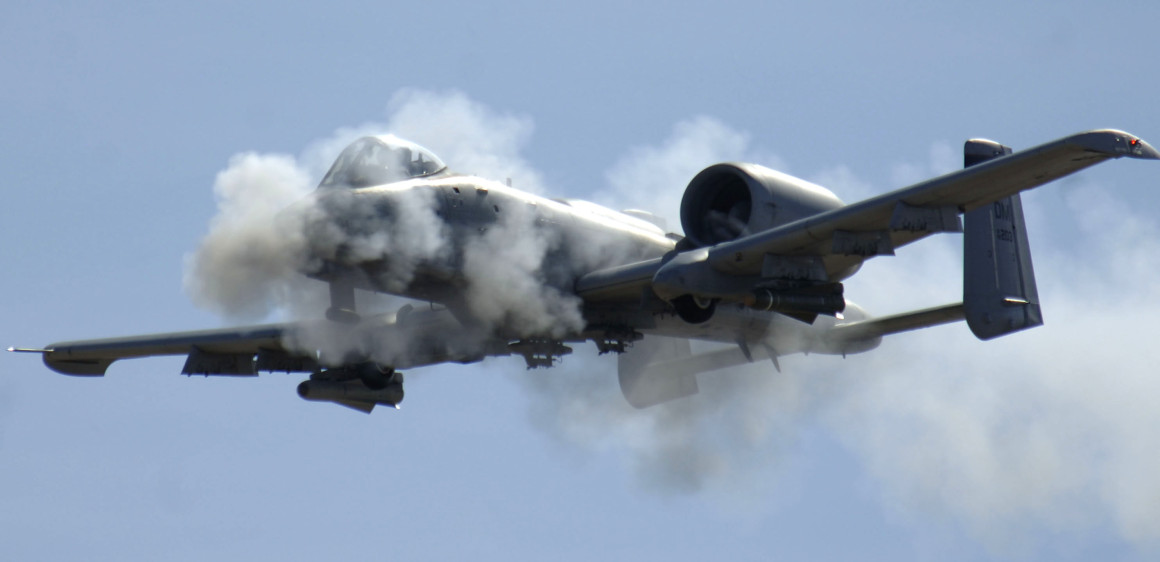
    The Hill reports that the Pentagon is deploying 10 A-10 Warthogs to Iraq with the Indiana National Guard’s 122nd Fighter Wing;

    The 122nd Fighter Wing will send 303 airmen, and the Terre Haute Air Guard base will send five as part of the mission, The Journal Gazette reported.

    Second Lt. Christopher Myers, public affairs officer for the 122nd Fighter Wing, told The Journal Gazette that the A-10 jets would be “in a support role.”

    Although A-10s generally are used to support ground combat troops with close air support, Obama has repeatedly said that U.S. troops would not have a combat mission.

    Yeah, well, this happens every time – the Air Force tries to do away with the A-10 Thunderbolt to save money and then suddenly, an operation raises it’s head that only the A-10 can accomplish. That back-and-forth has been going on since the first George Bush was President.

    The A-10 is the infantryman’s best friend, and there really is nothing that can fill the close air support role like the A-10. Apparently, the A-10 is designed to survive combat and to survive a political situation equally well.


  • Airmen saving the world

    Airmen saving the world

    Air Force Accident scene

    Eggs sends us a link to af.mil with the story of three airmen who came up on an accident in the Arizona desert;

    Airmen 1st Class Jared Dumale, Tyler Ray and Michael Rivera, came to the aid of four individuals involved in an automobile accident Aug. 24.

    “We were on our way out toward the boulder fields near Florence, Arizona,” said Dumale, HC-130J avionics specialist. “Right before we hit the dirt road, we managed to see a truck that was overturned and a young man was waving us down with a cell phone.”

    The Airmen stopped at the scene without hesitation and evaluated the situation.

    They were all questioning what was happening until they saw one of the victims covered in so many cactus needles, they could not see his face.

    The three began removing cactus needles and embedded debris from the skin of each of the victims. They attributed their efforts to the Self-Aid Buddy Care they received in basic military training.

    “It’s amazing,” Dumale said. “You hear all these stories about how people’s training kicks in during emergency situations and you never think it’s going to be you, and when it finally happens it all becomes textbook.”

    The Airmen continued to administer first aid even after paramedics arrived.

  • Cold War Overflights of Russia – the Peripheral Missions

    My article the other day provided a pointer to information concerning US deep penetration overflights of the Soviet Union between 1950 and 1956 – before the U2 was flying.  Needless to day, these weren’t the only overflights of Soviet territory conducted by US aircraft during the “Cold War”.  Nor were they the only ones during which shots were exchanged.

    Far more numerous were peripheral missions – those that flew along the Soviet Union’s land or maritime borders.  I also found an article that gives a fairly good (if perhaps not fully comprehensive) rundown of this far more numerous type of Cold War Soviet overflight mission.

    You can find that article here.  It also seems to be of good quality, and I’d assess it as being reliable as well.  Also highly recommended.

  • USAF Overflights of Russia

    I ran across a fascinating article this morning.  I thought I’d share it.

    The article deals with USAF involvement in overflights of the Soviet Union between 1950 and 1956.  And no, not just quick in-and-out “border dashes”.  Some of the missions were indeed deep penetration overflights.

    The article is not sourced, and the author appears to desire anonymity.  I thus can’t give a good assessment of how credible the article is based on sources or author’s reputation.

    However, the article does generally square with other accounts generally accorded to be of high-reliability. It also provides details that lead me to believe the author had access to some . . . very good documentation.  My assessment is that very likely quite accurate.

    The CIA and the U2 generally get the bulk of the credit for overflying the Soviet Union. But the CIA weren’t the only “players” in that deadly Cold War game – which was at times neither “cold” nor played for low stakes.

    Fascinating reading.  Highly recommended.

    . . .

    (Note:  it’s been my experience that sites such as the one to which this article is posted are often ephemeral.  I’ve captured the article to PDF in the case it disappears.) 

  • Regarding USAF Personnel Cuts

    One of our readers of the USAF-persuasion recently provided a link regarding USAF personnel issues.  So thought I’d write about that too.

    As has been the case with the Army and Navy, members of the USAF are also being scrutinized for involuntary separation. The USAF recently completed a records review of 7,121 individuals in the ranks of Senior Airman through Senior Master Sergeant in “over-manned specialties”.   Of that group, 5,700 were retained – a retention rate of just over 80%. The remaining 1,421 individuals will be discharged, will be offered the opportunity to retire under temporary early retirement authority (TERA), or will be allowed to retire normally (but involuntarily) NLT 1 February 2015.  And individual’s time-in-service will determine which option(s) they can use.

    Little information was provided regarding current USAF officer force-shaping measures. The article did mention that due to voluntary losses there would be no reduction-in-force of USAF medical officers by the reduction-in-force board to be held in October.

    To put things in perspective: the number enlisted personnel selected for involuntary discharge by the USAF this year is approximately the same as the number of CPTs and MAJs that the Army has selected this year for involuntary separation.  And while I have no idea how many enlisted personnel have/will be been identified by the Army to get their walking papers this year, I’d guess that number will be somewhat larger than the number of O3s and O4s combined.  But I could be wrong.

    Still – for those selected, I’m sure they’re thinking “Bless Our Hearts, It’s Christmas Almost. Or at least thinking the acronym.

    And, yeah – being told to “hit the bricks” is one helluva Christmas present from Uncle Sam.

  • Happy Birthday, Old Friend

    This Saturday will be an old friend’s 60th birthday. On 23 August 1954, the Lockheed C-130 made its first flight.

    It’s not the US military aircraft with the longest operational history. That honor goes to the B-52, which first flew on 15 April 1952 and entered operational service on 29 June 1955 (the C-130 entered operational service on 9 December 1956).

    However, like the B-52 the C-130 has been a US military fixture – and workhorse – as far back as I can remember.

    It was not the first military aircraft in which I ever flew. That would have been either a UH-1 or a C-123. After three plus decades, I can’t remember with certainty which of those two was the first – I think it was a UH-1, but I’m not positive.

    However, it was indeed a C-130 that took me from Kuwait to Iraq – both times. And I left Iraq both times on one.  It was also the military aircraft on which I flew last while in uniform.

    Over the years, I flew on a number of C-130s – including at least one that might have literally been older than I was. When I was young, the Air National Guard still had a few “A model” C-130s in their inventory.   Some of those C-130As supported my unit on one exercise.

    The C-130 always put me down safely, and took me where I wanted to go (with one minor hiccup, discussed here).  Unless, of course, I was jumping out of the bird’s jump doors – or walking off it’s loading ramp at jump altitude (got the chance to do a tailgate jump or two – they were a blast).  (smile)

    The C-130 has been called the most successful military aircraft in history.   Frankly, it’s hard to argue with that characterization.  It’s a helluva fine piece of military hardware.

    Finally:  believe it or not – you can indeed get more than 450 people on-board a C-130, take off – and land safely. It’s been done at least once. And yes, this last link is indeed worth your time to read.

    Happy birthday, Herc. I hope to be here for your 70th and beyond.


    PS, and FWIW:  according to his autobiography, Ben Rich helped designed the intakes on the C-130 in his pre-Skunk Works days.  Maybe that’s one reason why the bird was so successful.  (smile)

  • Tech. Sgt. Matthew McKenna earns Silver Star

    Tech. Sgt. Matthew McKenna earns Silver Star

    Matthew McKenna

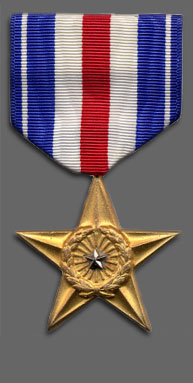
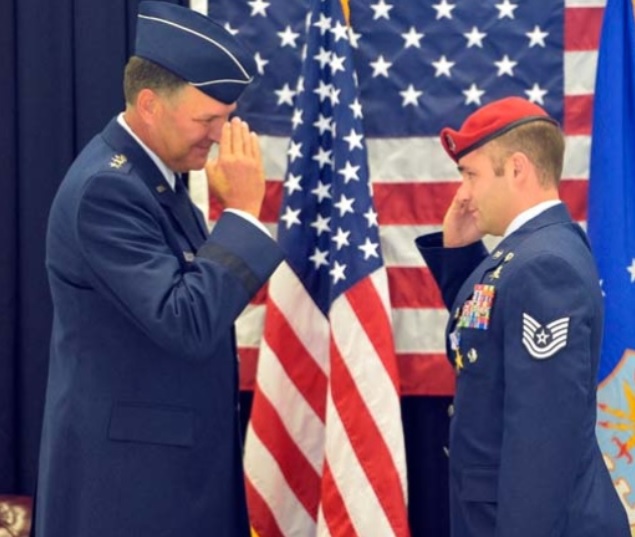
    Stars & Stripes tells the story of Air Force Tech. Sgt. Matthew McKenna, a combat controller who was awarded the Silver Star Medal for his actions in Afghanistan last year;

    McKenna and his team found themselves outnumbered with the enemy closing in on their position from higher ground, according to an Air Force statement.

    McKenna coordinated airstrikes on 10 insurgents, preventing them from completing an ambush of his team.

    “At one point, he discovered his team was running out of ammunition and coordinated an aerial resupply at two locations placing desperately needed munitions within 50 feet of the endangered service members,” the statement said.

    Despite pleas from his teammates to take cover, McKenna rushed into the “kill zone,” exposing himself to heavy fire in order to control airstrikes that were within about 600 yards of him, the statement said.

    The airstrikes gave the team a chance to move up the mountain for an emergency pickup.

    Placing resupplies within 50 feet of defenders and placing ‘splodies only 600 yards from your position is a lot more difficult than it might sound to the uninitiated, especially when the person directing those aircraft to deliver that hardware is himself being shot at. Combat controllers are near the top of a long list of “Friends of Infantry”.

  • Airmen saving the world

    Near Las Vegas, a flash flood trapped an 80-year-old woman in her car and swept her away. Luckily for her, three airmen were nearby to rescue her;

    FOX5 Vegas – KVVU

    “It started out really slowly and then it was right on top of you.”

    The raging river came so fast, the airmen said they didn’t have time to think about the danger.

    “As soon as we heard him yelling, the water was on top of us before we knew it.”

    As the water rose from ankle to knee-deep, the group of about 10 airmen from Nellis raced to get an elderly couple out of their Prius before it was swept away.

    “I had to slam the door and tell the guys on the other side to grab her out of there.”

    But things weren’t over yet as the fast-moving water started to sweep one of the airmen away, but luckily Airman Christopher Jones was ready, “I just saw an arm and a head flying down the water and was like, I’m going to pull them out and hope I don’t fall in.”

    […]

    “I don’t think hero. I feel most people would do the same thing.”

    Two other airmen actually helped carry the elderly woman through the waist-deep water.

    The 81-year-old woman who was rescued said she and her husband are visiting from Arizona. She said even though all of their luggage was in the Prius that was washed away, she’s just happy she and her husband are okay.