Author: NHSparky

  • 45 Years Ago Today

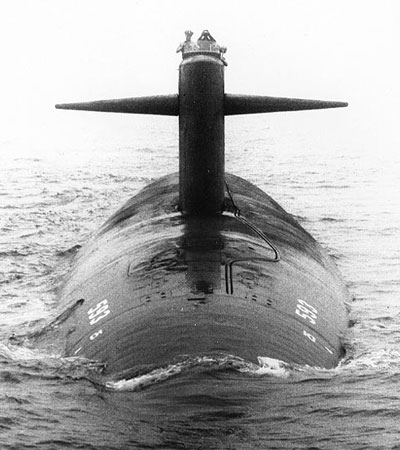
    May 22, 1968 marks the date of the loss of USS SCORPION (SSN-589) the only other time in the nuclear era in which a submarine was lost, coming just over five years from the loss of USS THRESHER (SSN-593). SCORPION was returning from a Mediterranean deployment to her homeport of Norfolk, VA. Her loss, unlike that of the THRESHER, was not immediately noted–only when she failed to return from deployment and declared lost with all 99 on board on June 5th, 1968.

    Her wreckage was discovered later that year due to the work of Dr. John Craven and others from the Navy’s Special Projects Division and SOSUS groups. What is certain is that an explosion or catastrophic failure of some sort cause her to go down in 10,000 feet of water a few hundred miles off the Azores. What has not, nor will it likely ever be conclusively determined, is what caused that explosion. Theories have been suggested that it was anything from a battery fire, to a “hot run” torpedo and detonation, to an encounter with a Soviet submarine.

    What is certain is this–the sea is a very demanding environment, and a very unforgiving one.

    Sailors, rest your oars.

  • 50 Years Ago

    null

    50 years ago today, USS THRESHER (SSN-593) departed on her ill-fated voyage after having undocked and completed an overhaul period at Portsmouth Naval Shipyard. She transited to a point about 200 miles off Cape Cod with 129 crew and civilian shipyard engineers and technicians, and commenced a series of dive tests to verify her work in the shipyard. She successfully completed a series of tests on 9 April and remained submerged overnight.

    On the morning of 10 April, THRESHER commenced another series of dive tests. The approximate timeline of that fateful day is as follows:

    07:47 Thresher begins its descent to the test depth of 1,000 ft (300 m).

    07:52 Thresher levels off at 400 ft (120 m), contacts the surface, and the crew inspects the ship for leaks. None are found.

    08:09 Commander Harvey reports reaching half the test depth.

    08:25 Thresher reaches 1,000 ft (300 m).

    09:02 Thresher is cruising at just a few knots (subs normally moved slowly and cautiously at great depths, lest a sudden jam of the diving planes send the ship below test depth in a matter of seconds.) The boat is descending in slow circles, and announces to Skylark she is turning to “Corpen [course] 090.” At this point, transmission quality from Thresher begins to noticeably degrade, possibly as a result of thermoclines.

    09:09 It is believed a brazed pipe-joint ruptures in the engine room. The crew would have attempted to stop the leak; at the same time, the engine room would be filling with a cloud of mist. Under the circumstances, Commander Harvey’s likely decision would have been to order full speed, full rise on the fairwater planes, and blowing main ballast in order to surface. The pressurized air rapidly expanding in the pipes cools down, condensing moisture and depositing it on strainers installed in the system to protect the moving parts of the valves; in only a few seconds the moisture freezes, clogging the strainers and blocking the air flow, halting the effort to blow ballast. Water leaking from the broken pipe most likely causes short circuits leading to an automatic shutdown of the ship’s reactor, causing a loss of propulsion. The logical action at this point would have been for Harvey to order propulsion shifted to a battery-powered backup system. As soon as the flooding was contained, the engine room crew would have begun to restart the reactor, an operation that would be expected to take at least 7 minutes.

    09:12 Skylark pages Thresher on the underwater telephone: “Gertrude check, K [over].” With no immediate response (although Skylark is still unaware of the conditions aboard Thresher), the signal “K” is repeated twice.

    09:13 Harvey reports status via underwater telephone. The transmission is garbled, though some words are recognizable: “[We are] experiencing minor difficulty, have positive up-angle, attempting to blow.” The submarine, growing heavier from water flooding the engine room, continues its descent, probably tail-first. Another attempt to empty the ballast tanks is performed, again failing due to the formation of ice. Officers on Skylark could hear the hiss of compressed air over the loudspeaker at this point.

    09:14 Skylark acknowledges with a brisk, “Roger, out,” awaiting further updates from the SSN. A follow-up message, “No contacts in area,” is sent to reassure Thresher she can surface quickly, without fear of collision, if required.

    09:15 Skylark queries Thresher about her intentions: “My course 270 degrees. Interrogative range and bearing from you.” There is no response, and Skylark’s captain, Lieutenant Commander Hecker, sends his own gertrude message to the submarine, “Are you in control?”

    09:16 Skylark picks up a garbled transmission from Thresher, transcribed in the ship’s log as “900 N.” [The meaning of this message is unclear, and was not discussed at the enquiry; it may have indicated the submarine’s depth and course, or it may have referred to a Navy “event number” (1000 indicating loss of submarine), with the “N” signifying a negative response to the query from Skylark, “Are you in control?”]

    09:17 A second transmission is received, with the partially recognizable phrase “exceeding test depth….” The leak from the broken pipe grows with increased pressure.

    09:18 Skylark detects a high-energy low-frequency noise with characteristics of an implosion.

    09:20 Skylark continues to page Thresher, repeatedly calling for a radio check, a smoke bomb, or some other indication of the boat’s condition.

    11:04 Skylark attempts to transmit a message to COMSUBLANT (Commander, Submarines, Atlantic Fleet): “Unable to communicate with Thresher since 0917R. Have been calling by UQC voice and CW, QHB, CW every minute. Explosive signals every 10 minutes with no success. Last transmission received was garbled. Indicated Thresher was approaching test depth…. Conducting expanding search.” Radio problems meant that COMSUBLANT did not receive and respond to this message until 12:45. Hecker initiated “Event SUBMISS [loss of a submarine]” procedures at 11:21, and continued to repeatedly hail Thresher until after 17:00.

    Recent reports suggest that the last transmission from THRESHER at 0917 might have meant that the boat was 900 feet greater than her designed test depth of 1300 feet, or 2200 feet. It’s estimated that she imploded in less than a tenth of a second at a depth of 2400 feet, nearly double her test depth and greater than her design crush depth of 2000 feet.

    The loss of the boat was due to several factors:
    –Joints subjected to sea pressure were often silver-brazed joints, which were susceptible to leaking.
    –The scram (shutdown) of the reactor also caused the main steam stops to close, preventing use of residual steam being produced to be used for propulsion.
    –In the EMBT (Emergency Main Ballast Tank) blow system, 4500 psi air is taken from tanks located inside the ballast tanks, through “knocker valves” and into the main ballast tanks themselves. Prior to underway, THRESHER used “shore air” to pressurize their EMBT cylinders. This air had very high moisture content. When the emergency blow was conducted, this air was redirected through piping as small as one inch in diameter, and the reduction in pressure and lowering of temperature caused the moisture to freeze and plug the EMBT piping, preventing more air from getting into the main ballast tanks.

    What was learned from the loss of THRESHER was put to use in what is called the SUBSAFE system. Welds replaced brazed joints. New procedures allowed propulsion to be maintained even in the event of a plant shutdown. More robust piping for the EMBT systems, and many other changes were implemented. From 1915 through 1963, 16 submarines were lost due to non-combat conditions. Since THRESHER, only one has been lost: USS SCORPION (SSN-589), which was not a SUBSAFE boat and whose cause for her loss has never been conclusively determined.

    Another reminder for submariners that “There is no such thing as peacetime underway” and the inherent hazards of the sea.

    USS Thresher’s name was retired, but she was never struck from the commissioning list. She remains “on eternal patrol.”

    Sailors rest your oars.

  • USS Lincoln (CVN-72) Refueling Delayed

    The US Naval Institute is reporting that the sequestration cuts to DoD budget will cause a delay in the refueling and long-term overhaul of the USS Abraham Lincoln (CVN-72), which was scheduled to go into a 4-year complex overhaul/refueling (RCOH) later this year:

    Lincoln was scheduled to be moved to Huntington Ingalls Industries’ (HII) Newport News Shipyard later this month to begin the 4-year refueling and complex overhaul (RCOH) of the ship.

    “This delay is due to uncertainty in the Fiscal Year 2013 appropriations bill, both in the timing and funding level available for the first full year of the contract,” the message said.
    “CVN-72 will remain at Norfolk Naval Base where the ships force personnel will continue to conduct routine maintenance until sufficient funding is received for the initial execution of the RCOH.”

    Apparently, only the local Congressman, Rep. Randy Forbes (R-VA) seems to be displaying any level of concern regarding this issue, but as bad as this looks at first glance, it’s even worse:

    Forbes called the delay, “another example of how these reckless and irresponsible defense cuts in Washington will have a long-term impact on the Navy’s ability to perform its missions. Not only will the Lincoln be delayed in returning to the Fleet, but this decision will also affect the USS Enterprise (CVN-65) defueling, the USS George Washington (CVN-73) RCOH, and future carrier readiness.”

    The move by the navy is the second this week involving funding for carriers. On Wednesday it announced it would delay the deployment of the USS Harry S. Truman (CVN-75) to the Middle East do to the ongoing budget strife bringing the total number of carriers in U.S. Central Command (CENTCOM) to one until funding normalizes.

    As anyone who has ever served in a maintenance-intensive MOS/NEC knows, especially one like nuclear power where constant “oversight” or “help” is a way of life, deferring or postponing maintenance is NEVER a good thing. As with most critical issues in life both in and out of the military, it’s a question of, “Pay me now, or pay LOTS more later.” We’re not paying now so that people can create the illusion we’re fiscally responsible, at the very real cost of readiness and national security.

    This is, as we all can easily deduce, a sham. Here we have a government which has no interest in paying for items which fall under Constitutional mandate under Article I, Section 8, but is hell-bent on spending trillions of dollars per year over and above what it takes in to provide “fairness” for things like SS Disability for adult babies, welfare and food stamps for (some) professional deadbeats, and checking out how well shrimp perform on treadmills, none of which the Founding Fathers ever envisioned the government being the benefactor of such largesse. We’re not paying now for what we should. Unfortunately, the prices we pay down the road will be measured in more than dollars.

    This administration, and specifically this president, said in front of veterans that they had no intent of balancing the budget on the backs of veterans. Of course they didn’t…then again, they had no intention of balancing the budget, period.

    But we’ve been down this road before. Welcome to the hollow force, circa 2013.

  • Shiny Squirrel Monday

    Banthapug

    Just a bit of a distraction from the world going to hell and usual Monday crap. TSO, you can thank me later.

  • Makin Bacon Pancakes!

    Damn you, TSO. Just damn you. At least the kids loved them.

    Bacon1

    Bacon2

    No better way to spend the weekend than making the kids happy by doing goofy crap. Beer can chicken for dinner, anyone?

  • 67 Years Ago Today and the Continuing Nuclear Protest

    It was on this date in 1945 that Hiroshima was destroyed by a new weapon, a single bomb dropped by a B-29 named Enola Gay, named after the mother of the pilot, Colonel Paul Tibbets. In the years since, many have tried to make the point that dropping of the bombs was an unnecessary act, as they claim the Japanese home islands were on the verge of defeat and would have surrendered soon enough without dropping the bomb.

    There are several flaws in that argument. First, after nearly four years of all-out war, Americans were tired of war. The prospect of what would surely be at least another 12-18 months taking the Japanese home islands was not a palatable thought. Second–as alluded to in movies and elsewhere, the Allies won the war in Europe, but at a huge cost. America was nearly bankrupt, spending nearly 38 percent of GDP on defense, compared to less than 4 percent of GDP today. Third–the casualty estimates of Operation Downfall varied widely, but all agreed that there would be huge casualties, and most of those estimates were only for the first sixty days, and only one took into account Navy casualties. Iwo Jima and Okinawa that same year showed that taking of the Japanese home islands would be possibly far more devastating in terms of both allied and Japanese casualties than eariler estimates. Finally, when the Japanese were asked to surrender after the July 16th test of the Trinity device in New Mexico, the Japanese basically was that of “mokusatsu,” meaning to treat with silence or silent contempt–a nice way of them telling the Allies to shove it up their ass.

    A quick end to the war with the fewest casualties was needed, and the atomic bomb, rightly or wrongly, provided that end. It is said that all of the Purple Hearts made up for Operation Downfall have been given out to the casualties of every war and action the United States has been involved in over the past six and a half decades, and there are still Purple Hearts left.

    To that end, a semi-related story from WBIR-Knoxville about several protestors who broke into the Y-12 facility at Oak Ridge last week and threw what they claimed was human blood on the building. Way to go, G4S–great security job you’re doing there. I would suggest to those people that the bloodshed had the bomb NOT been dropped, and the deterrence it provided for several decades afterwards, saved far more blood than was shed on this day and three days later in 1945.

  • 22 Years Ago Today:

    I was in the middle of a body of water east of China/Russia, west of Alaska, when we got the news posted on the Forward Compartment Middle Level saying that the day before, Saddam Hussein had crossed over the border into Kuwait.

    The thing to know about boats, especially fast attacks, is that there’s no real means of contact with the outside world, or at least not at that time. Mail followed us from port to port, and any notifications from family were in 50-word “familygrams” that were the Navy equivalent of a postcard, with their words having been read upwards of a half-dozen times before finding their intended recipient. So even though all we got on Iraq invading Kuwait was about two sentences, we all knew it was serious.

    The day we got word (August 3rd), US Naval forces were committed to the Gulf region. While I never went to the Gulf for Desert Shield/Storm, there were a few guys on a few of the boats I knew who did (a couple of my buddies from the nuke pipeline were on the USS Chicago) make it there.

    Where were you when you got word troops were being committed to the Gulf in 1990?

  • Arrest Made in USS Miami Fire

    Word comes down this morning that Casey James Fury, a civilian employee of Portsmouth Naval Shipyard, has been arrested for, “willfully and maliciously” setting fire and burning a vessel, namely the USS Miami, and “willfully and maliciously” setting fire to and burning building materials and supplies located in and around the USS Miami.”

    More on the story on Portsmouth Herald website.

    Wanted to get out of work because you were butthurt over your girlfriend, eh? Hope it was worth spending a good chunk of your life in federal pound-me-in-the-ass prison for it. Some of the shipyard civilian workers weren’t the brightest bulbs in the string, and he just dragged down the average by a whole bunch.